The Pig Under the Pecan Tree
By the third morning, Miles Tanner stopped yelling at the pig.
The first day, he thought Otis was just being Otis.
The old hog had always been stubborn. He rooted under fences, flipped feed buckets, shoved his snout into mud like the whole earth had personally offended him. But this was different.
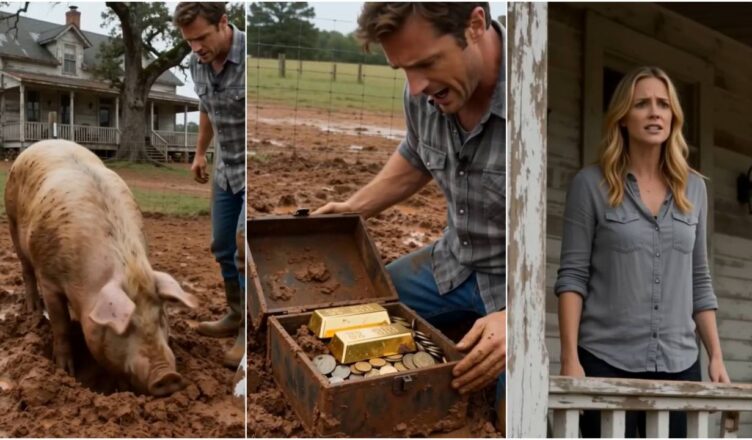
For three straight days, Otis had been digging in the same corner of the pen, beneath the crooked pecan tree near the back fence. Miles filled the hole twice. Otis opened it again. Miles dragged a sheet of plywood over the spot and weighed it down with two cinder blocks. By sunrise, the blocks were shoved aside, the plywood was flipped over, and Otis was shoulder-deep in wet Alabama clay, grunting like he was trying to tear a secret out of the ground.
Miles stood in the yard with a shovel in one hand, watching him.
Behind him, the old farmhouse sat quiet in the morning sun, its porch boards warped from years of rain, its paint peeling in long tired strips. The roof still leaked over the pantry. The back steps leaned to one side. A pot of water sat warming over the dented barrel fire because the stove had gone out again and Miles hadn’t had the money to fix it.
On the porch, Nora watched with her arms folded.
“Miles,” she called, worried but tired, “what is he doing now?”
Miles didn’t answer right away.
Otis dug harder, throwing mud behind him in thick wet clumps. His whole body shook with effort. His snout disappeared into the hole, then came back coated in red clay.
Miles stepped closer.
“Otis… what is it?” he muttered. “You’ve been digging in that spot for three days.”
The pig only grunted louder.
Miles felt something crawl up the back of his neck.
He didn’t believe in signs. He believed in bills, broken tractors, bad weather, and the kind of luck that usually arrived too late to matter. But there was purpose in the way Otis fought that patch of ground. Not hunger. Not boredom.
Purpose.
Miles nudged the hog aside with his boot and the wooden handle of the shovel.
“Move, you crazy old thing.”
Otis squealed and tried to push back in.
Miles shoved him away harder, stepped into the muddy hollow, and drove the shovel into the clay.
The first strike went deep into wet dirt.
The second hit root and mud.
The third landed with a sharp metallic clang.
Miles froze.
The sound rang up the shovel handle and into his bones.
“What the hell…”
Otis stopped moving.
Even the wind seemed to pause.
Miles dropped to one knee and scraped at the mud with the shovel blade, then with his hands. His fingers struck rusted metal. Flat. Box-shaped. Buried deep beneath the pecan roots.
His heart began to pound.
He dug faster, breath coming rough, mud caking under his nails. The chest was small, no longer than his forearm, but heavy as sin. It had been underground long enough for the iron to blister with rust. Wet dirt clung to the hinges and fell away in clumps as he worked it loose.
He hooked the shovel under one side and lifted.
The chest came free with a sucking sound, spilling red clay back into the hole.
Miles dragged it onto the ground beside him.
The lock was almost eaten through. He struck it twice with the shovel edge. The old metal gave.
He flipped the lid open.
For one second, his mind refused to understand what his eyes were seeing.
Gold.
Not bright movie gold. Not clean treasure from a storybook.
Real gold.
Mud-streaked bars wrapped in rotted cloth. Dirty old coins stuck together with soil. Dull yellow metal beneath years of earth, heavy and quiet and unmistakable.
Miles stared into the chest.
“…oh my God.”
From the porch, Nora’s voice cut across the yard.
“Miles? Did you find something?”
He jerked like he’d been caught stealing.
She was too far away to see inside the hole. Too far to see the gold. She stood in the porch shadow, one hand over her eyes against the sun.
Miles looked from her to the chest.
Then panic moved faster than thought.
He slammed the lid shut, grabbed the chest with both hands, and lowered it back into the hole. Mud smeared across his shirt. His breath came too loud. He shoveled loose dirt over the iron, then dropped to his knees and shoved clay over the edges with both hands, keeping his body between Nora and the pit.
“Miles?” Nora called again.
He stood too quickly, almost slipping.
“Yeah…” His voice cracked, so he cleared his throat and forced calm into it. “An empty can.”
Nora stood very still on the porch.
She didn’t believe him.
He could tell.
But she didn’t say so.
That was worse.
For the rest of the day, Miles moved like a man with a snake hidden in his shirt.
He fed the animals. Fixed the loose gate. Hauled water. Took the kids to school when the bus didn’t come because the road was still soft from rain. He answered Nora’s questions too fast and avoided the pecan tree completely.
But every time he looked toward the pen, Otis was watching him.
That night, after Nora and the children went to bed, Miles lay awake staring at the ceiling.
The house creaked around him. Rainwater dripped somewhere behind the wall. Nora breathed softly beside him, turned away.
Miles told himself he should tell her.
Then he pictured her face.
Nora was honest in a way that made the world harder. If she knew, she would want to do things properly. She would want to call somebody. The sheriff. A lawyer. The county office. Someone who wore clean shoes and asked questions for a living.
And once questions started, Miles knew how it would end.
Somebody would say the gold belonged to the state. Somebody would say it belonged to whoever owned the land eighty years ago. Somebody would call it evidence, stolen property, abandoned property, historical property — anything except his.
He had lived poor long enough to understand one rule clearly.
When a poor man found something valuable, the world suddenly remembered the law.
So Miles got out of bed.
Outside, the moon sat low behind the trees. He took a flashlight and shovel and went back to the pigpen. Otis grunted from the goat enclosure, where Miles had locked him for the night.
The clay came up easier the second time.
Miles pulled the chest from the ground, wrapped it in an old feed sack, and carried it to the barn. It was heavier than he remembered. By the time he set it behind the tack wall, his arms were shaking.
He opened it again under the flashlight.
The gold didn’t vanish.
Six small bars. A pile of old coins. Some American. Some foreign. A few dates from the 1930s. One bar had a faint stamped mark beneath the mud.
Miles sat on the barn floor until dawn, staring at the chest.
By sunrise, he knew one thing.
He could not spend it like a fool.
He could not brag.
He could not suddenly buy trucks, land, and new clothes in a town where every person knew exactly how broke he had been the week before.
If the gold was going to save him, it had to do it quietly.
The first lie was small.
Two weeks later, Miles told Nora he wanted to mortgage the farm and open a feed and hardware store in the old brick building on Main Street.
Nora stared at him across the kitchen table like he had spoken in a foreign language.
“A mortgage?” she said. “On this house?”
“It’s the only way.”
“Miles, we can barely keep this place standing now.”
“That’s why I have to do something.”
She laughed once, but there was no humor in it.
“Something? You mean gamble the only roof our children have?”
“It’s not a gamble.”
“It is when you don’t have money.”
Miles looked down at his hands.
He wanted to tell her the truth then. He wanted to open the barn wall, show her the chest, show her that he wasn’t being reckless.
But truth was a match.
Once struck, it could burn the whole house down.
So he said, “I’ve thought it through.”
Nora’s eyes filled, but she did not cry.
“You’ve thought it through without me.”
That should have stopped him.
It didn’t.
The bank approved the loan because the farm, poor as it looked, still had land beneath it. Miles signed papers with a pen that felt heavier than the shovel had.
Nora barely spoke to him for two days.
Then, on the third morning, she packed his lunch and set it by the door.
“I still think you’re wrong,” she said.
“I know.”
“But if you’re going to drag us into this, don’t you dare do it halfway.”
Miles nodded.
“I won’t.”
Tanner Supply opened in October.
At first, people laughed behind his back.
A feed and hardware store in a dying town. Two aisles of fence wire, seed, work gloves, nails, and cheap coffee by the register. A hand-painted sign. A used register that jammed twice a day. A delivery truck so old the passenger door had to be tied shut with rope.
Nora ran the books because she was better with numbers than Miles and too practical to let the business fail out of spite.
Miles ran deliveries.
Their son Caleb swept the floor after school. Their daughter Maisie arranged seed packets so carefully customers started asking for “the little manager.”
The store did not make money at first.
It leaked money.
Every week, something broke. A supplier demanded faster payment. A freezer died. The truck needed tires. The mortgage payment sat on the calendar like a loaded gun.
And every time the business came close to choking, Miles went to the barn.
Not often.
Never in daylight.
Never with greed in his hands.
He sold a coin here. A bar there. Always far from town. Always through people who didn’t know his name well enough to remember it. He never sold enough at once to make a story. He never came home with cash flashing in his pocket.
The gold became the quiet hand beneath the table.
It paid a late supplier before the store’s shelves went empty.
It covered the mortgage when December rain kept half the farmers home.
It bought a second freezer when the local meat co-op needed a place to store orders.
It paid for repairs, inventory, payroll, insurance.
To everyone else, Tanner Supply looked like a struggling business that somehow kept surviving.
To Nora, it looked like her husband had the strangest luck in Alabama.
One evening, after Miles paid three bills that should have buried them, she stood in the office doorway and watched him file receipts.
“Where did the money come from?” she asked.
Miles didn’t look up.
“Sales were better this week.”
“No, they weren’t.”
He stopped writing.
Nora stepped inside.
“I do the books, Miles. Don’t talk to me like I’m one of the men by the coffee pot.”
His throat tightened.
“There was a cash job. Delivery out toward Selma.”
“What kind of delivery?”
“Fence posts.”
She stared at him for a long time.
Then she said, “You’re hiding something.”
Miles met her eyes.
“Yes,” he said quietly.
That answer stunned her.
“What?”
“I’m hiding how scared I am.”
It was true enough to sound honest.
Nora’s face softened, but only a little.
“We’re all scared.”
“I know.”
“You don’t have to carry it alone.”
He almost laughed at the cruelty of that sentence.
Instead, he reached for her hand.
“I’m trying to make it work.”
She let him hold her fingers, but her eyes stayed sharp.
“Then don’t make me regret trusting you.”
By spring, the store began to breathe on its own.
Farmers who had been driving forty miles for basic supplies came in. Then gardeners. Then contractors. Then old men who bought one bolt and stayed an hour talking about rain.
Miles learned what people needed before they asked. He carried feed to trucks for men with bad backs. He kept a running list of widows who couldn’t haul bags themselves. He extended credit carefully, not because it was good business, but because he remembered what it felt like to count pennies in front of a cashier and pretend you had left your wallet in the truck.
When his cousin Ray lost his job, Miles hired him to drive deliveries.
When Nora’s sister needed surgery and the insurance left a hole big enough to swallow her, Miles found a way to cover it.
When Mrs. Dobbins had to choose between medicine and heat, an envelope showed up through the church office with no name on it.
People noticed.
They noticed the roof on the Tanner house got fixed.
They noticed the stove got replaced.
They noticed Caleb had sneakers that fit and Maisie went on her field trip with ten dollars extra in her pocket.
They noticed Tanner Supply had more inventory every month and a second truck by summer.
But nobody could prove anything strange.
A loan was a loan. A business was a business. Hard work was hard work.
That was the story Miles let the world believe.
And because people like a story that makes sense, they believed it.
Years passed.
Tanner Supply became two stores, then four.
Miles bought land, not loudly, but steadily. He hired people with records, people with gaps in their resumes, people who had been told too many times that one mistake meant forever. He helped relatives without making them beg. He paid medical bills through third parties. He covered school lunches anonymously. He put money into churches, ball fields, repairs, funeral funds, and quiet emergencies.
Every gift had a reason attached to it.
A good quarter.
A business write-off.
A private investor.
A customer who paid early.
A supplier rebate.
Miles became very good at giving people explanations before they knew they needed one.
Nora changed too.
She stopped arguing about the mortgage after the last payment cleared years early. She stopped worrying over every expansion when the numbers kept working. She began to enjoy the business, then command it. By the time Tanner Supply had six locations, everyone knew Nora was the one you went to if you wanted the truth and Miles was the one you went to if you needed a chance.
But sometimes, late at night, she still watched him.
She watched him walk to the barn when he thought the house was asleep.
She watched the way he kept one old section of wall locked behind tools nobody used anymore.
She watched him return with dirt on his boots even after years of concrete floors and clean trucks.
And she never asked.
Maybe because she was afraid of the answer.
Maybe because part of her already knew.
Otis lived like a king through all of it.
He got better feed, a new pen, and a reputation no animal deserved but fully enjoyed. People came by just to see him. Miles told every one of them the same thing.
“He’s still mean.”
Otis proved it regularly.
He died one hot August afternoon under the pecan tree.
Old, enormous, and unpleasant until the end.
Nora insisted they bury him near the spot where he had dug.
Miles said that was ridiculous.
Nora handed him a shovel.
So he dug.
They put a small stone there, carved by Caleb with uneven letters:
OTIS
FOUND WHAT WE NEEDED
AND NEVER LET US FORGET IT
By the time Miles Tanner was called a successful businessman, the chest was almost empty.
There were no mansions. No gold watches. No foolish cars bought to impress men he didn’t respect.
There was a clean farmhouse with a roof that didn’t leak.
There were stores with his name on them.
There were employees who sent their kids to college.
There were cousins with paid-off medical bills, friends with jobs, families who never knew why their lights stayed on one more month.
There was Nora, standing beside him at ribbon cuttings, smiling like she had built half the empire herself because she had.
And there was Miles, carrying a secret so long it became part of his bones.
One evening, long after the stores had closed and the yard had gone soft with summer dusk, Miles walked out to the old pigpen.
The fence was new now. The farmhouse had fresh paint. The barrel fire was gone, though Nora kept the dented barrel behind the shed because she said people should not throw away reminders too quickly.
The pecan tree still leaned crooked over the yard.
Miles stood beneath it with his hands in his pockets, staring at the ground.
Nora found him there.
“You thinking about Otis?” she asked.
Miles smiled faintly.
“Yeah.”
She stood beside him.
For a while, neither of them spoke.
Then Nora said, “That pig changed everything.”
Miles looked toward town, where the lights of Tanner Supply glowed near Main Street. Across the road, the bakery his quiet money had helped open was still lit. Beyond it, the youth center windows shone warm against the dark.
“Yes, he did.”
Nora slipped her hand into his.
“You ever wonder what he found under there?”
Miles went still.
Just for a second.
Then he looked at the crooked little stone beneath the tree.
The world called him self-made.
The bank called him responsible.
The town called him generous.
His family called him lucky.
Only Otis had ever known the truth.
Miles squeezed Nora’s hand and turned toward the porch light.
“Come on,” she said. “Dinner’s ready.”
He followed her back to the house, leaving the pecan tree behind him, the secret beneath it long gone, and the life it had built glowing quietly in the distance.