The Kindness Test
By two in the afternoon, the heat had turned mean.
It rose off Peachtree Street in silver waves, bending the air above the asphalt and making the glass bus shelter feel less like shade than a trap. Traffic crawled past in the glare. Tires hissed over softened tar. Somewhere down the block, a horn blared and kept blaring until it became just another part of the city’s fever.
The Number 38 was twenty minutes late.
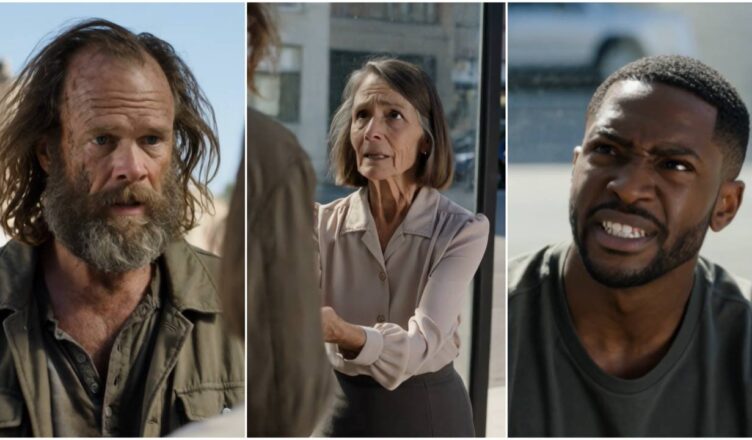
Ruth Ellison sat at one end of the bench with two grocery bags at her feet and an old phone in her hand. She was seventy-one, white-haired, small-boned, and tired in a way that seemed to live under her skin. Her modest blouse had gone damp at the collar. Her skirt stuck to her knees. In her purse, folded behind a pharmacy receipt, was the bill she had been trying not to think about since morning.
At the other end of the bench sat a Black man in his early thirties, dressed in loose streetwear and new sneakers, his shoulders hunched with irritation. He kept checking the street as if the late bus had personally offended him. Sweat shone at his temples. Every few seconds, he muttered under his breath and tapped his thumb against his phone screen.
Advertisements
There was no one else at the stop.
No crowd. No easy place to hide from what a person was.
Then a man came out from beneath the overpass.
At first, Ruth thought he was just another person beaten down by the city’s heat. Then he came closer, and she saw how bad it was. His long hair was tangled and unwashed. A scruffy beard covered most of his face. His torn gray shirt clung to him in dirty patches beneath a stained, worn jacket that made no sense in that weather. One bootlace dragged loose behind him. His hands were grimy. His face was streaked with sweat and dust.
But his eyes did not match the rest of him.
They were too clear.
Too steady.
He stopped a few feet from the bench, careful not to crowd either of them. For a moment he simply stood there, breathing through the heat.
Then he looked at the man on the bench.
“Sir, can I borrow your phone for one quick call?”
The younger man recoiled as if the stranger had reached for him.
“Get the hell away from me.”
The words snapped through the bus shelter and hung there, ugly and sharp.
The stranger absorbed them quietly. He did not argue. He did not step closer. He only lowered his gaze for half a second, as if filing the answer somewhere inside himself.
Ruth looked from the man on the bench to the stranger.
She had lived long enough to know danger. She had also lived long enough to recognize humiliation when it was happening right in front of her.
The stranger turned slightly, not fully toward her, almost as if he expected the same answer.
Ruth’s fingers tightened around her old phone.
It was not worth much. The purple case was cracked at one corner. The screen had a faint line through it from when she dropped it in the kitchen. But it was still hers, and she knew what people said about handing things to strangers at bus stops.
Still, the man’s eyes stayed with her.
Not pleading.
Not wild.
Human.
“Wait,” Ruth said.
The stranger looked up.
She reached out with the phone.
“Here—take mine.”
The man on the bench gave a short, disgusted laugh under his breath.
Ruth ignored him.
The stranger took the phone carefully in one hand. He did not lift it to his ear. He did not dial. Instead, with his other hand, he reached into the deep pocket of his worn jacket and pulled out a thick stack of hundred-dollar bills.
Ruth froze.
The money was real. Crisp. Banded. Too much of it to make sense in the hands of a man who looked like he had slept on concrete.
The stranger held it out to her.
His face remained calm, almost gentle.
“Please take this money, ma’am,” he said. “You have a kind heart.”
Ruth stared at the cash.
For a second, her mind refused to join the scene. Heat, glass shelter, late bus, old phone, filthy stranger, hundred-dollar bills. None of it belonged together.
“What?” she whispered.
The stranger kept his hand extended.
Ruth looked at him, then down at the money again. Her mouth opened, but no words came. A small sound escaped her throat, half gasp, half sob. Then she covered her face with both hands.
The old phone was still in the stranger’s hand.
The money was still between them.
The man on the bench had gone silent.
Ruth lowered her hands slowly, tears already standing in her eyes.
“I don’t understand,” she said.
“I know,” the stranger replied.
His voice had changed. Not louder. Not dramatic. Just cleaner somehow, as if the grime had never reached that part of him.
The younger man leaned forward, staring at the stack.
“Hold up,” he said. “What is this?”
The stranger did not look at him.
Ruth shook her head. “I didn’t give you my phone for money.”
“No,” the stranger said. “That is why I’m giving it to you.”
She still would not take the cash.
“I can’t accept that.”
“You can,” he said. “And you should.”
“Who are you?”
The stranger glanced down the street, toward the shimmer of traffic. Then he looked back at Ruth.
“My name is Thomas Callahan.”
The name meant nothing to her at first. Then it did.
Her husband had spoken that name for almost thirty years. Callahan Foods. Callahan trucks. Callahan warehouses. Callahan paychecks. Callahan layoffs.
Ruth’s face changed.
“You own Callahan Foods.”
“I founded it,” he said.
The man on the bench suddenly straightened. “No way.”
Thomas Callahan handed Ruth her phone back.
“May I use it now?”
She stared at him. “You really need a call?”
“Yes, ma’am.”
“Then why pull out the money first?”
“Because I needed you to know the call wasn’t the test,” he said. “The kindness was.”
Ruth looked at the cash again.
“I don’t like tests.”
“Neither do I,” Callahan said. “Especially when people fail them.”
He glanced once at the man on the bench. The younger man looked away.
Ruth held the phone out again, this time with a hand that trembled.
Callahan took it and dialed from memory.
“It’s Callahan,” he said when the line connected. His voice became cold, clipped, and absolute. “I’m alive. Trace this number and send Gray. No police scanner. No company channel. Six minutes.”
He listened once.
“No,” he said. “They don’t know I’m mobile.”
Then he ended the call and gave the phone back.
Ruth looked at the money still in his hand.
“Mr. Callahan—”
“Thomas.”
“I was just trying to help you make a call.”
“And I am trying to make sure you can pay whatever bill you folded into your purse and have been worrying about since I walked up.”
Ruth went still.
He gave a faint, tired smile.
“I notice things.”
She looked down.
The pharmacy receipt was still visible through the open edge of her purse.
“My husband used to work at your Decatur packaging plant,” she said quietly. “Twenty-nine years.”
Callahan’s smile disappeared.
Ruth kept her eyes lowered. “They shut it down three years ago. Called it efficiency. He died six months later.”
The heat pressed against the glass.
For the first time, Callahan looked genuinely wounded.
“What was his name?”
“Leon Ellison.”
Callahan repeated it softly. “Leon Ellison.”
“He was a good man,” Ruth said.
“I believe you.”
“He gave your company his back, his knees, and half the skin off his hands. Then one morning a manager read from a paper and told them the work was gone.”
Callahan did not defend himself. That surprised her more than anything.
“It was my fault,” he said.
Ruth looked at him.
“Maybe not my signature,” he continued. “Maybe not my lie. But I built a company big enough for cowards to hide inside it. Then I stopped looking in the corners.”
Before Ruth could answer, a black limousine turned the corner and slid to the curb with eerie precision.
The man on the bench stood halfway up.
The back door opened. A large man in a dark suit stepped out, scanned the street, and froze when he saw Callahan.
“Mr. Callahan.”
The stranger straightened.
It was subtle, but Ruth saw the whole man change. The sag left his shoulders. The uncertainty vanished. Authority returned to him so naturally that even the air around him seemed to rearrange itself.
“Gray,” Callahan said. “You’re late.”
“Had to lose two tails.”
“Good.”
Gray’s eyes moved briefly to Ruth, then to the man on the bench, then to the stack of money in Callahan’s hand.
Callahan held the money out again.
“Ruth Ellison helped me,” he said. “Start there.”
Gray nodded once, as if he had been expecting that command all his life.
Ruth still did not take the cash.
“I can’t just walk off with this.”
Callahan’s expression softened.
“Then don’t think of it as walking off. Think of it as the first dollar returned to the people who should never have been robbed.”
That landed somewhere deep.
Ruth took the money with both hands.
It was heavy.
The man on the bench stepped forward, his voice suddenly careful. “Mr. Callahan, I didn’t realize—”
Callahan turned to him.
“That was the point.”
The younger man swallowed.
“I’m sorry, man.”
“No,” Callahan said. “You’re embarrassed. That is not the same thing.”
The man had no answer.
Gray opened the limousine door. “Sir, we have twelve minutes before the emergency vote.”
Callahan looked back at Ruth.
“I need to go somewhere dangerous,” he said. “I’d like you to come with me.”
Ruth stared at him. “Me?”
“Yes.”
“I was just trying to get home with my groceries.”
“I’ll get you home.”
“My ice cream’s already melted.”
“Then we have nothing to lose.”
Despite herself, Ruth let out one small, stunned laugh.
Gray picked up her grocery bags before she could protest. Callahan offered his hand, and Ruth stepped out of the glass shelter and into the boiling afternoon light.
Behind them, the Number 38 finally appeared at the far end of the street, crawling through traffic as if nothing in the world had changed.
But for Ruth, everything had.
Inside the limousine, the air-conditioning hit her damp skin like mercy. Gray placed her grocery bags carefully on the floor. Callahan sat across from her, still filthy, still in the torn shirt and stained jacket, the stack of money now resting in Ruth’s lap like an accusation against every hard day she had survived without help.
He pulled a cloth from a side compartment and wiped grime from his face. Under it, Ruth saw the man more clearly: late fifties, lean, bruised, with a cut along one cheek and purple marks around one wrist.
“Somebody hurt you,” Ruth said.
“Somebody tried.”
“Why?”
“Because I trusted the wrong people with the keys to my company.”
Gray looked back from the front seat. “Board vote starts in nine minutes.”
Callahan checked his watch. “Then drive like Atlanta owes you money.”
The limousine surged into traffic.
Ruth held onto the armrest with one hand and the money with the other.
“What board vote?” she asked.
“The people running Callahan Foods while I was recovering from surgery decided recovery was taking too long. This morning, they planned to declare me incapacitated, bury an audit, and sell off pension assets to cover what they stole.”
Ruth’s stomach tightened.
“Pension assets?”
“Yes.”
“My Leon’s pension got cut after the plant closed.”
Callahan looked at her then, and she could see him absorbing the cost of his own distance.
“How much?”
“Enough that I went back to work at sixty-eight,” she said. “Enough that when he needed the better medicine, we had to talk about prices before side effects.”
Callahan closed his eyes briefly.
“I’m sorry.”
Ruth studied him.
Powerful men were always sorry after the damage got expensive enough to investigate. She had seen apology on television, apology in press releases, apology in letters printed on thick paper. But this man, filthy in the back of his own limousine, did not sound like he was performing for anyone.
Still, she was too old to be easily moved by remorse.
“Why were you dressed like that?” she asked.
“Because last night I was supposed to disappear.”
Ruth said nothing.
“They drugged me at a private clinic,” Callahan continued. “There were transfer papers under another man’s name. If Gray had arrived fifteen minutes later, the official story would have been mental decline, private treatment, no visitors.”
Gray’s jaw tightened in the front seat.
Callahan looked toward the window as the city blurred past.
“I needed a phone they couldn’t predict. No company device. No driver. No line they might be watching.”
“And the rest?” Ruth asked. “The money. The bus stop. Asking that man first.”
Callahan met her eyes.
“I needed to know whether anybody would still reach out to a person who looked useless.”
Ruth’s gaze sharpened.
“You keep saying that like kindness is a thing people owe you.”
“No,” he said. “Kindness is a thing that tells you who people are when there’s no reward.”
“And what did you learn?”
“That I should have ridden the bus more often.”
The answer was quiet enough to be honest.
The limousine stopped beneath a blue-glass tower that caught the sun like a blade.
Callahan stepped out still wearing the torn gray shirt and filthy jacket.
Gray came around quickly. “Sir, there’s a clean suit upstairs.”
Callahan looked up at the tower.
“Leave it there.”
“Media may be in the lobby.”
“Good.”
Ruth hesitated inside the open door.
Callahan turned back.
“You don’t have to come up,” he said.
She looked at the tower, then at the money in her lap, then at the grocery bags on the floor. She thought of Leon coming home with chemical burns on his hands and saying it was nothing because men like him were trained to be grateful even while being used up. She thought of the plant closing, the letter, the folded bills, the medicine they delayed too long.
Then she stepped out.
“I’m already here,” she said.
Callahan nodded once.
They crossed the lobby together.
People froze.
A receptionist dropped a stack of visitor badges. Two executives near the elevators backed away as if a ghost had walked in wearing their secrets. A security guard reached instinctively toward his radio, then saw Gray and stopped.
Ruth stayed close to Callahan’s side.
“Should I be here?” she whispered.
“You were more useful at that bus stop than most people in this building have been all year.”
The elevator climbed to the fortieth floor.
No one spoke.
When the doors opened, a woman’s voice spilled from the boardroom down the hall.
“Thomas Callahan is incapacitated. We have medical confirmation, and we have a fiduciary obligation to proceed before outside parties exploit instability.”
Callahan walked in.
The room died.
Twelve board members turned in their seats. At the head of the table stood Marlene Pierce, silver-haired, elegant, and pale enough that her lipstick suddenly looked too dark for her face.
“Hello, Marlene,” Callahan said.
Her hand tightened on the table edge.
“Thomas,” she breathed. Then, quickly, too quickly: “Thank God. We were told—”
“You were told exactly what you paid to hear.”
Callahan reached into Gray’s outstretched hand, took a flash drive, and tossed it onto the table.
“Shell invoices. Clinic transfers. Pension assets routed through dummy funds. And the recording where you said working people don’t read footnotes.”
A man near the windows pushed back his chair.
Gray stepped into the room behind Callahan.
Two federal agents entered after him.
One board member whispered, “You can’t just bring them in here.”
Callahan looked at him.
“I built the door.”
Marlene tried to smile, but fear had already ruined it.
“Thomas, listen to me. We can contain this.”
“No,” Callahan said. “You can confess this.”
Her eyes flicked to Ruth.
“And who is she?”
The question carried the old poison Ruth knew well. The quick measurement of clothes, shoes, age, usefulness. The decision that a person did not matter before she had even opened her mouth.
Callahan turned slightly so the whole table could see Ruth.
“She is Ruth Ellison,” he said. “The first person today who treated me like I was human. That makes her more qualified than anyone at this table.”
Marlene let out a brittle laugh.
“Qualified for what?”
Callahan opened a folder and placed it in Ruth’s hands.
“The Ellison Fund,” he said. “Every worker affected by the Decatur shutdown will receive a settlement. Every stolen pension dollar will be restored before one executive bonus is paid. The fund will be independent, fully audited, and chaired by Ruth Ellison with counsel, staff, and veto power.”
Ruth looked down at the folder, stunned.
“Thomas,” she said quietly.
He did not look away from Marlene.
“She has no experience,” Marlene snapped.
Ruth raised her head.
For the first time all day, she did not look tired.
“My husband had experience,” she said.
The room turned toward her.
Ruth’s hands trembled, but her voice did not.
“He had experience getting up at four-thirty in the morning. Experience eating lunch in a parking lot because the break room smelled like chemicals. Experience coming home with burns on his hands and telling me it was nothing because he still had a job. He had experience believing people in rooms like this knew the difference between a worker and a number.”
Marlene’s face hardened.
Ruth took one step forward.
“If you’re asking whether I know what your decisions cost,” she said, “yes. I’ve got plenty of experience.”
No one spoke.
Outside the glass walls, employees had begun gathering in the hallway. Phones were held low, not recording openly, just clutched in disbelief. One agent cuffed the man by the window. Another took Marlene’s phone from her hand.
Marlene’s voice rose. “This is theater.”
Callahan looked at her.
“No,” he said. “Theater was dressing theft as strategy. This is consequence.”
Gray leaned close. “Press is downstairs.”
Callahan nodded. “Let them wait.”
He turned to Ruth, and for the first time since entering the building, some of the force went out of him. He looked older. Bruised. Human again.
“You still need to get home,” he said.
Ruth looked at the boardroom, the agents, the executives with ruined faces, and the man who had refused a clean suit because he wanted everyone to remember what they had chosen not to see.
“My groceries are in your car,” she said.
“Yes, ma’am.”
“And my bus pass is still good.”
Callahan’s tired eyes warmed.
“Today,” he said, “I think we can do better than the bus.”
Weeks later, Ruth would still remember the exact weight of that afternoon: the heat at the bus stop, the cracked purple phone in her hand, the stack of hundreds she had been too shocked to take, the way the boardroom fell silent when ordinary truth entered dressed in a torn shirt.
The money Callahan gave her paid the pharmacy bill first.
Then the electric bill.
Then the overdue balance she had been too proud to mention to anyone.
But the larger money—the settlement, the restored pensions, the fund named for Leon Ellison and the workers like him—took longer. Lawyers argued. Executives resigned. Marlene Pierce’s face appeared on the evening news beneath words Ruth never expected to see connected to people that rich: fraud, conspiracy, federal charges.
Ruth did not enjoy the cameras. She did not enjoy meetings. She did not enjoy the way people suddenly treated her as wise because a wealthy man had said her name in public.
But she took the chair.
Not because she wanted power.
Because she knew what happened when nobody at the table understood the people being discussed.
On the first morning of the Ellison Fund’s hearings, Ruth wore her modest blue blouse and Leon’s wedding ring on a chain around her neck. She sat at the center table while former plant workers filed in one by one carrying envelopes, pay stubs, medical bills, pension statements, and grief.
Thomas Callahan sat beside her, clean-shaven now, in a plain dark suit.
He did not speak first.
Ruth did.
She looked at the first worker, an old man with swollen knuckles and a folder held together with rubber bands.
“Tell me what happened,” she said.
And he did.
By sunset, Ruth was exhausted. Her feet hurt. Her voice had gone rough. But as she stepped outside, a black car waiting at the curb, she saw a city bus pull up at the corner.
For a moment, she stood still.
The doors opened. People climbed down into the heat. Tired people. Working people. People carrying bags and bills and private burdens folded away where no one could see.
Callahan followed her gaze.
“Do you want the car?” he asked.
Ruth thought about it.
Then she smiled faintly.
“Not today.”
He looked surprised, then nodded.
They walked together toward the bus stop.
This time, when the bus doors opened, Thomas Callahan stepped back and let Ruth Ellison board first.