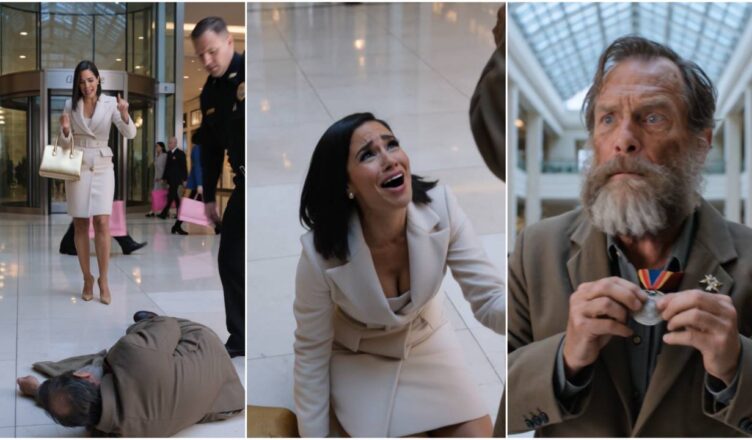
By four-thirty that afternoon, Natalie Ford had answered seventy-three emails, cut two vendors from a redevelopment deal, and rearranged the seating chart for a charity gala she was no longer sure she wanted to attend. Efficiency, she liked to say, was kindness in a sharper suit.
So when she crossed the marble atrium of Bellmere Galleria and saw an old man hunched on a bench near the escalator in a coat too thin for November, her first reaction was not concern. It was irritation.
He looked wrong against the polished brightness of the mall. His shoes were worn through at the sides. His hands were tucked beneath his arms for warmth. Shoppers drifted around him with shopping bags and expensive indifference. Natalie turned to the nearest security guard, a broad-shouldered man named Ortega she knew from the valet entrance. “There’s a man sleeping by the escalator,” she said. “Please take care of it.”
Ortega glanced over her shoulder and sighed. “I’ll talk to him, ma’am.” Natalie folded her arms and checked her watch. She had a fitting in twelve minutes, talking points to revise before seven, and no patience for a scene in the middle of a luxury mall. Ortega crossed the atrium, crouched by the bench, and spoke to the old man in a low, careful voice. The man nodded, pressed one palm to the bench, and slowly stood. When he did, his coat shifted. Something silver flashed beneath the lapel. At first it was only a glint of metal against old wool. Then Natalie saw the ribbon. Saw the medal itself. And all at once the air seemed to thin around her. It was a Soldier’s Medal. Her father had kept one in a glass case in his study for as long as she could remember. Not his own—he had never claimed that. When she was little, she used to ask why it sat among his most treasured things. Daniel Ford would tap the glass with one finger and answer in the same quiet voice every time. I’m alive because of a man who wore one of these. Natalie was moving before she fully understood why. “Where did you get that?” The old man looked down, startled by the urgency in her voice. He drew the medal free with careful fingers. The ribbon was frayed, but the metal had been polished so often it still caught the light. “Fort Bragg,” he said. “Seventy-eight. Field exercise. Transport caught fire.” His voice was thin, but steady. “Pulled a man out before the fuel line went.” Natalie could hear her own pulse. “What was his name?” Now the old man looked at her closely. “Daniel Ford,” he said. For one long second she heard nothing but her father’s voice, years of it, telling the same story in fragments. The accident. The burns. The limp that worsened every winter. The debt of gratitude he spoke of like scripture. “That was my father,” she said. The old man blinked. Then his eyes narrowed, not in suspicion but in memory. “Little Nat?” he said softly. Her breath caught. He gave a faint, unbelieving smile. “You used to bring crayons to the rehab ward. Drew horses that looked like dogs.” Tears hit her eyes so fast it made her angry. “Oh my God,” she said. “Frank?” He nodded once. Frank Mercer. The name landed with a force memory did not need help carrying. Thanksgiving dinner. Her father saying Sergeant Frank Mercer deserved a better country than the one men like him got after the applause wore off. Two minutes earlier she had asked security to remove him. A hot wave of shame moved through her so sharply she almost felt unsteady. “I’m sorry,” she said. “Frank, I am so sorry.” He lifted one hand, tired but kind. “It’s all right, child. Most people only see the part of a life that’s in front of them.” That gentleness made it worse. Natalie looked at him properly now: the hollows beneath his cheekbones, the careful way he kept weight off one leg, the clean collar gone shiny with age. The medal rested against his chest beneath that threadbare coat like proof from another world. “Come with me,” she said. His spine stiffened. “I’m not asking you for money.” “I know.” “I don’t want pity.” Usually she would have solved this with distance—written a check, called an assistant, handed the whole thing to someone trained to deal with it. But nothing about this felt delegable now. “My father owed you his life,” she said. “And if he were standing here, he would never forgive me for leaving you on that bench after what I just did. So don’t do it for me. Do it for him.” Frank studied her for a long moment. Then, reluctantly, he nodded. She took him first to the café on the top floor. He insisted he only wanted coffee. She bought him soup, coffee, and a turkey sandwich he claimed was too much until he finished every bite. While he ate, Natalie canceled her fitting, told her assistant to handle the gala dress without her, and asked the questions she should have asked before she made assumptions. The story came in pieces. After the Army, Frank had worked in city maintenance for nearly thirty years. He married late. His wife got sick early. The savings went first, then the car, then the apartment when the rent jumped higher than either of them could carry. After his wife died, everything narrowed. He got on waiting lists for veteran housing, senior housing, and a benefits review that kept stalling because one claim had been coded wrong, then refiled wrong, then lost between offices. He slept in shelters when he could, in church basements when he couldn’t, and came to the mall on cold afternoons because it was warm and no one bothered him if he stayed quiet. “Why didn’t you call us?” Natalie asked before she could stop herself. Frank wrapped both hands around the coffee cup. “Your father died six years ago,” he said. “After that, it didn’t feel right to come to your door carrying my troubles.” Her father had died. She had inherited his study, his stories, the rituals of grief he had left behind. And somehow she had still managed to lose the man inside the story. Natalie took Frank to urgent care before he could object again. She paid for an exam, prescriptions, and a proper winter coat when the nurse mentioned how cold his hands were. She brought him home because it was getting dark, the shelters were full, and she had a furnished guest suite over the garage that had sat empty for months. After he went to shower, Natalie crossed the hall to her father’s study and opened the glass case. The medal sat exactly where it always had. Beside it was a photograph she had not looked at in years. Her father stood in a hospital corridor on crutches, young and gaunt and grinning through pain, his arm around a younger Frank Mercer in dress uniform. At the lower edge of the frame, barely visible, a child’s hand held up a red crayon drawing with four crooked legs and what was probably meant to be a mane. On the back, in her father’s handwriting, were six words: The man who brought me home. Natalie sat at the desk and cried with the stunned force of someone realizing grief had missed a room in the house. By morning, sorrow had hardened into something useful. Before eight, she had called her attorney, the director of a senior residence her company owned on the west side, and the executive director of the Ford Family Foundation, which Natalie had treated for years as a moral accessory to more serious business. By noon, Frank had a furnished transitional apartment at the residence, a caseworker to untangle his veterans’ benefits, and an appointment with a specialist. When Natalie drove him there herself, he spent most of the ride looking out the window. “This is too much,” he said at last. “It isn’t enough.” He turned toward her with the faintest smile. “Your father used to say that.” Natalie tightened her grip on the steering wheel. “Then maybe I’m finally learning from the right person.” She visited that Sunday, and the one after that. Then the visits became routine. Frank had stories her father had never told to the end—cheap coffee on base, stupid jokes during drills, the way Daniel sang badly when he thought no one could hear him. Natalie brought books, better shoes, and once a stack of old photographs from the study. Frank gave her back pieces of her father she had not known she was still missing. Three weeks later, the gala arrived. It was held in the ballroom of the same hotel where Natalie had planned to give a speech about civic partnership and philanthropy in language polished enough to mean almost nothing. The room glittered with donors, board members, and city officials. Natalie stood at the podium in a dark blue gown, looked down at the prepared remarks in her hand, and folded them in half. In the front row sat Frank Mercer in a tailored navy suit borrowed from the residence director’s husband. His Soldier’s Medal was pinned above his heart. Natalie let the silence settle. Then she said, “A few weeks ago, I saw a man sitting alone in a mall and mistook need for nuisance. I asked security to remove him. That man once ran into a burning vehicle and saved my father’s life.” The room went still. She told them about Frank. Not every detail. Just enough. The waiting lists. The paperwork failures. The convenience of looking away. Then she said, “Don’t judge someone by the life they’re living. Judge them by the life they’ve saved.” When she announced the Ford-Mercer Housing Initiative, it was no longer charity theater. It was a commitment: transitional housing units for low-income seniors and veterans across properties her company controlled, case-management funding through the foundation, and a benefits advocacy team that knew how to force broken systems to answer the phone. Later, after the applause and the handshakes, Natalie walked Frank to the car herself. The night air was cold and clean. At the curb, he paused and looked at her with the same steady kindness he had shown her on the bench that afternoon, when she had least deserved it. “Your father would’ve been proud of you,” he said. Natalie thought of the first thing she had felt when she saw him: not compassion, not curiosity, just annoyance that suffering had appeared where she preferred polish. Then she thought of the photograph in the study and the six words on the back. She shook her head. “No,” she said quietly. “He would’ve expected better sooner.” Frank smiled at that, and together they stepped into the wash of light spilling from the hotel doors.