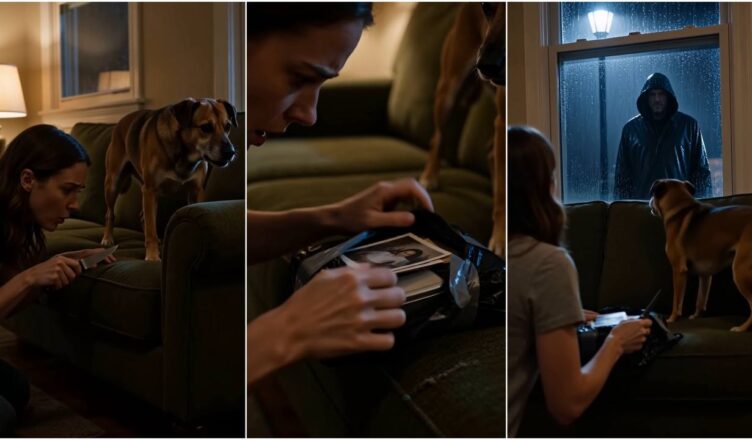
I knew something was wrong with the couch before I knew why.
It looked perfect when I bought it.
Deep green fabric, low wooden legs, wide cushions, the kind of clean mid-century shape that made my little living room in Burlington feel more expensive than it had any right to. I found it at a furniture shop thirty minutes outside town, one of those places with old dressers, polished dining tables, and “restored vintage pieces” arranged under warm yellow lights.
The owner told me the couch had come from an estate sale.
“Solid frame,” he said, slapping the armrest. “They don’t build them like this anymore.”
I should have asked more questions.
Instead, I paid him, arranged delivery, and spent the ride home feeling proud of myself for finding something that looked like it belonged in a magazine.
My dog, Milo, hated it immediately.
Milo was a seven-year-old mutt with gray around his muzzle and the calm, suspicious soul of an old detective. He didn’t bark at delivery men. He didn’t chase squirrels. Most days, his strongest opinion was whether I had placed his bed too far from the heater.
But the moment the delivery guys set the couch against the living room wall, Milo froze.
His ears lifted.
His nose twitched.
Then he walked slowly toward the right armrest and began sniffing like he had found a body under the floorboards.
“Milo,” I said, laughing. “It’s a couch.”
He ignored me.
He circled it once, twice, then came back to the same armrest. His body went stiff. A low growl vibrated in his throat.
That made me stop smiling.
“Milo?”
He barked once.
Sharp. Warning.
I checked under the cushions. Nothing. I looked behind the couch. Dust, a delivery sticker, one loose thread. I pressed my hand against the armrest, expecting to feel a dead mouse or maybe some old food trapped under the fabric.
Nothing.
“Mystery solved,” I told him. “You’re dramatic.”
Milo did not agree.
For the rest of the day, he would not leave the couch alone. He scratched at the right armrest until I pulled him away. He refused treats. He refused his toy. He stood in front of the couch and whined, staring at it like whatever was inside might stare back.
By midnight, I was too uneasy to sleep.
The apartment was quiet except for the rain ticking against the windows and Milo’s nails clicking on the floor as he paced between my bedroom and the living room. Every few minutes, he returned to the couch and sniffed the same spot.
Finally, I got up.
“Fine,” I muttered. “You win.”
I grabbed a utility knife from the kitchen drawer, knelt beside the armrest, and held the blade against the green fabric.
For a second, I hesitated.
The couch was beautiful. I had owned it less than twelve hours. Cutting it open felt insane.
Then Milo let out a sound I had never heard from him before.
Not a bark.
A frightened, desperate whine.
I cut.
The fabric split with a soft ripping sound.
Inside was yellow foam, old wood, and a smell that made my stomach tighten.
Damp.
Metallic.
Rotten, but not like food.
I pulled the foam aside and saw something black wedged deep inside the frame.
A plastic bag.
It had been wrapped again and again with silver duct tape, the edges pressed flat, hidden so carefully that no one would have found it unless they were looking for it.
Or unless they were Milo.
My hands started shaking.
I carried the bag to the coffee table. Milo backed away from it, ears pinned, growling under his breath.
I should have called the police right then.
Instead, I picked up the knife and cut through the tape.
The plastic loosened.
Inside were photographs.
Dozens of them.
Old prints, bent at the corners, some stuck together from dampness. The first few showed a family in a living room I didn’t recognize. A man with dark hair and a square jaw. A woman with soft blond curls. A little girl missing her two front teeth.
And behind them, in every photo, was my couch.
The same green fabric.
The same wooden legs.
The same right armrest Milo had been trying to tear open.
At first, the pictures looked ordinary. Birthdays. Christmas. A child asleep under a blanket. A woman laughing while holding a mug with both hands.
Then the photos changed.
The woman stopped smiling.
In one picture, she sat on the couch with sunglasses on indoors. In another, her hand was wrapped in gauze. In the last few, she stared directly at the camera with an expression that made the room feel colder.
Fear.
Not sadness. Not stress.
Fear.
Under the photos was a small black notebook.
The first pages were normal: grocery lists, doctor appointments, reminders about school forms and dentist visits.
Then the handwriting changed.
It became smaller.
Tighter.
Harder to read.
He’s watching the accounts.
He says no one will believe me.
If something happens, don’t let him sell the couch.
I turned the page, my mouth dry.
There was one final line written so hard the pen had torn the paper.
Look inside the right arm.
The apartment seemed to shrink around me.
Milo barked again, but this time he was staring at the couch.
I went back to the torn armrest and pulled out more foam. Behind the springs, my fingers found a strip of loose wood. It shifted under my hand.
A hidden panel.
I pried it open with the screwdriver from my junk drawer.
Behind it was a metal box.
It took both hands to pull it free. It hit the floor with a heavy thud that seemed much too loud for my quiet apartment.
The box wasn’t locked.
Inside were stacks of cash wrapped in brittle rubber bands.
Thousands of dollars.
Maybe more.
Beneath the money was a revolver wrapped in a dish towel, a wedding ring taped to an envelope, and a newspaper clipping dated twelve years earlier.
LOCAL FAMILY VANISHES AFTER SELLING HOME
The photo beneath the headline showed the same family from the pictures.
Daniel Reed.
His wife, Laura.
Their six-year-old daughter, Emma.
Police believed they had left town after a failed business deal. Neighbors said the family had packed in a hurry. No bodies had ever been found. No charges had ever been filed.
I sat there on the living room floor, staring at the article, while Milo growled toward the window.
Low.
Slow.
Every hair on my arms rose.
I looked up.
A man stood outside in the rain.
He was under the streetlamp across from my building, wearing a dark coat, his face half-hidden by the hood. He was not walking. He was not passing by.
He was staring straight through my window.
At the open couch.
At the metal box.
At me.
For a second, neither of us moved.
Then he smiled.
My body went cold.
I grabbed my phone and crawled away from the window, pulling Milo with me by the collar.
The man crossed the street.
I called 911 with one hand while trying to drag the coffee table in front of the apartment door with the other.
“What’s your emergency?” the dispatcher asked.
“There’s a man outside my apartment,” I whispered. “He’s coming here.”
“What is your address?”
I gave it to her, barely able to speak.
Milo was barking now, furious and terrified. The sound filled the whole apartment.
Then came the knock.
Three slow taps.
Not frantic.
Not uncertain.
Polite.
That was worse.
I backed into the hallway, phone pressed to my ear.
The dispatcher said, “Officers are on the way. Do not open the door.”
The man knocked again.
Then he spoke.
“Miss Bennett.”
My blood turned to ice.
He knew my name.
“I just need what’s in the couch,” he said through the door. “Give it to me, and I walk away.”
I couldn’t answer.
I couldn’t breathe.
The doorknob turned once.
Locked.
A pause.
Then the man hit the door so hard the frame cracked.
Milo lunged forward, barking like he would tear through the wood.
I ran into the bathroom, locked the door, and crouched inside the tub with Milo pressed against my legs. From the living room came another crash. Wood splintered. Something fell.
The dispatcher stayed on the line.
“Ma’am, stay where you are. Officers are one minute out.”
One minute felt impossible.
I heard the apartment door burst open.
Heavy footsteps entered.
Slow.
Controlled.
“Maya,” the man called.
My name sounded obscene in his mouth.
“I know you’re scared. I don’t want you. I want the box.”
Milo growled so deeply I felt it through my knees.
The bathroom doorknob moved.
Once.
Twice.
Then the man leaned close to the door.
“You have no idea what you found,” he whispered.
Sirens rose outside.
The footsteps stopped.
For the first time, panic entered his breathing.
He ran.
A second later, my living room window shattered.
Men shouted outside. Tires screeched. Milo barked until his voice broke.
Then someone pounded on my apartment door and called, “Police!”
I don’t remember walking out of the bathroom.
I remember blue lights flashing across the broken glass. I remember an officer taking the knife from my hand because I hadn’t realized I was still holding it. I remember Milo standing between me and everyone else, shaking but refusing to move.
The police caught the man two blocks away.
His name was Daniel Reed.
The missing husband from the newspaper clipping.
He was not missing anymore.
Neither, as it turned out, was the truth.
The story came out piece by piece over the next month. Daniel had owned a small construction company that was collapsing under debt. He had been stealing from clients, hiding cash, and planning to disappear before the lawsuits caught up with him. Laura found out. She kept records. Photos. Account numbers. The gun he had threatened her with.
She hid everything in the couch because Daniel hated that couch and never touched it.
Before she could get to the police, she vanished with her daughter.
For twelve years, everyone assumed Daniel had taken them somewhere.
He had encouraged that assumption.
But the evidence in the box led detectives to an old storage property outside Montpelier. They found Laura’s remains there two weeks later.
They also found evidence that changed the case again.
Emma Reed had not died with her mother.
She had been taken across state lines under another name, abandoned with a distant relative, and raised believing her mother had left her. She was eighteen when the police found her in Ohio.
I met her in Burlington six months after Daniel Reed’s arrest.
She came to my apartment with a detective and a victim advocate. She was tall, quiet, with her mother’s blond curls and the wary eyes of someone who had learned not to trust good news too quickly.
I had kept the photographs in a new envelope after the police returned copies to me. The originals were evidence. The copies were all Emma had left of the life she had been too young to remember clearly.
She sat on my couch—the new one, not green—and looked through them one by one.
She didn’t cry at first.
Then she found a photo of herself asleep against Laura’s shoulder, both of them on the old couch, sunlight falling across the room.
Her hand covered her mouth.
“That blanket,” she whispered.
I waited.
“I remember that blanket.”
The room went silent.
Milo, who had been watching her carefully from the doorway, walked over and rested his head on her knee.
Emma looked down at him, then at me.
“He’s the reason you opened it?”
I nodded. “He wouldn’t stop.”
She scratched behind his ears.
Milo closed his eyes.
For the first time since she arrived, Emma smiled.
Not fully.
Not happily.
But enough.
The old couch was taken into evidence and never came back. I didn’t want it back. For weeks, I still woke up hearing the knock on my door, seeing Daniel Reed under the streetlamp, smiling in the rain.
But sometimes, late at night, when Milo slept beside the window with one ear lifted toward the world, I thought about Laura Reed.
I thought about her sitting on that green couch, terrified but still planning, still hiding proof, still leaving a trail for someone to find.
She had not known it would take twelve years.
She had not known it would be a stranger with a nervous dog and a utility knife.
But somehow, inside all that fear, she had trusted the truth enough to hide it where it could wait.
And one rainy night, Milo heard it scratching from the dark.