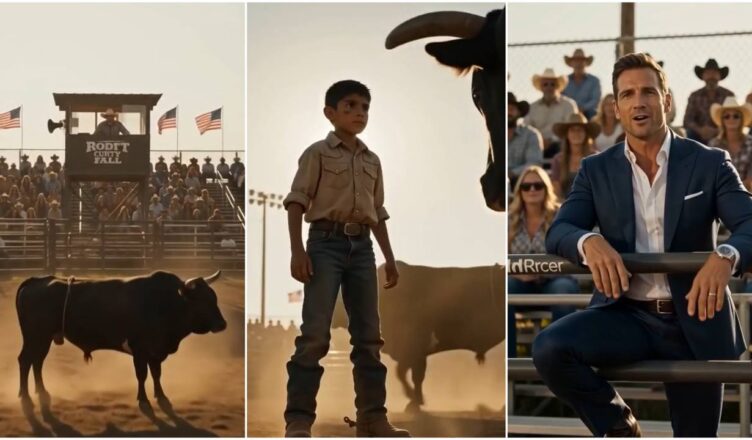
The sun sat hard and white over San Jacinto County Fairgrounds, baking the rodeo arena until the air itself felt gritty. Heat shimmered above the chutes. Dust clung to the rails, to the boots of the ranch hands, to the sweating faces packed shoulder to shoulder on the bleachers.
It was the last event of the afternoon, the one people had been waiting for all day.
Not because anyone expected beauty from it.
Because they expected blood.
Vendors wove the aisles with paper trays of roasted peanuts and sweating Styrofoam cups of lemonade. Kids leaned over the front rail with their caps turned backward. Old men in sweat-stained hats squinted into the ring and talked like they’d already seen how it would end. Every few seconds, somewhere in the crowd, a phone lifted into the air.
In the center of the arena, inside a holding circle of nervous handlers and open space, stood the bull.
His name was Brimstone.
He was big even by rodeo standards—close to two thousand pounds of black muscle and bad temper, with a neck as thick as a tree stump and horns that curved forward like something forged, not grown. His hide shone blue-black in the sun. Every twitch under his skin looked like a cable tightening. When he drove a hoof into the dirt, the impact carried through the boards and into the soles of the bleachers.
Brimstone didn’t move like a show animal. He moved like a creature that hated walls.
Rumor had done the rest for him. Three riders hospitalized in eleven months. One with a shattered pelvis. Another with a punctured lung. The third had taken a horn to the thigh and nearly bled out before the medics got to him.
By the time the announcer’s voice crackled over the speakers, Brimstone had already become something larger than a bull in people’s minds.
A test. A monster. A story people could say they’d seen with their own eyes.
“Ladies and gentlemen,” the announcer boomed, with the kind of excitement that only sounded natural if you’d been doing county fairs your whole life, “you are lookin’ at the meanest draw this side of Amarillo. Eight seconds on Brimstone and you don’t just get the buckle—you get your name remembered.”
The line got a cheer, but it was thinner than the announcer wanted. The riders waiting by the chute didn’t cheer at all.
They kept their eyes on the bull.
Nobody volunteered.
Not after the first guy took one look and stepped back.
Not after the second laughed like it was a joke and said, “I got two daughters at home.”
Not after the third muttered, “Ain’t worth it,” and walked away to a storm of boos from the cheap seats.
The announcer tried to keep it lively. “C’mon now, folks, somebody out here still got a pulse?”
Nobody moved.
The quiet that followed was worse than noise. Embarrassed. Expectant. Mean.
Then a man in a navy suit stepped down from the VIP platform and into the dirt.
He looked so out of place it took the crowd a second to react. He was in polished brown shoes, no hat, no dust on him yet, silver watch flashing at his wrist. He was in his forties, fit, expensive, the kind of man who wore confidence the way other people wore denim.
Everyone around town knew who he was.
Cade Mercer. Oil money. Real estate money. The kind of money that sponsored scoreboards, scholarship plaques, and election signs. He had put up the purse for the day’s exhibition because his company logo was on half the banners in the arena.
Mercer lifted a thick white envelope and held it high.
The crowd quieted almost immediately.
“One hundred thousand dollars,” he said.
He didn’t need the microphone. The man had one of those voices that landed clean even in open air.
A ripple ran through the stands.
Mercer turned slowly, making sure every section could see the envelope. “Cash. Right now. To anyone who can ride that bull, stop that bull, or put on a show worth remembering.”
A few people laughed. A few whistled. A woman in the front said, “Lord have mercy,” like it had become church all of a sudden.
Mercer pointed toward Brimstone. “You all came for a spectacle. So let’s have one.”
One of the riders near the chute barked back, “Why don’t you climb on him, Cade?”
That got a louder laugh.
Mercer smiled without much warmth. “I’m not the one claiming to be a cowboy.”
The laughter rolled, then faded. The money had changed the air in the place, but not enough. A hundred thousand dollars could pay off a mortgage, save a ranch, send a kid to college.
It still wasn’t enough.
Not for that bull.
Thirty seconds passed. Then a full minute. Nobody stepped forward.
Mercer’s smile thinned. His eyes went to the riders, then the stands, measuring all that silence and what it said about the men in it.
And then the metal side gate rattled with a violent clang.
Heads snapped toward the sound.
A boy had jumped the fence.
He couldn’t have been more than fourteen. Maybe fifteen if you were being generous. He was narrow-shouldered and sun-browned, wearing faded jeans, scuffed work boots, and a pearl-snap shirt that had gone soft from too many washings. The sleeves were rolled to the elbow. One side of his collar sat crooked like he’d pulled it on in a hurry. He looked less like a contender than somebody sent to fetch feed.
The first reaction from the crowd was laughter.
Not a little laughter. Full-throated, relieved laughter.
“Well, hell,” somebody shouted. “Now we got entertainment.”
A man higher up yelled, “Kid, you lost?”
Several phones came up at once.
Mercer stared at him for a beat, amused, then called across the dirt, “This isn’t a petting zoo, son.”
The boy didn’t answer.
He dropped down from the rail, brushed his palms together once, and started walking.
Not fast. Not dramatic.
Just steady.
That changed things.
Because he didn’t walk like a kid showing off for his friends. He didn’t swagger. He didn’t hesitate either. He moved with a quiet, deliberate focus that made the laughter start to snag in people’s throats.
From the announcer’s booth, somebody said, off mic but loud enough to carry, “Who is that?”
One of the pickup men near the rail narrowed his eyes. “That’s Luis Ortega’s boy, I think.”
“Which one?”
“The youngest. Nico.”
The name drifted outward through the crowd in fragments.
Nico.
Ortega’s boy.
The one from outside town.
The boy kept walking.
Brimstone saw him coming and stopped pacing.
That more than anything pulled the noise out of the arena.
The bull turned his head slowly, then fully, until one dark eye locked on the kid. He gave a long, low snort that lifted dust and strings of foam from his muzzle. Muscles bunched under his hide.
Nico kept coming.
Twenty feet.
Fifteen.
Ten.
One of the handlers swore under his breath. Another started forward, then stopped when Mercer put out an arm to hold him back. Mercer’s face had lost its smile now. He looked annoyed, then curious, then something closer to tense.
“Nico,” one of the pickup men shouted. “Back off. You hear me? Back off now.”
The boy didn’t even look at him.
He stopped a few yards from Brimstone.
The arena went so quiet you could hear the loose tin sign over the concession stand rattling in the wind.
Nico lifted one hand.
Not fast.
Not like a command.
Like you might raise a hand toward a skittish dog on a porch.
Mercer gave a short, incredulous laugh. “Jesus Christ.”
Brimstone lowered his head.
The bull’s front hoof carved a deep line through the dirt.
Everybody in the arena felt the charge coming before it happened. That terrible half-second when the world seems to hold itself together by pure tension.
Then Brimstone exploded forward.
Women screamed. Men shouted. Somebody dropped a drink and ice scattered across the boards. In the booth, the announcer yelled something nobody could make out.
Nico moved at the last instant.
It wasn’t the wild dive people expected. It was a clean sidestep, almost small, as if he’d been standing on a porch letting a storm door swing by.
Brimstone thundered past him close enough to brush his shirt.
The whole arena gasped as one body.
The bull hit the far side, dug in, twisted, and came around furious. Dust rose around him in a violent halo.
Nico had already turned to face him.
Still calm. Still breathing through his nose. Watching.
“Get him out of there!” a woman yelled.
“Open the damn gate!” another man shouted.
But no one moved fast enough, because Brimstone charged again.
And again Nico slipped away from him. A pivot this time. No panic. No wasted motion.
The third charge came meaner, lower, horn first. Nico stepped back, then sideways, making the bull commit and overrun. It was impossible to watch without feeling your own spine tighten.
By then nobody was laughing.
Even the drunks in the back had gone quiet.
Mercer took a few steps closer to the rail without seeming to realize he’d moved.
“What the hell is he doing?” he said.
An older rancher beside him never took his eyes off the arena. “He’s readin’ him.”
“Reading him?”
“Bull’s telegraphin’ every move. Boy knows where to look.”
The old man paused.
Then, almost to himself: “Or he knows this one.”
Brimstone wheeled again, breathing hard now, rage making him sloppy. Nico stayed just outside the bull’s line, not taunting him, not grandstanding, only waiting and measuring. He looked less like a boy in an arena than somebody remembering something.
A pasture gate.
A feed bucket.
A lesson shouted across dust and evening light.
When Brimstone came the next time, Nico didn’t retreat as far. He let the bull close the distance, then turned him with a shift of the shoulder and a palm flashing near the horn, redirecting just enough to steal the line of attack.
The crowd made a sound nobody had planned to make.
Not cheering.
Wonder.
Brimstone stopped in the center of the ring, sides heaving. Foam clung to his mouth. He tossed his head, searching for the next threat.
Nico took one step forward.
Then another.
A wave of alarm moved through the stands.
“No, no, no—”
“Kid, don’t do it.”
Mercer had one hand on the rail now so tight his knuckles had gone pale.
Nico kept walking.
He said something then, too low for the crowd to hear. Maybe in Spanish. Maybe not. Whatever it was, his voice didn’t carry. It only changed his face. Softened it. Made him look suddenly less like a challenger than someone speaking across a distance he had crossed before.
Brimstone stamped once.
Nico stopped close enough to touch him.
The bull’s head came up, then down, then held.
Slowly—so slowly that half the arena seemed to forget to breathe—Nico reached out and laid his hand between the bull’s eyes.
Brimstone froze.
Not stunned. Not trapped.
Still.
The transformation was so abrupt it felt unreal. The huge body that had been all violence a moment ago seemed to gather inward, to settle. His breathing changed first. Long pull in. Long push out. Then the tension along his shoulders eased. His head lowered a few inches.
Nico kept his hand there.
The whole place watched in dead silence.
After a moment, the boy leaned close to the bull’s ear and murmured something no one else got to hear.
Brimstone blinked.
That was all.
No kneeling. No theatrical trick. No miracle for the cheap seats. Just a dangerous animal standing quiet under the hand of a boy who knew exactly how not to lie to him.
When Nico finally stepped back, Brimstone didn’t lunge. He stayed where he was, sides rising and falling, as calm as he had been violent.
The silence broke all at once.
It came apart in screams, shouts, boots hammering the bleachers, people standing, hats flying into the air. The announcer found his voice too late and nearly lost it again trying to describe what nobody in the booth understood. Every phone in the place pointed toward the ring.
Mercer vaulted the rail before anyone could stop him.
“Kid!” he shouted over the noise. “Kid!”
Nico was already heading back toward the fence.
Mercer cut across the dirt and reached him just as he put a boot on the lowest rung. Up close the boy looked younger, sweat streaking the dust on his face. His chest rose and fell, but not wildly. His eyes were clear.
Mercer held up the envelope. “You earned this.”
Nico glanced at it, then at Brimstone behind them.
“That wasn’t the deal,” he said.
His voice was quiet, rough-edged, local. American, South Texas, with Spanish curled deep in the vowels.
Mercer frowned. “The hell it wasn’t.”
“You said tame him or defeat him.” Nico looked back at the bull. “I didn’t defeat him.”
Mercer gave a disbelieving laugh. “Son, you walked into the arena with a killer bull and walked back out. That counts.”
Nico shook his head once. “He ain’t a killer.”
Mercer’s jaw tightened, either at the correction or at being corrected by someone who couldn’t legally drive. “He put three men in the hospital.”
“Men climbed on his back and tied a rope around him in front of a screaming crowd.” Nico met his eyes. “What’d you think he was gonna do?”
For a second Mercer had no answer.
The crowd was still roaring around them, but inside that little pocket of space the silence turned personal.
“You know this bull?” Mercer asked.
Nico looked at Brimstone again, and something shifted in his face.
“My dad raised him.”
That landed.
The old rancher at the rail took off his hat.
Mercer’s expression changed in pieces as memory caught up—sponsorship papers, auction lots, some ranch sale years ago he’d signed without reading too hard. “Ortega Livestock,” he said.
Nico nodded.
Mercer glanced toward the bull. “Your daddy sold him.”
“Had to.” Nico’s mouth tightened. “After the bank took most of what was left.”
Mercer looked at the envelope in his hand like it had suddenly become something smaller than paper.
Nico climbed one rung higher on the fence.
Mercer stepped closer. “Take the money.”
Nico gave the smallest shake of his head. “If I take it, this turns into what you wanted.”
“And what’s that?”
“A show.”
Mercer opened his mouth, then shut it.
Nico dropped back down on the other side of the fence. For a second he stood there in the shade cast by the rail, just another thin kid in worn clothes while the crowd shouted his name louder than they knew it. Then he looked over once more at Brimstone.
The bull had turned toward the fence, ears forward, waiting.
Nico lifted two fingers in a brief, almost private gesture.
Then he disappeared into the bodies pressing down from the bleachers—through dust, through noise, through people who suddenly wanted to touch the shoulder of a boy they had laughed at two minutes earlier.
By the time Mercer made it around the rail and into the concourse, Nico was gone.
No cameras caught where he went.
Not one.
All anyone had afterward were shaky videos, sun-flared and full of screaming, showing a black bull stopping under a boy’s hand and a wealthy man standing in the dirt with a hundred thousand dollars still in his fist.
That night, after the fairgrounds emptied and the last beer cup rolled across the concrete in the dark, Mercer went down to the holding pen alone.
Brimstone stood at the far end under a yellow work light, massive and watchful.
Mercer rested his arms on the gate. Dust had finally found his suit. His shoes were ruined.
After a long minute, he said to no one, “You knew him.”
Brimstone flicked an ear.
Mercer looked at the bull, then out toward the dark arena where the noise of the afternoon had died so completely it felt imagined.
The envelope was still in his pocket.
He left it there.
And in the morning, before the trucks rolled out and the banners came down, one of the ranch hands found the latch on Brimstone’s pen wrapped with a fresh strip of blue cloth torn from an old pearl-snap sleeve.