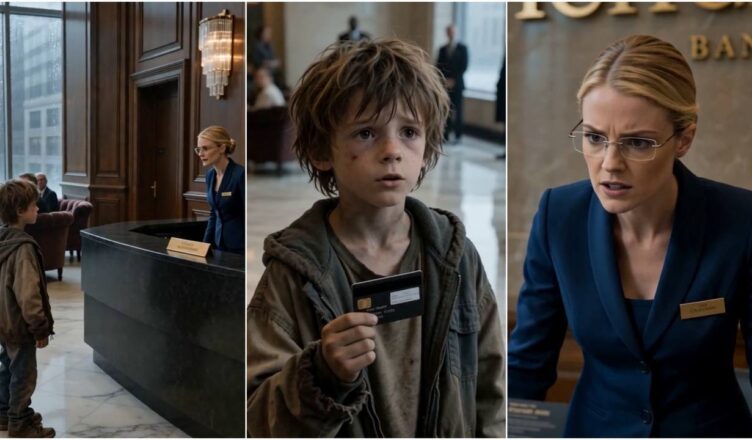
The Boy at the Marble Desk
The lobby of Northbridge Private Bank looked less like a bank than a cathedral built for people who never had to worry about money.
White marble floors reflected the chandeliers above like frozen water. Dark walnut walls rose around the room in polished panels. Behind the black stone reception desk, fresh orchids stood in a vase that probably cost more than most families spent on groceries in a month. Even the silence felt expensive.
Marissa Vale liked that silence.
At thirty-two, she had learned how to move inside wealth without ever truly belonging to it. Her navy skirt suit was pressed sharp enough to cut paper. Her blonde hair was pinned into a perfect twist. Rimless glasses sat precisely on her nose, and a small gold name badge rested above her heart. She knew every regular client by face, by preference, by impatience.
The retired hedge fund manager who wanted sparkling water at room temperature.
Advertisements
The widow with the emerald ring who never touched a pen unless someone wiped it first.
The real estate brothers who laughed too loudly and carried themselves like the building owed them a favor.
Marissa smiled for all of them.
Not warmly.
Not really.
Her smile was part of the architecture.
She liked being the first person people had to pass before reaching the private bankers upstairs. She liked deciding who belonged in that room and who did not. It gave her a sense of control she had chased since childhood, when she and her mother used to stand outside places like this in the cold and imagine what kind of people walked through those doors without being questioned.
Now Marissa did the questioning.
That rainy Tuesday morning, the downtown Chicago branch was unusually quiet. Soft gray daylight pressed against the tall windows facing LaSalle Street. A few wealthy clients sat in velvet chairs, checking watches that cost more than cars. Somewhere behind the walls, an espresso machine hissed softly. The marble smelled faintly of lemon polish and old money.
Then the front doors opened.
A boy stepped inside.
He was twelve, thin, white, wearing an oversized old coat that hung from his narrow shoulders like it had belonged to someone else first. His faded jeans were worn at the knees. His sneakers were cheap and old, the soles soft from too many miles. His hair was messy and unkempt, dark strands falling across his forehead. There was no dirt on his face, no visible injury, nothing dramatic enough to make anyone call an ambulance.
That almost made it easier for the room to dismiss him.
He simply looked poor.
Out of place.
Wrong for the marble.
Every head in the lobby turned.
The boy stood still for a moment beneath the chandelier light, blinking as if he had walked out of the rain and into another planet. He carried no backpack. No phone. No parent followed behind him. In one hand, he held a black metal card.
Marissa’s smile vanished.
A security guard near the doors straightened.
From one of the velvet chairs, Mrs. Elaine Sloane leaned slightly toward her financial adviser and whispered, not quietly enough, “Good Lord. Did someone lose a child?”
The adviser gave an uncomfortable little laugh.
The boy heard it.
His eyes moved toward Mrs. Sloane, then away. No shame. No anger. Just a strange, steady calm that made the laugh die faster than it started.
He walked toward the black stone desk.
His old sneakers made small sounds against the marble.
Marissa felt heat rise beneath her collar. Not sympathy. Irritation. The lobby had a rhythm, a standard, a shape. This boy had broken it simply by standing inside it.
He stopped in front of her desk and lifted the black card to chest level.
Marissa looked him over once, coldly.
“This is a private bank,” she said. “You don’t belong here.”
The boy did not lower his eyes.
“Please, just check the account.”
His voice was quiet. Controlled. Desperate, maybe, but not weak.
Marissa leaned forward, narrowing her eyes at the card and then at his old coat, his messy hair, his tired face.
“Where did you steal that card?”
A few clients shifted in their chairs.
The security guard took one step closer.
The boy’s jaw tightened, but his hand did not shake. He extended the card toward her with a small urgent motion.
“My grandfather gave it to me,” he said. “Please… just check it.”
Something in his tone gave Marissa a moment’s pause.
Not because she believed him.
Because he did not sound like a child making up a lie.
He sounded like someone following instructions he had been afraid he would one day need.
Marissa took the black metal card reluctantly, holding it by the edge. It was heavier than she expected. Cold too. No printed number. No visible name. Only a tiny silver crest etched near the corner: a bridge inside a circle.
Her expression shifted by the smallest degree.
Everyone trained at Northbridge had heard of the Founder’s Card. It was mentioned once during orientation, almost like a piece of corporate folklore. A legacy instrument issued decades earlier to the North family itself. It bypassed normal retail banking. It connected directly to trust structures so private, so layered, that most employees would never see one outside a manual.
Marissa looked from the card to the boy.
Her mind rejected the connection immediately.
Still, the clients were watching.
The guard was watching.
The boy was watching most of all.
She turned toward the secure reader at the side of her terminal and inserted the card.
The machine gave one soft beep.
Marissa glanced down at the monitor.
At first, she expected rejection.
Invalid.
Frozen.
Flagged.
Anything clean and simple that would let her straighten, return the card to security, and restore order.
Instead, the familiar Northbridge interface disappeared.
The screen went black by design.
A narrow white authorization line appeared.
Then another.
Marissa stopped breathing.
The system requested a secondary verification code, but before she could ask for it, the card completed a legacy override she had never seen in person. The display shifted again. A restricted account profile opened across the unseen monitor.
Her fingers went numb.
TRUST ENTITY: NORTH FAMILY HOLDINGS
BENEFICIARY: CALEB ELIAS NORTH
STATUS: PRIMARY HEIR
CONTROL TRANSFER: ACTIVE UPON DEATH OF DANIEL ASHER NORTH
BOARD NOTICE: CONFIRMED
Below the text was a number so large her mind refused to hold it.
Marissa read the name again.
Caleb Elias North.
Primary heir.
Active transfer.
Her face drained of color. Her eyes widened behind the rimless glasses. She could feel the lobby around her falling silent, but it sounded far away now, as if she were underwater.
The boy stood perfectly still on the other side of the desk.
Marissa lifted her head slightly, her breath catching.
“Oh my God…”
That was all she could say.
Caleb watched her carefully.
He did not look triumphant. He did not smile. Somehow, that made the moment worse.
A child who had been insulted in a room full of adults had just watched every one of them understand that he mattered only after a screen told them so.
Marissa looked down again, hoping she had misread it.
She had not.
The account profile remained open. The system had accepted the Founder’s Card. The transfer had triggered before sunrise that morning, tied to the death of Daniel Asher North, founder of Northbridge Private Bank and one of the most private billionaires in the country.
Marissa’s mouth moved once, but nothing came out.
The folded grief of the morning began to make sense in terrible pieces. Daniel North’s death notice had gone to senior management before dawn. Branch employees had been told only that leadership changes were underway and that a special representative from New York might arrive sometime that week.
No one had mentioned a child.
No one had said the heir might come alone.
Caleb reached toward the card reader.
Marissa flinched back to herself.
“Wait,” she said, her voice too sharp.
The boy paused.
She softened it immediately, but too late. “I mean… please wait.”
Please.
The word sounded unfamiliar coming from her in that direction.
The security guard had stopped moving. His eyes flicked from Marissa to Caleb, then to the clients. He was beginning to understand enough to look ashamed, though he had not touched the boy.
Mrs. Sloane sat frozen in her velvet chair.
Marissa swallowed.
“Your name is Caleb North?”
“Yes.”
“Daniel North was your grandfather?”
“He told me to come here if something happened to him.”
“Where is your attorney?”
“I don’t have one with me.”
“Your guardian?”
Caleb’s face changed, only slightly.
“I came alone.”
The answer landed softly, but it hollowed out the room.
Marissa looked at his old coat again. His worn jeans. His cheap sneakers. The neglected hair. The tired eyes. She saw everything she had seen a minute earlier, but now it rearranged itself into evidence of something else.
Not fraud.
Not inconvenience.
A child carrying too much.
There was a cream-colored envelope in his coat pocket, folded and refolded until the edges had softened. He removed it and placed it on the counter.
Across the front, written in old-fashioned blue ink, were the words:
For Caleb. If you are alone, go to Northbridge first.
Marissa’s stomach turned.
Before she could speak, the elevator doors at the rear of the lobby opened. Howard Lyle, the branch president, stepped out with his phone in one hand and panic in his face. He had the expression of a man who had just been told that the future had arrived downstairs without warning.
He stopped when he saw the boy.
Then he saw Marissa.
Then the card reader.
His face went gray.
“Caleb North?” he asked.
The boy turned.
Howard came forward carefully, no longer the polished executive who greeted clients with perfect warmth, but a frightened man approaching a truth he was already late to respect.
“I’m Howard Lyle,” he said. “I manage this branch. We received notice this morning, but we weren’t told when you would arrive. We were expecting counsel from New York.”
Caleb studied him.
“My grandfather said not to wait for people who profit from delay.”
Howard swallowed.
“Yes,” he said quietly. “That sounds like him.”
Marissa could feel tears threatening behind her eyes. She fought them. Crying now would only make the moment more pathetic.
“I didn’t know,” she whispered.
Caleb looked at her.
The words were useless the instant they left her mouth.
Howard’s expression sharpened. “What happened?”
No one answered at first.
The silence answered for them.
The security guard cleared his throat. “He asked her to check the card, sir.”
Howard looked at Marissa.
The guard continued, visibly uncomfortable. “She asked where he stole it.”
Mrs. Sloane lowered her gaze into her lap.
Howard closed his eyes for one brief second.
Marissa gripped the edge of the desk.
“He came in looking—” she started.
Then she stopped.
The sentence had nowhere decent to go.
Caleb waited.
“Looking how?” he asked.
Marissa looked at his coat. At his shoes. At the card. At the clients behind him who had gone silent only after learning his name.
She could not answer without revealing herself.
Poor.
Unimportant.
Disposable.
Like someone she had trained herself not to be.
Howard turned to Caleb. “We should take you upstairs. Your grandfather’s personal counsel is on the way. The board has been notified. We can get you dry clothes, food, anything you need.”
“I need to know if the transfer is real,” Caleb said.
Howard glanced at the monitor, then back at him.
“It is.”
The boy absorbed that without visible joy.
“My grandfather is dead?”
Howard’s face softened. “Yes.”
Caleb looked down.
For the first time since entering the lobby, he looked twelve.
Not steady. Not composed. Just a boy in an oversized coat standing under chandeliers while adults waited for him to behave like an heir.
“He told me people would lie after he died,” Caleb said. “He said some would lie because they wanted money. Some because they wanted power. Some because they were afraid. He said the bank would show me who was who.”
Howard said nothing.
Caleb looked around the lobby.
His eyes moved over the wealthy clients who had watched him like a stain on the marble. Over Mrs. Sloane, who had whispered before he reached the desk. Over Marissa, who had turned humiliation into procedure. Over the security guard, who had stepped forward but had not grabbed him.
“My grandfather said this place was sick,” Caleb said. “I thought he meant the company.”
Howard’s face tightened.
“The numbers were clean,” Caleb continued. “He said the people weren’t.”
Rain whispered against the tall glass windows.
The orchids behind Marissa looked suddenly obscene in their perfect black vase.
Caleb turned toward the security guard.
“What’s your name?”
The guard blinked. “Aaron Bell, sir.”
“You didn’t touch me.”
Aaron looked uncomfortable. “No, sir.”
“You were going to.”
“I thought I might have to.”
“But you didn’t.”
“No.”
“Why?”
Aaron’s eyes lowered. “Because you said you weren’t causing trouble. And you weren’t.”
Caleb nodded once.
It was the closest thing to approval anyone in the lobby had earned.
Then he looked back at Howard.
“Does he work for the bank or a contractor?”
Howard hesitated. “Contractor.”
“Hire him directly.”
Aaron looked up sharply. “Sir, I don’t know anything about banking.”
“You can learn banking,” Caleb said. “Apparently manners are harder.”
No one laughed.
Howard nodded slowly. “I can arrange that.”
Caleb turned toward Marissa.
She was shaking now, though she tried to hide it.
“I worked very hard to get here,” she said, hating herself for saying it before the sentence was even finished.
Caleb’s expression did not change.
“So did my grandfather.”
“I made a mistake.”
“You made a decision.”
Her eyes filled.
Howard spoke carefully. “Caleb, there are formal procedures for employee review and—”
“Start them,” Caleb said.
Howard lowered his head. “Yes.”
Marissa seemed to shrink behind the desk she had once treated like a throne.
Caleb picked up the black card from the reader himself and slipped it back into his coat. Then he took the envelope and held it carefully, as if the paper was the only remaining piece of his grandfather still warm from his hand.
Mrs. Sloane stood halfway from her chair.
“Mr. North,” she said, her voice thin, “I’m terribly sorry. I didn’t realize—”
Caleb looked at her.
“That I mattered?”
Her mouth closed.
The financial adviser beside her stared at the floor.
Caleb did not linger on them.
That may have been the cruelest part. He gave them no dramatic speech, no child’s revenge, no raised voice they could later call emotional. He simply turned away, and the entire lobby seemed to lean after him, suddenly eager to follow the power it had failed to recognize.
Howard gestured toward the elevators.
“This way, Caleb. We’ll take care of everything.”
The boy stopped at the foot of the private elevator bank. Above it, mounted in a dark frame, hung a portrait of Daniel North: white-haired, unsmiling, eyes sharp enough to make even paint feel judgmental.
Caleb looked up at it.
For a moment, he was not an heir. Not a beneficiary. Not a legal event activating a trust structure worth billions.
He was a child who had just lost the only person who had prepared him for a world that might despise him until it learned his value.
He turned back toward Marissa.
“You asked if I belonged here,” he said.
She could barely lift her eyes.
“My grandfather said this bank belonged to the people who could still recognize a human being before they recognized an account.”
No one spoke.
Caleb looked at the wet marks his old sneakers had left across the perfect marble floor.
“I guess we’ll find out if he was wrong.”
Then he followed Howard into the elevator.
The doors closed.
The lobby remained silent long after he was gone.
Marissa stood behind the desk for another few seconds, as if the shape of her old life might return if she stayed still enough. Then her knees weakened. She sat slowly into the chair behind her, one hand pressed to her mouth, staring at the faint trail Caleb had left behind.
No one rushed to wipe it away.
Upstairs, the executive conference room had already begun rearranging itself around the boy.
Attorneys joined by video. Trustees arrived in person. Two board members who had once treated Daniel North’s final years as an inconvenience suddenly spoke of legacy with moist eyes and trembling voices. Caleb sat at the end of the long table in his oversized coat, refusing the blazer someone tried to bring him, refusing the pastry tray, accepting only a bottle of water and the envelope his grandfather had left him.
When Daniel North’s personal attorney arrived from New York, she was a small woman named Vivian Cross with silver hair, sharp eyes, and no patience for theater. She took one look at Caleb and dismissed half the room.
“Anyone not legally required to be present can leave,” she said.
Three executives tried to protest.
Vivian looked at them. “That was not an invitation to discuss your importance.”
They left.
Only then did Caleb open the letter.
His grandfather’s handwriting filled three pages.
Caleb read it without crying at first.
Daniel North told him where to find the real trust documents. Which advisers could be trusted. Which relatives would appear within forty-eight hours pretending grief had made them generous. He wrote of Caleb’s mother, who had died when Caleb was small, and of Caleb’s father, who had signed away responsibility long before he understood the value of what he had abandoned.
And near the end, Daniel wrote:
If they welcome you only after they see the number, remember it. Money reveals what poverty was already trying to tell you.
Caleb folded the letter carefully.
Vivian sat beside him and waited.
“What happens now?” Caleb asked.
“Now,” she said, “we protect you.”
“From who?”
Vivian’s eyes did not soften. That was why he believed her.
“Almost everyone.”
The first week proved her right.
Relatives Caleb had met only once sent messages full of affection and legal questions. A cousin in Palm Beach offered to “host him for stability.” A former executive suggested a conservatorship “until the boy adjusts.” A trustee Daniel had already suspected tried to delay the transfer of voting control.
Vivian crushed each attempt with paperwork Daniel had prepared years in advance.
But Caleb remembered the lobby most.
Not because it was the cruelest moment of his life. It wasn’t. He had known worse things than Marissa Vale’s contempt. He had known foster homes where adults locked pantry doors. He had known school offices that called him difficult when he was only hungry. He had known his own father’s voice on the phone saying he was not in a position to take the boy in, not right now, maybe someday.
The lobby stayed with him because it was the moment his grandfather’s warning became real.
People did not become kinder when money entered the room.
They became more careful.
Two months later, Northbridge announced internal changes that rattled every private banking branch in the country.
A new client dignity policy.
Anonymous service audits.
Contract workers eligible for direct employment.
Employee advancement reviews based not only on revenue but conduct.
Marissa Vale’s termination appeared in the system as a violation of client intake standards, but everyone at the Chicago branch knew the truth. She had not been fired for failing to recognize an heir.
She had been fired for failing to recognize a child.
Aaron Bell, the security guard, was hired into branch operations. He spent evenings studying banking compliance and mornings greeting clients with the same calm respect he had shown Caleb before he knew his name.
Mrs. Sloane closed one account in protest after being asked to apologize to a junior employee she had berated in public.
Caleb did not try to stop her.
He had learned that some money cost more to keep than it was worth.
By spring, Caleb visited the Chicago branch again.
This time he wore clean clothes that fit: dark jeans, a simple sweater, new sneakers. His hair was still a little messy because he hated it combed flat, and Vivian had stopped trying to turn him into a brochure photograph.
When he entered the lobby, no one laughed.
No one whispered.
Aaron Bell stood near the reception area in a dark suit, no longer a contractor’s uniform, and gave him a respectful nod.
“Good morning, Mr. North.”
Caleb frowned a little.
“Caleb is fine.”
Aaron smiled. “Good morning, Caleb.”
The black stone desk was staffed by a young woman Caleb had never met. She greeted him politely, the same way she had greeted the elderly man before him and the courier after him.
That mattered.
Caleb walked to the center of the lobby and looked down.
The marble was flawless again. Polished. Perfect. No wet sneaker marks. No trace of the boy who had stood there in an old coat with a black card and a dead man’s instructions.
For a second, that bothered him.
Then Vivian, standing beside him, said quietly, “You’re thinking about him.”
Caleb looked up.
“My grandfather?”
“The boy you were that morning.”
Caleb looked back at the floor.
“I don’t want to forget him.”
“Good,” Vivian said. “He is the only reason any of this will matter.”
Caleb nodded slowly.
Outside, rain began tapping against the tall glass windows again, soft and steady, just as it had the morning he arrived alone.
This time, he was not alone.
And this time, when the front doors opened and an older man in a soaked work jacket stepped hesitantly into the lobby, carrying a folder against his chest and looking painfully unsure whether he belonged, Caleb watched the receptionist rise with a warm, professional smile.
“Good morning,” she said. “How can we help you?”
The old man’s shoulders eased.
Caleb looked toward Aaron.
Aaron looked back at him and nodded once.
No one in the lobby made a sound of disgust. No one whispered. No one reached for security before hearing a name.
Caleb touched the black card in his pocket, not because he needed it anymore, but because he remembered what it had cost to use it the first time.
Then he looked up at his grandfather’s portrait.
The painted eyes were still severe, still watchful.
But for the first time, Caleb imagined approval there.
Not because the bank was fixed.
Not yet.
Maybe not for a long time.
But because one child had walked into a room built to measure worth in silence and numbers, and by the time he left it, the room had been forced to measure itself.