The Winged Fox on My Arm
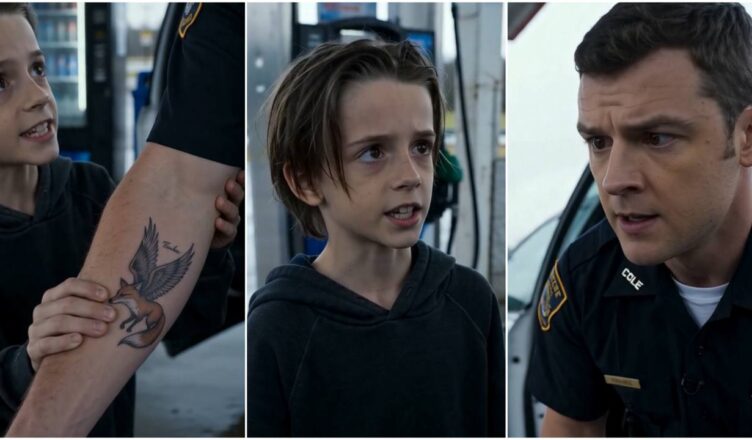
Eli was nine years old when he grabbed my forearm outside a gas station and said the sentence that split my life open.
It was a cold gray morning in Roanoke, Virginia, the kind of morning that made the whole city look half-awake. A thin rain had passed through before dawn, leaving the pavement black and slick. Traffic hissed along Franklin Road. The sky hung low and pale over the worn little gas station, and the air smelled like wet concrete, burnt coffee, and diesel.
My cruiser was parked beside the ice machine.
I had stopped there because the clerk had called in a report about someone sleeping behind the dumpsters. It turned out to be an old man waiting for the shelter van, half-frozen and embarrassed more than anything else. I bought him a breakfast sandwich, walked him to the curb, and started back toward my car.
That was when the boy stepped out from beside the ice machine.
Skinny. Dark hoodie. One shoe untied. Hair sticking up in the back like nobody had helped him get ready that morning. Serious eyes. Too serious for a child.
He wasn’t scared of me.
That was the first strange thing.
Most kids looked at the badge first.
This one looked at my arm.
My uniform sleeve had ridden up when I reached for the cruiser door, exposing the tattoo on my right forearm: a winged fox, curled as if resting, with its wings folded close like it was protecting something.
The boy moved so fast I barely had time to react. He grabbed my forearm with both hands, stared at the tattoo like he had found a ghost under my skin, and said, “Wait… my dad has that same winged fox tattoo.”
For a second, all the sound drained out of the parking lot.
The traffic still moved. The gas station door still chimed behind me. Somewhere nearby, a truck’s brakes sighed at the intersection. But I heard none of it clearly.
The boy let go of my arm almost immediately, as if he realized touching a police officer might get him in trouble. He stood there with his hands at his sides, watching my face.
I lowered myself slightly so I was closer to his height.
“Only one man ever had that tattoo,” I said. “Who’s your father?”
The boy glanced down at his untied shoe, then back up at me.
“He doesn’t remember anything,” he said. “Not since the accident.”
I felt the morning turn colder.
“This can’t be a coincidence,” I said. “Where is he?”
The boy didn’t answer right away.
He looked over his shoulder toward the road, then toward the gas station windows, as if checking whether he had already said too much.
“What’s your name?” I asked.
“Eli.”
“Eli, where’s your mom?”
His face shut down a little.
“I’m not supposed to talk to strangers.”
“That’s a good rule,” I said. “But you started this conversation, and I need to understand what you mean.”
His eyes went back to my tattoo.
“The fox was sleeping,” he said. “And it had wings, just like yours. He couldn’t say much, but when I asked who he was, he always pointed at it.”
My throat tightened.
That tattoo wasn’t something a man just happened to have.
My last name was Fox. My older brother Mason had drawn the design when we were teenagers, after our parents died in a house fire outside Salem. He said the fox had to be ours, because that part was obvious. The wings were his idea. He said if Mom and Dad couldn’t stay on earth with us, then maybe the fox should carry a little piece of them anyway.
We got the tattoos two days before I left for the police academy. Mine went on my right forearm. Mason’s went on his left.
At least, that was where it had been the last time I saw him.
Seven years earlier.
Mason had been twenty-eight then, restless and angry in a way I didn’t know how to help. He worked construction when he could, drove trucks when he couldn’t, and disappeared for days whenever grief caught up with him. We fought the night before he left Roanoke. I told him he couldn’t keep running from everything. He told me wearing a badge didn’t make me better than him.
Then he drove away.
And never came back.
For years, I told myself he had chosen to disappear.
It was easier than imagining he had needed me and I hadn’t come.
A woman came rushing out of the gas station, keys jangling in her hand.
“Eli! There you are.” She stopped when she saw my uniform. “Officer, I’m sorry. He’s from the home. He slips away sometimes. Never far, but still—”
“The home?” I asked.
“Ridgeview Children’s Residence,” she said. “I volunteer there on Tuesdays.”
I looked back at Eli.
He was still staring at the winged fox on my arm.
“Do they know who your father is?” I asked.
Eli shook his head.
“They said nobody knew.”
Not dead.
Not gone.
Nobody knew.
An hour later, I was sitting in the office of Ridgeview Children’s Residence with a paper cup of coffee I hadn’t touched.
The place sat behind an old Methodist church on a hill, all brick walls, clean floors, and fluorescent lights that made everybody look tired. Bulletin boards in the hallway were covered with construction-paper stars and drawings of smiling suns. It wasn’t cruel. That almost made it worse. It was warm. It was organized. The staff spoke softly.
But it was still a place where children waited for adults to figure out what to do with them.
The director, Denise Callahan, sat across from me with Eli’s file closed on her desk.
“You understand I can’t give you private records because a child recognized a tattoo,” she said.
“I understand.”
“And you’re telling me this may be connected to your missing brother?”
“I’m telling you my brother and I designed that tattoo ourselves,” I said. “A winged fox. Same shape. Same folded wings. Same curled body. Nobody else should have it.”
Denise studied my face.
Then my arm.
“What was your brother’s name?”
“Mason Fox.”
She didn’t open the file right away.
That told me something.
Finally, she said, “Eli’s birth certificate doesn’t list a father. His mother never provided a name to the hospital, the court, or child services. Every time someone asked, she said the father was gone.”
“Gone where?”
“That changed depending on the day.”
I stared at the closed file like the answer might rise through the cover.
Denise exhaled.
“There is one thing I can say because Eli has repeated it to multiple caseworkers. When he first came into emergency care, he kept describing a tattoo on his father’s arm. A fox with wings.”
My hand tightened around the paper cup.
“He said his father couldn’t speak.”
Denise nodded.
“That part is in the notes too.”
“What happened to him?”
She hesitated.
“A former caseworker tried to follow the lead. Eli’s mother once told a hospital social worker that the father had been in an accident years earlier. She said he hit his head and came back wrong. Her words.”
“What accident?”
“A truck was found overturned outside Bluefield, West Virginia, seven years ago. The driver had no wallet, no phone, no usable ID. Severe traumatic brain injury. He survived, but he had major memory impairment and expressive aphasia.”
“Aphasia?”
“He understood more than he could say. But he couldn’t give his name.”
The room felt smaller.
Denise continued carefully.
“He was transferred between hospitals and later placed in a long-term neurocare facility under a temporary identity.”
“Why didn’t anyone match him to my brother?”
“Because he wasn’t in a criminal fingerprint database. Because your brother was an adult missing person with a history of leaving town. Because the accident happened across the state line. Because the tattoo was documented badly as ‘animal marking on left forearm.’ Because systems don’t talk to one another as well as people think they do.”
Her answer wasn’t cold.
That made it worse.
No one had meant to lose him.
They had just let him stay lost.
“Where is he?” I asked.
“Officer Fox—”
“Please.”
Denise looked at my badge, then at my tattoo, then at the closed door behind me.
“I’m not saying he’s your brother,” she said quietly. “And I’m not saying he’s Eli’s father.”
Then she wrote an address on the back of her card and slid it across the desk.
“But if you’re going to ask questions,” she said, “ask them the right way. Reopen the missing person report. File the kinship request. Get the court involved. Get DNA before you say anything certain to that boy.”
I nodded.
For the first time that morning, I was grateful someone had enough sense to be careful.
I don’t remember driving to the recovery center.
I remember the smell first.
Lemon cleaner. Old carpet. Burnt coffee.
The building was called Brookhaven NeuroCare, though from the outside it looked less like a place for healing and more like a place people ended up when the world didn’t know where else to put them.
Because I was wearing a badge, everyone wanted to help until I started asking questions that required signatures. Then they got careful too.
So I did it properly.
I called my lieutenant. I updated Mason’s missing person report. I gave a statement. I showed old photographs. I signed forms. I waited in a plastic chair beneath a television no one was watching.
Finally, a nurse named Carla led me down a quiet hallway.
“Don’t push him,” she said gently. “Some days he understands almost everything. Some days he gets lost inside himself.”
“Can he speak at all?”
“A few sounds. Sometimes a word. Mostly gestures.”
“What does he call himself?”
She looked sad.
“He doesn’t.”
She stopped at a common room near a window.
A man sat alone in a chair, looking out at the parking lot.
Unshaven. Thin. Shoulders caved in. His hair was longer than Mason ever wore it, threaded with gray at the temples. One hand rested in his lap. The other rubbed the inside of his left forearm, right where the tattoo disappeared under his sleeve.
I knew him before he turned around.
Not because the records knew his name.
Not because the county had found him.
Because I did.
“Mason,” I said.
The man looked up.
His eyes moved over my face with polite confusion.
No recognition.
No smile.
No brother coming back from the dead.
Just a broken man trying to understand why a stranger was staring at him like the whole world had split open.
“It’s me,” I said, and my voice cracked. “Cole.”
He watched my mouth.
Then he looked at my uniform.
Then at my face again.
Nothing.
I sat across from him.
My badge felt heavy on my chest.
“You used to steal my cereal and blame it on the raccoon outside,” I said.
His brow tightened.
“There was no raccoon,” I whispered. “That was the joke.”
Still nothing.
Then his eyes dropped to my forearm.
The sleeve of my uniform had shifted when I sat down.
He saw the tattoo.
The winged fox.
For the first time, his face changed.
His breath caught.
Slowly, like his body was afraid of hope, he reached across the table.
Not for my face.
Not for my badge.
For the tattoo.
His fingers hovered above it, trembling.
Then he pulled back his own sleeve.
There it was.
The same fox.
The same folded wings.
The same curled body.
His finger moved from his tattoo to mine. Then back again.
Carla covered her mouth.
I couldn’t move.
Mason touched the fox on his arm once, then pressed his hand flat against his chest, as if he were trying to reach through damaged memory and pull something back.
I leaned forward.
“Mason,” I said. “It’s me. Cole.”
His face folded.
Tears filled his eyes before he seemed to understand why.
He pointed at me again.
I nodded.
“Yes,” I whispered. “I’m your brother.”
His mouth opened.
For a second, it looked like the word was trapped behind his teeth.
Then he pushed out one broken sound.
“Co…”
It wasn’t my full name.
It was enough.
For the next six weeks, nothing happened quickly.
That mattered.
The truth had to move through paperwork before it could reach the people who needed it.
Fingerprints. Medical records. Court orders. DNA. Interviews. A guardian’s approval. Child services. Adult protective services. Every step took longer than my heart could stand.
I didn’t tell Eli that the silent man was his father.
Not yet.
I didn’t tell Mason he had a son.
Not until we knew.
But I visited Brookhaven every day.
I brought old photographs. Our mother’s funeral card. A baseball glove Mason had given me when I was twelve. The cheap pocketknife he handed me the day I left for the academy.
Sometimes he remembered nothing.
Sometimes he remembered in pieces.
A song.
A smell.
The way our mother used to knock twice on the kitchen table before saying grace.
One afternoon, I showed him a picture of the two of us as teenagers, standing beside our father’s old pickup. Mason touched his own face in the photo, then looked confused, like he couldn’t believe that boy and he were the same person.
Another day, he took a pen from Carla’s pocket and wrote one crooked letter on a napkin.
C.
Then he looked at me.
I had to leave the room for a minute because I didn’t want him to see me cry.
The DNA results came on a Thursday.
Denise called me first.
She didn’t say hello.
She just said, “He’s Eli’s father.”
I was sitting in my cruiser outside the courthouse. For a while, I couldn’t move.
For seven years, I had lived with the guilt of not finding my brother.
For seven years, Eli had lived with a father nobody could name.
And all that time, Mason had been less than two hours away, trapped inside a mind that had lost the road home, pointing to a winged fox no one understood.
The first time I told Mason about Eli, I did it with a photograph.
Denise had sent one approved picture after the court allowed contact: Eli standing in front of a Christmas tree at Ridgeview, wearing a crooked paper crown and trying not to smile.
I laid the photo on the table.
Mason looked at it.
Nothing happened at first.
Then his fingers moved to his tattoo.
He touched the fox once.
Then touched the boy’s face in the picture.
His breathing changed.
“That’s Eli,” I said. “Your son.”
Mason stared at me.
Then back at the photo.
His hand shook so badly the picture slid across the table.
He made a sound low in his throat, almost like pain.
Then he picked up the pen.
It took him nearly a minute to write three letters.
K.
I.
T.
I stared at the napkin.
“Kit?” I asked.
Mason nodded, crying silently.
A baby fox.
His little kit.
That was when I knew some part of him had never stopped being Eli’s father.
The day they met again, I was more afraid than I had ever been in uniform.
I had been shot at once behind a liquor store. I had pulled people from wrecked cars. I had knocked on doors at midnight with bad news in my throat.
None of it felt like walking Eli down that hallway.
He wore his best shirt, a blue button-down Denise said he had picked himself. His hair had been combed flat, though one piece still stuck up in the back. He held a drawing in both hands.
At the door to the visiting room, he stopped.
“What if he doesn’t know me?” he asked.
I crouched beside him.
“He may not be able to say what he feels.”
Eli’s jaw tightened.
“But he’s my dad.”
“I know.”
“He used to point at the fox when he wanted me to understand.”
I looked through the glass.
Mason sat at a table with both hands flat in front of him. Carla stood near the wall. His face was pale. Terrified.
“He still does,” I said.
Eli looked at me.
Then he nodded.
We went in.
Mason looked up.
For a moment, neither of them moved.
Eli clutched the drawing to his chest.
Mason’s eyes dropped to the boy’s face.
Then to his hands.
Then to the drawing.
Eli lifted it slowly.
It showed three foxes beneath a tree.
One big.
One small.
One standing beside them.
The big fox had wings.
Underneath, in uneven letters, Eli had written:
US.
Mason covered his mouth with one trembling hand.
Eli stepped closer.
“Hi,” he said.
Mason tried to answer.
No word came out.
Panic flashed across his face, sharp and terrible. He looked down like he was ashamed of his own silence.
Then Eli did something none of us expected.
He set the drawing on the table, walked right up to him, and gently pushed up Mason’s sleeve.
The winged fox appeared.
Eli touched the tattoo with one finger.
“I remember,” he whispered.
Mason froze.
Eli traced the wing softly, exactly the way Mason must have shown it to him years before.
Then he pointed to himself.
Mason stared at him.
His whole body seemed to shake.
Slowly, Mason lifted his hand.
He touched the tattoo.
Then he touched Eli’s chest.
Then he reached for the pen.
The room was so quiet I could hear the fluorescent lights humming.
Mason bent over the paper.
His hand was clumsy. The letters came out uneven.
K.
I.
T.
Eli looked at the word.
His face changed.
No one had told him that nickname.
Not Denise.
Not me.
No one.
His lower lip trembled.
“You called me that,” Eli said.
Mason nodded.
Tears ran down his face.
Eli made a sound like he had been holding his breath for seven years.
Then he crossed the room and wrapped his arms around his father’s waist.
No speech.
No perfect movie line.
Just a child holding on to the person he had been waiting for.
Mason sat rigid for one awful second, his hands open in the air.
Then his body remembered what his mind could not fully hold.
His arms closed around the boy.
Slowly.
Carefully.
Like he was afraid Eli might disappear if he held too tight.
He pressed his face into his son’s hair.
And from somewhere deep inside the wreckage, one word broke free.
“Kit.”
Eli cried then.
So did Mason.
So did Carla.
I turned toward the window because police officers are supposed to have some dignity, and I had none left.
After that, nothing became simple.
That’s the part people leave out.
They want the hug to fix everything. They want music to swell and the credits to roll before anyone has to learn how to live with what happened.
But Monday came.
Then Tuesday.
Then all the hard days after.
Mason still couldn’t speak much. Some mornings he understood the world clearly. Other mornings, he stared at a spoon like it was something from another life. Eli pretended to be brave until he wasn’t. Court hearings dragged on. Eli’s mother called from different numbers, sometimes sweet, sometimes angry, always promising she was getting better, always disappearing before the next visit.
I became the person the county called when decisions had to be made.
Kinship placement.
Medical consent.
School meetings.
Speech therapy.
Trauma counseling.
I learned that love could look like signing forms under fluorescent lights. Like sitting outside a counselor’s office while a nine-year-old refused to come out. Like learning picture cards so my brother could tell us when he was tired, hungry, scared, or lost inside his own head.
Three months later, Eli came to live with me.
Not forever, the judge said at first.
Just until things were stable.
But that first night, when I showed him the small bedroom at the end of the hall, he stood in the doorway like he didn’t trust it.
The bed had a blue comforter. A used bookshelf I had sanded and painted myself. A desk under the window. A little lamp shaped like a rocket ship because Denise told me he liked space.
Eli looked around without speaking.
“You can change anything you want,” I said. “It doesn’t have to stay like this.”
He set his backpack on the bed.
Then he asked, “Can I put my drawing on the wall?”
“Yeah,” I said. “Of course.”
It was the drawing of the three foxes.
Underneath, in uneven letters, he had written:
US.
By late spring, Mason was cleared for supervised weekends at my house.
The first Saturday morning, I woke to noise in my kitchen.
Not a crash.
Not a crisis.
Laughter.
I came downstairs and found flour across the counter, Eli standing on a chair, and Mason at the stove holding a pancake shaped like something that might have been a fox if foxes had been run over by a lawn mower.
Eli looked over his shoulder.
“Uncle Cole, don’t say anything.”
I raised both hands.
“Wouldn’t dream of it.”
Mason glanced at me.
For a second, I saw him clearly.
Not the patient.
Not the missing man.
My brother.
Tired.
Damaged.
Alive.
Then he turned back to the stove.
Eli bumped his shoulder against him.
“Dad, you’re burning it.”
Mason didn’t flinch at the word.
He grabbed the spatula, lifted the ruined pancake, and studied it seriously.
Then he picked up the marker board he used for speech practice and wrote:
ANOTHER.
Eli laughed.
Outside, morning light came through the kitchen window and landed on the tattoo on Mason’s arm.
The winged fox.
The mark my brother had pointed to when he had no name, no voice, and no way to explain that he belonged to someone.
Mason still forgot things.
He forgot where I kept the coffee filters. He forgot the name of Eli’s school. Some mornings, he woke up scared because pieces of his own life still came back out of order.
But he never forgot the fox.
And he never forgot what it meant.
One of us gets lost.
The other comes looking.
That morning, while Eli laughed and Mason ruined another pancake, I stood in the doorway and watched my broken family become a family again.
Not perfect.
Not easy.
But home.