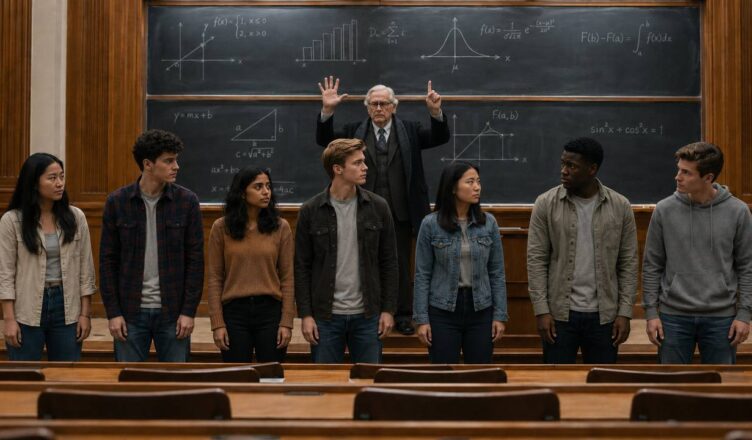
For several seconds, the enormous lecture hall remained completely silent.
Then answers began flying from every direction.
“Thirty!” shouted one student from the back.
“Forty!” called another.
A young woman near the aisle raised her hand. “I think it’s fifty.”
Professor Angleton stood motionless beside the chalkboard, watching them through his thick glasses.
Then Marcus, a confident student in the third row, lifted his hand.
“Sixty,” he said. “Each handshake involves ten fingers. Six times ten equals sixty.”
Several students nodded. It sounded logical.
Professor Angleton slowly shook his head.
“No.”
The room fell silent again.
He looked across the steep rows of desks and waited, but no one offered another answer.
“At least now I know none of you will be receiving a perfect score,” he said coldly.
A few students laughed nervously.
Professor Angleton placed the chalk on the desk and pointed his cane toward the class.
“Mei. Hana. Marcus. Priya. Ethan. Jack. Noah. Come down here.”
The students exchanged confused looks.
Mei and Hana rose from the front rows. Marcus followed them. Priya closed her notebook and stood. Ethan, Jack, and Noah joined them.
Professor Angleton arranged all seven students in a straight line at the front of the room.
“Watch carefully,” he told the class.
He nodded to Mei.
Mei shook Hana’s hand.
Then Hana turned and shook Marcus’s hand using the same hand.
Marcus shook Priya’s hand.
Priya shook Ethan’s.
Ethan shook Jack’s.
Finally, Jack shook Noah’s hand.
Professor Angleton faced the class.
“How many handshakes did you see?”
“Six,” several students answered.
“And how many people participated?”
This time, the students hesitated.
“Seven,” someone finally said.
Professor Angleton raised one hand and spread his fingers.
“Each person contributed five fingers. Seven people multiplied by five fingers equals thirty-five.”
Marcus frowned.
“But some of them shook hands twice.”
“Exactly,” the professor replied. “The same fingers participated twice, but they do not become new fingers simply because they were used again. We are counting the fingers involved, not the number of times they moved.”
He turned toward the chalkboard and wrote:
7 × 5 = 35
Then he faced the class once more.
“The answer is thirty-five.”
The lecture hall became completely silent.
Marcus slowly lowered his eyes. The students who had confidently shouted their answers moments earlier now stared at the seven people standing in front of them.
Professor Angleton picked up his chalk and cane.
“Mathematics is not only about multiplication,” he said. “It is about understanding what you are actually counting.”