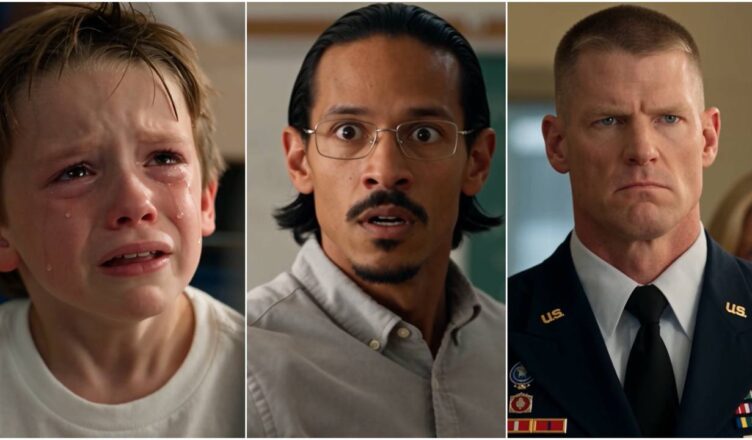
The whole class heard Mr. Nolan Mercer tell eight-year-old Ethan Reed that his father was a nobody.
What Mercer did not know was that Ethan’s father was only a few feet away.
And he had heard him.
Late-morning sunlight filtered through the yellowing blinds of Room 12 at Cedar Ridge Elementary, laying pale golden bars across scratched desks and the polished wooden floor.
Cedar Ridge sat near Fayetteville, North Carolina, not far from Fort Liberty. Military families were everywhere. Children there understood deployment before they understood fractions. They knew birthdays could happen without Dad, Christmas could come while Mom was overseas, and sometimes a parent simply could not explain where they were going.
April was the Month of the Military Child.
Purple decorations filled the hallways, and that week the third graders had been asked to write about someone they considered a hero.
Ethan Reed chose his father.
Ethan was eight, with messy brown hair, a stubborn cowlick, and serious brown eyes. He knew his father was a soldier. He knew Daniel sometimes disappeared for months and returned looking more tired than when he left.
What Ethan almost never told anyone was that his father was Major General Daniel Reed.
Daniel preferred it that way.
He did not want his son using his rank to impress classmates.
At home, there was no general.
There was only Dad.
The man who burned pancakes, fixed Ethan’s bicycle, read adventure books in ridiculous voices, and always hugged him too tightly after a deployment.
Mr. Nolan Mercer knew none of that.
Mercer was a thin thirty-nine-year-old Black teacher with neatly combed black hair, rectangular glasses and a sharply trimmed goatee. He called himself strict.
The children had another word for him.
Cruel.
Mercer rarely touched a student. He did not need to. His favorite punishment was humiliation.
Earlier that morning, Ethan had stood beside his first-row desk and read from his composition notebook.
“My father is my hero. He helps keep people safe. Sometimes he has to go away, but I want to be brave like him someday.”
Mercer immediately began questioning him.
Where did his father go?
What exactly did he do?
How could Ethan call him a hero if he could not even explain his job?
Ethan tried to tell him that his father could not discuss everything.
Mercer laughed.
By writing period, Ethan wanted nothing more than to disappear.
But Mercer returned.
He stopped directly in front of Ethan’s desk, gripping a thin wooden classroom pointer.
The other children went quiet.
Then Mercer’s voice exploded across the room.
“Your father is a nobody! He’s never done anything for this country!”
Every pencil stopped.
Ethan stared upward.
His face went pale, then red. Tears filled his eyes.
But he did not look away.
“That’s not true! My father is a hero! He is!”
Mercer became even angrier.
He leaned toward the crying boy and shouted:
“Shut your mouth, or I’ll throw you out that door!”
Ethan flinched and lowered his head.
Only after finishing the threat did Mercer turn toward the classroom entrance on the left side of the room.
He raised the wooden pointer and sharply pointed toward it.
The door opened.
Mercer froze.
Every child turned.
Ethan lifted his tear-covered face.
Major General Daniel Reed stepped into the classroom.
He was tall and broad-shouldered, with a regulation-short haircut and a clean, square face. His immaculate dark Army dress uniform carried dense rows of ribbons, badges and decorations. Silver general stars caught the sunlight on his shoulders.
Principal Claire Vaughn entered directly behind him.
She was a composed woman in her early fifties with shoulder-length blonde hair and a tailored navy blazer.
Daniel stopped.
His eyes immediately found Ethan.
His son sat at the first desk, cheeks wet, shoulders shaking.
Daniel’s jaw tightened.
Then his gaze shifted slowly toward Mercer.
He said nothing.
Mercer’s arm lowered.
The anger disappeared from his face almost instantly.
His eyes moved over Daniel’s medals.
The ribbons.
The stars.
Then back toward Ethan.
His mouth opened slightly.
For the first time that morning, Nolan Mercer looked frightened.
Ethan stared at the man in the doorway.
“Dad!”
He pushed out of his chair and ran.
Daniel’s stern expression disappeared.
He dropped onto one knee and opened his arms.
Ethan crashed into him.
Daniel caught his son firmly, wrapping both arms around him and placing one hand protectively behind his head.
Mercer remained near the desk.
Silent.
Daniel rose with Ethan close beside him.
Claire remained directly behind Daniel and addressed the class.
“Class, this is Major General Daniel Reed—a decorated combat veteran who has led American soldiers overseas for more than twenty years.”
The children stared.
Some looked at Daniel’s medals.
Others looked at Ethan.
Mercer’s eyes remained fixed on the silver stars.
Then Sophie Bennett stood beside her desk.
Sophie was an eight-year-old Asian American girl with straight dark hair tied neatly back.
She looked directly at Mercer.
“Ethan was right. His dad really is a hero.”
A child began clapping.
Then another.
Within seconds, the entire classroom joined.
Ethan stood beside Daniel as his father rested a protective hand on his shoulder.
Mercer did not speak.
His face slowly flushed red.
He looked at Sophie.
Then Ethan.
Then Daniel.
Finally, he glanced toward Claire, who watched him from behind Daniel with unmistakable disapproval.
Mercer’s breathing grew heavier.
His hands began to shake.
He abruptly grabbed his leather work bag from beside the teacher’s desk.
“I quit!”
The applause stopped instantly.
Twenty children stared at him.
Ethan’s eyes widened.
Claire looked genuinely stunned.
Daniel remained stern and still.
Mercer turned and rushed for the exit.
Daniel shifted only enough to allow him to pass without touching him.
Mercer stormed into the hallway and disappeared.
For several seconds, nobody moved.
Then Claire stepped farther into the classroom.
Her shock had already begun turning into anger.
“What happened before we came in?”
Sophie raised her hand.
Slowly, she explained.
She told Claire about Ethan’s hero essay. About Mercer repeatedly questioning whether Ethan knew anything about his own father. About the mocking comments. About the wooden pointer striking Ethan’s desk.
Other children began joining in.
“He kept making fun of him.”
“He made Ethan cry.”
“He told him his dad was nobody.”
“And he kept yelling even when Ethan was crying.”
Claire looked toward the pointer.
Then toward Ethan.
Her face hardened.
But Sophie was not finished.
“He does things like that to other kids too.”
That changed everything.
Claire looked around the room.
Several children nodded.
One boy admitted Mercer had called him stupid after a wrong math answer.
A girl said he mocked her reading until she cried.
Another child said Mercer had once told them that complaining about him would not matter because he was the teacher.
Claire remained silent for several seconds.
Then she looked at Daniel.
“I need to deal with this.”
Daniel nodded.
Claire promised the children that each of them would have a chance to speak privately and that no one would be punished for telling the truth.
Then she went after Mercer.
Daniel stayed with the class.
He could see that the children were still unsettled.
So instead of giving the prepared speech about military service, he pulled a chair closer and sat down among them.
“Can I tell you something?”
They nodded.
Daniel touched the decorations on his chest.
“These don’t make me better than anybody.”
The children looked surprised.
He explained that medals represented things he had done, but they did not determine whether he was a good man.
Neither did rank.
“What matters,” Daniel told them, “is what you do with the power people trust you with.”
A teacher had authority over students.
An officer had authority over soldiers.
A parent had authority over a child.
Real leadership meant using that authority to protect people, not frighten them.
“To make people feel safer,” Daniel said, looking at Ethan, “not smaller.”
Then he told them something else.
Respect was important.
But respect did not mean remaining silent when someone humiliated or frightened them.
If an adult treated them badly, they should tell another trusted adult.
And if that person did not listen, they should keep telling until somebody did.
Mason, one of the boys who had laughed nervously at Ethan earlier, stared at his desk.
Daniel noticed.
He did not embarrass him.
Instead, he said that courage did not mean reacting perfectly every time.
Sometimes people laughed because everyone else was laughing.
Sometimes they stayed silent because they were scared.
What mattered was recognizing it and doing better next time.
Mason finally looked at Ethan.
Later, when Daniel was speaking with another child, Mason quietly approached him.
“I’m sorry I laughed.”
Ethan studied him.
Then nodded.
“Okay.”
Sophie joined them.
“Me too.”
Ethan shrugged awkwardly.
Forgiveness was embarrassing when you were eight.
But something had changed.
Meanwhile, Claire found Mercer near the faculty workroom stuffing folders into his bag.
He immediately tried to justify himself.
He said Ethan had been disrespectful.
He said the boy had exaggerated.
Then he made the worst possible defense.
He said he had not known who Ethan’s father was.
Claire stared at him.
“That’s your explanation?”
Mercer hesitated.
Claire told him that Daniel Reed’s rank had nothing to do with what had happened.
If Ethan’s father had been a mechanic, a janitor, a bus driver, a cashier, or unemployed, Mercer still would have had no right to humiliate an eight-year-old.
The problem was not that he had insulted the son of a general.
The problem was that he believed there was a child he was allowed to treat that way.
Mercer repeated that he had resigned.
Claire told him resignation would not stop the district from investigating his conduct.
By lunchtime, the superintendent had been notified.
Parents were contacted.
Within forty-eight hours, the story widened.
Ethan had not been the first.
Former students had stories.
One mother said her daughter had stopped reading aloud because Mercer mocked her pronunciation.
A father said Mercer called his son lazy after the boy admitted he was having trouble sleeping during his mother’s deployment.
Another parent said her child had begged to stay home from school for months.
Teachers admitted they had noticed pieces of the pattern but had failed to recognize how serious it had become.
Mercer’s resignation was accepted.
The investigation continued.
He never returned to Cedar Ridge.
Two days later, Ethan returned to Room 12 feeling nervous.
He paused outside the door.
Sophie saw him first.
“We saved you a seat.”
Mason was beside her.
Nobody applauded.
Nobody made a spectacle.
And Ethan was grateful for that.
They simply made room for him.
By recess, they were arguing about kickball again.
That felt better than being famous.
A new teacher, Mrs. Avery, took over Room 12 the following week.
She found Mercer’s wooden pointer inside a cabinet.
She looked at the children.
“Do we need this?”
Nobody answered.
Sophie shook her head.
Mrs. Avery dropped it into a storage box and carried it away.
Then she looked at the old sign above the whiteboard:
BE KIND, EVEN WHEN IT’S HARD.
A few days later, she replaced it.
The new sign said:
KINDNESS IS SOMETHING WE DO.
Ethan liked that one much better.
Under Mrs. Avery, the classroom slowly changed.
Children raised their hands again.
Wrong answers became opportunities to learn instead of reasons for humiliation.
Ethan stopped rehearsing sentences in his head before speaking.
His grades improved.
So did his confidence.
A week later, Cedar Ridge finally held its Month of the Military Child assembly.
Daniel returned in uniform.
This time Ethan knew he was coming.
The gym was filled with military parents, spouses, teachers and students.
Daniel refused to sit in the most important chair on stage. He sat with the other service members instead.
When Claire introduced him, the gym applauded.
Daniel walked to the microphone.
He could have talked about combat.
Instead, he talked about children.
Military children who missed parents.
Children who counted days between phone calls.
Children who learned that birthdays sometimes had to wait.
Then he looked toward Ethan.
“Courage does not belong to one profession.”
He said sometimes courage was a firefighter entering a burning building.
Sometimes it was a nurse staying beside a frightened patient.
Sometimes it was a parent working two jobs.
And sometimes it was an eight-year-old child sitting at a desk with tears in his eyes and refusing to call something he knew was true a lie.
The gym erupted in applause.
Ethan lowered his head, embarrassed.
Laura Reed squeezed his hand.
“They’re proud of you.”
Ethan slowly looked up.
Daniel was watching him.
For the first time, Ethan understood that his father was proud of him too.
After that day, everyone at Cedar Ridge knew Ethan had been telling the truth.
But he never became boastful about it.
When students asked:
“Is your dad really a general?”
Ethan simply answered:
“Yeah.”
“Why didn’t you tell everybody?”
“You never asked.”
More importantly, other children began respecting Ethan for reasons that had nothing to do with Daniel’s rank.
When someone dropped books, Ethan helped pick them up.
When a new student was mocked for his accent, Ethan told the others to stop.
When Mrs. Avery later asked why he had stepped in, Ethan shrugged.
“He looked like he needed somebody.”
Months later, Ethan pulled his old hero essay from a drawer at home.
Daniel sat beside him at the kitchen table.
The paper was still wrinkled from the day Ethan had gripped it while crying.
At the top were the words:
My father is my hero.
Ethan picked up a pencil.
Underneath, he wrote:
I was telling the truth.
Then:
I am proud of my father.
Finally:
I want to be like him someday.
Daniel smiled.
“You want to become a general?”
Ethan shook his head.
“No.”
“Then what do you mean?”
Ethan thought about Room 12.
He remembered Mercer shouting.
He remembered being frightened.
Then he remembered the door opening.
“When you walked into my classroom, I wasn’t scared anymore.”
Daniel became very still.
Ethan looked at him.
“I want to be the kind of person who makes people feel safer when I show up.”
Daniel pulled his son close.
“That,” he said quietly, “would make me prouder than any rank you could ever earn.”
Years later, Ethan would forget most of third grade.
He would forget spelling tests.
Worksheets.
Lunch menus.
He would forget exactly where Sophie sat and which child dropped a pencil that morning.
But he would remember Mercer standing in front of his desk.
“Your father is a nobody! He’s never done anything for this country!”
He would remember himself crying back:
“That’s not true! My father is a hero! He is!”
He would remember Mercer screaming:
“Shut your mouth, or I’ll throw you out that door!”
He would remember the wooden pointer turning toward the entrance.
Then the door opening.
Daniel Reed walking through it.
Claire Vaughn directly behind him.
He would remember shouting:
“Dad!”
He would remember Claire telling the class:
“Class, this is Major General Daniel Reed—a decorated combat veteran who has led American soldiers overseas for more than twenty years.”
He would remember Sophie standing and saying:
“Ethan was right. His dad really is a hero.”
He would remember the applause.
Mercer’s red face.
His shaking hands.
And finally:
“I quit!”
But as Ethan grew older, Mercer’s humiliation stopped being the important part.
So did the medals.
So did the applause.
What mattered was what came afterward.
The children who found the courage to speak.
The adults who finally listened.
The classroom that became safe again.
The friends who apologized.
The father who taught twenty children that authority was supposed to protect, not intimidate.
And the boy who entered Room 12 ashamed of his tears but eventually understood that standing up for something you love while frightened was its own kind of courage.
Ethan had never lied.
Daniel Reed really was his hero.
But by the end of that year, Ethan had learned something even more important.
He did not need to become his father.
He only needed to become the kind of man his father had taught him to be.