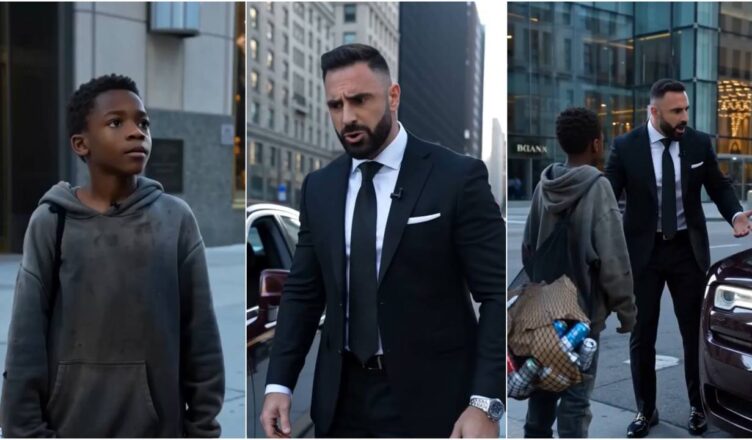
Вот более сильная, более кинематографичная версия — тоже от третьего лица, но с более живым литературным ритмом и более сильным финалом.
The Afternoon a Hungry Kid Fixed More Than His Car
Nathan Mercer kicked the front tire of his black sedan hard enough to make his shin throb.
“Of course,” he muttered.
Then, because frustration always turned him into a performer when anyone was watching, he said it louder.
“Of course today.”
A few pedestrians glanced over as they passed. No one slowed for long. Downtown Chicago burned in the late-afternoon light—glass towers, polished stone, sharp reflections everywhere. The city looked expensive and indifferent, which normally suited Nathan just fine. He understood expensive. He had built his life around indifference.
In twenty-eight minutes, he was supposed to be across town finalizing an investor deal that would move eight figures with one signature and two well-timed smiles. His suit was tailored within an inch of arrogance. His watch was exact. His schedule had been arranged with the kind of precision that left no room for weather, weakness, or bad luck.
Then his car had died at the curb like it had developed a grudge.
The dashboard still glowed with warning lights he didn’t recognize and resented on principle. He tried calling service. One bar. Then none. He stepped toward the street, raised his phone, turned slightly, tried again. Nothing. He walked back into the shadow of the building, lifted the phone higher, swore under his breath, waited for one blessed signal.
Nothing.
Nathan hated helplessness more than he hated losing. Losing could be corrected. Helplessness simply stood there and made a man look ridiculous.
“You’ve got to be kidding me,” he said, dragging a hand through his hair.
“Hey.”
The voice was small, but steady.
Nathan turned.
A boy stood a few feet away near the edge of the sidewalk, thin in the unmistakable way of kids who hadn’t eaten enough often enough. He looked fourteen, maybe fifteen. An oversized hoodie hung off his shoulders. His jeans were worn white at the cuffs. The rubber at the front of his sneakers had split open. There was dirt on one cheek and a scrape on one knuckle. But his eyes were alert—clear, watchful, alive.
Not pleading.
Measuring.
“I can fix your car,” the boy said. “But you gotta feed me.”
Nathan stared at him for a second, then let out a short laugh.
“You can fix my car.”
“Yeah.”
The answer came without hesitation. No bravado, no grin, no attempt to charm him. Just fact.
Something sharp and ugly rose in Nathan before he could stop it. He had spent years turning quick judgments into a professional skill. He knew how to size people up, sort them into categories, decide who mattered and who didn’t. It was one of the reasons he was rich.
“Maybe start by fixing your clothes,” he said.
The boy’s jaw tightened. That was the only sign the remark landed.
“Then at least give me something to eat,” he said.
Nathan looked back at the dead car, at the useless phone in his hand, at the second hand sweeping around the face of his watch as if mocking him. He was furious at the engine, at the timing, at the city, at the crowd moving around him without caring. Mostly he was furious that a situation existed in which money was not immediately solving the problem.
That had not happened to him in a long time.
He turned back to the boy. Men like Nathan did not like discomfort unless they were the ones causing it. When life backed him into a corner, he threw cash at the corner until it widened. So he did what came naturally.
“Fine,” he said, letting sarcasm carry most of the weight. “Fix it and I’ll give you a million dollars. And food.”
He expected the boy to roll his eyes. Or laugh. Or walk away.
Instead, the boy nodded once, as if they had settled something ordinary.
“Pop the hood.”
Nathan blinked.
Then he pulled the release and stepped out, not because he believed the kid could help, but because disbelief had briefly become less interesting than curiosity.
The boy walked over to the car without rushing. No showmanship. No nervousness. He leaned over the engine bay and listened for a moment, head tilted slightly, as if the machine were speaking in a language Nathan had never learned.
Nathan crossed his arms.
“What are you going to do,” he said, “fix it with magic?”
The boy ignored him.
His hands moved over the battery housing with quiet precision. He pressed one cable, traced another, tugged lightly, then stopped.
“Battery terminal’s loose,” he said.
“That’s impossible. It was just serviced.”
The boy didn’t even look up.
“Loose,” he repeated. Then he pointed. “And there’s corrosion.”
There was no attitude in his voice. No pleasure in correcting him. Just certainty.
He glanced toward the trunk. “You got a tool kit?”
Nathan hesitated, then hit the trunk release. There was a compact factory kit tucked beside the spare tire—unused, immaculate, the kind of thing he had paid for and never once thought about again.
The boy took a wrench and tightened the terminal with two careful turns. Then he scraped away the crusted corrosion with the edge of a small metal tool, working patiently, economically, with the self-possession of someone who had done this before.
A few people slowed down to watch. An office worker with his tie loosened. A woman holding an iced coffee. A delivery driver balancing a paper bag against his hip. Someone behind Nathan said, half amused, “Kid thinks he’s a mechanic.”
The boy stepped back and wiped his hands on his jeans.
“Start it.”
Nathan slid into the driver’s seat mostly to prove him wrong.
He turned the key.
The engine came alive instantly.
Clean. Smooth. Obedient.
Nathan froze with his hand still on the ignition. Then he shut the car off and started it again.
Same result.
Behind him, a small murmur moved through the little crowd. Surprise. Approval. The quick animal thrill people felt when the person they’d underestimated turned out to know exactly what they were doing.
Nathan got out slowly.
For the first time, he looked at the boy and saw more than the hoodie, the dirt, the shoes. He noticed the hands—steady hands, competent hands. He noticed the stillness in his face, the absence of triumph.
“How did you know that?”
The boy shrugged.
“Loose terminal. Corrosion. Happens.”
Simple. Matter-of-fact. As if the answer had been obvious all along.
Then he looked at Nathan and said, “You said you’d feed me.”
Nathan glanced at his watch.
Twenty minutes.
He should have gotten in the car and driven away. That would have been the sensible choice. The efficient choice. The version of himself he had spent the last fifteen years becoming would have done it without a second thought.
Instead, Nathan pulled out his wallet, took several hundred-dollar bills from it, and held them out.
“Here.”
The boy looked at the money but didn’t reach for it.
“Food,” he said again.
Just that.
Not bargaining. Not posturing. Not pretending he was too proud to be hungry.
Nathan felt something shift unpleasantly inside him.
He had offered cash the way people like him often offered cash—not as kindness, but as removal. As a way to clean up a human problem without letting it get close enough to matter.
The boy had refused to be cleaned away.
Nathan nodded toward the restaurant on the corner, all white tablecloths and tall windows and discreet lighting.
“Come on,” he said.
Inside, heads turned.
Nathan noticed it because he had spent years in rooms where status announced itself before a word was spoken. He saw the hostess look at his suit, his face, the watch at his wrist. Then her eyes moved to the boy beside him, and there it was—that tiny pause in which a person revealed exactly who they were.
“Table for two,” Nathan said.
His tone stayed cool, effortless. Money had a sound to it. Most people recognized it.
They were seated in a corner booth. Nathan handed the boy a menu and told him to order whatever he wanted.
The boy studied it carefully. He didn’t drift toward the expensive entries. Didn’t even glance at the steaks for long. When the server came, he ordered a burger, fries, and water.
When the food arrived, he started slowly, almost cautiously, as if he had learned not to trust good things until they stayed in front of him for a while. Then hunger overtook caution. He ate quickly, but not messily, with the concentration of someone whose body knew exactly what food was worth.
Nathan sat across from him and watched.
Most of Nathan’s meals were negotiations disguised as dinner. Men in tailored jackets cutting into expensive meat while discussing leverage. Women with polished smiles and sharpened instincts pretending appetite was inelegant while devouring whatever stood in front of them—companies, rivals, each other. Everything in those rooms was performance.
The boy performed nothing.
“You learn cars from your dad?” Nathan asked after a while.
The boy nodded.
“Yeah.”
He swallowed, took a sip of water, and said, “He used to say engines talk. You just gotta listen.”
Nathan’s hand stilled against the edge of the table.
His father used to say the exact same thing.
Not something close. The same words.
For a moment Nathan was no longer in a downtown restaurant with polished silverware and linen napkins. He was ten years old again, standing in the heat of a one-bay garage on the South Side, watching his father lean over the open hood of a battered Chevy. Oil on his hands. Grease under his nails. Sweat darkening the collar of his shirt. A patient, tired man who could diagnose a problem by sound alone and who believed machines told the truth if you listened longer than your own impatience.
That garage had become a dealership. Then another. Then a chain. Then an empire with conference rooms, regional managers, and acquisition teams. Nathan had taken what his father built and made it enormous.
Somewhere along the way, he had also made it cold.
He looked up at the boy.
“What happened to your dad?”
The boy’s eyes dropped to his plate.
“Heart attack,” he said. “Two years ago.”
Nathan nodded once.
“And your mom?”
“She’s sick.”
The words were flat, plain, practiced by necessity.
“She needs treatment. We got behind on everything. Rent. Bills.” He lifted one shoulder in a shrug that was too quick to mean he didn’t care. “So now I stay where I can.”
Nathan looked at him for a long moment.
There were people in his world who would have heard that and felt generous. Nathan knew the type. They enjoyed pity because pity left the hierarchy intact. It let them keep looking down while feeling morally elevated.
What Nathan felt was different. It had no warmth in it at all.
Shame, he discovered, was a cold instrument. It did not blur your vision. It sharpened it.
He heard again the way he had spoken on the sidewalk. Go fix your clothes first.
He saw himself holding out cash as if the point were to end the interaction, not honor it.
He thought of all the money that moved through his hands in a week without leaving any weight behind, while this boy had asked him for one meal and meant it with his entire body.
The boy looked up.
“You said one million dollars.”
Nathan almost smiled out of reflex. Then he stopped.
The boy wasn’t joking.
He wasn’t being greedy, either. He had heard Nathan’s words the way hungry people heard promises—with seriousness. To Nathan, a million dollars had been sarcasm. To the boy, it was the name of another life.
“What would you do with it?” Nathan asked quietly.
The answer came without hesitation.
“Get my mom treatment. Get a place to live. Go back to school.” He paused. “Maybe open a garage one day. Like my dad.”
That was all.
No sports car. No penthouse fantasy. No catalog of luxury items learned from advertisements and windows he’d never enter.
Just treatment. Housing. School. A future small enough to be real.
Nathan leaned back in the booth and looked at him.
For years he had called himself self-made as if the phrase were a medal. Disciplined. Efficient. Ruthless when necessary. He had used those words so often they had stopped sounding like choices and started sounding like character.
But sitting across from that boy, Nathan understood something he had spent years outrunning:
he had become a man so insulated from need that he had started mistaking inconvenience for suffering.
“What’s your name?” he asked.
“Marcus.”
Nathan nodded.
“Finish eating, Marcus.”
Marcus’s shoulders stiffened. “Why?”
“Because I kept my word about the food,” Nathan said. Then he held the boy’s gaze. “And I’m going to do something about the rest.”
Marcus looked at him with quick, learned suspicion. It was the look of a child who had been promised things before and had watched those promises evaporate in ordinary daylight.
Nathan didn’t blame him.
When Marcus was done, Nathan drove him—not to the investor meeting, which by then was already underway without him—but to the address Marcus gave him.
The apartment building was narrow and tired, its hallway smelling faintly of bleach, damp heat, and old paint. Marcus led him up one flight of stairs and into a small unit that had been worn thin by living.
The poverty in it was not theatrical. It never was.
A sagging couch. A pharmacy bag on the table. A radiator clanking like a complaint. A cracked blind that never fully closed. Everything clean, everything trying, everything tired.
Marcus’s mother rose too quickly from the couch when they came in, the blanket slipping from her lap. She was younger than Nathan had expected, but illness had a way of borrowing years. Her face went tight the moment she saw him.
“Marcus?”
“It’s okay,” Marcus said quickly, though he sounded as if he was still trying to convince himself.
Nathan introduced himself without titles, without company names, without any of the polished armor he usually wore into unfamiliar rooms.
“Your son helped me today,” he said. “I owe him. I’m here to help.”
The woman—Tasha—looked at him for a long time.
“People don’t do that,” she said.
Nathan nodded.
“No,” he said. “Most people don’t.”
Then he started making calls.
Real calls.
Not the kind wealthy men made when they wanted to be seen performing compassion. The kind that moved things.
He called a physician at a private clinic and got an assessment scheduled for the next morning. He asked Marcus to gather every prescription bottle in the apartment and photographed the labels. He paid deposits. He pushed past polite delays. He called an attorney. Then the director of a housing nonprofit his foundation had funded for years while he barely noticed where the money went. Then his chief of operations, who had long ago learned to hear the difference between a casual instruction and a line that would not be crossed.
Tasha watched him with the wary stillness of someone waiting for the trick.
Marcus watched him like follow-through itself was unbelievable.
Late that evening, once the first arrangements were in motion and the apartment had gone quiet, Marcus followed Nathan out to the parking lot.
The city felt colder at night. The light above them buzzed faintly, staining everything yellow.
“Why are you doing this?” Marcus asked.
Nathan could have given him a speech. He had a thousand of them available if he wanted—about opportunity, about responsibility, about second chances. The language of respectable generosity came easily to men like him.
Instead, he told the truth.
“Because when I offered you money,” he said, “you didn’t reach for it.”
Marcus frowned. “So?”
“So you were hungry enough to tell the truth,” Nathan said. “Most people stop doing that long before they grow up.”
Marcus looked down.
Nathan exhaled and glanced toward the dark line of buildings beyond the lot.
“And because,” he added, “I think somewhere along the way, I forgot how.”
He did not hand a fourteen-year-old boy a million dollars in cash. That would have been reckless, dangerous, and mostly about Nathan feeling dramatic.
What he built instead was harder to steal.
Over the next two weeks, his attorneys established a protected trust in Marcus’s name—medical care for Tasha, stable housing, education expenses, living support, and a business fund Marcus could access later if he still wanted to open a garage of his own. A third-party trustee managed it. The rules were airtight. No one could pressure Marcus into handing it over, no relative could drain it, no landlord could circle it like a vulture.
When Nathan brought the papers over, Marcus stared at them for a long time.
“You really did it,” he said.
Nathan looked at him. “You kept your word first.”
Tasha began treatment almost immediately. The diagnosis was serious, and the road ahead was not miraculous or easy, but at last there was a plan. Specialists. Appointments. Medications. People whose job it was to make sure she did not disappear inside the machinery of being poor and sick at the same time.
Marcus went back to school.
Not neatly. Kids who had spent too long surviving rarely slipped back into ordinary life without friction. Nathan arranged tutoring. Then he arranged a paid apprenticeship in one of his service departments after school and on weekends. Legitimate, supervised, earned.
On Marcus’s first day in the shop, he walked in wearing clean work boots and a fresh uniform, shoulders a little stiff with the self-consciousness of someone unaccustomed to being given anything new.
A few of the older mechanics gave him the same look Nathan had given him on the sidewalk.
Nathan saw it. And ended it.
“This is Marcus,” he said, loud enough for everyone in the bay to hear. “He’s the kid who saved me.”
Not the kid he’d helped.
Not the charity case.
The kid who saved him.
And by then Nathan knew that was true in ways Marcus couldn’t yet understand.
Months passed.
The investor meeting Nathan had missed that afternoon was rescheduled. The deal closed. The world did not end because he had chosen a different emergency. That realization embarrassed him more than he would ever say aloud.
One afternoon in early fall, Nathan pulled up outside Marcus’s school to take him to the shop. Students spilled down the front steps in clusters, loud and careless and alive in the way only teenagers could be. Marcus came out with a backpack over one shoulder, laughing at something one of his friends had said.
Nathan noticed the laughter first.
Then the ease in it.
Marcus was still sharp-eyed, still tougher than boys his age had any right to be, but some of the old vigilance had loosened. He looked younger when he smiled. Lighter.
He saw Nathan’s car and jogged over.
“You checking my attendance now?” Marcus asked as he opened the passenger door.
Nathan smirked. “Someone has to.”
Marcus got in and shut the door.
“How’s your mom?” Nathan asked as they pulled away.
Marcus looked out the window for a second before answering, as if he still didn’t trust good news until he’d tested it for weak points.
“Better,” he said. “Still tired. But better.”
Nathan nodded.
For a moment, neither of them spoke.
The city moved around them—traffic lights changing, buses sighing at corners, people hurrying through their own emergencies. Nathan rested one hand lightly on the wheel and thought about how close he had come to driving away from all of it. How easy it would have been. How ordinary.
Later that week, he was walking through the service bay when he heard Marcus’s voice over the low thrum of engines.
A younger apprentice stood beside him, frowning into an open hood.
Marcus leaned in, listened for a second, then said, “Turn the radio off.”
The apprentice did.
Marcus tilted his head.
“See? There. Hear that? Engines talk. You just gotta listen.”
Nathan stopped where he was.
The garage smelled like oil and hot metal, the same way his father’s place had. Somewhere a wrench clinked against concrete. An air compressor hissed. Light poured through the high windows in long dusty bands.
Marcus bent back over the engine, focused and certain, his hands moving with the calm confidence Nathan had first seen on a sidewalk beside a dead car.
For years, Nathan had believed the important sounds in life were louder than this—the click of a contract closing, the buzz of a phone that could move markets, the softened tone people used around money and power.
He knew better now.
Sometimes the truest thing a person ever heard came from a hungry boy who asked for food before he asked for dignity.
Sometimes salvation arrived looking like inconvenience.