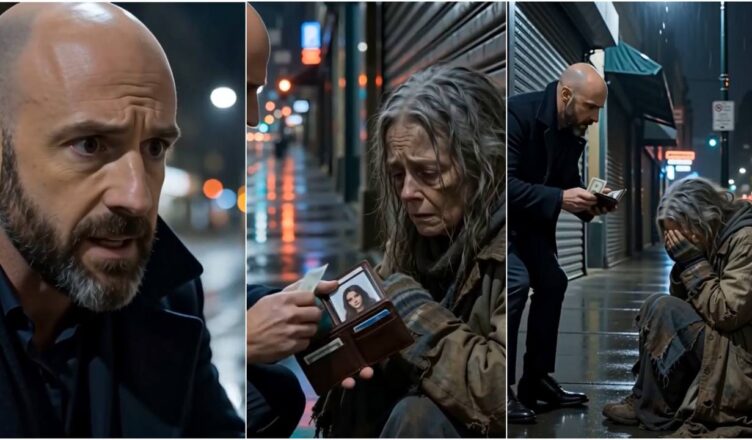
The night in downtown Seattle always looked different after rain—deep black smeared with metallic reflections, like the streets had been lacquered by exhaustion.
I sat with my back against a brick wall outside a closed storefront, the security gate pulled down, the neon sign dead. A streetlight above me flickered in tired bursts, turning the sidewalk into a stuttering film reel—bright, dark, bright again. I’d learned to keep my hands still and my eyes down. Movement attracted the wrong kind of attention.
My name is Patricia Harper, but no one on that street knew it. To most people I’d become part of the scenery, an older homeless woman in mismatched layers, as ordinary as a fire hydrant. Tonight I wasn’t even holding out a cup. I was just listening to the city breathe and trying not to count the years.
A pair of shoes stopped in front of me.
Not sneakers. Not the staggering steps of someone drunk. Leather shoes—clean, expensive. A faint cologne that didn’t belong on this street.
I lifted my head, wary. Experience taught you that “kindness” could be another name for humiliation.
The man was tall, in a dark coat, with the focused expression of someone who moved through the world without actually seeing it. He hesitated like he was about to keep walking—then crouched down until we were level.
No flinch. No practiced smile. No pity.
He pulled out his wallet.
“Here,” he said quietly, voice careful like he was speaking to a person and not a problem. “Take this.”
I didn’t move. I’d seen hands extend and then snatch back. I’d seen good deeds performed for cameras that weren’t even there. I’d learned that accepting money could come with a lecture, a joke, or worse.
My eyes landed on the open wallet anyway.
Bills. Cards.
And a photo tucked behind a clear slot, the corner of it peeking out.
It should’ve been nothing. A normal picture. The kind of thing men kept to remind themselves why they were working late.
But the world tilted.
My breath caught like someone had grabbed my throat. My hand lifted, trembled, dropped. Then lifted again—harder—like my body wanted to run while my mind couldn’t look away.
The photo was of a young woman, mid-to-late twenties, dark hair, a wide bright smile that warmed whatever it touched.
My daughter’s smile.
I hadn’t seen it in five years.
“No,” I whispered. The word barely made it past my teeth.
The man’s brow creased. “Ma’am—are you okay?”
I wasn’t listening. The city disappeared—cars, footsteps, wind—everything swallowed by that one image.
“That’s my daughter,” I said, and my voice sounded like it belonged to someone else.
The man went still.
He blinked once like he’d misheard. “I’m sorry… what?”
Tears rose so fast I felt embarrassed by them, then furious at myself for caring. I hadn’t cried in a long time. Tears out here drew attention.
Tonight they came anyway.
“That’s my daughter,” I repeated, louder now, like I needed the universe to hear it. “I’d know her anywhere.”
He turned the wallet toward himself and stared at the picture as if it had changed. A line carved itself between his eyebrows.
“That’s impossible,” he said slowly. “This is Emily.”
Hearing her name in his mouth made my chest tighten.
He swallowed, voice dropping. “Emily is my wife.”
The word wife hung in the wet air like smoke.
My head snapped side to side, sudden and fierce. “No,” I said. “A mother doesn’t forget her child.”
His face hardened—not cruel, but defensive. His fingers tightened on the leather. “Ma’am, I’m sorry, but you’re mistaken.”
“Mistaken?” A short laugh tore out of me, sharp with pain. “You think I’m confusing her with someone else?”
I wiped my face with the back of my glove, smearing rain and tears. “I carried her. I rocked her to sleep. I taught her how to walk. When she was scared of the dark, I called her my sunshine.”
The words rushed out like they’d been trapped behind a locked door for years. “She had a tiny scar under her left eyebrow from falling into the coffee table when she was three. She hated peas and would hide them in her napkin. She used to tuck her hair behind her ear when she lied.”
My throat tightened. “I can’t be wrong.”
He shifted back slightly, like the air had thinned around him. His confidence flickered.
“If… if she’s your daughter,” he said, and now his voice shook just a little, “then explain to me—where have you been?”
I held his gaze. There was no trick in my eyes. No hustle. Just an old pain that never got a proper ending.
“She disappeared,” I said.
His shoulders tightened. “Disappeared?”
“Five years ago,” I whispered. Saying it still felt like swallowing glass. “They told me she died.”
He blinked hard. “Who told you that?”
“The police,” I said. “They said it was an accident. They found her car down by the waterfront—water everywhere, like the whole night had swallowed her. They showed me a closed casket and told me there wasn’t… enough left to identify.”
My voice sank. “I buried an empty box and still screamed into it.”
His eyes widened, and something in his face started doing math—years, timelines, lies, missing pieces.
“And after that?” he asked, almost afraid.
“After that I lost everything,” I admitted. “I quit my job because I couldn’t stop searching. I spent my savings on private investigators who all took my money and handed me the same shrug. I moved down here because I couldn’t stand living in a place where every corner held her shadow. Grief doesn’t pay rent.”
He stared at me like he was seeing the sidewalk under his feet for the first time.
Then my mouth betrayed me with the next truth, the one I hadn’t planned to say out loud.
“She’s… she’s got kids now,” I murmured, more to myself than to him. “Two little ones.”
His eyes snapped up. “The kids,” he said, stunned. “How do you know about—”
“I saw her once,” I said quickly, embarrassed and desperate all at once. “Not in person. In a magazine someone left at the shelter. She was in a feature—some charity gala. Emily with two little ones beside her. I thought I was losing my mind. I didn’t even know if it was real.”
My voice broke. “Two babies. I never got to hold them. I don’t even know if they’d recognize my name.”
The man didn’t move. His jaw clenched so hard I saw the muscle jump.
He looked down at the wallet again, then back at me, and I realized something terrifying: he wasn’t acting.
He wasn’t covering.
He didn’t know.
He lived with Emily—ate dinner with her, slept beside her—without knowing a mother out here had already buried her.
“What’s your name?” he asked suddenly.
“Patricia,” I said.
He nodded, throat working. “I’m Ben,” he said. “Ben Mercer.”
His voice cracked on the next sentence. “If you’re right… then I just found my wife’s mother on a sidewalk.”
Shame slipped into his tone—brief, real.
I shrugged because I didn’t know what else to do with that. “Life doesn’t ask permission before it breaks you.”
Ben’s hand went to his pocket. His phone appeared, screen lighting his face with a cold glow. His thumb hovered over a contact like he was afraid the act of touching it would split his life open.
“If I call her,” he whispered, more to himself, “if I call her right now…”
I reached out and placed my fingers lightly on his wrist—gentle but urgent. “Careful,” I said. “A truth like this… you can’t throw it like a rock.”
He looked at me, panic exposed. “You think she lied to me.”
“I think someone hid something,” I said quietly. “And people don’t hide things like this without a reason.”
Ben swallowed hard, then hit call.
The ringtone stretched through the wet street like a wire pulled tight over a drop.
One ring.
Two.
Three.
Each tone made my heart stop and start again.
Then a click, and a woman’s voice—soft, sleepy—came through the tiny speaker.
“Hello?”
Ben didn’t speak right away. His eyes closed for a second like he needed to borrow strength from somewhere.
“Emily,” he said finally, and his voice cracked. “Where are you?”
“At home,” she answered immediately, confusion sharpening. “Why? What’s going on?”
He glanced at me like he needed permission to do what he was about to do.
“I’m… I’m outside,” he said. “And I’m with someone.”
“With who?” Emily’s voice tightened.
Ben inhaled. The streetlight flickered again.
“I’m with your mom,” he said.
Silence.
Not even a breath.
My fingers tightened around Ben’s wrist so hard they went white.
When Emily finally spoke again, her voice was low and strained. “My mother is dead.”
Ben’s eyes shut. “No, Emily,” he said, gentle but firm now. “She’s right here. I’m holding your picture. She recognized you immediately.”
A sound on the other end—something dropping. A sharp inhale that turned into a small, broken noise I recognized.
Shock.
Grief.
Fear.
Then: “Where are you?”
Ben gave the address. He didn’t add anything else. He couldn’t.
When he ended the call, his hands shook. He looked at me like I was both miracle and disaster.
“She’s coming,” he whispered.
My legs felt hollow. I didn’t know whether to feel joy or terror.
Because finding someone isn’t just finding them.
It’s finding everything that disappeared with them.
Headlights appeared at the end of the street—fast, impatient. A car pulled up hard and stopped with the urgency of someone driving on pure adrenaline. A door opened.
A figure stepped out.
Even from a distance, I recognized the walk—one slight hitch on the right leg, the way she always tucked her hair behind her ear when she was nervous.
The streetlight finally held steady long enough to light her face.
Emily.
Alive.
My world collapsed and rebuilt in the same second.
But Emily didn’t run into my arms.
She stopped in the spill of light, chest rising and falling too fast, eyes wide and wet. Her gaze darted from Ben to me like she was trying to decide which reality to live in.
“Mom?” she whispered—and the word sounded both precious and foreign, like she’d never expected to use it again.
I tried to stand and my knees nearly buckled. “Sunshine,” I said, because I didn’t trust anything else.
Emily’s face crumpled so quickly it looked painful. She took one step, then another, then stopped again as if the ground might vanish.
“You can’t be here,” she choked out. “You can’t—”
“You were dead,” I whispered back. “They told me you were dead.”
Ben’s voice cut in, raw with disbelief. “Emily. Explain. Right now.”
Emily flinched at his tone like she’d been slapped. “Ben, please—”
“Did you know your mother was out here?” he demanded, and the hurt in his voice made my chest twist. “Did you know she was alive?”
Emily shook her head hard. “No. I didn’t.” Tears spilled over. “I thought she was gone.”
I stared at her, shaking. “Then why did you tell him I was dead?”
Emily’s eyes squeezed shut. When she opened them, guilt poured out of her like a confession she’d been carrying alone.
“Because it was easier,” she whispered. “Because I didn’t know how to say, ‘My mom and I got separated and I couldn’t find her and I didn’t know if she hated me.’ Because every time Ben asked about my family, I froze.” Her voice broke. “So I said you were dead. And then I kept saying it. And the longer I said it, the more impossible it felt to undo.”
Ben’s jaw clenched. “Separated how?”
Emily dragged in a breath that sounded like pain. “The accident,” she said. “It happened. But I didn’t die.”
My stomach turned. “Then—”
“I crawled out of the car,” she whispered. “I don’t even remember how. I remember water, cold, and lights. Then… nothing. I woke up in Harborview two days later. I couldn’t remember my name. The social worker said no one had reported me missing that matched what they had.” She shook her head, tears dropping to the wet pavement. “By the time my memory started coming back, it was in pieces. I tried to call you. The number didn’t work. I went to the old apartment—someone else lived there. I asked around and nobody knew where you’d gone. I thought… I thought you left because you couldn’t handle it.”
I made a small sound of disbelief. “I stayed,” I said. “I stayed until staying destroyed me.”
Emily’s mouth opened, then closed. She looked at me the way people look at a cliff edge.
“I tried again,” she whispered. “I did. But I was… ashamed. I was angry at myself for surviving when everyone thought I was dead. I didn’t know how to walk back into your life without ripping you open again.” Her eyes flicked toward Ben. “And then I met him. He gave me steadiness. He gave me a life that didn’t feel like falling.”
Ben’s voice went quiet, dangerous in its restraint. “And you never told me.”
Emily’s shoulders shook. “I was afraid you’d see me differently,” she admitted. “I was afraid you’d think I was broken.”
I laughed once, bitter and exhausted. “Honey,” I whispered, “I’ve been sleeping on concrete for years because I thought you were in the ground.”
Emily’s hand flew to her mouth. Ben’s face drained.
“Oh my God,” he breathed, and the words sounded like prayer and horror at the same time.
Emily stumbled toward me then, finally, like her body had decided before her mind could stop it. She knelt in front of me on the wet sidewalk, not caring about her coat or the water soaking her jeans.
“I’m sorry,” she sobbed. “I’m so sorry.”
I wanted to be angry. I wanted to demand why she hadn’t fought harder. I wanted to make her feel, for one minute, what it was like to bury a child.
Instead, my hands rose and cupped her face, because my body remembered her before my pain could speak.
“You’re here,” I said, and my voice cracked. “You’re alive.”
Emily pressed her forehead to my palm like she was eight again and needed permission to breathe.
Ben stood above us, shaken, staring at the scene like it didn’t fit his world. Then he did something that made my throat tighten—he took off his coat and draped it over my shoulders without a word, as if to cover the part of his wife’s story he’d been stepping over for years.
“We’re not staying out here,” he said, voice rough. “Both of you. Get in the car.”
I hesitated. Habit screamed at me not to get into anyone’s car, not to trust, not to hope. But Emily’s hand gripped mine like she’d never let go again, and Ben’s face held something I hadn’t seen from strangers in a long time.
Respect.
The drive was quiet except for Emily’s uneven breathing. She kept glancing at me like she was afraid I’d disappear if she looked away. Ben drove with both hands tight on the wheel, jaw locked, doing his own kind of grieving.
When we pulled up to their house—warm lights in the windows, a quiet street, a porch that looked like safety—I almost couldn’t move. It felt like stepping into someone else’s life.
Inside, the air smelled like laundry detergent and dinner that had cooled on the stove. Emily’s voice shook as she whispered, “The kids are asleep.”
I didn’t ask to see them. I didn’t want to break anything.
Emily took my hand and led me down a hallway with framed photos—birthdays, vacations, tiny faces with her eyes. She cracked open a bedroom door.
Two small children slept in twin beds, stuffed animals tucked under their chins. One had Emily’s dark hair. The other had Ben’s profile. Their chests rose and fell in soft rhythm, unaware the world had just rearranged itself.
My knees gave out silently. Emily caught me before I hit the floor.
“I didn’t even know their names,” I whispered, ashamed of how much that hurt.
Emily’s tears slid down her cheeks. “I was going to tell you,” she lied softly, and then flinched at her own words. “I… I wanted to. I just didn’t know how.”
Ben’s voice came from behind us, quieter now. “We’ll figure it out,” he said. “But we’re not hiding anymore.”
Emily nodded, gripping my hand like a lifeline. “No more hiding,” she echoed.
That night, they gave me a shower, clean clothes, a room with a bed so soft it felt unreal. I lay there staring at the ceiling, listening to the sound of a house settling, and I couldn’t sleep. My body didn’t know how to trust comfort.
At dawn, Emily knocked and came in slowly, like she was approaching a skittish animal.
“I made coffee,” she whispered. “The way you used to—too much cream.”
I laughed, a small broken sound.
We sat at her kitchen table with steam rising between us. Ben moved quietly around the room, giving us space while still staying close, like he didn’t trust the truth to hold yet.
Emily stared into her cup. “I thought if I buried the past hard enough, it wouldn’t come back,” she said. “I thought I could start over without paying for what I left behind.”
I watched her hands—steady now, wedding ring on her finger—and thought about the years I’d spent invisible on sidewalks, waiting for life to notice I existed.
“It always comes back,” I said softly. “Not to punish you. To be acknowledged.”
Emily’s eyes filled again. “Can you forgive me?”
I didn’t answer right away, because forgiveness isn’t a switch you flip. It’s work. It’s time. It’s rebuilding trust inch by inch.
But I reached across the table and covered her hand with mine.
“I’m here,” I said. “That’s where we start.”
Outside, the Seattle sky was still gray, rain threatening again. The city would keep moving, indifferent as ever. But inside that kitchen, the world had finally stopped long enough to let a mother and daughter find each other again—not cleanly, not perfectly, but alive.
And for the first time in five years, I didn’t feel like scenery.
I felt seen.