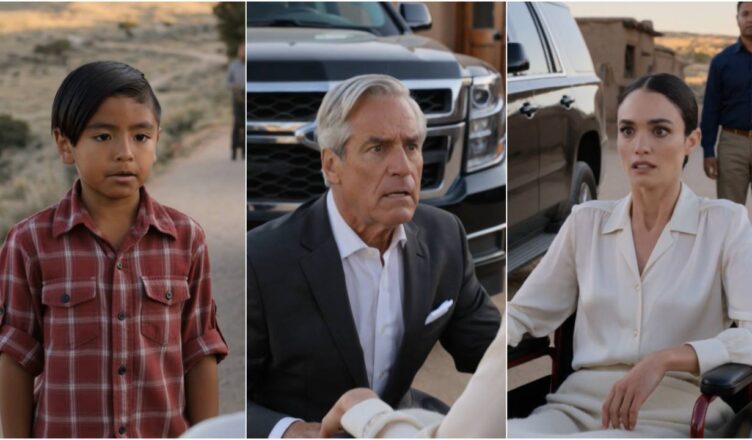
By the time the third black SUV crawled into the mountain village, every door had opened.
The road was hardly a road at all—just ruts, dust, and stone winding between adobe houses, prayer flags, sagging wire fences, and pickup trucks baked pale by years of high desert sun. Children stopped chasing each other. Men rose from porch chairs. Women shaded their eyes and watched the convoy move past in silence, glossy and black and so out of place against the dry northern New Mexico hills that it looked like a piece of another world had taken a wrong turn.
Then the lead door opened, and Julian Cross stepped out.
At sixty-three, Julian had the kind of presence that made people lower their voices without knowing why. He was tall, broad-shouldered, silver-haired, and dressed in a charcoal suit that belonged in a Manhattan boardroom, not on a dirt road at the edge of a mountain village. Wealth had polished him. Grief had carved him down to something harder. For the last eighteen months, he had lived inside routines, reports, appointments, and the exhausting discipline of control. It was the only way he knew how to survive what had happened to his son.
Two security men stepped out behind him. Then a nurse came around the second SUV and carefully lowered a wheelchair onto the packed dirt.
Elena sat beneath a pale cashmere blanket despite the heat. Her dark hair was pinned back in a sleek knot. Her skin was flawless, almost too luminous for the dusty road and thin mountain air. She looked fragile in an expensive way, the kind of fragility that had been protected, moisturized, medicated, chauffeured, and arranged. There was a sadness to her face people found easy to pity.
She had not walked in eighteen months.
At least that was what everyone believed.
The village already knew why Julian Cross had come. Word had reached these hills before his convoy had. There was a boy here, people said. A child who could see through sickness. A child who knew when pain was real and when it was borrowed. A child who asked the kind of questions adults spent whole lives avoiding.
Julian did not believe in miracles.
He believed in expertise. In institutions. In names that impressed other names. Since the accident, he had taken Elena to specialists in Boston, Houston, Zurich, and Tokyo. He had paid for neurologists, rehabilitation experts, spine surgeons, private trauma consultants, boutique recovery programs, and treatments no insurance company would touch. He had built a wing onto his estate so she could recover in comfort. He had hired aides, nurses, therapists, drivers, and attendants. He had done all of it for one reason, and one reason only.
His son Daniel had died in that crash.
Elena had survived.
And whether Julian admitted it or not, keeping her close had become the only thing that made him feel as if some part of Daniel remained in the world.
Two weeks earlier, his driver’s mother had served him coffee and said, with infuriating calm, “There’s a boy in the mountains who sees what people hide from doctors.”
Julian had almost told her to leave the room.
Instead, he had asked for directions.
Now he stood in the middle of a dirt road surrounded by villagers, guards, and the woman he had spent a year and a half protecting, financing, and grieving around.
A murmur moved through the crowd. Someone pointed toward the ridge.
Hoofbeats.
A small horse appeared first, picking its way down the slope. Then the rider came into view—a thin boy in faded jeans, worn boots, and a sun-bleached shirt. He could not have been older than eleven or twelve. He rode with an ease that made the SUVs, the armed security, the polished shoes, all of it, look faintly ridiculous.
He guided the horse straight toward Julian, stopped a few feet away, and swung down.
No ceremony. No performance. No hesitation.
Just stillness.
Julian studied him. “Are you the boy they’ve been talking about?”
The boy glanced at Elena, then back at him. “Depends who was talking.”
A few people in the crowd smiled nervously. Julian did not.
“Can you help her?”
The boy’s gaze moved to Elena again. Not to the chair. Not to the blanket. To her face. He held it there longer than was comfortable.
Then he said, “She doesn’t need the kind of help you think she does.”
The nurse frowned. Elena’s fingers tightened under the blanket.
Julian’s expression hardened. “Explain that.”
The boy tilted his head. “Not yet.”
Julian had spent his life around men who delayed answers to gain leverage. He disliked the tactic even more in a child.
“My name is Julian Cross,” he said, voice quiet and controlled. “I didn’t drive all this way for riddles.”
“I know who you are,” the boy replied. “That’s part of the problem.”
A hush rippled through the crowd.
One of Julian’s security men took a step forward, but Julian stopped him with a slight motion of his hand.
The boy turned and walked toward Elena. He did not ask permission. He did not look intimidated. He simply stopped in front of her wheelchair and crouched until they were eye level.
Up close, Julian could see how young he really was. A healing scrape on one elbow. Dust at the hem of his jeans. A narrow wrist. Nothing about him suggested training or authority. And yet, the entire village watched him the way people watch a match near dry timber.
“What’s your name?” the boy asked.
Elena gave him a cool, measured look. “You already know.”
“I want to hear you say it.”
She hesitated. “Elena.”
He nodded once. “And what hurts?”
Her answer came too quickly. “My legs.”
The boy said nothing.
Elena lifted her chin. “That’s why we’re here, isn’t it?”
“No,” he said. “That’s why he’s here.”
He rose slowly and turned toward Julian.
“She can stand.”
The road went dead still.
For one full second, even the wind seemed to stop.
Then the nurse gave a short, shocked laugh. “That’s impossible.”
Elena’s face changed—only for an instant, but Julian saw it. A flicker. Not fear exactly. Not pain.
Alarm.
Julian looked at the boy. “You’d better be very sure.”
The boy met his gaze. “I am.”
Elena let out a brittle breath and forced a wounded smile, as though indulging a rude child. “Julian, please. We came all this way for this?”
The tone struck him first. Too practiced. Too polished. More annoyed than humiliated.
It was such a small thing. But grief sharpens some instincts while dulling others, and over the last year Julian had ignored many small things because the larger pain made them feel unworthy of scrutiny.
Now, suddenly, they began returning to him.
The time he had walked into the physical therapy room unexpectedly and found Elena standing at the parallel bars with no therapist beside her—only for her to collapse the second she saw him.
The late-night security footage he had once half-watched on his phone, in which she seemed to shift farther across the bed than he had thought possible without assistance.
The driver mentioning, in passing, that Elena had asked for high heels to be brought to the house and then laughed it off as “habit.”
The maid who quit after three months, saying only, “She is not what she pretends to be.”
At the time, Julian had dismissed all of it. Exhaustion. Bitterness. Misunderstanding.
He looked at Elena now, and for the first time in eighteen months, a possibility entered his mind so ugly he almost rejected it on principle.
The boy stepped closer to him. When he spoke, his voice was low enough that only Julian, Elena, and the nurse could hear.
“You built her a palace to stay broken in,” he said. “And she noticed.”
Julian stared at him.
“She’s not afraid of standing,” the boy continued. “She’s afraid of what happens when she does.”
Elena’s voice cut in sharp. “That is enough.”
The edge in it turned heads. So did the fact that it did not sound weak.
Julian looked down at her.
Her face had gone pale beneath the careful makeup. “He’s a child,” she said. “A cruel one, apparently. Let’s go.”
No one moved.
Julian’s eyes stayed on hers. “Stand up.”
She laughed once, incredulous. “Julian.”
“Stand up.”
Her expression softened instantly. It was a look he knew too well by now—hurt, patience, restrained sorrow. The expression that turned every challenge to her into an act of brutality.
“You know what happened to me,” she said quietly.
The boy answered for him. “No. He knows what you told him happened to you after it stopped being useful to tell the whole truth.”
Elena’s head snapped toward him. “Be quiet.”
Julian did not look away from her. “What whole truth?”
She blinked, too fast. “I don’t know what game this is, but I won’t sit here and be humiliated by a little boy trying to impress a village.”
The villagers shifted at that. The insult had landed badly.
The boy’s expression did not change. “You practice the sick voice when you’re alone less than you think.”
Julian turned sharply. “What?”
The boy shrugged. “People who hurt for real protect the hurting part. They don’t decorate it.”
A line of anger appeared in Elena’s jaw.
And that, more than anything, unsettled Julian.
Over the past year and a half he had seen Elena frightened, tearful, medicated, withdrawn, elegant, exhausted, grateful, quiet, tender, and numb. But he had almost never seen her angry.
Not like this.
The boy took one step back and spoke to Julian plainly.
“Ask her what happened three weeks after the funeral.”
Julian’s chest tightened. “What are you talking about?”
No answer came from Elena.
“Ask her,” the boy repeated.
Julian’s voice dropped. “Elena.”
She looked away.
The nurse, standing beside the chair, seemed suddenly uncertain. “Mr. Cross…”
Julian barely heard her. “What happened three weeks after the funeral?”
Elena let out a trembling breath. “You were grieving. I was grieving. Things were difficult.”
“That’s not an answer.”
Her eyes flashed. “Because it’s a stupid question.”
The boy spoke quietly. “She went into your study after midnight.”
Julian turned to him.
“She wasn’t in the chair,” the boy said. “She walked.”
A pulse moved in Julian’s temple.
“That’s enough,” Elena snapped. Then, catching herself, she softened again and looked up at Julian with wet eyes. “Please. Don’t do this here.”
Too late. The words had already found the place in him where suspicion had begun knitting itself into certainty.
Three weeks after the funeral.
He remembered the night with violent clarity now that it had been named. He had fallen asleep in the study, fully dressed, bourbon untouched on the desk, Daniel’s college baseball photo still in his hands. He had opened his eyes sometime after midnight and seen Elena standing in the doorway in a silk robe, one hand on the frame.
Standing.
Not seated. Not supported. Standing.
At the time, he had thought he was dreaming. Or mis-seeing. Or drunk on grief despite barely drinking. The next morning, when he had mentioned it gently—carefully—Elena had looked stricken and said he must have imagined it because she had not left her room all night.
He had apologized.
God help him, he had apologized.
Julian’s mouth went dry. “Did you come into my study that night?”
Elena held his gaze a second too long.
Then she said, “You were exhausted. You weren’t yourself.”
It was not a denial.
The nurse looked at Elena in open confusion now. “Ma’am?”
Elena’s voice sharpened. “Don’t.”
Julian crouched in front of the chair, forcing her to look directly at him. For the first time in months, the gentleness was gone from his face.
“Did you stand in my study?”
She swallowed.
“Did you?”
Her lips parted, closed, parted again.
And Julian suddenly saw every performance he had mistaken for vulnerability. The carefully timed tears. The fragile gratitude. The way she clung to his hand when guests were present. The way expenses expanded. The new jewelry she said friends had sent. The designer handbags delivered to side entrances. The increasing insistence on private staff, private cars, private shopping, private pain.
It all rearranged itself in front of him.
Not grief.
Strategy.
When Elena finally spoke, her voice was low and furious. “I did what I had to do.”
The words hit the road like a match.
The nurse stepped back. One of the security guards muttered, “Jesus Christ.”
Julian did not move.
“What does that mean?”
Elena lifted her chin, and something in her broke the wrong way—not into shame, but into contempt.
“It means I knew exactly what would happen if you realized I was fine,” she said. “You would’ve sent me away. Back to what? A condo Daniel picked. An allowance? A few sympathetic calls on holidays?”
Julian stared at her.
“You wanted me in your house,” she went on. “You wanted someone who still smelled like him. Someone who kept him in the room. Don’t stand there and pretend this was one-sided.”
The villagers were silent now, the kind of silence that comes when truth turns ugly and public.
Julian’s voice was flat. “You lied to me for eighteen months.”
“I survived you for eighteen months,” she shot back.
His expression hardened. “You lived in my home.”
“Yes,” she said, and now the resentment was spilling fast. “Your giant mausoleum of a house where every dinner tasted like a memorial and every hallway had your son’s face staring down from framed photographs. You think I didn’t know why I was there? You think I didn’t understand that half the reason you kept me was because losing me would make him more dead?”
Julian stood slowly.
There was color rising in his face now, but his voice got quieter, not louder. That was when he was most dangerous.
“So this was what?” he asked. “A long con? Pretend to be paralyzed, let me pay for your life, let me build you a wing in my home, let me hire nurses and therapists and staff for an injury you knew you didn’t have?”
Elena laughed once, but there was no humor in it.
“Please. The doctors helped me more than you think.”
Julian went still. “What does that mean?”
She saw, too late, that she had said too much.
“What does that mean, Elena?”
Her silence answered first.
Then, very quietly, she said, “Not all of them believed it.”
The nurse made a sound of disgust.
Julian looked as though someone had struck him. “You fooled physicians?”
“A few suspected. None of them could prove it,” Elena said. “Do you know how easy it is when everyone already expects you to be broken? Especially a beautiful widow. Especially after a public tragedy. People see what they’re prepared to see.”
The boy spoke for the first time in several minutes.
“Especially when seeing the truth would cost them something.”
Julian turned toward him.
The boy’s face was calm, but not unkind. “She knew your grief needed her helpless. And you knew her helplessness needed your money. Both of you made a bargain. You just didn’t admit it out loud.”
Julian absorbed that in silence.
Because it was not entirely wrong.
Elena looked up at him, suddenly wary now that the performance had collapsed and there was nothing left but consequence. “Julian…”
He cut her off. “Can you walk right now?”
She said nothing.
His stare sharpened. “Get out of the chair.”
For the first time, she looked truly frightened.
“Julian, not here.”
“Here is perfect.”
She glanced around at the village, the guards, the nurse, the watching faces. Humiliation washed over her features.
And then, slowly, knowing there was no longer any version of the story she could save, Elena threw back the blanket.
She placed both feet on the dirt.
Pushed herself upward.
And stood.
A harsh sound went through the crowd—not surprise now, but revulsion.
The nurse covered her mouth in disbelief. One of the guards looked away as if embarrassed to have spent a year treating this as sacred. Julian himself did not react at all. That was the most frightening part. He only watched.
Elena steadied herself, then took one step, then another. She was graceful. Fully capable. Not rusty, not relearning. Just exposed.
Julian let the silence punish her.
Finally he said, “How long?”
She lifted her eyes to his. “Since the beginning.”
The nurse whispered, “My God.”
Julian’s face lost the last trace of softness. “You are finished.”
Elena’s composure cracked. “Don’t do this.”
“Do what?”
“Throw me away because I was smarter than you?”
That did it.
The force in Julian’s voice came back all at once. “Smarter?”
The word echoed off the adobe walls.
“My son died on a highway, and you turned his death into a lifestyle.”
Elena flinched.
“You sat in my house and let me grieve in front of you while you billed my sorrow to my own accounts. You let nurses lift you, let doctors examine you, let staff serve you, let me rearrange my life around a lie because it bought you silk sheets and chauffeurs and jewelry.”
His eyes were cold now, stripped of every illusion.
“And you made one mistake. You assumed grief made me blind forever.”
Elena’s voice dropped to a pleading register. “I did care about you.”
Julian gave a short, disbelieving laugh.
“No,” he said. “You cared about what I could be used for.”
He turned to his head of security. “She does not return to my home.”
Elena’s face blanched. “Julian.”
“Her things will be inventoried. Anything purchased with my accounts stays. She is to be placed in a hotel in Santa Fe for seventy-two hours. After that, she can fund her own life with whatever talent she’s clearly been preserving.”
“Julian—”
He didn’t look at her. “If she attempts to access the estate, the staff is to call my office, not me.”
That hurt her more than anything else. Not anger. Irrelevance.
She took a step toward him. “After everything—”
He turned then, and the look in his eyes stopped her cold.
“Do not use that phrase with me.”
The village remained utterly silent.
Elena glanced around once, as if searching for someone to rescue her from the moment, then seemed to understand at last that there was no audience left to manipulate. Only witnesses.
She drew herself up, dignity rushed back over her like a final coat of paint, and said, “You needed this lie more than I did.”
Julian regarded her for a long moment.
Then he said, “Maybe. But I’m not the one standing in dirt without a future.”
He turned away.
That was the end of her.
One of the guards moved to escort her toward the SUV. She hesitated, as if expecting Julian to call her back, to soften, to revise, to remain the man she had learned how to manage.
He never did.
When she was gone from the center of the road, Julian looked at the boy.
For the first time since arriving, there was no command left in his voice. Only a tired, private astonishment.
“What’s your name?”
“Mateo.”
Julian nodded once. “How did you know?”
Mateo glanced toward the empty wheelchair. “She looked at the chair the way some people look at a house they don’t want to leave.”
Despite everything, Julian almost smiled.
Then Mateo added, “And when I said she could stand, she was offended before she was afraid.”
That landed hard because it was exactly true.
Julian exhaled and looked around at the village—the cracked porches, the patched roofs, the clinic building near the chapel with one broken window boarded over in plywood. He had arrived in these mountains chasing a miracle. Instead he had been handed something rarer and far less flattering.
Clarity.
“What do I owe you?” he asked.
Mateo shrugged. “Nothing.”
Julian studied him. “I don’t like debts I can’t name.”
The boy pointed with his chin toward the old clinic. “Then build something useful.”
Julian followed the gesture.
The building was barely more than a few rooms and failing paint.
“Is that your hospital?” he asked.
“It’s where people wait to find out if the road to Santa Fe kills them first,” Mateo said.
The line hit with the dry force of truth.
Julian stood in silence for a moment, then reached into his jacket and pulled out his phone. He looked at his chief of staff’s number on the screen, then at the building again.
When he spoke, his tone had changed. It was the voice that made projects happen, markets move, men run.
“Call Albuquerque,” he told one of the guards. “Then call my office in New York. I want land surveys, permits, medical planners, and a construction team. I want a real facility here. Trauma care, imaging, rehab, maternal health, telemedicine capacity, staff housing if we have to build it ourselves.”
The guard blinked. “Yes, sir.”
Julian looked at the clinic again. “Not a vanity project. Not a plaque with my name in six-inch letters. A real hospital.”
He turned to Mateo. “And local people help decide what gets built.”
Mateo nodded once, as if that were the only correct answer.
The villagers began murmuring now, not loudly, but with a cautious wonder. Hope had to move carefully in places that had gone too long without it.
Julian slipped his phone back into his jacket.
For a moment neither he nor Mateo spoke.
Then Julian said, “You didn’t just expose her.”
“No,” Mateo replied. “You were already starting to see it.”
Julian considered that. He thought of the study doorway. The physical therapy room. The maid’s resignation. The expensive deliveries. The feeling, every now and then, that Elena’s helplessness had a kind of choreography to it. He had seen pieces of the truth and looked away because the lie was easier to live with.
Mateo had not given him the truth.
He had taken away his excuse not to look at it.
Julian gave a short nod. “That may be worse.”
Mateo’s mouth twitched, almost a smile.
The sun had begun to lower over the ridge, turning the dust gold. Elena’s SUV was already halfway down the road out of the village, shrinking into the distance. Julian watched it go without regret, though not without shame. Not shame for exposing her.
Shame for how long he had mistaken usefulness for love and grief for loyalty.
When he finally turned back toward his own vehicle, the village no longer looked poor to him in the flat, contemptuous way wealthy men often viewed places they did not live. It looked underfunded. Overlooked. Forced to survive with too little. There was a difference, and it mattered.
He paused before getting into the SUV and looked once more at the clinic, then at Mateo.
“My son would have hated her,” he said quietly.
Mateo considered that. “Then it’s good you found out before you turned her into a monument.”
Julian stood very still.
Because that, too, was true.
He had almost done exactly that.
Almost taken a liar and wrapped her forever in the holiness of his son’s memory.
Instead, the memory remained his son’s.
Unstolen.
Untouched.
He got into the SUV at last, but before closing the door, he looked back at Mateo and said, “When the hospital is finished, I’ll come see it myself.”
Mateo nodded. “Come without the convoy next time.”
For the first time that day, Julian actually smiled.
Then the door shut.
The engines started. Dust rose. The black SUVs turned carefully in the narrow road and began the long descent out of the village.
In the second vehicle, the empty wheelchair had been folded and laid flat in the cargo area, its silver frame catching one blade of sunset through the tinted glass.
Julian watched it in the side mirror until the road curved and the village disappeared behind him.
By the time night fell over the mountains, calls had already been made. Architects had already been interrupted at dinner. Lawyers had already begun drafting. Men in offices hundreds of miles away were being told that, by morning, a hospital project in northern New Mexico would become the most important item on their desks.
Not because it would generate returns.
Because some debts could only be paid by building something that remained after humiliation had done its work.
Months later, when the foundation was poured and the first steel rose from the red earth, locals would still talk about the day the billionaire came looking for a miracle and instead discovered a fraud.
But the story would not stay centered on Elena for long.
Stories like that rarely do.
What lasted was what came after.
The imaging wing.
The trauma bays.
The women’s health unit.
The rehab center.
The scholarships for local nursing students.
The paved access road that cut winter travel time nearly in half.
And the small bronze plaque by the front entrance, placed so discreetly most visitors missed it, that read only:
Built because the truth arrived here first.
Julian approved every part of the hospital except that line.
Mateo had chosen it.
In the end, Julian left it untouched.
Because it was true.
And because the most expensive lesson of his life had come from a boy in a faded shirt who took one look at a woman in a cashmere blanket and understood, before anyone else would say it aloud, that some people do not fake weakness because they are fragile.
They fake it because weakness, in the right room, can be turned into power.
And sometimes the only thing more dangerous than a lie is the need that makes it welcome.