The Red Lie
Evan Hale had never understood why Mara married him.
He was tall, narrow-shouldered, almost too thin, with a quiet face people tended to forget until he smiled. He moved carefully through the world, as if trying not to take up space that belonged to someone else. At work, people described him as dependable. At parties, when Mara could still be convinced to go to them, women called him sweet.
Mara hated that word.
Sweet meant harmless. Sweet meant the kind of man other women could smile at too freely because they assumed he belonged to nobody important.
Mara was impossible to overlook, even when she wished she could disappear. She was very overweight, broad through the hips and shoulders, with a round face, tired skin, and acne that never fully left her alone. Some mornings she stared at the pimples along her cheeks as if they had betrayed her personally. She wore oversized sweatshirts even in summer and deleted almost every picture anyone took of her.
Evan knew all of that.
He knew she turned away when she changed clothes. He knew she hated restaurants with mirrors on the walls. He knew she laughed too loudly when someone made a joke about weight because she wanted to prove it did not hurt her before anyone checked.
So he loved her carefully.
“You look beautiful,” he would say before dinner.
Mara would roll her eyes. “You’re my husband. You have to say that.”
“No,” Evan would answer. “I have to pay taxes. I choose to say that.”
Sometimes she smiled.
Most of the time, she didn’t believe him.
Their marriage slowly became a house full of small tests.
If Evan looked too long at a waitress while ordering, Mara went quiet for the rest of the night. If he came home twenty minutes late, she asked where he had been, then asked again ten minutes later with different words, then brought it up in bed as if time itself had become evidence. If he put his phone facedown, she stared at it like it was a loaded gun.
Evan tried to be patient because he understood where the fear came from. Mara had been mocked by girls in school, ignored by men in bars, praised only when she lost weight, pitied when she gained it back. She had learned to expect abandonment before love had a chance to prove itself.
But patience, he eventually learned, could become a room with no doors.
By their third year of marriage, Evan was exhausted from proving the same truth every day: that he was still there, that he still chose her, that every woman in the world was not a threat waiting to happen.
Then came the red underwear.
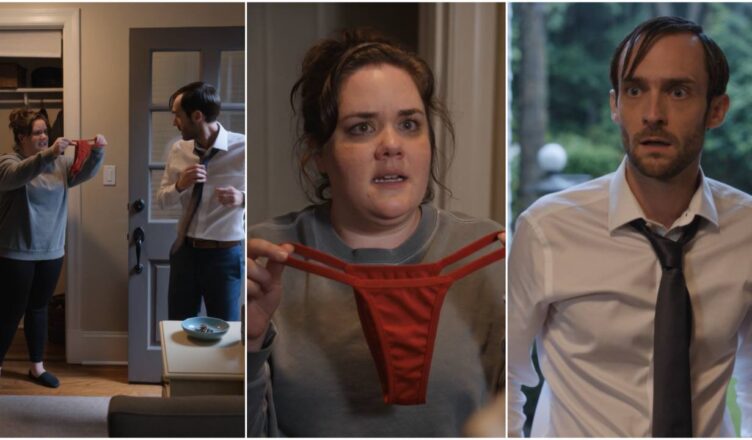
It was a rainy Thursday evening in November. The house was warm but dim, the kind of modest middle-class entryway where every object had a place because there was no room for anything extra. Rain tapped softly against the kitchen windows. A small table by the front door held a ceramic bowl for keys. The coat closet stood half-open, shadows gathered inside it.
Evan came in from work with rain on his overcoat and stress still sitting heavily in his shoulders. His white office shirt was wrinkled from twelve hours at a desk, his dark tie loosened at the throat. He dropped his keys into the bowl with a tired clink and pulled at his tie as if it had been choking him all day.
Mara was already standing beside the coat closet.
She wore an oversized faded gray sweatshirt and black leggings. Her messy hair was tied up badly, strands falling loose around her face. In the warm hallway light, the acne along her cheeks and chin was visible beneath the uneven layer of makeup she had not fully washed off. She was unnaturally still.
Evan looked up.
“Mara?”
She reached into the pocket of his coat before he could ask what was wrong.
For one second, he thought she had found a receipt. Maybe a parking ticket. Something ordinary.
Then she pulled out a bright red thong.
She gripped it with both hands, opening it wide in front of her chest like evidence, the thin straps stretched between her fingers. Her face twisted with hurt before anger swallowed it.
“Evan… what are these?”
Evan froze.
His eyes widened. His body seemed to stop functioning for a beat.
“What?”
Mara’s breathing grew harder. She kept the red thong held open, forcing him to look at it.
“I found them in your coat pocket.”
Evan stared at the underwear as if it had appeared from another planet. Then he took one small step forward, hands slightly open, face pale with confusion.
“Mara, listen to me. I swear, I have no idea how they got there.”
Her chin trembled. Tears shone in her eyes, but they did not soften her. They made her more dangerous.
“And you expect me to believe that?”
The question hung between them, bitter and sharp.
Evan looked from the thong to her face.
There was no guilt in him. No panic of being caught. Only disbelief so complete it bordered on physical pain.
“I didn’t put that there,” he said quietly.
Mara laughed once. “Of course you didn’t.”
“I’m serious.”
“They were in your coat.”
“I understand that. I don’t understand why.”
“Who is she?”
“There is no she.”
“Don’t insult me.”
“Mara, I have never cheated on you.”
“You expect me to believe some woman’s underwear magically appeared in your pocket?”
“I don’t know where it came from.”
“That’s your answer?”
“That’s the truth.”
The rain kept tapping at the windows. Somewhere in the kitchen, the refrigerator hummed. The entryway felt smaller than it had a minute ago.
Mara searched his face with an intensity that looked almost desperate. She wanted something from him—some crack, some flicker, some proof that her worst fear had been right all along.
But there was nothing to find.
Evan looked hurt now. Not angry yet. Hurt.
“Are you actually accusing me of cheating on you?”
“I’m asking why these were in your pocket.”
“And I’m telling you I don’t know.”
“That’s convenient.”
He let out a slow breath. “No. Convenient would be having a wife who trusts me.”
Mara flinched, and for a second her anger slipped.
Underneath it was fear.
Then guilt.
Evan saw the shift. His eyes narrowed.
“Mara,” he said carefully. “Where did they come from?”
She looked away.
The answer arrived before she said it.
Evan’s face changed.
“No,” he whispered.
Mara’s hand tightened around the red thong.
“I bought them.”
The silence after that was worse than the accusation.
Evan stared at her.
“What?”
“I bought them,” she said, louder now, as if volume could make it less humiliating. “They’re mine.”
He looked at the tiny piece of red fabric. It was too small for her. So small it was almost cruel.
“They’re not yours.”
“They were supposed to look like they belonged to someone else.”
Evan did not move.
The words seemed to reach him one at a time, each one doing its damage separately.
“You planted underwear in my coat,” he said.
Mara’s eyes filled again. “I needed to know.”
“Know what?”
“If you would lie.”
He stared at her like she had become someone he did not recognize.
“You framed me?”
“Don’t say it like that.”
“How else should I say it?”
“I was scared.”
“So you tried to make me look guilty.”
“I thought if you were innocent, you’d act innocent.”
Evan laughed once, but there was no humor in it. It sounded almost broken.
“That’s not a test, Mara. That’s a trap.”
Her face flushed red. “You don’t know what it feels like.”
“What what feels like?”
“To be me!” she snapped. “To stand next to you and see women look at you like I’m not even there. To wonder every day when you’re going to realize you could have done better. To know that one day some pretty, skinny woman is going to smile at you and you’re going to wake up.”
Evan’s anger faltered for a moment.
He saw it then—the raw, ugly fear behind everything. The mirror. The silence after dinners. The questions. The constant suspicion. Mara was not just afraid he would leave. Some part of her believed she deserved to be left.
But understanding why someone hurt you did not make the hurt disappear.
“Mara,” he said, quieter now, “I have spent three years trying to make you feel safe.”
“I know.”
“No. You don’t. Because if you knew, you wouldn’t have done this.”
She wiped at her face with the back of her hand. “I’m sorry.”
He looked at the red thong still hanging from her fingers.
“Are you?”
“Yes.”
“Or are you just sorry I didn’t confess to something you invented?”
That made her cry harder.
“Evan, please.”
He stepped past her and picked up his keys from the bowl.
Her eyes widened. “Where are you going?”
“For a drive.”
“It’s raining.”
“I noticed.”
“Please don’t leave.”
He stopped with his hand on the doorknob.
For a moment, she thought he might turn around, might forgive her right there because he always forgave her. Instead, he looked back with an expression she had never seen on his face before.
“I need to be somewhere I’m not being interrogated for a crime you created.”
Then he walked out into the rain.
That night, Evan slept in the guest room.
Mara apologized the next morning. Then again by text at lunch. Then again when he came home. She cried in the kitchen and told him she had panicked, that she hated herself, that she loved him so much it made her crazy.
Evan forgave her out loud.
But something in him had shifted.
Trust, he realized, was not always a vase that cracked and still held water. Sometimes the crack was where everything slowly drained out.
For the next few weeks, Mara was gentle. Too gentle. She cooked dinners she didn’t eat, touched his arm when he passed her in the hallway, sent him heart emojis in the middle of the day. She stopped questioning him for a while, and that should have felt like progress.
Instead, it felt like weather before a storm.
Evan hated himself for noticing.
He hated the way he started watching her the way she had always watched him. He hated the way his stomach tightened when she took her phone into another room. He hated that the red thong had not only accused him of betrayal, but had introduced suspicion into him like poison.
Two months later, Mara was in the shower when her phone lit up on the kitchen island.
Evan was making coffee.
He did not mean to look.
The screen glowed brightly against the dark counter, and the message appeared before he could turn away.
I can’t stop thinking about last week. Same time when he’s gone?
The contact name was saved as Aunt Lisa.
Evan stood perfectly still.
He had met Aunt Lisa twice. She was seventy-four, lived in Ohio, and still used a flip phone with buttons big enough to read without glasses.
The shower kept running upstairs.
Coffee dripped steadily into the pot behind him.
Another message appeared.
I miss the way you look at me when you open the door.
Something in Evan went cold.
He did not touch the phone. He did not open it. He did not run upstairs and pound on the bathroom door. He did not scream her name.
Instead, he stepped back from the counter.
For the first time in their marriage, Evan understood something Mara had probably been counting on him never learning.
Guilty people often accuse first.
That night at dinner, Mara laughed at something on her phone, then turned the screen facedown when she noticed him looking.
“Everything okay?” she asked.
Evan stirred his soup.
“Yeah,” he said. “Just tired.”
“You’ve been tired a lot.”
“Work.”
She watched him for a second too long.
Then she smiled.
It was almost convincing.
The next day, Evan bought two small home security cameras.
He did not put them in bedrooms. He did not put them anywhere private. One went on a bookshelf in the living room, angled toward the sofa and fireplace. The other went on the entryway shelf, hidden among mail and old paperbacks, facing the front door. Common spaces. Places where a lie would have to enter before it could become truth.
Then he waited.
A week later, he told Mara he had a business trip.
“A week?” she asked, her eyebrows lifting with what looked like disappointment.
“Maybe less,” he said. “Depends how fast we close the deal.”
She came around the kitchen island and wrapped her arms around his thin waist.
“I’ll miss you.”
Evan looked over her shoulder toward the bookshelf.
“Yeah,” he said. “Me too.”
He packed a suitcase and drove away Monday morning.
But he did not leave town.
He checked into a hotel thirty minutes away under his own name, placed his suitcase on the luggage rack, and sat on the edge of the bed for a long time with his phone in his hand.
Part of him still wanted to be wrong.
That was the most humiliating part.
He wanted the cameras to show nothing. He wanted to come home ashamed and delete the footage and apologize silently by being kinder for the next twenty years. He wanted Mara to be broken but faithful. Difficult but honest. Afraid but not cruel.
On the second night, at 8:17 p.m., his phone buzzed.
Motion detected.
Evan opened the app.
The front door swung inward.
Mara stood in the entryway wearing the black dress she had once told him no longer fit. It fit now because she had forced herself into it. Her hair was curled. Her makeup was careful and heavy, the acne concealed as much as she could manage. She looked nervous and excited in a way Evan had not seen in years.
A man stepped inside.
He was broad, confident, wearing a leather jacket and carrying a bottle of wine.
Mara threw her arms around him before the door was fully closed.
They kissed in the hallway, right beside the key bowl where Evan had dropped his keys the night she had accused him.
Evan watched from the edge of a hotel bed as his wife smiled against another man’s mouth.
He did not cry.
Not then.
The man said something Evan couldn’t hear clearly. Mara laughed, took his hand, and led him into the living room.
The second camera caught enough.
Not everything.
Enough.
Mara curled against him on the sofa. The man kissed her neck. She touched his face like she had been waiting all week to touch it. Their voices were low, but one sentence came through cleanly.
“He has no idea,” the man said.
Mara laughed softly.
“He believes whatever I tell him.”
That was when Evan stopped watching.
He set the phone down on the bed, walked into the hotel bathroom, and gripped the sink until his hands hurt.
The face in the mirror looked unfamiliar.
Not furious.
Not shattered in any dramatic way.
Just emptied.
The next morning, he called a divorce attorney.
By Friday afternoon, he returned home early.
The rain had stopped, but the house still smelled faintly damp, like wet leaves and old wood. Mara was in the kitchen, humming while she washed a wineglass that did not belong to them.
She turned when she heard him.
For half a second, her face lit with panic before she arranged it into surprise.
“You’re home.”
“I am.”
“I thought you weren’t coming back until Sunday.”
“The deal closed early.”
“Oh.” She dried her hands on a towel. “That’s good, right?”
Evan placed a folder on the counter.
Mara looked at it.
“What’s that?”
“Divorce papers.”
Her face emptied.
“What?”
“I know.”
She stared at him. “Know what?”
He held her gaze.
“Don’t do that. Not this time.”
Her lips parted. For a moment, denial moved through her like muscle memory. He could see it forming, see her reaching for the same old tools—confusion, tears, accusation, blame.
Then Evan placed his phone on the counter and played ten seconds of the video.
The front door.
The man.
Her arms around him.
Her smile.
Mara grabbed the edge of the counter.
“Evan—”
He stopped the video.
“I don’t need to hear it.”
“It’s not what you think.”
He almost laughed.
“You brought a man into our home while I was away.”
She shook her head. “I was lonely.”
“So was I.”
“You were distant after the underwear thing.”
“You mean after you falsely accused me of cheating?”
Tears filled her eyes. “I made a mistake.”
“No,” Evan said. “You made a rehearsal.”
That landed harder than shouting.
Mara covered her mouth.
He pushed the folder slightly closer.
“My lawyer has the footage. So do I. The cameras were in common areas only. Nothing private. But they prove what happened.”
“Please don’t ruin me,” she whispered.
“I’m not ruining you.”
“You’ll tell people.”
“You already did.”
Her eyes lifted.
Evan’s voice stayed calm. “You told your friends I was cold. You told your mother I made you feel unwanted. You hinted for months that I was probably cheating. You built the story before I even knew I was in it.”
Her face went pale.
“I was hurt.”
“You were guilty.”
She flinched.
Evan looked at the wineglass in the sink.
“I spoke to your parents this morning.”
Mara recoiled. “You did what?”
“I told them the truth.”
“You had no right.”
“I had every right to defend myself.”
“They’ll hate me.”
“That is between you and them.”
By noon, Mara’s mother had called six times.
Her father left one message. It was short and devastated. He said only, “Mara, call your mother. What Evan told us better not be true.”
But it was true.
That was the problem.
The story did not spread because Evan screamed it from the rooftops. It spread because Mara had spent months quietly making herself the tragic wife and Evan the likely villain. She had complained at family dinners about his late nights. She had cried to friends about feeling undesirable. She had made small, careful comments about trust and men and how wives always knew.
When the truth arrived, it found an audience already waiting.
The divorce moved faster than either of them expected.
There were no children. The house was in Evan’s name, bought before the marriage. Their savings were mostly separate because of a prenuptial agreement Mara had once mocked as unromantic.
Now it protected him from the wreckage.
At the final meeting, Mara looked smaller than Evan had ever seen her. No makeup. Hair flat. Acne visible. Gray sweater too big for her body. Eyes swollen from weeks of crying.
They sat across from each other in a conference room while lawyers shuffled papers and spoke in careful, bloodless language about signatures, disclosures, final terms.
When it was over, Mara followed him into the hallway.
“Evan.”
He stopped, but he did not turn around at first.
“I’m sorry,” she said.
He looked back.
She was crying openly now.
“I hated myself,” she said. “And instead of fixing that, I punished you for loving me. I thought if you were guilty, then I wouldn’t have to feel so afraid all the time.”
For one brief second, Evan’s expression softened.
Because he had loved her.
That was the part nobody could erase. Not the lie. Not the red thong. Not the man in the living room. He had loved the woman standing in front of him so much that he had mistaken endurance for devotion.
Then his face settled into something firmer.
Not cruel.
Finished.
“I loved you when you didn’t love yourself,” he said. “You used that love as a place to hide.”
“I know.”
“And then you betrayed it.”
Mara stepped closer. “Can we ever—”
“No.”
The word was quiet.
Final.
She flinched like he had shouted.
Evan opened the building door. Cold air rushed into the hallway.
“I hope you get help,” he said. “But it won’t be from me.”
Then he walked out without looking back.
For a while, his life became very small.
Work. Gym. Takeout dinners. Empty rooms. The silence of a house that no longer felt dangerous, only hollow. He stopped wearing his wedding ring, but for weeks his thumb still found the place where it had been.
Some nights he sat alone in the living room and looked at the shelf where the camera had been. He hated that it had been necessary. He hated that proof had become the only language anyone believed.
But slowly, the house changed.
He painted the entryway. He replaced the key bowl. He donated the couch. He took down the framed wedding photo from the hallway and left the wall bare for months, not because he couldn’t choose another picture, but because he liked the honesty of empty space.
Spring came quietly.
One Saturday morning, rain began falling while he was walking downtown, so he ducked into a small neighborhood bookstore with fogged windows and narrow aisles. He was standing in the biography section with one hand on a book when a woman beside him reached for the same title.
“Oh,” she said, laughing softly. “Sorry.”
“It’s okay.” Evan pulled his hand back. “You take it.”
She was not dramatic. Not polished in a way that asked to be noticed. She had warm brown eyes, a raincoat with one missing button, and damp hair tucked behind one ear. There was something calm about her presence that made the air feel less sharp.
Her name was Claire.
They had coffee in the bookstore café because the rain got heavier and neither of them was in a hurry to leave. She asked what he did for work, and when he answered, she listened without waiting for her turn to speak. He told her a harmless story about a client who once sent a forty-page email with no punctuation, and for the first time in months, Evan heard himself laugh without effort.
Claire smiled at him over her cup.
“You seem like someone who’s learning how to breathe again.”
Evan looked down at his coffee.
The rain slid down the window beside them, soft and steady.
“Maybe,” he said.
She did not ask why.
Not that day.
That was one of the reasons he liked her.
Outside, the street shone clean and silver under the rain. Evan watched people hurry past with umbrellas and paper bags, everyone carrying something invisible. For years, rain had sounded to him like the night Mara stood in the entryway holding a red lie between her hands.
Now, for the first time in a long time, it sounded different.
Not like a trap.
Like the world washing itself clean.