The Plane Beyond Hollow Creek
By late November, the woods outside Hollow Creek, Maine, had gone so quiet that Claire Bennett could hear the wind moving through separate rows of pine from her front porch.
That was one of the reasons she had stayed.
The forest never asked for explanations.
Her cabin sat more than a mile from the nearest paved road, tucked between black spruce, granite ledges, and a narrow creek that froze at the edges before winter fully arrived. Most afternoons, Claire wrapped herself in an old wool blanket, drank tea from a chipped blue mug, and watched the tree line fade into dusk.
Four years earlier, her husband, Owen, had died at the sawmill after a hydraulic press failed. The company spent months calling it “operator error” until an inspector finally proved the machine had been unsafe for years. By then, apologies were useless. The check they sent her felt less like compensation than hush money.
Claire sold the house in town, moved into the cabin her father had built, and stopped expecting people in power to tell the truth unless someone forced them to.
So when the sky tore open with the sound of a dying engine, her body reacted before her mind did.
She was on her feet before the mug shattered on the porch boards.
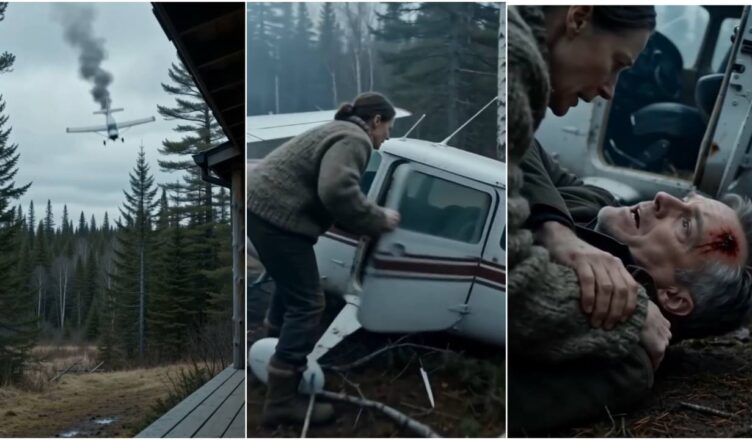
A small plane dropped through the low clouds, one wing tipping hard, the engine coughing in violent bursts. It clipped the top of a pine, spun sideways, and disappeared behind the ridge.
The crash rolled through the woods like thunder.
Claire ran.
Branches slapped her face. Cold mud grabbed at her boots. By the time she reached the clearing, the plane was crumpled nose-first between two broken birches, steam hissing from the engine, one wing folded like paper. The smell of fuel hit her throat.
Inside the cockpit, a man hung half-conscious against the harness.
Mid-fifties. Gray at the temples. Blood running from a cut near his hairline. His eyes opened and closed as if he were fighting to stay in the world.
“Can you hear me?” Claire shouted.
His mouth moved.
She couldn’t make out the words.
The cockpit door was jammed. Claire grabbed a rock, smashed the cracked side window, reached in, and cut the harness with the folding knife she kept in her coat. Owen had taught her years ago what leaking fuel could do.
Don’t stand there thinking. Do the next thing.
The man fell hard against her shoulder, groaning. She dragged him backward through wet leaves, away from the wreck, until they reached a safer stretch of ground.
Only then did she pull out her phone.
“I’m calling 911.”
His hand closed around her wrist.
Hard.
“No police,” he rasped.
Claire stared at him. “You just fell out of the sky.”
“No police.”
“You’re bleeding. You may have broken ribs.”
“If they find me before I get this out…” He swallowed, fighting for air. “I’m dead anyway.”
Claire looked toward the smoking plane, then back at him.
She should have called.
A reasonable woman would have called.
But reasonable people had once stood in her kitchen and explained that her husband had killed himself through carelessness. Reasonable people had smiled while burying the truth.
“What’s your name?” she asked.
The man’s eyes found hers.
“Daniel.”
“Daniel what?”
He hesitated.
That told her enough.
Claire slipped the phone back into her pocket.
“All right,” she said. “But understand me. If you start dying on my couch, I’m calling whoever I have to.”
His grip loosened.
“Fair.”
She used an old deer sled to get him back to the cabin. It took nearly an hour. By the time she hauled him through the front door, darkness had lowered over the ridge and sleet had begun ticking against the windows.
Claire had been a volunteer EMT years earlier, back when Hollow Creek still had enough volunteers to pretend it could handle emergencies. She knew basic trauma care. Enough to clean the cut near his temple. Enough to wrap his ribs tight. Enough to check his pupils and keep him awake when he started slipping too far under.
He had a bruised chest, a wrenched shoulder, a concussion, and the kind of exhaustion that came from running long before the crash.
At midnight, he woke on the couch beside the woodstove.
Claire held a cup of water to his mouth.
“You’re safe for now,” she said.
Daniel drank slowly.
“For now,” he murmured.
Then he passed out again.
The storm lasted two days.
No search helicopters came. No sheriff’s truck appeared on the logging road. No voices moved through the trees.
On the third morning, Claire went back to the crash site alone.
The plane was a burned-out skeleton half-hidden under wet pine needles. Near the passenger side, wedged beneath a bent panel, she found a black waterproof case. Inside were a scorched notebook, two encrypted drives, and a photo of Daniel standing beside a teenage girl on a rocky beach. On the back, written in blue ink, were the words:
Maya — Bar Harbor, 2019. Before everything.
Claire brought the case back and placed it on the kitchen table.
When Daniel saw it, the color left his face.
“You went back.”
“You crashed carrying it,” she said. “I figured it mattered.”
He looked at the drives for a long moment.
Then he told her the truth.
His full name was Daniel Mercer. He had been the chief safety engineer at Northstar AeroSystems in Seattle, a private contractor building navigation software for military and emergency aircraft.
His best friend, Adrian Voss, was Northstar’s chief operating officer.
At least, he had been Daniel’s best friend until Daniel discovered falsified test reports, missing grant money, and software failures hidden from federal auditors. If the system went live, aircraft could lose positioning in bad weather. Pilots could fly blind without knowing it.
Daniel confronted Adrian privately.
“I gave him forty-eight hours,” Daniel said, sitting by the fire with one arm wrapped around his ribs. “I thought I was giving him a chance to fix it.”
Claire looked at him. “And?”
“He used the time to destroy me.”
Two days later, Northstar’s servers were wiped in a staged breach. Daniel’s credentials were tied to the deletion. Payments to shell companies were linked to accounts opened in his name. A junior engineer who could have cleared him suddenly changed his statement after a private meeting with company lawyers.
Then the headlines began.
Whistleblower becomes suspect.
Trusted engineer accused of fraud and sabotage.
Daniel’s attorney urged him to accept a plea deal before things got worse.
Instead, Daniel ran.
“I kept copies,” he said, nodding toward the drives. “Original test logs. Board emails. Audit trails. Everything they said never existed.”
“And the plane?”
“A friend kept it at a small airfield outside Bangor. I was trying to reach someone in Boston who still owes me a favor.” He looked toward the window, where snow clung to the glass. “Fuel line failed twenty minutes after takeoff.”
“You think it was sabotage.”
“I know it was.”
Claire sat across from him, quiet.
He looked at her carefully. “You don’t believe me.”
“I didn’t say that.”
“You’re thinking I sound like a man with a very convenient story.”
“I’m thinking men with convenient stories usually don’t crash into the woods with evidence they could’ve thrown away.”
For the first time, he almost smiled.
It changed his whole face.
Over the next few weeks, the cabin became something neither of them had planned.
Daniel healed slowly and hated every second of being useless. Claire refused to treat him like glass, which helped more than kindness would have.
When he could stand, she handed him tools.
The porch step needed fixing. The woodpile needed stacking. The kitchen faucet had been dripping for six months. Daniel moved carefully, ribs protesting, but the work steadied him. It gave his hands something to do besides shake.
At night, they sat by the stove.
At first, they talked only about practical things. Pain. Weather. Food. Whether the old radio in the pantry still worked.
Then, little by little, the truth widened.
Claire told him about Owen. Not the version from the reports. The real version. How he sang badly when he cooked. How he hated hospitals. How he used to leave notes on the bathroom mirror because he woke before she did.
Daniel listened without interrupting.
In return, he told her about his daughter, Maya, who had stopped answering his calls after the charges. Not because she believed he was guilty, he said, but because the story had become too heavy for a seventeen-year-old to carry.
“I told her to stay away until I cleared my name,” he said one night.
Claire looked at him across the firelight. “And did she?”
His jaw tightened.
“She listened.”
“That must have hurt.”
“It was supposed to.”
Outside, wind pushed snow against the window.
Daniel looked down at his hands.
“Do you ever get tired of being strong?” he asked.
Claire almost laughed, but the question was too honest.
“All the time.”
“What do you do?”
She leaned back in her chair.
“I make tea. I split wood. I keep going because nobody else is coming to do it for me.”
Daniel looked at her then, really looked, and something between them shifted.
Not quickly.
Not like lightning.
More like ice beginning to crack under spring water.
By February, he could walk to the creek without stopping. By March, they had memorized each other’s silences. By April, Claire no longer pretended she slept well when he had bad nights on the couch. He no longer pretended not to hear her crying in the pantry on Owen’s birthday.
One evening, after a hard rain, Daniel found her on the porch watching fog move through the pines.
“I can’t stay here forever,” he said.
Claire kept her eyes on the trees. “I know.”
“If I leave, they may find me.”
“I know that too.”
“If I stay, I’m just letting them finish the job quietly.”
That made her turn.
He looked thinner than when she found him, but steadier. The fear was still there. It just no longer owned his face.
“What do you want?” she asked.
“My life back.” He paused. “And my daughter.”
The lawyer who agreed to meet them worked out of a brick office above a hardware store in Portland. Her name was Ruth Callahan, and she had the tired eyes of a woman who had spent thirty years listening to powerful men lie under oath.
She reviewed Daniel’s files for four days.
On the fifth, she called them in.
“This isn’t dramatic,” she said, tapping the notebook with one finger. “That’s what makes it good. Dates. Emails. Original file hashes. Maintenance reports. Payment records. Whoever kept this knew exactly what mattered.”
Daniel looked at Claire.
Claire said, “He did.”
Ruth nodded. “Then we go carefully. No heroics. No midnight meetings. No trusting old friends.”
Daniel gave a dry smile. “I’m done with old friends.”
The months that followed were brutal.
Daniel surrendered with Ruth beside him and Claire sitting in the back row of the federal courthouse. For a while, it looked as if the machine might grind him down anyway. Northstar denied everything. Adrian Voss appeared on television with a wounded expression and called Daniel “a troubled man under enormous pressure.”
Then the first witness turned.
Then a backup archive was recovered from a third-party compliance firm.
Then one of Adrian’s offshore accounts surfaced.
Finally, Maya came to court.
Daniel saw her from across the hallway and stopped walking.
She was nineteen now, taller than in the photograph, her hair shorter, her face guarded. For one terrible second, neither of them moved.
Then she crossed the hallway and hit him in the chest with both fists.
“You told me not to call,” she said, crying so hard the words broke apart. “You told me to stay away.”
Daniel folded around her.
“I know.”
“I thought you were gone.”
“I know.”
“You don’t get to do that again.”
He closed his eyes.
“No,” he said. “I don’t.”
The case against him cracked after that.
Not dramatically. Not all at once.
But piece by piece, the lie lost its shape.
Charges were dismissed. Adrian Voss was indicted for fraud, obstruction, conspiracy, and attempted murder after investigators confirmed the plane’s fuel line had been cut before takeoff. Northstar’s board issued a statement full of careful regret and no real apology. Daniel didn’t read past the first paragraph.
When he walked out of the courthouse, Claire was waiting under the stone steps.
Maya stood beside her.
For a moment, Daniel looked at both of them as if he didn’t trust the world enough to believe what it was giving back.
Then Maya rolled her eyes through tears.
“Dad. Move.”
He laughed.
A real laugh.
The sound almost undid Claire.
A year later, Daniel and Claire married in the clearing behind the cabin, between the pines and the creek.
Ruth came. Maya came. Three neighbors came, including one who brought a cake that leaned badly to the left but tasted like heaven. The ceremony lasted seven minutes. Claire wore a cream dress and boots because the ground was soft. Daniel cried before she did, which made her smile so hard she forgot the cold.
They stayed in Hollow Creek.
Daniel built a proper workshop beside the cabin. Claire planted tomatoes, then blueberries, then too many herbs because Maya said the place needed “at least one thing that looked intentional.” Some nights, Daniel still woke from dreams of alarms and falling sky. Some mornings, Claire still reached for grief before she remembered joy had moved in beside it.
Life did not become perfect.
It became theirs.
Years later, when people asked how they met, Daniel always looked at Claire first.
She would lean back on the porch, mug in hand, watching the pines bend softly in the wind.
“He dropped in without calling,” she’d say.
Daniel would laugh every time.
And down by the creek, where the wreck had once burned in the snow, the trees had grown thick again.