Heavy rain had been falling since dawn, turning a quiet subdivision outside Nashville into a slick ribbon of blacktop and soaked leaves. The sky hung low and colorless, pressing down in cold gray layers, and every porch light and mailbox shimmered in the puddles as if the whole street had been dipped in oil.
A yellow cab slowed, tires hissing through standing water, and stopped in front of a modest two-story house with peeling trim.
Captain Andrew Miller stepped out.
His duffel hit the curb with a dull thud—heavy with miles, desert dust ground into the seams, and two years of silence he had never found the right words to fill. His uniform was clean but worn, creased by airports and long nights without sleep, and the rain immediately darkened the fabric across his shoulders. He stood still for a moment, letting the cold water run down the back of his neck, staring at a street he knew by heart.
Two years.
Two years of heat that felt like a hand closing around your throat. Nights that never truly went quiet. Days measured in missions, mail drops, and old photographs handled so often the edges went soft.
And through all of it, one picture had kept him upright: Emma sprinting barefoot to the door, hair flying, laughing so hard she could barely breathe. “Daddy!” Like it was the only word in the world that mattered.
He had played that scene on loop in his head. The front door swinging open. The smell of home—laundry detergent, coffee, and the faint sweetness of a child’s shampoo. Proof that his real life was still here. Proof that it had waited for him.
He tried not to think too hard about Lauren standing behind Emma, smiling the way she did at church picnics and neighborhood cookouts. His second wife. Emma’s stepmother. The woman who had promised, hand over heart, “I’ve got her,” when he shipped out.
But as he stepped onto the walkway, something in him tightened.
The yard was wrong.
Grass swallowed the path in uneven wet patches. The little flowerbed Emma used to water—bright marigolds, a painted stone she called her fairy rock—was gone. In its place sat mud, weeds, and a cracked plastic pot on its side as if somebody had kicked it and never bothered to pick it up. The windows were filmed with grime. One curtain hung crooked, half-fallen from its rod. A gutter sagged over the porch, spilling water in a steady sheet.
Neglect was not just mess.
Neglect was a message.
Andrew adjusted the duffel strap and walked to the front door. His boots, heavy with rain, left dark prints across the porch boards. He knocked once. Then again, louder.
Nothing.
No footsteps. No television. No shadow moving behind the cloudy glass. Just rain hammering the roof and wind pushing wet branches against the siding with a soft, repetitive scrape.
His stomach dropped.
He reached for the handle—and that was when he heard it.
Not from inside the house.
From behind it.
A cough.
Small. Weak. Choked down, like someone had learned that making noise only made things worse.
Andrew went still.
His body moved before his mind finished the thought. He stepped off the porch, cut around the side of the house, and followed the sound through the rain, boots sliding on the soaked grass.
Then the backyard came into view, and his breath locked in his chest.
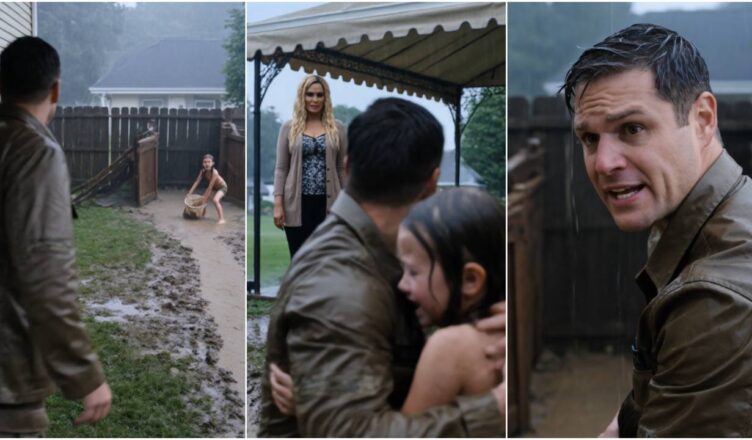
The back fence had partially collapsed, one section caved inward. The yard was churned into mud, deep footprints filled with brown rainwater. Near the far end stood an old livestock shelter the previous owner had never torn down—a narrow pen of warped boards and wire, with soaked straw on the ground and a sagging roof panel that offered almost no cover from the storm.
Inside it was a child.
Barefoot.
Shivering so hard her knees knocked together. Her clothes clung to her like wet paper, streaked with mud. Dark hair was plastered across her cheeks in stringy strands, and she was trying to lift a heavy plastic bucket slick with rainwater and grime. Her thin arms trembled with the effort.
Andrew’s vision tunneled.
“Emma…?” he whispered, and his voice came out like he had swallowed gravel.
The girl froze.
Slowly, as if she was afraid the sound was a trick, she turned her head. Her eyes widened. For a second she only stared, like her mind could not make the picture fit.
Then her mouth parted.
“Daddy…?”
The word came out thin and fragile. Not the bright shout he had carried in his head for two years. This sounded like a hope she was afraid to trust.
Andrew dropped his duffel.
He took one step toward the pen—
—and a voice cut across the yard like a blade.
“She’s fine.”
Andrew turned.
Lauren stood beneath the back-porch awning, sheltered enough to make the contrast obscene. Her hair lay smooth against her shoulders. Her cardigan looked dry. Her arms were folded tightly across her chest, her face set in that practiced expression people wear when they have already decided they are the reasonable one.
“She’s doing chores,” Lauren said. “Don’t turn this into something it’s not.”
Andrew looked at her, then back at Emma. The child’s shoulders would not stop shaking. Water ran down her face, mixing with dirt and tears she did not even bother wiping away. Her lips had gone pale.
“She can barely stand,” he said, and there was something dangerous in how calm his voice sounded.
Lauren shrugged. “She disobeyed me. She needed discipline.”
Emma made a tiny sound—half cough, half swallowed sob. Her eyes stayed locked on Andrew as if she was afraid that if she looked away he would disappear.
“She…” Emma whispered. “She made me sleep here. In the straw. Since last night.”
For a moment even the rain seemed louder.
Something cold spread through Andrew’s chest. Not anger at first. Something deeper.
Outside. Overnight. In the mud.
Like an animal.
He stepped to the pen and pulled Emma’s hands away from the bucket. Her fingers were red and stiff, dirt packed beneath the nails. When he touched her, her whole body flinched—then leaned toward him so fast it was obvious she had been holding herself up by sheer will.
“Emma,” he said quietly, forcing his voice to soften for her. “Come here. Right now.”
She hesitated.
Not because she did not want to.
Because her eyes flicked to Lauren first.
Fear. Automatic fear. The kind that had become habit.
Andrew saw it, and it hit him harder than the pen itself.
“Don’t move!” Lauren snapped.
Andrew turned slowly and put himself between them without thinking. Rain slid off his brow, down his jaw, and dripped from his lashes.
The yard went still except for the storm.
“Touch her again,” he said, his voice low and even, “and you are going to regret it.”
Lauren stared at him as if she could not believe he had spoken to her that way. Then outrage rushed in to replace the shock.
“You do not get to come back after two years and tell me how to run this house,” she shot back. “You left. I handled everything. You think you can just walk in here and play hero?”
Andrew did not answer.
Not with Emma shaking behind him.
Not with the truth standing barefoot in the mud.
He stripped off his military jacket—heavy, soaked, smelling faintly of cold rain and old travel—and wrapped it around Emma’s narrow shoulders. The second it settled over her, her body sagged. She grabbed at him with desperate little hands, clutching his shirt and collar.
Then he lifted her into his arms.
She was too light.
That was the part that caught in his throat hardest. A child should not feel this easy to gather up.
Emma pressed her face into his chest and held on with both hands, like she did not trust the ground anymore.
Lauren stepped off the porch. “Andrew, stop. You’re making this look insane.”
He did not even look at her.
He turned and carried Emma toward the house, rain streaming off his uniform and dripping from her hair onto the floorboards when he crossed the back door. Behind him Lauren followed, her voice rising—excuses, accusations, threats—the frantic sound of somebody feeling control leave her hands.
Andrew answered none of it.
He took Emma straight into the kitchen and set her carefully in a chair beside the heat vent. He kicked the thermostat up until the vents groaned to life. Up close, he could see how bad it was: her fingers swollen from cold, a bruise yellowing near one wrist, a raw scrape across one heel caked with dirt. When a cabinet door banged behind him, Emma jerked so hard her teeth clicked together.
Andrew looked at Lauren then.
Only once.
Whatever she saw in his face made her stop talking.
He pulled out his phone and dialed 911.
“My daughter was kept outside overnight in a livestock pen during heavy rain,” he said, voice clipped and steady. “She’s soaked, shaking, and showing signs of possible hypothermia. I need an ambulance and a police officer at this address immediately.”
The dispatcher began asking questions. Andrew answered every one of them with brutal clarity.
Yes, the child was conscious.
Yes, she had been outside overnight.
Yes, the woman responsible was still in the house.
Yes, he would stay on the line.
Behind him, Lauren found her voice again.
“This is absurd,” she said sharply. “You are not doing this over one punishment. She lies. She always lies when she wants attention.”
Emma folded inward at the words, shoulders drawing up, eyes dropping to the floor.
Andrew’s hand tightened around the phone.
Too late, he thought.
Too late for excuses. Too late for performance. Too late for any version of this that could still be cleaned up and explained away.
Keeping the dispatcher on speaker, he opened his camera and started taking pictures.
One: the backyard through the rain-streaked window—the collapsed fence, the carved-up mud, the rotting pen.
Two: Emma’s hands in his palm, red and swollen, dirt driven into the creases of her skin.
Three: the straw matted dark beneath the shelter, flattened in one corner where a child had clearly been made to sleep.
Four: the bruise near her wrist.
Then he crouched in front of Emma and lowered his voice until it was meant only for her.
“Listen to me,” he said. “I’m here. I’m not leaving again. Do you understand?”
Her chin trembled.
She gave the smallest nod.
Outside, a siren rose faintly through the rain.
Lauren heard it too. For the first time since he had stepped through the back door, the certainty went out of her face.
Andrew stood, the phone still in his hand, and looked at the woman he had trusted with his child.
Emma sat wrapped in his jacket, too small inside it, watching him with exhausted, disbelieving eyes.
“Stay right there,” Andrew said into the phone.
The siren was louder now.
“They’re pulling in.”