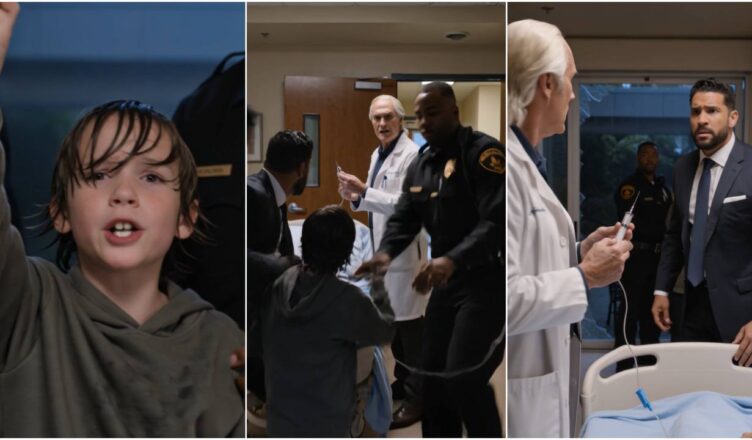
The Boy Who Broke the Window
Months before Victoria Harper was walked out of Greenwich General in handcuffs, a red rubber ball disappeared over the Harper estate wall.
It was the kind of wall that told boys like Samuel to keep moving—too high, too clean, topped with iron points and discreet black cameras. He should have let the ball go. But it was his, and Samuel had spent enough nights in shelters to know you did not abandon the few things in the world that belonged to you.
So he climbed the oak tree at the corner, edged out onto a branch that stretched over the stone, and dropped into the yard.
He expected shouting.
Instead, he heard a window open.
When he looked up, a girl stood behind the curtains of a second-floor bedroom with one hand on the sash, as if even opening it that far carried risk. She looked about twelve, but so pale she seemed washed out by the afternoon light. Her hair fell loose over narrow shoulders. Her smile, when it came, was small and careful, like something she had not used much lately.
Samuel held up the ball.
“Sorry.”
The girl glanced toward the hallway behind her before whispering, “Don’t be. I’m glad it happened.”
Then she said the thing that kept him from forgetting her.
“Come back tomorrow,” she whispered. “Before my stepmother closes the curtains.”
He should have stayed away.
Boys without addresses learned early not to get tangled in other people’s trouble. But the next afternoon he was back beneath the oak tree, and the girl was waiting at the cracked-open window with a deck of cards and the restless, hopeful look of someone who had been listening for footsteps all day.
Her name was Ellie Harper.
Samuel sat on the stone path below her window while she dealt cards across the sill and laughed when he accused her of cheating. After that, he came whenever he could—after school if he had gone, after odd jobs if he had found any, after the shelter served dinner if he could slip away.
Once he brought sidewalk chalk, and Ellie drew whole cities on the flagstones beneath her window while he guessed what the buildings were supposed to be. He told her about Father Gannon at St. Luke’s, who pretended not to notice when Samuel took an extra dinner roll at supper. Ellie told him about the books she had read three times because they were the only adventures she was allowed.
Nobody in the house seemed to notice him at first.
Or if they did, they dismissed him the way wealthy people often dismissed boys in cheap sneakers—as part of the scenery, harmless as long as he stayed outside the glass.
That was how Samuel noticed what others missed.
Ellie was not just quiet.
She was fading.
Some days her words came slowly, as if she had to drag them up through mud. Some days her hands shook when she picked up the cards. Some afternoons she lost the middle of a sentence and blinked at him, confused, as though she had forgotten where she was.
Every time Dr. Leonard Beale came to the house, she seemed worse afterward.
“What do they say is wrong with you?” Samuel asked one afternoon.
Ellie looked down at the paper cup on her bedside table.
“Depends on the day.”
“That’s not an answer.”
She tried to smile. “Victoria says my nerves are weak. Dr. Beale says I have episodes and agitation and that I have to stay calm or I’ll make myself worse.”
“Episodes of what?”
Ellie gave a tired little shrug.
“That’s the part nobody explains.”
A week later she told him the part that made his stomach turn.
“I feel worse after the medicine,” she whispered. “Not better. It feels like somebody is putting me farther away.”
Samuel looked at the paper cup again. The pills were different colors now than when he had first started coming. There were more of them too.
“When I say that,” Ellie went on, “Victoria tells me that’s proof I need them.”
Samuel did not know much about medicine.
He knew when grown-ups were lying to children in calm voices.
A month earlier, Father Gannon had fished an old pocket voice recorder out of a box of church donations and handed it to Samuel because the batteries still worked. Samuel kept it because there was something powerful about a machine that remembered things exactly.
Grown-ups forgot.
They denied.
They changed their stories.
The recorder did not.
One rainy evening, Samuel saw Dr. Beale’s car in the Harper drive and did what he was best at: he climbed where nobody thought to look.
The study window on the east side of the house never latched right. Samuel eased onto the branch outside it and crouched beneath the eaves, close enough to hear. This time he held the recorder in his palm and pressed the button.
Victoria Harper sat on the leather sofa with a glass of wine in her hand. Dr. Beale stood by the mantel, chart open.
“She was lucid too long today,” Victoria said. “She asked for Richard twice. She keeps saying the medicine is making her weak.”
“Then tonight we stop the oral regimen,” Dr. Beale replied. “Once she’s admitted, we keep her deeply sedated.”
Samuel went still.
Victoria lowered her voice.
“For how long?”
“Until the trust papers are finished and signed. If she wakes up, she talks. If she talks, everything becomes difficult.”
“And Richard?”
“He’ll hear the word coma and believe he’s watching a medical emergency. Men like him always do when the language sounds expensive enough.”
Victoria was quiet for a moment.
“You’re sure you can keep her under?”
“Yes,” Dr. Beale said. “Through the IV. One injection in the line after evening rounds, another if she starts to come around. After that, nobody will question why she isn’t waking.”
Samuel felt the rain running cold down the back of his neck.
He kept the recorder steady.
Not suspicion.
Not fear.
A plan.
The next morning, Ellie was barely able to lift her head to the window.
“They changed the drops,” she whispered. “And Victoria said Dr. Beale is coming again.”
“Don’t take anything else,” Samuel said.
Her laugh was thin and frightened.
“I don’t get to refuse.”
Before he could answer, the bedroom door opened behind her.
Victoria swept in wearing cream slacks and pearls, carrying a glass of water and the paper cup. Ellie flinched so hard Samuel felt it in his own chest.
He ducked below the sill.
Through the crack in the window he heard Victoria say, bright and soothing, “There you are, sweetheart. Let’s help you rest.”
By noon, an ambulance was in the drive.
Samuel saw it from the wall. Paramedics rushed Ellie out on a stretcher while Victoria pressed a hand to her mouth for the neighbors and Richard Harper came tearing up in a black sedan, his face stripped of color.
Samuel ran after the ambulance until he could not keep up, then cut through side streets until Greenwich General rose ahead of him in gray brick and glass.
He burst through the main entrance wild-eyed and breathless and went straight to the front desk.
“My friend is here,” he said. “The doctor is hurting her. You have to let me in.”
The receptionist looked at his wet hoodie, his scuffed shoes, his scraped hands, his shaking voice.
“What room?”
“Ellie Harper. Please. He’s going to put something in her IV.”
The woman stiffened.
“Security.”
Samuel tried again with the guard. Then with another one downstairs. He said doctor, IV, poison, tape, coma. Each word made the adults’ faces close more completely.
In their eyes he became what boys like him always became the moment they raised their voices in nice buildings.
A problem.
By the second time they pushed him outside, dusk had settled over the hospital.
Rain came down hard, silver against the courtyard lights.
Samuel still had the recorder.
He still had Dr. Beale’s words in his head.
One injection in the line after evening rounds.
He circled the old pediatric wing until he found the side courtyard. It was locked, fenced off, and slick with rain, but Samuel had been climbing fences before he ever learned how to trust locked doors. He scaled the iron gate, dropped down into the wet courtyard, and ran low beneath the windows.
The full-height glass side window to Ellie’s room glowed cold and pale in the rain-darkness.
Through the glass he could not hear anything, but he could see enough.
Ellie lay unconscious in the bed at the center of the room. An IV stand stood beside her. Richard Harper sat beside the bed, still in his dark suit, his strong shoulders bent forward, his neatly trimmed beard making his exhausted face look even harsher. His eyes were fixed on his daughter as if staring hard enough might bring her back.
Dr. Leonard Beale stood beside the IV line.
Tall and thin. Long white hair brushed back to his shoulders. Pale sharp face. White doctor’s coat.
And in one hand, clearly visible, he held a syringe near the IV injection port.
Samuel stopped breathing.
There was a heavy metal patio chair near the courtyard wall.
He grabbed it with both hands.
For one second, he saw his own reflection in the glass: twelve years old, soaked from the rain, cheap hoodie plastered to his thin frame, messy wet brown hair across his forehead, fear all over his face.
Then he swung the chair as hard as he could.
The chair slammed into the full-height glass window.
The sound cracked through the courtyard.
Glass broke inward.
Samuel dropped the chair outside on the wet ground immediately. It clanged against the stone and stayed there. He used both hands on the broken frame, ducked through the opening, and climbed into the hospital room.
No chair came in with him.
No second impact followed.
Inside the room, everything froze.
Samuel stood just inside near the already-broken window, rainwater dripping from his hoodie onto the floor. Behind him, the broken window stayed jagged and still, opening onto the dark courtyard. The heavy metal chair remained outside in the rain.
Dr. Beale stood beside Ellie’s IV line, syringe still visible in one hand near the injection port.
Richard remained seated beside Ellie’s bed.
Both men turned toward Samuel in shock.
Samuel pointed at the IV line, terrified.
“Don’t let him put that in her IV!”
For a single second, nobody moved.
Then Dr. Beale’s controlled expression broke.
His long white hair framed his panicked face as he lifted the syringe hand slightly away from the IV, trying to look composed and failing.
“Security!” he yelled.
The hallway door burst open from the opposite side of the room.
Two Black male hospital security guards in dark uniforms rushed in fast and professional, following Dr. Beale’s command before they fully understood the scene. They ran directly across the room toward Samuel’s position near the broken window and grabbed him hard by both arms.
Samuel twisted, not enough to hurt anyone, just enough to free one hand.
“Wait!” he shouted.
The guards held him from both sides.
He reached inside his soaked hoodie and pulled out the small pocket voice recorder. His fingers slipped once, but he got it high enough for Richard to see.
Dr. Beale remained in the background, terrified now, syringe still in his hand.
Samuel’s voice cracked through the room.
“I have proof they want to hurt her!”
Richard rose from his chair for the first time.
His bearded face shifted from shock to something far more dangerous.
Fury.
He looked at the recorder in Samuel’s raised hand.
Then he turned directly toward Dr. Beale.
The doctor froze, visibly panicking, still holding the syringe.
Richard locked eyes on him and roared, “Stop!”
The word tore through the room.
The security guards went still.
Dr. Beale did not move.
Richard stepped between him and the IV line.
“Put the syringe down.”
“Mr. Harper,” Dr. Beale said, trying to recover his authority, “this child is trespassing. Your daughter is medically unstable, and any delay—”
“I said put it down.”
Richard’s voice had gone low now.
Worse than shouting.
The nurse at the doorway looked from the broken window to the syringe to Samuel’s recorder. Her face changed. She moved quickly to the IV stand and clamped the line.
Dr. Beale snapped, “Do not touch that.”
Richard took one step toward him.
The doctor stopped speaking.
The nurse looked at the syringe.
“What medication is that?”
Dr. Beale said nothing.
Samuel strained against the guards.
“Play it,” he pleaded. “Please. Just play it.”
Richard crossed the room, took the recorder from Samuel’s shaking hand, and stared at it for one terrible second.
Then he pressed play.
The tape hissed.
Rain on leaves. Faint room noise.
Then Victoria’s voice, unmistakable:
“She was lucid too long today.”
Dr. Beale answered, just as clearly:
“Once she’s admitted, we keep her deeply sedated.”
The room seemed to shrink around the sound.
Victoria on the tape again:
“You’re sure you can keep her under?”
Then Dr. Beale, cool and precise:
“Through the IV. One injection in the line after evening rounds, another if she starts to come around. After that, nobody will question why she isn’t waking.”
Richard did not blink.
He let the tape run.
“If she wakes up, she talks,” Dr. Beale said on the recording.
Then Victoria, almost whispering now:
“And Richard?”
Dr. Beale’s reply came back thin and metallic through the recorder speaker, but every word landed.
“He’ll hear the word coma and believe he’s watching a medical emergency.”
When the tape clicked off, nobody in the room breathed.
The first person to move was the nurse.
She removed the IV bag, disconnected the medication line, and said over her shoulder, “Nobody touches anything. Call the attending. Call pharmacy. Call hospital administration. Now.”
Dr. Beale took one step backward.
One of the security guards released Samuel and moved toward the doctor instead.
Dr. Beale tried to keep his voice calm.
“That recording is incomplete. It proves nothing.”
Richard looked at the syringe still in the doctor’s hand.
“It proves enough to stop you.”
Victoria Harper appeared at the hallway door a moment later.
She was still elegant, still composed, still dressed like a woman who expected every room to rearrange itself around her. But when she saw the broken window, the clamped IV line, Samuel in custody, Richard holding the recorder, and Dr. Beale standing frozen with the syringe, her face changed.
Not confusion.
Not fear.
Calculation.
“Richard,” she said softly. “What is going on?”
He turned toward her.
For the first time, he looked at his wife as if he had never seen her before.
“Tell me it isn’t your voice.”
Victoria went still.
The room gave her no place to hide.
The charge nurse took the syringe from Dr. Beale with gloved hands and placed it into a specimen bag. Another nurse sealed the IV tubing. The attending physician arrived within minutes, listened to the tape once, and ordered toxicology, a complete medication audit, and hospital security lockdown on the room.
Police came before the rain stopped.
They separated everyone.
Dr. Beale kept insisting there had been a misunderstanding until pharmacy confirmed the medication in the syringe was not listed in Ellie’s current active orders. The drug was a powerful sedative, strong enough to keep a child deeply unconscious if administered repeatedly.
A chart review found discrepancies between what had been documented and what had actually been given.
The toxicology screen raised even worse questions about the days before that.
Victoria tried, once, to leave the hallway.
A uniformed officer stopped her before she reached the elevator.
Samuel sat on a plastic chair outside the room while a nurse wrapped his scraped hands and checked him for injuries from the climb. The little recorder rested beside him in an evidence bag.
He watched through the glass while doctors worked over Ellie—not with panic now, but with sharp, furious concentration. The sedatives were stopped. The monitors kept blinking. Oxygen hissed softly. Richard never left his daughter’s side.
She did not wake immediately.
That was the cruelest part.
Truth did not work like magic.
You could stop the harm and still wait in terror to find out what had already been taken.
The night stretched thin and merciless around the ward.
Near dawn, Richard came out into the waiting area and found Samuel sitting with his bandaged hands tucked inside the sleeves of his wet hoodie.
The man looked older than he had the day before.
“How long?” Richard asked quietly.
Samuel knew what he meant.
“Since the ball went over your wall.”
For a moment Richard said nothing.
Then he sat beside him and covered his face with one hand.
“I was right there,” he said hoarsely. “Signing forms. Listening to doctors. Letting them explain my own daughter to me.”
His voice broke.
“And you were the one who heard her.”
Samuel stared at the floor.
“She kept saying the medicine made her feel far away.”
Richard closed his eyes.
“And I did not listen.”
Samuel did not know what to say to that.
A while later, the attending physician came to tell them Ellie was beginning to emerge.
Not fully.
Not cleanly.
But enough.
Richard went in first. Then he came back to the door and looked at Samuel.
“She wants to see you.”
Ellie’s eyes were only half open when Samuel stepped into the room. Her face looked smaller somehow, as though everything they had done to her had stripped it down to the child underneath. The oxygen cannula rested beneath her nose. Her gaze moved slowly across the room until it found him.
For a second he thought she might not know him.
Then the faintest smile touched her mouth.
“You came back,” she whispered.
Samuel’s throat closed.
“Yeah,” he said. “I did.”
Her fingers shifted weakly against the blanket, and he moved closer and took her hand carefully, as though it were something breakable and holy.
“I knew you would,” she murmured.
Then she drifted back to sleep.
After the police left and the specialists explained, in cold controlled language, how close Ellie had come to never waking at all, Richard found Samuel by the vending machines.
“You should never have had to break into a hospital to make adults listen,” he said.
Samuel looked down.
“I tried the front door first.”
For the first time in hours, something painful and almost human moved across Richard’s face.
Not a smile.
Something sadder.
“I know,” he said.
Then he did something Samuel never expected from a man in an expensive suit whose whole life had just split open.
He knelt on the hospital floor and met the eyes of a boy in secondhand clothes and borrowed bandages.
“Where do you go when you leave here?” Richard asked.
Samuel shrugged.
“Mostly St. Luke’s. Sometimes the shelter’s full.”
Richard nodded once, like a man accepting one more unbearable fact.
“There is a room for you in my home,” he said. “For as long as you want it. And when the courts and the social workers are finished, if you still want it, I would like to make that permanent.”
Samuel forgot how to breathe.
“A home?” he whispered.
Richard’s voice broke.
“If you’ll have us.”
Samuel’s answer came out in tears before it became words.
“Yes,” he said. “Yes, please.”
By spring, Victoria Harper was facing charges that included child endangerment, fraud, conspiracy, and unlawful administration of medication. Prosecutors were still deciding how far beyond that they meant to go. Dr. Leonard Beale lost his license before the criminal case reached its first hearing.
Ellie needed months of recovery.
Sleep came hard.
Hospitals came harder.
There were nights she woke shaking because in her dreams she was still trapped somewhere deep inside herself, hearing voices through water and unable to move.
Samuel had his own rough edges. He read below grade level. He flinched at raised voices. He hid granola bars in his dresser for the first month because some part of him could not believe food would still be there tomorrow.
They got better slowly.
That was how real healing worked.
Some evenings, when Ellie was strong enough, they sat in the garden with a deck of cards between them and the late light warming the stone path below her old window. Richard would watch them from the porch, not smiling at first, just listening—as if he were still learning the sound of a house that no longer held a lie at its center.
The Harper wall was still there by summer.
High.
White.
Mercilessly neat.
It had been built to keep boys like Samuel out.
In the end, it was the thing he learned to climb so he could get in twice: once to find a lonely girl at a window, and once to save her life.
Some houses hide danger behind polished doors and expensive voices.
It took a boy with nowhere to belong to break through the glass and drag the truth into the light.