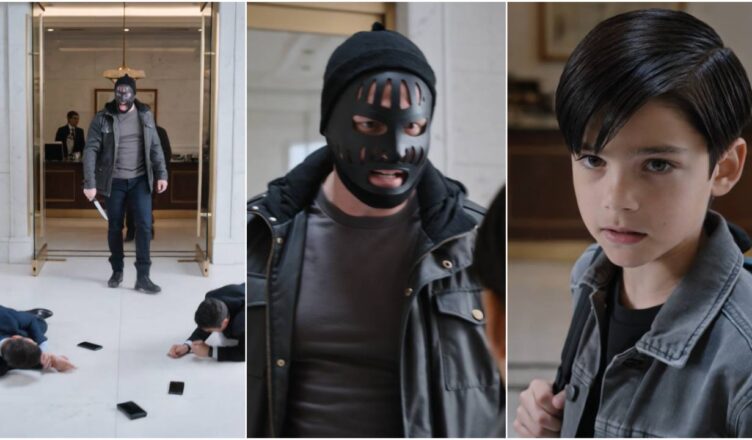
The Boy in the Marble Bank
The main branch of Harrington Trust stood in Philadelphia’s financial district like a building that did not believe in accidents.
Everything about it was controlled.
The glass walls were spotless. The white marble floors were polished until they reflected the ceiling lights in long, cold lines. The counters were brushed steel. The private offices were framed in dark walnut and frosted glass. Even the silence felt expensive.
At 2:17 on a Tuesday afternoon, that silence broke.
The front doors flew inward with a crash.
Two men stormed into the lobby wearing black masks and heavy jackets, moving with the wild, overcharged speed of men who had rehearsed only the first ten seconds of a crime. Their boots slapped against the marble. Their breathing was loud. In their hands were knives, bright under the fluorescent lights.
“Down!” the first robber screamed, waving the blade as clients and bankers cried out around him. “Everybody down now!”
The lobby exploded into panic.
A woman near the reception desk dropped her leather bag and threw herself to the floor. A silver-haired man in a navy suit crawled behind a column. A young banker raised both hands, shaking. Somewhere near the teller line, a glass of water tipped over and spread across the counter in a clear, trembling sheet.
The second robber rushed in behind the first, stockier and tense beneath his black mask and dark hoodie. He forced people lower with sharp, angry gestures.
“Hands where I can see them!”
Phones slid across the marble. A woman began crying into the sleeve of her blazer. A man whispered, “Please, please, please,” with his forehead pressed to the floor.
The first robber moved through the lobby like an animal trying to make himself larger. He kicked one phone aside, then pointed his knife toward the private banking offices.
Then he stopped.
In the center of the marble lobby, surrounded by terrified adults on the floor, one person was still standing.
A boy.
He looked about twelve.
Pale. Slim. Dark hair falling over his forehead. Gray jacket. Black jeans. Backpack strap over one shoulder. His hands hung loosely at his sides, and his eyes were fixed on the masked men with a calm that did not belong in a room full of screaming adults.
The first robber turned toward him, confused and angry.
“Why is that boy still standing?”
The boy did not move.
The crying did not stop. The breathing did not stop. But something in the fear changed. People who had been staring at the floor began looking up through their lashes.
The boy looked directly at the robber.
“Because this isn’t a robbery.”
The first robber took a step closer. His knife lowered slightly, but his shoulders stayed tight. Behind the mask, his eyes narrowed.
“Then what is it?”
The boy held his gaze.
In the background, some of the supposed hostages began lifting their heads. A woman in a cream-colored suit near the marble column shifted one hand beneath her jacket. The silver-haired man in the navy suit stopped shaking. A young banker behind the teller counter slowly turned his wrist toward the inside of his sleeve.
The boy’s voice stayed quiet.
“A trap.”
The robber’s eyes widened behind the mask.
For one breath, the whole bank seemed frozen.
Then the woman in the cream suit rolled onto one knee and drew a compact pistol from beneath her blazer.
“Federal agents!” she shouted. “Drop the knives!”
The silver-haired man rose beside the column, weapon trained on the first robber’s chest. The young banker at the teller counter drew his own gun and badge. A crying woman near the reception desk rolled behind cover and came up with a firearm in both hands.
Fear peeled away from the lobby like a costume.
The front doors sealed with a heavy hydraulic thud.
The security shutters behind the glass locked into place.
Red emergency lights washed over the white marble, turning the elegant bank into something cold, hard, and final.
“Knives down!” the woman in the cream suit ordered. “Now!”
The second robber spun toward the exit and stopped when he saw two more agents step out from behind the frosted glass office wall, weapons raised.
The first robber looked from the agents to the boy.
“You little—”
“Drop it,” the woman snapped. “Last command.”
For one second, it looked as if he might try anyway. His shoulders lifted. His knife hand tightened. His eyes searched for a gap.
There was none.
The knife clattered onto the marble.
The second blade fell a heartbeat later.
Agents moved in fast. The first robber was driven down onto the floor, wrists pinned behind his back. The second tried to twist away and was slammed against the base of a marble column before cuffs snapped shut around his wrists.
“Clear left!”
“Clear right!”
“Lobby secure!”
The boy stood exactly where he had been, his gray jacket untouched, his face still calm in a way that made the adults around him look more shaken by comparison.
The woman in the cream suit holstered her weapon and walked to him.
Her name was Special Agent Mara Voss. To everyone else in the lobby, she had spent the last hour pretending to be a frightened private banking client with too much jewelry and not enough courage.
To the boy, she was simply Mara.
“You okay, Owen?”
Owen Vale looked down at the place where the robber’s knife had flashed under the bank lights.
Then he nodded.
“I told you he’d come toward me first.”
Mara’s expression tightened.
“Yes,” she said. “You did.”
Across the lobby, one of the agents pulled the mask off the first robber.
Underneath was a rough white face, late thirties, shaved head, broken blood vessel in one eye. He glared at Owen with pure hatred.
“You little freak,” he spat.
Mara turned sharply.
“Keep him quiet.”
An agent pushed the man’s face toward the marble.
Owen did not react to the insult. He only looked at the robber, studying him with that same unsettling stillness.
“You work for Keller,” Owen said.
The robber’s face changed.
It lasted less than a second.
But Mara saw it.
So did every trained agent in the room.
The second robber, still on his knees near the column, snapped his head toward his partner.
“Shut up, Ray.”
Mara smiled without warmth.
“Well,” she said. “That saves us ten minutes.”
The silver-haired agent stepped closer.
“Names confirmed. Raymond Doss and Carter Whelan.”
Owen’s hand tightened around the strap of his backpack.
“Where is Keller?”
Raymond Doss laughed into the marble.
“You think we’re scared of some kid?”
Owen stepped closer.
Mara put a hand in front of him, not stopping him exactly, just reminding him he was not alone.
The boy’s voice stayed quiet.
“My mother was scared,” he said. “She still went to the police.”
Raymond said nothing.
The lobby seemed to shrink around the name that had not been spoken.
Owen’s mother, Rebecca Vale, had been a senior compliance analyst at Harrington Trust. She was not famous. She did not come from money. She wore old flats to work, packed leftovers for lunch, and kept a framed photograph of Owen beside her monitor.
Three months earlier, she discovered that millions of dollars were being washed through Harrington Trust’s private accounts—money routed through charities, shell companies, political foundations, and investment vehicles connected to judges, contractors, city officials, and men whose names never appeared on paper.
At first, she thought it was internal fraud.
Then she found the pattern.
The accounts were not simply hiding stolen money. They were paying people. Buying permits. Burying investigations. Moving funds through respectable institutions until crime looked like philanthropy.
Rebecca copied the files.
She hid one drive.
Then she died in what the first police report called a single-car accident.
Owen never believed that.
Neither did Mara Voss.
The problem was evidence.
Rebecca had been careful, but whoever killed her had been careful too. Her work laptop vanished before police reached the crash site. Her apartment had been searched without looking searched. Her phone was wiped clean. The official explanation came too quickly, wrapped in words like tragic and weather-related and loss of control.
Owen heard adults accept it because accepting it was easier.
He did not.
He had seen a face through the kitchen window the night before the crash. He had heard a voice on his mother’s phone when she thought he was asleep.
A man named Keller.
Not enough for court.
Enough for a trap.
The FBI leaked one piece of information through the right dirty channel: Rebecca Vale’s son would be brought quietly to the main branch of Harrington Trust to open a safe-deposit box his mother had left behind.
They emptied the branch before noon.
Every client after that was an agent.
Every teller was armed.
Every camera was live.
And Owen had insisted on standing in the lobby.
Mara had argued with him for twenty minutes in the armored van.
“You are twelve,” she had said. “You are not bait.”
“I’m the only thing they’ll move fast for.”
“That is exactly why you should not be exposed.”
“They won’t hurt me in the middle of a bank,” Owen said.
“You don’t know that.”
Owen looked out the tinted window toward the marble building.
“No,” he said. “But my mom knew they would come. She left the box under my name for a reason.”
Mara had hated the logic because it was too clean.
So they compromised in the most uncomfortable way possible: Owen would be visible, but never unprotected. The agents would control every exit, every camera, every line of movement. The robbers would be stopped before they got close enough to put a knife on him.
But the first robber had moved faster than expected.
And Owen had not flinched.
Now, standing under the red emergency lights while the two men were dragged upright, Owen looked smaller than he had moments earlier.
Twelve years old again.
A boy with no mother, no father in the picture, and a backpack full of schoolbooks he had not opened in weeks.
Mara crouched in front of him.
“You did enough,” she said.
Owen looked past her at Raymond Doss.
“No,” he said. “They know where the drive is.”
Raymond’s eyes flicked again.
This time toward the private vault corridor.
Mara saw it.
She stood.
“Lock down the vault wing. Now.”
Two agents moved immediately.
The second robber, Carter Whelan, began breathing faster.
“I want a lawyer,” he said.
“You’ll get one,” Mara replied. “After you tell us who sent you to grab the boy.”
“I don’t know anything.”
Owen looked at him.
“Yes, you do.”
Carter tried not to look back.
That made him look guilty.
The silver-haired agent leaned down beside him.
“Your partner just gave up the vault with his eyes. You want to be the last one useful in this room?”
Carter swallowed.
Raymond shouted, “Don’t say a word.”
Mara turned toward Raymond.
“You should worry less about him and more about yourself.”
Then her radio crackled.
“Voss, vault corridor. We found a maintenance access panel open behind the records room. Fresh tool marks.”
Mara’s face hardened.
“Keller has someone inside.”
Owen closed his eyes once, like he had expected that too and hated being right.
A muffled crash sounded from the back of the bank.
Every weapon in the lobby turned toward the vault corridor.
Mara grabbed Owen by the shoulders and moved him behind the marble reception desk.
“Stay down.”
This time, he obeyed.
Agents flooded toward the corridor. A man in a Harrington Trust maintenance uniform burst out from the side hall and tried to run across the lobby. He was carrying a black hard case.
He made it six steps.
The woman in the cream suit tackled him cleanly at the knees. The case slid across the marble and stopped near Owen’s shoes.
The man hit the floor hard, cursing.
Mara kicked the case away and pinned him with her weapon.
“Hands where I can see them!”
The maintenance man went still.
Owen stared at him.
Then at the case.
“That’s hers,” he said.
Mara looked down.
The black hard case had a small strip of blue tape wrapped around the handle. Written on it in Rebecca Vale’s neat black marker were three words.
For my son.
For the first time all afternoon, Owen’s face changed.
His mouth parted slightly. His eyes brightened with something he fought hard to hold back.
Mara picked up the case carefully and handed it to the evidence technician.
“Nobody opens that until it’s logged.”
Owen nodded, but he was no longer looking at the case.
He was looking at the maintenance man.
“Who is Keller?” Owen asked.
The man said nothing.
Mara stepped closer.
“You just got caught stealing federal evidence during an armed kidnapping attempt inside a secured crime operation. Whatever Keller promised you, he cannot protect you from this room.”
The maintenance man’s face shone with sweat.
Raymond Doss was silent now.
Carter Whelan looked like he might be sick.
The maintenance man closed his eyes.
“Elias Keller,” he whispered. “He runs private security for Northbridge Capital.”
Mara’s gaze sharpened.
“Northbridge Capital launders through Harrington?”
The man nodded once.
“Where is Keller?”
The man opened his eyes and looked toward the glass doors.
“He’s outside.”
The lobby went silent.
Mara touched her earpiece.
“All units, suspect Elias Keller may be on-site. Perimeter status.”
A pause.
Then a voice answered.
“Black town car pulling away from curb on Market Street. Tinted windows. No plates.”
Mara’s face changed.
“Stop that car.”
Outside, through the sealed glass, Owen saw movement beyond the rain-streaked doors. Agents in plain clothes turned. A vehicle at the curb surged into traffic.
Then came the sound of tires screaming.
A black town car fishtailed across the wet street, clipped a delivery bike, and slammed sideways into a concrete planter half a block away.
Agents swarmed it.
Owen watched through the glass as a tall man in an expensive coat was pulled from the back seat and forced onto the pavement.
For the first time, Owen’s stillness broke.
He stepped forward.
Mara put a hand on his shoulder.
“Is that him?”
Owen looked at the man outside.
The face was older than the voice he remembered. Thinner. Calm even with his cheek pressed against the wet street.
But Owen knew.
He had heard that voice through his mother’s bedroom door.
Don’t make this harder than it has to be, Rebecca.
Owen nodded.
“That’s Keller.”
Mara exhaled once, slowly.
Then she looked at the agents holding Raymond Doss and Carter Whelan.
“Take them alive,” she said. “I want every name.”
Owen did not speak.
He did not need to.
An hour later, after the lobby lights had returned to their cold white glow and the fake hostages had become federal agents writing reports, Owen sat alone in a private office with a cup of water he had not touched.
The black hard case sat on the table in front of him, sealed inside a clear evidence bag.
Mara stood by the window, watching rain slide down the glass.
“We’ll process it tonight,” she said. “If your mother put what we think she put in there, this goes much higher than Keller.”
Owen nodded.
He looked exhausted now.
Not mysterious.
Not frightening.
Just a child who had spent too long acting like he had no right to fall apart.
Mara sat across from him.
“You scared those men,” she said.
Owen looked up.
“I wasn’t trying to.”
“I know.”
“I just wanted them to stop pretending they were in control.”
Mara studied him for a moment.
Then she said, “That sounds like something your mother would’ve liked.”
Owen looked down quickly.
His eyes filled before he could hide it.
For a few seconds, he fought it with the same discipline he had shown in the lobby. Then his face broke, silently at first, then all at once. He covered his mouth with one hand, shoulders shaking.
Mara did not tell him to be strong.
She did not tell him it was over.
She only moved around the table and sat beside him.
Outside the office, agents walked across the marble lobby carrying evidence boxes, laptops, sealed folders, and the names of men who had believed money could turn murder into paperwork.
Owen cried until he had nothing left.
When he finally wiped his face, the rain had stopped.
The city beyond the glass looked sharp and clean under the evening lights.
The hard case was opened that night in an evidence room under three cameras.
Inside was the drive Rebecca had hidden, along with printed account charts, handwritten notes, and a letter addressed to Owen.
Mara did not read the letter first.
No one did.
She brought it to him sealed.
His aunt sat beside him in the interview room, one arm around his shoulders, while Owen opened the envelope with hands that shook for the first time all day.
My brave boy,
If you are reading this, it means I was right to be afraid, and I am so sorry.
I wanted to keep you far away from all of this. I wanted you to be twelve. I wanted you to worry about homework and cereal and whether your sneakers looked stupid. But the world does not always let mothers choose what their children have to survive.
So I need you to know something.
You are not responsible for fixing what adults broke.
If this drive helps, good. If it doesn’t, you still did enough by being my son. That was always enough.
I love you more than every file, every truth, every dangerous thing I tried to carry.
Do not let them make you hard forever.
Mom
Owen read the letter twice.
Then he folded it carefully and held it against his chest.
The investigation did go higher.
Much higher.
Keller cooperated after two nights in federal custody and the discovery that Northbridge’s attorneys had already decided he was expendable. Raymond Doss and Carter Whelan identified the man who had paid them to stage the bank robbery and grab Owen before he reached the vault. The maintenance worker gave up the internal contact at Harrington Trust who had left the access panel open.
By the end of the month, three executives resigned.
By Christmas, two were arrested.
By spring, the scandal had reached judges, city contractors, private equity partners, and a former deputy mayor who insisted on camera that he had done nothing wrong until prosecutors released Rebecca Vale’s spreadsheets with his initials on seven wire approvals.
The news called her a whistleblower.
Owen hated that word at first.
It sounded too small for what she had been.
She was his mother.
She burned toast. She forgot where she put her keys. She sang badly when she cleaned. She fell asleep on the couch with work papers in her lap and woke up apologizing like sleep was a failure.
She was not a symbol to him.
She was the person who used to kiss his forehead before leaving for work.
But one afternoon, Mara drove him past the federal courthouse after another deposition, and Owen saw a group of Harrington Trust employees standing outside holding candles. One of them held a photograph of Rebecca. Another held a sign that said, She told the truth.
Owen watched through the car window.
For the first time, the word whistleblower did not feel like it had taken her away from him.
It felt like it had given part of her back to the world.
Months later, Owen returned to the bank.
Not the main lobby. That branch stayed closed during the federal review. The marble floors were covered with paper, the private offices stripped of files, the frosted glass doors marked with evidence tags.
Mara met him outside on Market Street.
“You sure?” she asked.
Owen nodded.
His aunt waited in the car, giving him the choice without pretending it was easy.
Inside, the lobby was empty.
No screaming. No knives. No agents pretending to be afraid.
Just silence.
Owen stood in the center of the white marble floor where he had once faced two masked men and told them the truth before they understood the room had already turned against them.
Mara stood beside him.
“They’re turning this branch into a public financial crimes unit,” she said. “Different agency partnership. Training, investigations, victim support.”
Owen looked around.
“My mom would like that.”
“I think so too.”
He walked to the place where the black case had slid across the floor and stopped at his feet.
For a moment, he could still see it there.
Blue tape.
For my son.
His throat tightened, but he did not cry this time.
Mara watched him quietly.
After a while, Owen said, “I was scared.”
“In the robbery?”
He nodded.
“I looked calm because I kept thinking if I moved, they’d know.”
Mara’s face softened.
“Owen,” she said, “being scared does not mean you weren’t brave.”
He looked down at the marble.
“My mom used to say that.”
“She was right.”
Outside, Philadelphia moved on. Cars passed in the wet street. People hurried under umbrellas. Somewhere down the block, someone laughed too loudly into a phone.
The world had not stopped for Rebecca Vale.
But it had been forced to listen.
Owen took one final look at the lobby.
Then he turned and walked out with Mara beside him.
At the curb, his aunt opened the car door and reached for him.
This time, Owen did not hesitate.
He ran into her arms.