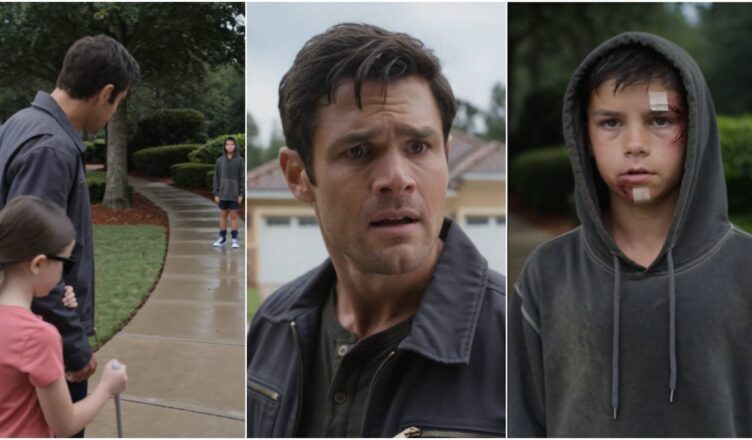
The late-afternoon light over Fieldstone Ridge had that polished, golden look expensive neighborhoods always seemed to wear best. It slid over stone mailboxes, blacktop driveways, white porch columns, and the neat green sweep of lawns trimmed within an inch of perfection. Somewhere behind the houses, a lawn sprinkler ticked in slow, steady turns. Farther off, children shouted over the rise of a fenced backyard trampoline. The subdivision outside Franklin, Tennessee, looked like the kind of place where trouble would feel out of place just standing on the curb.
Ben Rowan used to believe that.
Now, even on a quiet street with his daughter’s hand tucked into his, he had learned not to trust appearances.
Lucy walked carefully beside him, the rubber tip of her white cane tapping the edge of the sidewalk in a small practiced rhythm. She was nine, all fine wrists and serious little shoulders, with dark glasses covering half her face and a braid lying against the back of her pink T-shirt. She had once run everywhere, usually faster than the moment required. Then eight months earlier, after one terrible afternoon and a collapse in a pharmacy parking lot, her world had supposedly gone dark.
The first ER doctor had called it possible post-traumatic visual impairment. A neurologist had used longer phrases that only made Ben feel dumber: cortical involvement, delayed recovery, inconclusive markers, uncertain prognosis. There had been scans, referrals, mobility training, special school accommodations, and the slow, humiliating death of hope. Ben had spent spring and most of summer on storm-repair crews after the tornadoes, sleeping in motels, climbing poles, sending money home, and trusting the updates Claire gave him over the phone.
Claire handled the appointments. Claire kept the records. Claire highlighted the bad parts and said they needed to focus on reality.
“Dad?” Lucy tipped her face toward the warmth. “Can we sit on the bench by the pond for a minute?”
Ben glanced at her. “Tired?”
She smiled a little. “No. I just like the sun.”
His throat tightened in that old familiar way. “Yeah,” he said. “Me too.”
They were halfway to the pond when a boy’s voice came from ahead of them.
“Your little girl can see.”
Ben stopped so fast Lucy’s cane tapped into his boot.
A boy stood beside the neighborhood walking trail sign. He couldn’t have been older than ten or eleven. His T-shirt was dingy and too big, one sleeve stretched out at the collar. His jeans were frayed at both knees, and his sneakers looked like they had long ago stopped pretending to keep water out. His hair needed cutting. His face needed a good meal and an honest bed.
But his eyes were steady in a way that made Ben instantly wary.
Lucy turned her face toward the voice. “Dad?”
“It’s okay,” Ben said, though it wasn’t. He shifted slightly, putting himself between her and the boy. “You lost?”
The boy didn’t answer the question. He looked at Lucy, then at the cane in her hand, then back at Ben.
“I said she can see.”
Ben felt irritation arrive first, sharp and hot, because anger was easier than the sudden cold unease that followed it. “That’s enough.”
The boy didn’t move. “You ever wonder why she only misses things when your wife’s around?”
Ben stared at him.
The sprinkler somewhere behind the houses kept ticking.
“What did you say?”
The boy shoved his hands into his pockets. “Ask yourself why she never clips the curb unless somebody’s watching. Ask yourself why she reaches straight for things when she thinks nobody’s paying attention.”
Lucy’s fingers tightened around Ben’s hand.
Ben took one step forward. “Listen to me. You don’t know my family, and you don’t get to come up to a child and say—”
“It’s your wife,” the boy said flatly. “She’s the one making her do it.”
For one suspended second Ben could only hear his own pulse.
Then he laughed once, hard and disbelieving. “You need to keep walking.”
The boy’s expression didn’t change. “Wrong question anyway.”
Ben frowned. “What?”
“Not who I am.” The boy glanced at Lucy again, and something almost human, almost sad, passed over his face. “Why your daughter only makes mistakes on cue.”
Ben wanted to grab him by the shirt and demand an explanation. Wanted to drag him to the nearest porch camera and call the police. Wanted, irrationally, to hear one more detail and have all of this suddenly make sense.
Instead he said, “Where did you hear that?”
“I didn’t hear it.” The boy stepped back toward the trail. “I noticed it.”
Then he turned and walked away.
“Hey!” Ben called.
The boy didn’t run. He just cut down the trail between magnolia trees, slipped past the pond fence, and was gone.
Lucy tugged at Ben’s hand. “Who was that?”
Ben looked at the empty trail opening. “I don’t know.”
But all the way home, one line kept scraping across the inside of his skull.
Why your daughter only makes mistakes on cue.
That night he stayed awake long after Claire had fallen asleep beside him.
She had been the one who held the house together after Lucy’s diagnosis. She had quit her job at the title company, organized specialists, filled color-coded binders, learned insurance language, sat on hold with clinics, argued with school administrators, and still found the strength to smile at Lucy like the world was manageable. Ben had loved her for that. Maybe he had needed to love her for that. Life was easier when one person in a marriage still looked like they knew what to do.
At 2:11 a.m., he got out of bed.
Lucy’s door was cracked open. A soft plug-in light glowed amber against the baseboard. Ben stood there for a moment feeling foolish, ashamed even. A ragged stranger says something cruel on a sidewalk, and suddenly a father is sneaking around his own house like a thief.
He was about to turn away when Lucy moved.
Not the loose shifting of a sleeping child.
Her blanket had slipped off one shoulder. Without opening her eyes, she reached up and caught the fabric cleanly between two fingers, then pulled it back into place with easy precision. No searching. No fumbling. No blind guess.
Ben’s mouth went dry.
He leaned closer. “Lucy?”
Her eyes opened.
And landed directly on him.
Not toward the sound of his voice.
On him.
Ben felt something inside him drop hard and fast.
Then Lucy blinked, and her expression changed as if she had remembered herself.
“Daddy?” she whispered. “Is that you?”
He could barely get the words out. “Yeah, sweetheart.”
“I had a bad dream.”
“It’s okay.” His voice sounded strange in his own ears. “Go back to sleep.”
She nodded and rolled over.
Ben stood there in the half-light with the sick certainty that the street-boy had not been guessing.
The next morning at breakfast, Claire hummed softly while she buttered toast. Lucy sat at the kitchen island with her glasses on, her cane leaning against the stool. The scene looked so ordinary it felt staged.
“Ben?” Claire set a plate in front of him. “You’re quiet.”
“Just tired.”
Lucy smiled in his direction. “Dad, can you pass the orange juice?”
The glass sat slightly to her left.
Ben didn’t move.
A second passed. Then another.
Lucy’s hand lifted and hovered in the air. For the briefest moment it seemed to pause, as though waiting for instruction. Then it adjusted and went cleanly toward the glass. Her fingers wrapped around it before she should have found it.
Claire glanced over from the counter. “Everything okay?”
Ben looked at her and, for the first time in years, could not read what lived behind her face.
“Yeah,” he said. “Fine.”
It wasn’t.
Later that afternoon, while Claire was in the shower and Lucy was doing an audiobook lesson in her room, Ben opened the family iPad on the kitchen desk. Claire used it for school emails and prescriptions. He didn’t know exactly what he was looking for, only that panic had started to sharpen into purpose.
The patient portal was already logged in.
He clicked through ophthalmology notes, neurology follow-ups, referrals, scanned attachments.
And there it was.
A report from six months earlier from Vanderbilt Pediatric Neuro-Ophthalmology.
Visual tracking normal.
Pupillary response normal.
No structural or functional evidence of permanent blindness.
Recommend psychological evaluation regarding coached symptom presentation if inconsistencies persist.
Ben read it once.
Then again.
There were two more notes after that, both cautious, both clear in the ways that mattered. Lucy was not blind.
Claire had told him those appointments had “confirmed the worst.”
His hands were shaking by the time he reached Lucy’s room.
She was sitting cross-legged on the rug with her stuffed rabbit in her lap. Her glasses were off. Sunlight from the window caught in her eyes before she lowered them.
“Hey, baby,” Ben said.
She knew at once from his voice that something had changed.
He closed the door behind him and knelt in front of her. “I need you to tell me the truth.”
Her fingers tightened around the rabbit’s ear.
“Can you see?”
The room went still.
Lucy swallowed. Her chin trembled. For a long moment, she didn’t answer at all.
Then, very slowly, she nodded.
Ben closed his eyes.
He had imagined rage. Instead what hit him first was grief—raw, total, bewildered grief for months he would never get back, for fear he had lived inside, for the part of his daughter that had been made to carry something too heavy for a child.
“When?” he asked hoarsely. “Since when?”
“Almost the whole time.” Tears slid down her face. “It was blurry at first. Then it got better.”
“Why didn’t you tell me?”
Lucy looked terrified now. “Mom said I couldn’t.”
Ben sat back on his heels. “Why?”
“She said the man from the parking lot would know I saw him.”
Ben felt the room seem to shift around him.
“What man?”
Lucy began to cry in earnest. “The one in the SUV. The one with blood on his hand.”
Ben stared at her.
“He looked right at me,” she whispered. “Mom said if he found out I could still see, he’d come back.”
The shower shut off down the hall.
Ben rose slowly, every nerve inside him tightening.
Claire was toweling her hair dry when she stepped into the kitchen and found him standing there with the printed medical notes in one hand.
For one second her face emptied completely.
Then she saw Lucy in the hallway behind him and understood.
“Ben—”
“You lied to me.”
Claire’s eyes closed.
“Six months,” he said. “Six months of reports saying she can see, and you looked me in the face every day and told me she couldn’t.”
Claire set the towel down with deliberate care, as if sudden movement might break something already cracked beyond repair. “Not because I wanted to hurt her.”
“Then why?”
Her gaze flicked toward Lucy. “Go to your room, baby.”
Lucy didn’t move.
Ben said, “No. Not this time.”
Claire looked at him then, and whatever he had expected—defensiveness, denial, manipulation—what he saw instead was exhaustion. A level of fear so old it had gone quiet.
“Eight months ago,” she said, “I stopped at the Greenway Pharmacy in Antioch after ballet. Lucy was in the passenger seat. There was a dark SUV parked two spaces over. I thought a couple was fighting.” Claire’s voice shook once, then steadied. “They weren’t fighting. The woman in the passenger seat was trying to get out. The man pulled her back in.”
Ben said nothing.
“Lucy saw his face when the dome light came on. So did I.” Claire swallowed. “I grabbed Lucy, and she twisted away from me and fell on the curb. Hit the back of her head. She started crying that everything looked wrong, that the light was smeared. At the hospital they said she might have lasting visual damage. Two days later I gave a statement to Metro police.”
She laughed once without humor. “That night I got a blocked call. A man described Lucy’s room. Her quilt. The stuffed rabbit she slept with. He said, ‘Blind girls don’t identify people.’”
Ben felt a deep, deliberate cold settle in his chest.
“I thought it was someone trying to scare me,” Claire said. “Then another call came after my second interview. Then a car sat across from the house for three nights. I went back to the detective, and two hours later another caller repeated part of my statement word for word.” She looked at him. “Somebody in that department was leaking.”
Ben said, “So you lied to me?”
“I hid the updated reports,” she said. “At first I thought it would be for a week or two. Long enough for the story to die. Long enough for whoever he was to stop paying attention. But the case never aired right, the woman vanished, and the calls didn’t stop.” Her voice broke. “I told myself a blind child was a useless witness. I told myself if he believed she couldn’t identify him, he’d move on.”
Lucy had crept close enough to clutch the back of Ben’s shirt.
Ben turned on Claire with a fury that made even him sound unfamiliar. “You turned our daughter into a prisoner in her own body.”
Claire flinched. “I know.”
“You made her lie to her father.”
“I know.”
“Why not tell me?”
Claire’s answer came fast, almost angry now from the force of long-contained terror. “Because you would have gone to the police. Or to the press. Or to one of your cop buddies from high school. You would have kicked in the wrong door trying to protect us, and if I was right about the leak, you would have gotten us killed.”
The kitchen fell silent.
Ben hated that part of him understood.
He hated it more because understanding did not soften what she had done.
That evening, after Lucy finally slept, Ben drove back to the trail by the pond and kept going until he found the church food pantry two miles away, the one with volunteers loading canned goods into trunks on Thursdays. He didn’t know why he was there. Instinct, maybe. Boys like the one on the sidewalk always seemed to live just outside the places respectable neighborhoods pretended not to notice.
He found him sitting on the low stone wall behind the fellowship hall, eating crackers from a plastic sleeve.
The boy looked up without surprise. “Took you long enough.”
Ben stopped a few feet away. “Who are you?”
The boy brushed salt from his fingers. “Eli Vale.”
The name hit Ben a second later.
There had been a flyer tucked inside Claire’s hidden file folder. Tessa Vale, twenty-eight, missing. Last seen leaving Greenway Pharmacy.
“My mom was the woman in the SUV,” Eli said.
Ben went still.
“She never came home.” Eli’s jaw tightened, but his voice stayed flat. “Police said they were working the case. Then they stopped calling back. My grandma got sick. Then she died. My aunt took me for a while. Then she didn’t.” He shrugged like it meant nothing. “I saw your wife at the station once. Later I saw your girl at Kroger reading the word barbecue off a chip bag when your wife walked away. Then your wife came back and told her, ‘Glasses on. Cane in your left hand.’ So yeah. I noticed.”
Ben sat beside him on the wall because his knees had suddenly lost interest in supporting him.
Eli pulled a crumpled photograph from his pocket and held it out. It showed a man climbing from an SUV at night, blurred by distance but not enough to miss the heavy silver ring on one hand—snake coiled around the finger.
“My mom texted me this two hours before she disappeared,” Eli said. “She said, ‘If anything happens to me, remember the ring.’”
Ben took the photo.
Lucy’s whisper came back to him.
The man from the parking lot.
The one with blood on his hand.
The next morning, before sunrise, Ben had a bag packed, Lucy dressed, Claire pale and silent at the kitchen table, and a plan to drive straight past Metro and county lines to the Tennessee Bureau of Investigation field office in Jackson. Not local police. Not friends. Not favors. Something clean or as close to clean as he could get.
He had just locked the back door when the motion light by the porch snapped on.
A manila envelope sat on the welcome mat.
No one had heard a car.
Ben picked it up and opened it carefully.
Inside was a glossy photograph of Lucy in their backyard from the day before, standing in profile beneath the maple tree.
On the back, printed in block letters, were seven words.
YOU SHOULD HAVE LEFT HER BLIND.
Claire made a sound Ben had never heard from a human throat.
Lucy looked up at him from the doorway, small and frightened and fully seeing.
Ben folded the photo, slid it into his pocket, and reached for his daughter’s hand.
Only then did he understand the boy on the sidewalk had not brought danger into his life.
He had only pointed at where it had been standing all along.