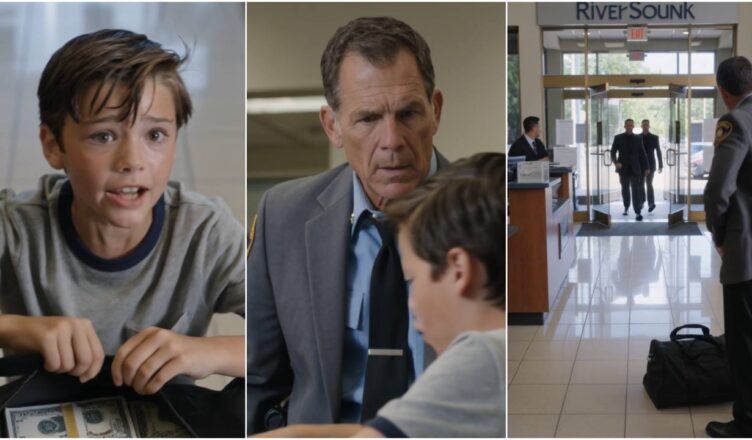
The first thing Frank Hollis noticed was how fast the boy was moving.
Kids came into the RiverSouth Bank branch all the time—dragged in by parents, bored into silence, sticky from summer snacks, too young to understand why money made adults so tired. They wandered. They stared at the candy dish. They asked whether the pens were free.
This boy came through the glass doors like he was already late for something terrible.
It was a little after three on a Tuesday, the hottest part of a Charlotte afternoon. The outer doors sighed open, letting in a wave of heat from Tryon Street before the air-conditioning swallowed it. Inside, the bank was all quiet order: soft keyboard clicks behind the teller line, the printer humming in the back office, customers standing in patient little clusters under recessed lighting.
Frank stood near the entrance in a gray security blazer with his badge clipped to the chest pocket. Before RiverSouth, he had spent twenty-four years with the sheriff’s office. He knew the difference between confusion, panic, and trouble.
The boy walking toward him was trouble.
He looked twelve, maybe. Thin, dark hair damp with sweat, gray T-shirt, jeans, sneakers powdered with dust. He was carrying a black duffel bag in both hands. Not dragging it. Carrying it. It looked heavy enough that his shoulders had started to shake.
He stopped right in front of Frank and spoke before Frank could ask a single question.
“I have one million dollars in this bag,” the boy said. “Two men in black are about to come in after me. When they do, lock the doors behind them, point your gun at them, and call the police. They don’t have weapons. I know they don’t. Please don’t waste time.”
For a second Frank just looked at him.
Not because the words were unbelievable—although they were—but because of the way the boy said them. No drama. No wild eyes. No performance. Just raw urgency held together by discipline that did not belong on a child’s face.
“What’s your name?” Frank asked.
“Noah Mercer.”
“Who are the men?”
“They work for Victor Shaw.”
“That doesn’t tell me much.”
“It’ll tell the police enough.”
Frank held his stare. “How do you know they’re unarmed?”
“I watched them lock both pistols in the console of a black Yukon two blocks away,” Noah said immediately. “They were arguing about it. Victor said no guns in a bank, not downtown, not with cameras everywhere. They’re right behind me.”
Frank’s hand moved to the radio on his shoulder, but he still hadn’t committed. Not yet.
Then Noah dropped the duffel onto the polished floor, yanked the zipper open six inches, and tilted it just enough.
Frank saw bundled hundreds.
Brick after brick of them.
Noah zipped it shut again.
That was enough.
Frank keyed his radio. “Tessa,” he said, his voice suddenly flat and official, “I need vestibule lock on my mark. Silent alarm now. Tell the tellers stay calm and step back from the line.”
There was a beat of silence from the manager’s office.
Then Tessa Morgan said, “Frank?”
“Do it.”
Something in his tone made her stop asking questions.
The branch had two sets of security doors: an outer pair facing the sidewalk and an inner pair leading into the lobby. In an emergency, the small glass vestibule between them could be locked from the manager’s desk. Frank had worked there almost three years and had never once needed it.
Noah’s chest was rising and falling too fast now. Adrenaline had finally caught up with him.
Frank lowered his voice. “When they come in, I need you visible. If they don’t see you, they may not follow.”
Noah nodded once.
“You can do that?”
Another nod.
Frank moved him three feet to the right, near the reception counter but still in clear sightline from the doors. Then he rested one hand just above his holster and watched the sidewalk through the glass.
The outer doors opened.
Two men stepped inside the vestibule.
Both wore dark suits despite the heat. One was older, broad through the chest, silver at the temples, with the polished calm of a man who had spent years talking his way through bad situations. The other was younger and narrower, clean-shaven, sharp-faced, his expression blank in a way that felt practiced.
The older man saw Noah first.
Then he saw Frank.
Then he saw Frank’s hand near the holster and the boy standing beside an armed guard instead of walking toward the curb with the bag.
His face changed.
Not panic. Worse.
Calculation.
He turned slightly to step back out, but the outer doors had already sealed behind him.
Frank said into the radio, “Now.”
The inner doors clicked locked.
The outer doors deadlocked a split second later.
The vestibule became a glass box.
Frank drew his pistol and leveled it through the glass.
“Hands up!” he shouted. “Both of you! Right now!”
The bank changed all at once.
A woman in line gasped and backed into a brochure stand. Someone dropped a folder. One teller ducked instinctively, then rose halfway back up, unsure whether to hide or help. Tessa appeared at the far end of the lobby with one hand still on the lockdown panel, pale and rigid.
Inside the vestibule, the younger man’s hands went up first.
The older man tried charm.
“Officer,” he said, calm as a dinner host, “you’re making a mistake.”
“On your knees.”
“This boy is upset.”
“Knees.”
The older man did not move. He looked through the glass at Noah, and for the first time there was something open in his face. Not anger. Not fear. Betrayal, maybe. The cold, offended disbelief of a man who had expected obedience and found strategy instead.
Noah’s voice came out rough but steady.
“His name is Victor Shaw.”
That did it.
The younger man dropped to his knees immediately. He could read a room. He saw the cameras, the customers on their phones, the silent alarm they were all too late to stop.
Victor held out two more seconds.
Then he went down too.
Frank kept the gun trained until Charlotte-Mecklenburg officers came through the employee entrance ninety seconds later with rifles and body armor. The arrest itself took less than thirty seconds. Victor Shaw and his fixer, Reed Sloan, were cuffed, searched, and removed one at a time. Noah had been telling the truth: neither man carried a weapon.
Only after the vestibule was cleared did Frank glance back at the boy.
Noah was no longer standing.
He had sunk to the floor beside the reception counter, shoulders against the wood, the duffel still clutched in both hands as if letting go of it might undo everything he had just done.
Frank knelt beside him.
“It worked,” Frank said. “You hear me? It worked.”
Noah nodded, but his eyes were unfocused.
“Are they your family?” Frank asked.
“No.”
“Then who’s in danger?”
Noah swallowed.
“My mom,” he said. “And my sister.”
They moved him into the branch manager’s office and shut the door. Tessa brought water. Frank stayed by the wall. Two detectives arrived within minutes, one of them a woman in a navy suit with a yellow legal pad and the practical, unhurried face of someone who knew how to speak to frightened people.
Her name was Detective Laura Bennett.
She pulled up a chair and sat across from Noah.
“You did the right thing,” she said. “Now I need the whole thing.”
For the first few seconds, Noah stared at the paper cup in his hands.
Then he began.
His mother’s name was Lena Mercer. She had worked for Shaw Recovery Group, a disaster-remediation company that specialized in emergency cleanup after floods, storm damage, chemical spills, and structural collapses. On paper, it was a respectable business. The kind with municipal contracts, clean trucks, and men in reflective vests on local news after hurricanes.
Off paper, according to Lena, it ran a million-dollar cash reserve.
Not for payroll. Not for emergency equipment.
For bribes.
Inspectors, subcontractors, fake labor crews, signatures that needed buying, files that needed vanishing. Lena had spent six months quietly copying records after she realized the books weren’t messy by accident. Then she made the mistake of letting Victor Shaw understand she was no longer afraid of what she knew.
“She thought he might try something,” Noah said. “That’s why she moved the money.”
Months earlier, Lena had rented a storage unit under a different name on the west side of the city. Inside it, hidden behind old furniture pads and paint cans, she placed a commercial fire safe bolted to a steel plate. The safe held two things: one million dollars in cash from Shaw’s off-books reserve, and a flash drive containing copied ledgers, contract files, shell-company payments, and internal emails.
Detective Bennett asked the obvious question.
“If your mother hid it, why did Shaw need you?”
“Because she made me set the code,” Noah said.
Bennett stopped writing.
“What?”
Noah looked up at her for the first time.
“She told me not to tell anybody. Not even her. She said if she knew the code, then someone could make her give it up. So I picked six numbers I’d never forget, and she never asked what they were.”
That landed in the room with a strange kind of force. Frank felt it too. The cold practicality of it. The way fear had already been living in that family long before today.
Victor Shaw and Reed Sloan had taken Lena and Noah’s seven-year-old sister, Lucy, the night before. They grabbed them from a motel outside the city after Lena moved there when she realized someone had been sitting in a black SUV outside Noah’s school for two straight afternoons. Noah had been at a basketball clinic when they took them.
When he got back to the house, Victor called from his mother’s phone.
“They made me meet them at the motel first,” Noah said. “They wanted me to see Lucy and my mom alive.”
That was how he knew where they were being held.
The Graystone Motor Lodge. Room 214.
He said it clearly. Detective Bennett wrote it down and, without interrupting him, slid the note to the uniformed officer at the door. The officer was gone in two seconds.
Noah continued.
Victor and Reed drove him from the motel to the storage facility and made him open the safe. Reed watched from the unit doorway. Victor stayed in the Yukon at first, then came in when Noah got the code right on the first try. The cash was packed in bank straps inside sealed plastic bundles. Reed shoved the money into the black duffel. Victor took the flash drive but didn’t check whether the files were readable.
Then they changed the plan.
Originally they were going to take the bag from Noah right there and leave him. But Victor saw two facility cameras above the lane and a patrol car rolling slowly at the far end of the block. He decided to move the handoff downtown, where they planned to switch vehicles in a parking garage and disappear into traffic before anyone connected the money to Shaw Recovery.
“They made me carry the bag from the garage entrance,” Noah said. “Victor said a kid with a gym bag doesn’t draw eyes. Two men in suits do.”
So they parked two blocks away. Victor put both guns in the Yukon’s locked console. Reed argued. Victor shut him down.
No guns. Not downtown. Not with this much glass around.
Then they sent Noah ahead.
That was when he saw RiverSouth.
Glass front. Cameras. Armed guard. Plenty of witnesses.
And something else: he remembered the last thing his mother had managed to tell him when Victor let her speak for three seconds on speakerphone at the motel.
“If they make you move it,” she said, “do it where people can see.”
Noah looked at Frank then.
“That’s why I came in here.”
The room went quiet.
Bennett asked one more question, softly this time.
“Why didn’t you just hand them the money? Why risk it if your mother and sister were still with them?”
Noah’s answer came immediately.
“Because my mom said they weren’t going to let us walk anyway.”
No one in the office said anything for a moment after that.
By the time Bennett stood up, a raid team was already rolling toward the Graystone Motor Lodge.
The rest happened fast.
The officers hit Room 214 less than twenty minutes later. Lena Mercer and little Lucy were found alive inside, both tied to separate chairs but otherwise unhurt. A third man sitting guard in the adjoining room tried to run through the back breezeway and made it six steps before officers put him on the concrete.
Victor Shaw and Reed Sloan were transported separately.
The million dollars never left the bank.
When detectives inventoried the duffel, they found more than cash. Victor had taken one flash drive from the safe, but Lena had been smarter than he was. Sewn into the inner hem of the duffel’s shoulder strap was a second drive—an automatic backup she had prepared weeks earlier, just in case the first one vanished or was destroyed. That second drive held enough records to turn a kidnapping case into a full financial-crimes investigation by nightfall.
By evening, federal agents were in the building.
By morning, search warrants were being served at Shaw Recovery offices in two states.
Three days later, Lena Mercer came back to RiverSouth with both children.
She looked like somebody who had aged five years in a week. There were bruises she couldn’t quite cover, and the kind of careful, exhausted posture people had after living too long in anticipation of the next bad thing. But she walked through the bank doors with Lucy holding one hand and Noah close at her side.
Frank was by the entrance.
For a second Lena just stood there, looking at him.
Then she said, “You listened.”
Frank glanced at Noah.
The boy had changed clothes. Clean jeans. Ball cap. Fresh sneakers. He looked more like twelve than he had that afternoon. Smaller somehow. Lighter. But not soft. Whatever had happened this week had burned something permanent into him.
Frank said, “He made it easy.”
Noah gave the smallest shrug.
“My mom came up with the important part.”
Lena laughed once, unexpectedly. It broke in the middle and turned into tears.
Lucy leaned into her side. Noah put a hand on her back without thinking, the way older brothers do when childhood gets interrupted too early and never quite goes back to normal.
Outside, traffic kept moving. People hurried past with coffee cups, dry cleaning, groceries, problems of their own. The city had already started forgetting.
Inside the glass doors of RiverSouth, nobody who had been there that afternoon forgot anything.
Not the look of the duffel hitting the floor.
Not the older man in the dark suit realizing too late what kind of place he had walked into.
Not the boy who came in carrying a million dollars and enough fear to flatten a grown man, then went straight to the one person in the room with a gun and said exactly what needed to happen.
Later, when reporters called it brave, Frank never liked the word.
Brave made it sound clean.
What Noah Mercer had done didn’t feel clean. It felt desperate, intelligent, and horribly necessary—the kind of decision a child should never have to make and made only because his mother had taught him one hard truth before the world turned ugly:
if dangerous men ever forced you into the dark, your best chance was to drag them back into the light.