The Goldfish Confession
“I did something bad,” the little girl whispered, “but I don’t want to go to jail.”
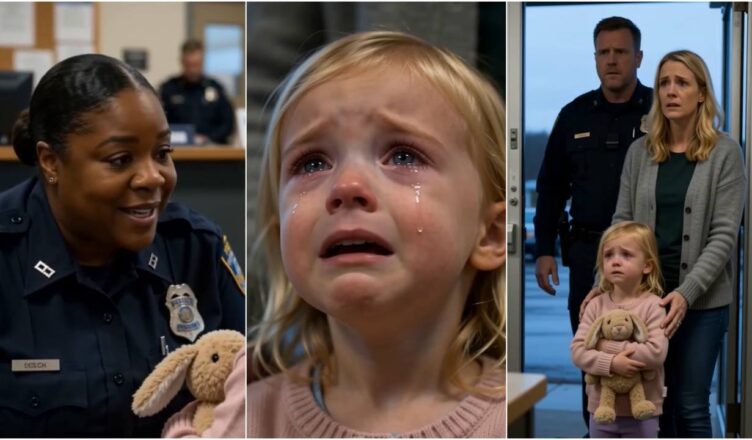
Every head in the front office of the Pine Harbor Police Department turned.
It was late afternoon in coastal Maine, the hour when the sky outside the glass doors turned the color of cold steel and the station smelled faintly of coffee, wet coats, and copy paper. A dispatcher sat behind the counter with a headset over one ear. Two patrol officers were finishing reports near the back wall. The old clock above the bulletin board ticked louder than it needed to.
Standing just inside the entrance was a child who looked far too small to be carrying so much fear.
She couldn’t have been more than three.
She had blonde hair, tearful blue eyes, red cheeks, yellow rain boots, purple leggings, and a pink sweater with one sleeve stretched over her hand. In her arms, she clutched a stuffed rabbit so tightly its floppy ears were bent sideways.
Her mother stood beside her, blonde and worried, one hand resting protectively on the girl’s shoulder. Her father lingered slightly behind them, tired, anxious, and clearly unsure whether this was an emergency, a parenting failure, or the strangest errand of his life.
“I’m sorry,” he said to the officer at the front desk. “We know this is unusual. She’s been begging us to bring her here since Monday.”
Officer Price looked at the little girl and softened immediately.
She was a Black woman in her late forties, broad-shouldered, plus-size, with kind eyes and a calm face that made frightened people lower their voices without knowing why. She had been a police officer for twenty-one years. She had seen men lie with perfect confidence, seen good people collapse under bad news, seen grief sit silently in waiting-room chairs.
But nothing made her more careful than a scared child.
She came around the desk slowly, then lowered herself to one knee.
“Hi, sweetheart,” she said gently. “What’s your name?”
The little girl pressed her face into the rabbit.
Her mother rubbed her back. “Tell her, honey.”
A tiny voice came out from behind the stuffed animal.
“Maisie.”
Officer Price nodded seriously. “Maisie. That’s a beautiful name.”
Maisie peeked at her with wet eyes. “Are you a real police officer?”
“I am.”
“Not pretend?”
“Not pretend.”
Maisie looked at the badge on her uniform.
“Can I see?”
Officer Price leaned forward just enough for the little girl to look.
“Right here.”
Maisie stared at the badge for one long second.
Then her whole face crumpled.
She burst into tears.
“I’m sorry,” she sobbed. “I didn’t mean to do it.”
Her mother closed her eyes, pained and trying not to cry herself. Her father looked helplessly toward Officer Price.
Price did not smile.
Not even a little.
She sat down right there on the lobby floor, making herself smaller, safer, less like authority and more like shelter.
“It’s okay,” she said softly. “You can trust me. Tell me what happened.”
Maisie shook her head hard. “No. I can’t.”
“Why not?”
“Because then you’ll know.”
“That’s true,” Officer Price said. “But knowing is how grown-ups help.”
Maisie sniffed, still clutching the rabbit.
“If I tell you, are you gonna put handcuffs on me?”
The dispatcher behind the counter stopped typing.
One of the younger officers near the back wall suddenly became very interested in the report in front of him.
Officer Price kept her voice steady.
“No, sweetheart. I’m not putting handcuffs on you.”
“You promise?”
“I promise.”
Maisie looked at her hands, as if checking whether the handcuffs might appear anyway.
Then she whispered, “Do little kids go to jail?”
Her father let out a rough breath. “Maisie, honey—”
Officer Price lifted one hand gently, not to silence him, just to let him know she had it.
“This police station is for helping kids,” she said. “Not scaring them.”
Maisie wiped her nose with the sleeve of her sweater.
Her mother quickly pulled a tissue from her pocket. “Use this, baby.”
Maisie ignored the tissue and hugged the rabbit harder.
For a moment, the whole station waited.
Then Officer Price said, “Why don’t we sit over there on that bench? You can stay with your mom and dad. Nobody’s in trouble right now. We’re just talking.”
Maisie looked suspicious. “Right now?”
“Right now,” Price said. “And probably after talking too.”
That answer seemed safe enough.
They moved to the wooden bench beside the front window, where people usually sat to report stolen bikes, dented mailboxes, or neighbors who had been arguing too loudly after midnight. Maisie climbed into her mother’s lap but kept her eyes on Officer Price the entire time.
Price pulled a chair close, sat backward on it, and folded her arms on the top rail.
“All right,” she said. “Tell me what happened.”
Maisie opened her mouth.
Nothing came out.
Her eyes filled again.
Her mother kissed the top of her head. “It’s okay. Just tell her what you told us.”
Maisie shook her head. “I can’t.”
“Why?” Officer Price asked.
“Because then it’s real.”
Price nodded slowly.
Sometimes even adults believed that. As long as the words stayed inside you, there was still a chance the terrible thing hadn’t fully happened.
She glanced at the stuffed rabbit.
“Does your bunny know what happened?”
Maisie sniffed. “Mr. Waffles saw everything.”
“Okay,” Price said. “Maybe Mr. Waffles can help.”
Maisie held the rabbit up slightly, then pulled him back to her chest.
After a long silence, she whispered, “It was Goldie.”
Her father rubbed both hands over his face.
Her mother said softly, “Goldie was her fish.”
Officer Price nodded. “I understand.”
Maisie’s eyes widened. “You knew?”
“No. But now I do.”
The little girl swallowed hard.
“Goldie lived in the bowl on my dresser. He was orange. Not yellow, even though his name was Goldie.”
“Important detail,” Price said.
“He liked when I sang the pancake song.”
“The pancake song?”
Maisie nodded solemnly. “My own song.”
“Sounds like Goldie had good taste.”
Maisie’s mouth twitched, almost smiling.
Then fear rushed back in.
“But then I wanted to pet him.”
Her mother looked away, biting her lip.
Maisie’s voice became smaller.
“I know I wasn’t supposed to. Mommy said fish are only for looking. But he looked lonely. So I got the little net.”
Officer Price stayed perfectly still.
“And then?” she asked.
Maisie stared down at Mr. Waffles.
“He jumped.”
The word came out like a confession.
“I tried to help, but he was on the floor. And he was slippery. And I panicked.”
Her breathing quickened.
“I ran to the bathroom because I thought water. He needed water. But then he fell in the toilet.”
Her father closed his eyes.
Maisie covered her face with the rabbit.
“And then I pushed the button.”
Officer Price waited.
Maisie lowered Mr. Waffles just enough to look at her.
“I flushed him.”
The words left her like a terrible secret.
Her mother wrapped both arms around her.
Maisie started crying again, harder now.
“I didn’t mean to send him away. I got scared. Daddy said one time that people go to jail when they hide evidence, and I didn’t know Goldie was evidence, but then he was gone, and I thought I hid him, and I thought you were gonna come to my house.”
Her father straightened, horrified.
“It was a joke,” he said quickly. “I was watching some crime show, and I said something stupid about hiding evidence. I didn’t think she even heard me.”
Maisie turned to him, devastated.
“I heard you.”
“I know, baby.” His voice broke. “I’m so sorry.”
Officer Price leaned forward.
“Maisie,” she said.
The little girl looked at her through tears.
“I need to ask you something very important.”
Maisie’s chin trembled. “Okay.”
“Did you love Goldie?”
Maisie nodded hard.
“Did you try to hurt him?”
“No,” she cried. “I wanted to pet him because he didn’t have friends.”
“Did you get scared?”
“Yes.”
“And after you got scared, did you come here to tell the truth?”
Maisie nodded again, quieter this time.
Officer Price sat back and let out a thoughtful breath.
“Well,” she said, “I’ve heard enough.”
Maisie went rigid.
Her mother held her closer.
Officer Price stood.
For one awful second, Maisie looked like she might scream.
But Price only walked to the front desk, took a yellow sticky note, and borrowed a pen from the dispatcher. She wrote carefully, folded the note once, and came back.
Then she crouched in front of Maisie again.
“I’m not arresting you,” she said.
Maisie blinked.
“You’re not?”
“No.”
“Not even a little?”
“Not even a little.”
Officer Price handed her the sticky note.
“This is an official warning.”
Maisie took it with both hands, terrified and fascinated.
Her mother read it over her shoulder.
OFFICIAL WARNING: DO NOT PET FISH. THEY ARE TERRIBLE AT IT.
For half a second, nobody moved.
Then Maisie’s father made a sound that was half laugh, half sob. Her mother pressed her fingers to her mouth, trying to hold herself together.
Maisie stared at the note.
Then she looked at Officer Price.
“Fish are terrible at petting?”
“They’re slippery,” Price said. “It’s not really their fault.”
Maisie thought about that.
Her shoulders dropped for the first time since she had walked into the station.
“I’m not a criminal?”
“No, ma’am.”
“I made a mistake?”
“Yes.”
“A bad mistake?”
Officer Price’s expression softened.
“A sad mistake,” she said. “Those are different.”
Maisie looked down at Mr. Waffles.
Her face twisted again, but this time the crying was softer.
“I miss Goldie.”
Her mother kissed her hair. “I know, sweetheart.”
Officer Price gave her a moment.
Then she said, “Would you like me to write Goldie’s name in our station log?”
Maisie lifted her head. “What’s that?”
“It’s where we write important things that happened.”
“Goldie was important.”
“I figured.”
The dispatcher quietly slid the logbook across the counter.
Officer Price carried it over and opened it on her knee.
“All right,” she said. “Full name?”
Maisie sniffed. “Goldie Sparkle Marshmallow.”
Her father looked at the floor.
Her mother whispered, “I forgot about Marshmallow.”
Price wrote it down without hesitation.
“Goldie Sparkle Marshmallow,” she read back. “Beloved fish. Friend of Maisie. Enjoyed pancake songs. Not a crime victim. Deeply missed.”
Maisie listened carefully.
“Can you write that he was orange?”
“Absolutely.”
Officer Price added it.
Maisie leaned forward.
“And fast.”
She added that too.
When she finished, Price turned the book so Maisie could see, though the little girl was too young to read most of it.
“There,” she said. “Now he’s officially remembered.”
Maisie touched the page with one finger.
The fear had not vanished completely from her face, but something inside her had loosened. The terrible weight she had carried for days had finally been set down in a place big enough to hold it.
Her father crouched beside the bench.
“Maisie,” he said quietly, “I’m sorry I scared you. Daddy said something careless, and you thought it meant you were in trouble. That was my fault.”
Maisie looked at him. “You’re not mad?”
“No, baby. I’m sad with you.”
She studied his face for a moment, then leaned into him.
He wrapped his arms around her and closed his eyes.
Her mother wiped her cheeks and looked at Officer Price.
“Thank you,” she mouthed.
Price gave a small nod.
A few minutes later, as they were getting ready to leave, the dispatcher came around the desk with a sheet of shiny police stickers.
Maisie accepted one solemnly and stuck it to Mr. Waffles’s chest.
At the door, she stopped and turned back.
“Officer?”
“Yes, sweetheart?”
“If I get another fish, should I not touch him?”
“That would be best.”
“What if he’s lonely?”
Officer Price considered this seriously.
“Then sing the pancake song from a safe distance.”
Maisie nodded. “Okay.”
She held her mother’s hand with one hand and her father’s with the other. Together, they stepped out into the cold Maine evening, the sky turning pink above the harbor.
Officer Price watched through the glass doors.
The father lifted Maisie into the back seat. The mother buckled her in. For a moment, the little girl pressed the sticky note against the window for Officer Price to see.
Price raised one hand.
Maisie raised Mr. Waffles.
Then the car pulled away from the curb and turned toward home.
Behind the desk, the dispatcher looked down at the logbook.
“Goldie Sparkle Marshmallow,” she said softly.
Officer Price returned to her chair.
“Orange,” she said.
“And fast,” the dispatcher added.
Price smiled for the first time all afternoon, then picked up her report and went back to work while outside, the harbor lights began to flicker on one by one.