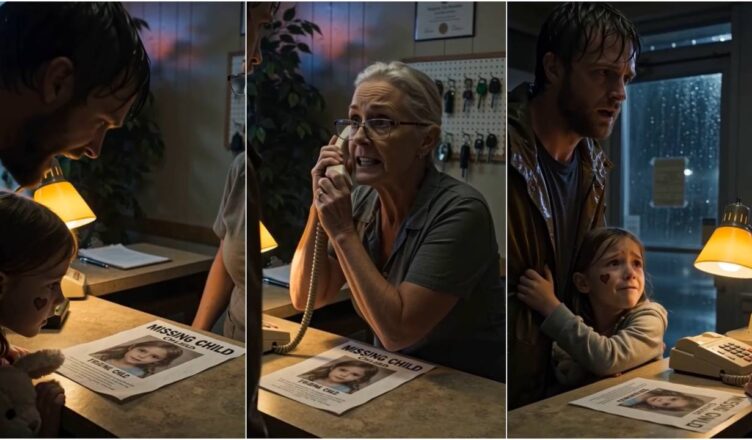
Daniel Lewis never planned to spend the night in a motel off the highway.
He had planned on getting home before midnight, carrying Emily inside half asleep, prying the stuffed rabbit from her arms just long enough to tuck the blanket around her, and standing in her bedroom doorway for one extra second the way parents do when they think nobody sees them do it. That was the plan.
Then the tire blew.
The sound was violent and sudden—rubber giving way, the wheel jerking hard in his hands, the car pulling toward the shoulder as rain streaked white through the headlights. Daniel fought it, got the sedan under control, and sat there gripping the wheel so tightly his knuckles hurt.
From the backseat came a small, frightened voice.
“Daddy?”
He turned at once. Emily was wide-eyed, her rabbit crushed against her chest.
“We’re okay,” he said, forcing calm into his voice. “Just a flat tire.”
“What’s a flat tire?”
“A very expensive reason we’re not home yet.”
That got the faintest smile. Then it was gone.
He tried roadside assistance. No signal. Tried again outside the car, walking farther down the shoulder with his phone raised toward the black sky like that would somehow help. Nothing. Pine trees. Rain. Empty highway.
By the time he got back in, Emily had that tight little look kids get when they’re trying not to cry because they can tell the adult is already carrying too much.
A mile later, through mist and drizzle, a neon sign appeared in the dark.
MOTEL.
One letter kept buzzing in and out.
Daniel looked at Emily in the mirror. “One night,” he said quietly. “That’s it. We sleep somewhere warm, and tomorrow we go home.”
Emily leaned between the seats and studied the place as they turned in.
It looked like the road had forgotten it on purpose. Long, low building. Cracked parking lot. Peeling paint. A vending machine glowing weakly beside the office. Rainwater shining under bad yellow lights.
“That looks like a scary motel,” she said.
“It looks old,” Daniel replied. “That’s different.”
Inside, the front office smelled like stale coffee, lemon cleaner, and cigarettes that had been trapped in the walls since the nineties. A fake plant drooped in one corner. Room keys hung behind the counter. A little television in the corner was playing the weather with the sound off.
The woman behind the desk looked to be in her mid-fifties, silver hair pinned up, reading glasses low on her nose. She glanced up when the bell over the door jingled.
Daniel stepped forward, damp from the rain, one hand still resting lightly behind Emily’s back.
“Evening,” he said. “I need a room for one night. Me and my daughter.”
The woman’s eyes moved to Emily.
And everything in her face changed.
She went pale so fast it was almost frightening.
“Oh my God,” she whispered.
Her hand flew to her mouth. She stared at Emily like she was looking at a ghost.
“Oh my God… that’s her.”
Daniel frowned. “Excuse me?”
The woman didn’t answer. She was already reaching under the counter with shaking hands. She pulled out a folded sheet of paper, opened it so fast she nearly tore it, and slapped it onto the desk between them.
It was a missing-child flyer.
A little girl stared up from the page.
Same blond hair. Same gray-blue eyes. Same tiny heart-shaped birthmark high on the right cheek.
Across the top, in bold black letters:
MISSING CHILD
EMILY CARTER
LAST SEEN TWO YEARS AGO
Emily leaned forward, confused.
Then her eyes widened.
“That’s me.”
Daniel looked from the paper to Emily and back again, and for a second it felt like all the blood had drained out of his body.
“What the hell?” he said, voice rough with disbelief. “That’s my daughter.”
The receptionist had already grabbed the motel phone.
“I’m calling the police.”
Emily instantly grabbed Daniel’s arm with both hands.
“No!”
Daniel’s head snapped up. “Ma’am, stop.”
The woman’s finger hovered over the keypad, but she didn’t take her eyes off him. “You expect me not to call? A missing little girl is standing right in front of me.”
Emily shook her head frantically, tears already gathering. “No, no, you’re wrong. He’s my dad. He’s my dad.”
The woman’s voice softened for a second when she looked at her. “Sweetheart, I need you to listen to me.”
“I am listening!”
Emily clung tighter to Daniel’s sleeve, rabbit crushed between them.
“He’s my dad,” she said again, more desperately now. “He makes my breakfast. He checks my closet for monsters even when I know there aren’t any. He stayed in my room all night when I had a fever. He reads the dragon book even when I pick the same one.” Her face crumpled. “He’s my dad.”
Daniel felt that somewhere deep enough to hurt.
The receptionist looked shaken now, but not convinced. Her eyes returned to Daniel.
“Sir, step away from the child.”
Something hot flashed through him.
“I’m not stepping away from my daughter.”
“Then explain this.”
“I can’t.” He checked himself when he felt Emily flinch beside him and lowered his voice. “I can’t explain that. But she is my daughter.”
The woman tightened her grip on the phone. “That flyer’s been hanging in this county for two years. Her mother still comes through here. She still asks questions. She still leaves copies. I know that child’s face.”
Daniel looked back down at the flyer.
Same smile. Same eyes. Same birthmark.
Something cold moved through him.
Because the truth was, Emily had been adopted two years earlier.
At six.
And the agency had rushed parts of the paperwork. Told him some records were sealed. Told him some details were missing because the surrender had happened out of state. Told him that sometimes children came out of messy situations with messy files. He had believed them because he had wanted to believe them.
Because by the second week Emily had fallen asleep on his shoulder like some part of her had already chosen him.
Now, standing in a damp motel office with a half-dialed phone and a missing-child flyer on the counter, those old memories were shifting shape.
Emily looked up at him, terrified now.
“Daddy… why is my picture there?”
He opened his mouth, but nothing came out.
The receptionist must have seen something change in his face, because her expression changed too.
Not softer.
Worse.
Less certain of his guilt, and more afraid of what the truth might actually be.
Emily wiped angrily at her tears. “Please don’t call the police. Please. This is a mistake. We just had a flat tire. We just need a room.”
Daniel crouched in front of her.
“Hey. Look at me.”
She did.
“You’re safe,” he said quietly. “Do you understand me? You’re safe.”
Her lower lip trembled. “Are you?”
That nearly broke him.
He touched her cheek gently. “Yes.”
The woman behind the counter took a slow breath.
“What’s your name, sir?”
“Daniel Lewis.”
“Driver’s license.”
He handed it over. She studied it, then wrote down his name, his plate number, the make of the car, and the room time on a yellow pad.
“I’m not letting this go,” she said.
“I’m not asking you to.”
That made her pause.
It was not the answer of a man looking for a way out. It was the answer of a man who had just had the ground ripped out from under him and was too stunned to pretend otherwise.
The woman slowly lowered the phone.
“I’m not calling 911 in front of her,” she said at last. “Not while she’s crying and not while I’m still trying to understand what I’m looking at. But hear me clearly, Mr. Lewis—if you try to leave before morning, I call the sheriff before you hit the main road.”
Daniel nodded once. “Fair.”
She reached for a key card and slid it across the counter.
“Room twelve.”
Then, after a beat, she added quietly, “Her mother’s name is Laura Carter.”
That was the moment it stopped being a flyer and became a person.
Not just a mistake.
A mother.
Daniel took the key card without looking at it. Emily was still clinging to him when he led her out into the rain.
Room twelve smelled like detergent and old carpet. The air conditioner rattled in the wall. Rainwater crawled down the window in crooked lines. Emily sat on one of the beds with her rabbit in her lap and watched Daniel pace the room like she had never seen him before.
Finally she said, “Am I stolen?”
He stopped moving.
Out of every question she could have asked, that was the one he wasn’t ready for.
He sat on the edge of the other bed and looked at her. Really looked at her. Her damp hair. The crease on her cheek from the car seat. The way she was trying so hard to be brave because she could tell he was failing at it.
“I don’t know everything yet,” he said.
“That means yes?”
“No.” He leaned forward. “It means I don’t know. And I’m not going to lie to you just because I’m scared.”
Emily stared at the rabbit in her lap. “She looked at you like you were a bad guy.”
He swallowed. “I know.”
“She was wrong.”
He could not answer for a second.
Then he crossed the room, sat beside her, and pulled her against him.
“If the police come,” she whispered into his shirt, “am I supposed to tell them the truth?”
“Yes.”
She nodded. “Okay. Then I’ll tell them you’re my dad.”
He held her so tightly he was careful not to let it become painful.
That night, after Emily fell asleep, Daniel spread every document from the adoption across the motel bed.
At midnight, it still looked official.
At one in the morning, it looked rushed.
At three, it looked criminal.
A court number that didn’t match the county seal. A notarized signature from a notary whose commission had expired before the date on the form. A medical release signed by “maternal relative” with no full name attached. A caseworker number that now led nowhere.
By dawn he was no longer trying to reassure himself.
He was trying to understand how a lie that large had wrapped itself around both of them and called itself legal.
He did not run.
That mattered later.
He could have thrown the papers into a bag, carried Emily to the car, and disappeared before sunrise. Some terrified, selfish part of him wanted to. But guilty men ran. Men who loved children more than themselves stayed and took the hit.
By nine the next morning, he had spoken to a family lawyer and a detective in Missing Persons.
By noon, the lawyer called back first.
The docket number on Daniel’s paperwork belonged to an unrelated probate matter. The agency office listed on his documents had been vacated eighteen months earlier. The notary stamp came back to a woman whose license had been suspended. The “adoption consultant” who had walked Daniel through the placement was already being investigated in two states for forged surrender records and fraudulent interstate transfers.
Daniel sat at his kitchen table after the call and stared at the wall.
Emily colored quietly nearby, humming to herself, unaware that the shape of her life had just cracked open again.
“What happened?” she asked.
He looked at her and forced his voice steady. “I need to make a phone call.”
The flyer was still folded in his wallet.
Laura Carter answered on the third ring.
“Hello?”
Her voice was careful. Worn thin by hope.
Daniel had practiced the sentence. It still came out broken.
“My name is Daniel Lewis,” he said. “I think I know something about your daughter.”
Silence.
Then, very quietly: “Don’t do that to me.”
He closed his eyes. “I’m not trying to hurt you.”
Another silence.
When Laura spoke again, her voice was shaking. “Then tell me something only a real lead would know.”
Daniel looked across the table at Emily. At the pink marker in her hand. At the rabbit propped beside her plate like it lived there.
“She has a heart-shaped birthmark on her right cheek,” he said. “And she still goes by Emily.”
Laura made a sound that did not sound human at first—just grief splitting open under pressure.
“Oh my God,” she whispered. “Oh my God.”
The first meeting happened at a child advocacy center with a counselor present, a detective in the hall, and a basket of toys nobody touched.
Emily held Daniel’s hand so tightly it hurt.
Laura walked into the room and stopped cold.
She was younger than Daniel expected and older than grief should have made her. For one terrible second he thought she might run across the room and make everything worse.
She didn’t.
She stood exactly where she was, one hand over her mouth, staring at Emily like the world had just returned a piece of itself.
Emily shrank closer to Daniel.
Laura lowered her hand slowly. “Hi, baby,” she said, her voice barely there.
Emily did not answer.
Daniel had spent the last several days bracing for hatred. For Laura to look at him and see only the man who had her daughter.
Instead she dragged her eyes from Emily to him and asked the question that mattered most.
“What did they tell you?”
Not hello. Not who are you. That.
Daniel swallowed. “That she’d been abandoned. That there was no mother coming back.”
Laura’s jaw tightened. “I never stopped coming back.”
“I know.”
“Do you?” she snapped, and then immediately seemed to hate herself for it. She looked back at Emily and took a slow breath. “Sorry. I’m sorry.”
Emily studied her for a long second and then asked, with the brutal directness children reserve for the worst moments, “Are you gonna take me away from him?”
Laura’s face broke.
She crouched down a little, keeping her distance. “Not today,” she said softly. “Not like this. I’m not here to rip you away from anybody.” Her voice shook. “I just needed to see you. I needed to know you were real.”
Emily stared at her another moment.
Then: “Did you miss me the whole time?”
Laura laughed once through tears. “Every second.”
The DNA test confirmed what all three of them already knew.
The investigation filled in the rest.
Two years earlier, Laura had left an abusive boyfriend named Rick Nolan after months of threats and control. He had no legal claim to Emily, but he knew enough about Laura’s life to be dangerous. When Laura was hospitalized for several days after he assaulted her outside her apartment, Rick used a corrupt placement broker and a disbarment-bound attorney to create forged surrender papers and fraudulent guardianship documents. By the time Laura got out, reported Emily missing, and began fighting through the system, her daughter had already been moved through a sham private placement under a case number designed to look real.
Daniel had not stolen Emily.
He had been lied to by professionals who knew exactly how to package a crime in legal language.
There were arrests after that. Charges. Hearings. Reporters Daniel learned to avoid. A district attorney who promised justice far more easily than justice ever actually came.
But the real story wasn’t in the courthouse.
It was in the ugly, exhausting work that came after.
It was in therapy rooms where Emily drew two houses and one little girl standing between them.
It was in supervised visits that slowly stopped needing supervision.
It was in long afternoons where Laura learned which cereal Emily liked now, which songs she sang in the backseat, what she called the stuffed rabbit, how she hated grape medicine, and how she always hid one sock when she was angry.
It was in Daniel standing in the kitchen one evening while Laura sat at the table helping Emily with spelling words, and feeling something complicated and painful settle inside him.
Not jealousy.
Not exactly.
Grief, maybe.
Gratitude too.
For the first time, he could see the shape of the mother Emily had been looking for without knowing she had been looking.
One night, after Emily was asleep, Laura stood on Daniel’s back porch and stared out into the dark yard.
“For a while,” she said, “I hated you.”
Daniel nodded. “I know.”
“I hated that she reaches for you first when she’s scared.” Laura laughed once, but there was no humor in it. “I hated that you know how she takes pancakes and what story she wants when she’s sick and the face she makes right before she cries.” Her voice cracked. “I hated that you got the ordinary years.”
Daniel looked down at his hands. “I would give them back if I could.”
Laura turned to him then. “I know you would.”
That was the worst part.
If he had been cruel, she could have hated him cleanly. If she had been selfish, he could have resented her honestly. But neither of them had chosen the crime that had connected them. They were just the two people left standing after it.
The court eventually voided the fraudulent adoption order, but the judge refused to treat Emily like a suitcase to be handed from one adult to another. There was a transition plan. Therapy. Gradual reunification. Weekends, then school nights, then longer stretches. Laura became home again by inches. Daniel learned the discipline of stepping back without disappearing.
Emily resisted some of it. Then leaned into it. Then cried on both of them in the same week and made everyone feel like they were failing.
They weren’t.
It just hurt.
Months later, at Emily’s winter concert, the school cafeteria smelled like coffee, folding chairs, and overheated radiators. Kids in paper snowflake crowns sang off-key under fluorescent lights.
Daniel sat on one side of the aisle.
Laura sat on the other.
Emily stood on the risers, spotted them both, and smiled so wide it changed her whole face.
After the concert she ran to Daniel first, because habits are powerful things.
Then she spun and grabbed Laura’s hand too.
For one awkward second, all three of them just stood there under the cheap gym lights, caught between what had been lost and what had somehow survived.
Then Emily rolled her eyes with the exasperation of someone far older than nine.
“Can you both stop making everything weird?”
Laura laughed first.
Daniel did too.
Emily squeezed both their hands and started pulling them toward the exit. “We’re getting pancakes,” she announced. “And nobody is allowed to cry in the restaurant.”
“That seems unrealistic,” Daniel said.
“It’s the rule,” Emily replied.
Laura smiled through tears she clearly had no intention of obeying. “She gets that from you.”
“No,” Daniel said. “She gets the bossiness from somewhere else.”
For the first time, Laura’s laugh came easy.
Outside, the air was sharp with winter. Their breath clouded in front of them. Emily walked between them, one hand in each of theirs, swinging their arms like this arrangement had always existed and everybody else had simply taken too long to catch up.
There was no perfect ending for a story like theirs.
No speech big enough to return the missing years. No apology strong enough to erase what had been done. No court order capable of untangling all the love from all the damage.
There was only the truth, arriving late.
A mother who had never stopped looking.
A father who had loved a child honestly inside a lie.
And a little girl who, against all odds, had managed to hold on to both of them long enough for the adults to become brave.
That was what Daniel finally understood.
The phone call had not been the beginning of losing Emily.
It had been the beginning of refusing to lie to her anymore.
And sometimes that is the closest thing love gets to justice.
Not every family begins with truth.
But this one, finally, would.