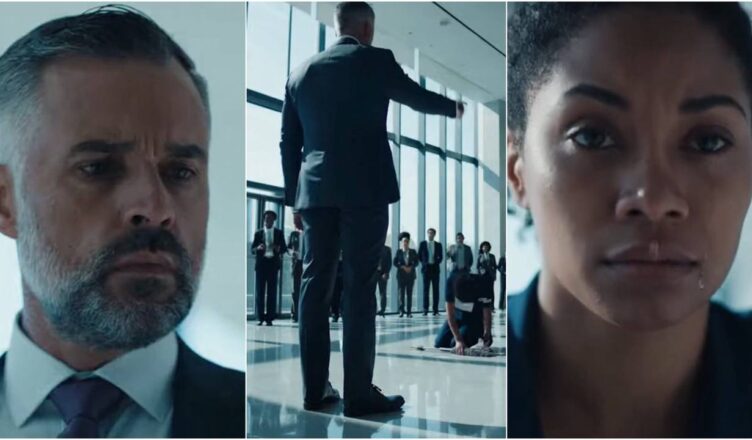
Judith was on her knees polishing marble when Henry Okafor decided to destroy her in public.
The reception floor of Natech’s headquarters gleamed under recessed lights, every reflection sharp enough to show the angle of a heel or the outline of a suit. Judith had spent the morning with a mop, a bucket, and a cart full of cleaning supplies, invisible in the way poor women in uniforms are expected to be invisible. She wore a faded blue janitor’s dress, a stained white apron, and yellow gloves damp from chemical water. To most of the staff, she was part of the building. Something between furniture and labor.
To Henry, she was unfinished business.
Two days earlier, he had called her into his office after hours under the pretense of complaining about the executive washroom. Then he had stepped too close, smiling like he was being generous, talking to her as if refusal were simply a form of confusion he could correct. When he reached for her waist, Judith slapped him.
Not hard enough to hurt him.
Hard enough to humiliate him.
Now the elevator doors opened, and the CEO of Natech crossed the lobby with that humiliation still burning in his eyes.
He was tall, dark-skinned, beautifully dressed in a loosened navy suit, the kind of man who had built his authority on volume, fear, and the assumption that his desires were self-justifying. Conversations dropped around him the way they always did. Assistants lowered their voices. Two interns near the reception desk went still.
Henry looked straight at Judith.
“I’ve been watching you,” he said loudly.
The room tightened.
Judith rose slowly, one hand still on the mop handle.
Henry pointed at her as if presenting evidence. “You’re lazy. You drag your feet, you waste time, and you irritate me.”
A few employees exchanged shocked looks. Others—petty, bored, and hungry for spectacle—watched with open interest.
Judith kept her voice quiet. “Sir, I do my work.”
“No,” he snapped. “You do just enough to keep breathing in my building.”
He took one step closer.
“I don’t want to see you here again. You’re fired.”
The words cracked across the lobby.
Judith let herself go still. She had known this was coming the moment he failed to shame her in private. Men like Henry always needed witnesses for revenge.
She lowered her eyes, because that was what he expected, and said, “Sir, please. I’ve only been here a week.”
“Then consider this an early lesson.”
She went down onto one knee—not because she had to, but because she wanted every person in that lobby to remember exactly what he looked like while doing this.
“I need the job,” she said softly.
Henry folded his arms. “Then you should have thought of that before embarrassing me.”
The sentence landed, and the room heard it.
That mattered.
He had not said you’re incompetent. He had not even pretended this was about work. He had told the truth in the only language he knew—power, injury, retaliation.
“Pack your things,” he said. “Leave before I come back down.”
Then he turned and walked toward the elevator as if the matter were beneath further thought.
Only when the doors closed behind him did the lobby breathe again.
Tina, one of the receptionists, hurried around the desk and crouched beside Judith. “My God,” she whispered. “Are you okay?”
Judith pulled off one glove finger by finger and looked toward the elevator bank.
“Yes,” she said.
Tina stared at her. “He just fired you in front of everyone.”
Judith’s mouth curved, just barely.
“I know,” she said. “And very soon, he’s going to regret it.”
She stood, took off the apron, folded it neatly over the handle of the mop cart, and walked to the janitor’s closet without another word.
An hour later, a black SUV carried her through the gates of a white mansion in Ikoyi.
The guard opened them before the driver even stopped.
“Good afternoon, Miss Anderson,” he said.
Judith nodded and stepped inside the cool marble foyer of the house she had grown up in, the one Henry would never have imagined she could enter through any door but the service entrance. She went straight to her father’s old study, sat behind his mahogany desk, and called the family’s general counsel.
“Harrison,” she said when he answered, “prepare a notice to Nate Global.”
He was silent for half a beat. “Go ahead.”
“Anderson Holdings is withdrawing its seventy percent stake unless I receive an executed emergency governance agreement by tomorrow morning.”
Another pause, this one heavier.
“Judith,” he said carefully, “that will throw the entire company into crisis.”
She looked out the window toward the city skyline, where Natech’s tower caught the late sun like polished steel.
“I know.”
The truth was, the company had already been in crisis. That was why she had taken the job in the first place.
For months, board reports about Natech had been too clean. Turnover buried in footnotes. Settlement language vague. Complaints resolved “internally.” Her father, before he died, had taught her that if you wanted to know the moral condition of a company, you did not start in the boardroom. You started with the people who could be humiliated without consequence.
So she had gone in under her mother’s maiden name and taken the lowest job in the building.
Henry had answered her question faster than any audit could have.
The letter went out before sunset.
By seven that evening, Harrison called back.
“He got it.”
Judith leaned back in her chair. “And?”
“He tried to claim a mistake. Then he tried to call three board members. Then he realized the signature was yours.” Harrison let out a quiet breath. “He’s asking for a meeting.”
“Tomorrow morning,” she said. “Here.”
“He won’t come alone.”
“I don’t expect him to.”
She slept well that night.
At nine-thirty the next morning, Henry Okafor was shown into the Anderson drawing room with his regional manager, Andrew Bello, two lawyers, and the face of a man who had not slept at all.
He looked smaller without an audience.
Not physically. Spiritually.
Judith let him stand there long enough to understand the room. Cream walls, old art, quiet money, no wasted motion. A butler poured coffee and left. Nobody rushed. Nobody filled the silence for him.
Then she said, “Good morning, Mr. Okafor.”
Henry’s throat moved.
He took one step forward, then another. Whatever speech he had prepared did not survive the distance between them. By the time he reached the rug in front of her chair, his knees gave out and he dropped onto the marble.
Andrew inhaled sharply. One of the lawyers turned away.
“Please,” Henry said.
The word came out cracked.
Judith watched him without expression.
“Don’t destroy Nate,” he went on. “I was wrong. I was cruel. I know that now. I’m asking you not to punish the whole company for what I did.”
Judith folded her hands in her lap.
“You came here because you’re afraid,” she said. “Not because you’re sorry.”
His eyes were wet already, but he did not deny it.
“That’s true,” he whispered.
“Good,” she said. “We can begin with truth.”
She let the silence stretch until he forced himself back to his feet. She did not offer her hand.
“I took the janitor’s job because I wanted to see how your company functioned when no one important was watching,” she said. “You answered that question personally.”
Henry lowered his gaze.
“You used your office to corner a woman you believed had no protection,” Judith continued. “Then, when she refused you, you humiliated her in public to restore your pride.”
“Yes.”
The word was barely audible.
Judith glanced once at Andrew, who looked ill.
“Here are my terms,” she said. “You will sell your entire thirty percent holding in Nate Global to Anderson Holdings at an independently assessed valuation. You will resign as CEO effective immediately. If you refuse, Anderson withdraws its stake, pulls its credit guarantees, and lets the market learn exactly why.”
Henry went pale.
“That will ruin me.”
“No,” Judith said evenly. “What ruined you happened yesterday in the lobby. This is just the paperwork.”
His mouth shook. “And if I accept?”
“You remain employed,” she said. “As general manager. You report to me and to a new compliance chair. You lose unilateral authority over staffing, legal settlements, and all HR matters. You will also make a public statement acknowledging abuse of power and the structural changes that follow.”
Henry looked up, stunned. “You would keep me?”
“I would keep the company alive,” Judith corrected. “Thousands of people work there. They are not collateral for your character.”
He closed his eyes.
A tear slipped free and hit the marble.
“I accept,” he said.
Judith nodded once.
“Good. Then understand this clearly: I am not sparing you. I am assigning you the harder sentence.”
The documents came in an hour later.
Henry signed first, each stroke stripping something from the old myth he had built around himself. Judith signed last. Calmly. Without flourish.
Before leaving, Henry said, “About what happened in my office—you didn’t deserve it. Not for one second.”
Judith held his gaze. “Then prove it. Not to me. To everyone you ever thought was beneath you.”
The company-wide meeting was called the next morning.
Every level of Nate filled the hall—executives in tailored suits, interns with notepads in their laps, cleaners standing near the back because no one had ever thought to reserve them seats. Tina was there. So were the interns who had watched the firing. So was every rumor in the building.
Judith walked onto the stage in a cream suit and low heels, no longer anonymous, no longer asking permission to occupy space.
The murmuring died immediately.
“Good morning,” she said. “I’m Judith Anderson.”
You could feel recognition travel through the room.
“Effective today, Anderson Holdings has assumed full ownership of Nate Global. Mr. Okafor is no longer CEO.”
A stunned hush followed.
Then Henry stepped up beside her.
He looked like a man being seen without the armor he had worn for years.
“I abused my power,” he said. No microphone feedback, no shaking script. “I crossed boundaries. I used humiliation to protect my pride. I am ashamed of what I did, and I will spend as long as it takes proving that this company will not be run that way again.”
No one applauded.
That was right too.
Judith took over.
“From today forward,” she said, “dignity is not a perk at Nate. It is policy.”
The changes came fast.
An outside audit. Two senior managers removed within a week. A direct reporting system to independent compliance counsel. Pay increases for the lowest-paid workers. Mandatory misconduct review. Protected channels that bypassed executive leadership entirely.
And Henry—now simply Henry—had to help deliver every one of those changes.
The first time he walked through the executive corridor without the CEO title, he looked almost physically exposed. The second time, he looked angry. The third time, something else had replaced it.
Attention.
He was finally watching what he had once stepped over.
Later that afternoon, Judith crossed the lobby where he had fired her. Tina stood at reception, trying to look busy and failing.
Judith stopped.
“Thank you,” she said quietly.
Tina blinked. “For what?”
“For kneeling beside me when everyone else stood still.”
Tina’s eyes filled at once. “I just couldn’t pretend it was normal.”
“Good,” Judith said. “Don’t start now.”
That evening, she was in the glass conference room above the finance wing reviewing HR transition plans when she heard voices in the hall.
Three senior executives. Low, irritated, careless.
“She’s moving too fast.”
“This whole dignity campaign is a joke.”
“We need to wait her out. Henry will come around once he remembers who built this place.”
Judith looked up.
Henry had just rounded the corner.
He heard every word.
For one long moment, he stood there with his face unreadable.
The men noticed him and fell silent.
This, Judith realized, was the real test. Not the kneeling. Not the apology. Choice.
Henry could laugh it off. Step past it. Rejoin the old gravity of men who mistook cruelty for competence.
Instead, he walked straight toward them.
“No,” he said.
His voice was not loud, but it cut clean.
“No more waiting anyone out. No more teaching people fear and calling it leadership. If you have a problem with the direction of this company, you can put it in writing to Compliance. If what you want is the old culture back, resign tonight and save everyone the paperwork.”
The men stared at him.
Behind the glass, Judith said nothing.
Henry held their gaze until one of them looked away, then another.
Only then did he turn and see her watching.
For a second, neither of them moved.
He did not smile. Neither did she.
But he did not look away either.
Judith understood then that she had been right about the hardest sentence. Losing power had not been the punishment. Living without the illusions it had given him was.
She closed the file in front of her and rose from the table.
The real work, after all, had never been the takeover.
It was what came after a locked system cracked open—what people chose when fear was no longer the language running the room.
And now, at last, Nate had to learn a different one.