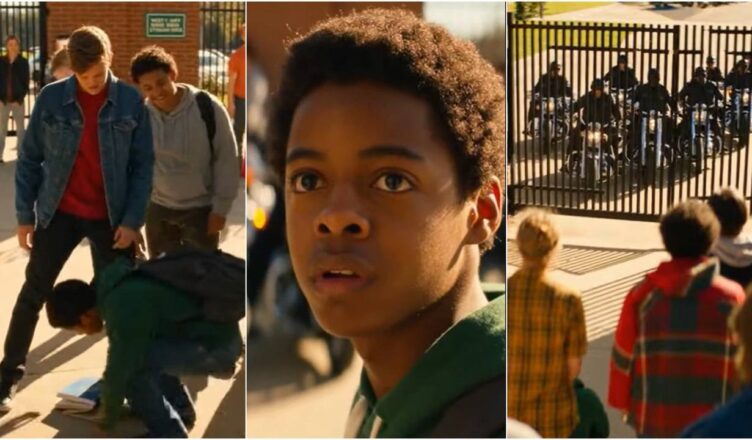
“Why don’t you go back to where you came from?”
The words hit Marcus before the shove did.
It was his first morning at Oakridge High, and by 8:12 a.m. he was already on one knee in the dust outside the front gate, trying to gather his algebra book, a half-crushed notebook, and the last of the dignity he had hoped to carry into his new life. The Texas sun was already hot enough to bleach the sidewalk white, but the circle of boys around him made the morning feel cold.
They were the kind of boys every school produced and every school pretended not to notice too clearly—loud, confident, sharp in their pressed uniforms, cruel in the casual way that came from long practice. Tyler Grayson stood at the center of them, tall and smirking, with the lazy ease of someone used to being obeyed by smaller people and excused by adults.
Marcus had been in town less than a week. His mother had called the move a fresh start. A new school, a better district, a chance to breathe after too many years of scraping by and too many months of grief settling over their apartment like dust. Marcus had wanted to believe her.
Then Tyler had shoulder-checked him hard enough to send his backpack sliding, and the rest had followed naturally.
“Can’t even hold onto your own stuff,” one of the boys laughed.
Marcus reached for his book. Another sneaker kicked it farther.
“I don’t want trouble,” he said quietly.
That made them laugh harder.
Tyler leaned down just enough to make sure Marcus heard every word. “Then you came to the wrong place.”
The morning bus hissed away from the curb. Students streamed through the gate around them, slowing just enough to see what was happening before hurrying on. A few stared. One girl looked uncomfortable and then looked away. Nobody stepped in.
Marcus got to his feet, clutching what books he could recover. He had promised his mother he would keep his head down. He had promised himself the same thing. New town, new rules. Don’t be noticed until you know how things work.
Then Tyler shoved him again.
Marcus hit the sidewalk hard enough for the breath to leave his chest. His math book slapped the concrete. The boys above him broke into delighted laughter.
And that was when the engines came.
Not one. Many.
A low, rolling thunder rounded the corner and moved straight toward the school like weather with chrome on it. Every head turned. Ten motorcycles came down the street in a staggered line, black and silver, sunlight flashing off polished metal and windshields. They slowed as one when the riders saw the cluster of boys at the gate, and then the lead bike peeled out, came straight to the curb, and stopped.
The engine idled once, deep and steady.
Then it cut.
The rider swung one boot to the pavement and lifted his visor.
He was older—fifties maybe—with a gray beard, heavy shoulders, and the kind of face that had seen too much to be impressed by teenage swagger. A black leather vest sat over a faded T-shirt, and on the vest was a patch: IRON BROTHERHOOD VETERANS.
The other riders killed their engines one after another.
The silence that followed was somehow louder than the noise had been.
The bearded man looked from Tyler to Marcus to the books scattered across the ground.
“What’s going on here, boys?” he asked.
Nobody answered.
Tyler’s grin flickered. “Nothing. Just helping him up.”
The man glanced at Marcus, still half on the pavement, dust on his palms and shame burning in his face. “Doesn’t look like help to me.”
One by one, the other riders dismounted. Ten sets of boots hit the street in near unison. They didn’t crowd the boys. They didn’t have to. Their presence changed the air all by itself.
The lead rider stepped toward Marcus and held out a hand.
“You okay, kid?”
Marcus looked at the hand, then at the man’s face. There was nothing mocking in it. Nothing pitying, either. Just direct concern.
He took the hand and stood.
Behind him, Tyler and his friends had already shifted backward.
The rider bent, picked up Marcus’s fallen notebook, dusted it once against his thigh, and handed it back. “Name?”
“Marcus.”
“Marcus what?”
“Daniels.”
The man nodded. “I’m Cole Matthews.”
Tyler tried for a laugh and failed. “We were just messing around.”
Cole looked at him for a long second. “That so?”
Nobody spoke.
Then one of the women riders, tall and sharp-eyed with a braid down her back, said, “Looks more like five-on-one to me.”
Another rider folded his arms and looked toward the school entrance. “Would be a shame if the principal saw it different.”
Tyler’s face went a shade paler.
Cole turned to Marcus. “You got somewhere to be?”
Marcus looked toward the school doors. “Homeroom.”
“Then let’s get you there.”
The group moved with him—not touching, not crowding, just surrounding him enough that the path through the front doors opened by itself. Hallway chatter thinned as they entered the building. Teachers stopped mid-sentence. The receptionist nearly dropped her pen.
By the time they reached the front office, Principal Larson was already coming out of her office with surprise written all over her face.
She took in the leather vests, the line of riders, Marcus standing in the middle with dust on his shirt and his books hugged to his chest.
“Can I help you?”
Cole removed his gloves slowly. “Ma’am, we came upon a few of your students working real hard to make sure this young man’s first day was unforgettable.”
Principal Larson’s expression changed. “Who?”
Marcus hesitated.
Cole saved him from having to answer first. “The tall blond one leading the pack. He’ll know who he is.”
Within ten minutes, security footage was pulled. Tyler and two of his friends were called in from class. Their stories fell apart almost immediately under the video. The camera angle showed everything: the shoulder check, the kicked books, the second shove that sent Marcus down. By lunch, suspensions were being discussed. By afternoon, parents were called.
Marcus sat in a plastic chair outside the principal’s office while the adults moved around him in determined, efficient circles. Every now and then he glanced up at the bikers, still waiting nearby as if they had nowhere more important to be.
He kept expecting them to leave.
They didn’t.
When Principal Larson finally came out, her tone with Marcus was gentler than it had been all morning. “We’re taking this seriously,” she said. “And I’m sorry this was your first day here.”
Marcus nodded, unsure what to do with an apology from a school that had nearly swallowed him whole before first period.
After a pause, she looked at Cole. “You were just passing by?”
Cole’s mouth twitched. “On our way to drop off a donation check at the VFW.” He nodded toward Marcus. “Changed plans.”
That afternoon, when the last bell rang, Marcus found the motorcycles still lined along the curb outside the school.
Cole was leaning against his bike, sunglasses pushed up into his hair.
“You heading home?”
Marcus hesitated. “My mom’s supposed to pick me up.”
“We already called her,” Cole said. “She’s meeting us there. Figured after the morning you had, better not leave you standing alone at the curb.”
Marcus stared at him. “You called my mom?”
“You had emergency contact info in your folder when the office brought your paperwork out.” He gave a half shrug. “Hope you don’t mind.”
For reasons Marcus couldn’t explain, the tightness in his chest loosened a little.
The woman rider with the braid handed him a spare helmet. “Ever been on a bike?”
He shook his head.
“Then today’s full of firsts.”
The ride home changed something in him.
At first he was stiff with nerves, hands barely touching the sides of the seat behind Cole, wind flattening his shirt against his chest. Then the road opened up, and the convoy rolled into formation around them, engines rising and settling together, the whole pack moving like one living thing. Cars gave way. People stared. For the first time all day, Marcus didn’t feel singled out. He felt carried.
When they pulled up in front of the small rental house on Preston Avenue, his mother was already on the porch.
Denise Daniels ran down the steps so fast she nearly lost a sandal. She grabbed Marcus into a hug, then stepped back to check his face, his arms, his whole body.
“You okay?”
He nodded. “I am now.”
Cole took off his helmet and held out a hand. “Ma’am. Cole Matthews.”
The look on Denise’s face changed when she saw the patch on his vest. Not fear. Recognition.
“My husband served,” she said quietly. “Army.”
Cole’s expression softened at once. “Then your boy’s got more strength in him than he knows.”
They stayed for dinner.
Marcus had not expected that. Neither had Denise, judging by the way she kept apologizing for the chipped plates and the fact that dinner was just burgers and frozen fries. But the bikers acted like it was a feast. They filled the little house with noise and stories and laughter that didn’t feel sharp. One man had done two tours overseas and now ran an auto shop. Another drove delivery trucks. The woman with the braid—Tasha—worked as a paramedic and teased everybody mercilessly. None of them looked anything like the sort of people teachers told kids to trust on sight.
Every one of them, Marcus realized, knew something about survival.
Before they left, Cole crouched so they were eye level.
“Listen to me,” he said. “What happened this morning? That wasn’t your shame to carry.”
Marcus looked down.
Cole waited until he looked back.
“Next time somebody tries to make you smaller, stand up. You hear me? Not because you need to fight. Because you belong where your feet are.”
Weeks passed.
The story of the first-day incident moved through Oakridge faster than any rumor Marcus had ever heard. Tyler and his friends returned from suspension quieter than before. They didn’t apologize, but they stayed out of Marcus’s way. That was enough for now.
More surprising were the smaller changes. A girl from science class asked if he wanted to join her lab group. Two boys invited him to sit at their lunch table. A teacher who had watched the office footage without realizing Marcus knew it took him aside after class and said, awkwardly but sincerely, “I’m glad you kept your composure.”
Rowan, who sat behind him in English, said it more plainly: “You looked scared, but you didn’t let them own you.”
Marcus thought about that for a long time.
The Iron Brotherhood checked in often. Sometimes a text from Cole. Sometimes Tasha showing up at one of his weekend bike rides and pretending not to notice how fast he was getting better. They helped him fix up his rusted BMX in Cole’s garage, teaching him how to true a wheel and patch a chain. On Saturdays, if Denise was working late, Marcus ended up at the VFW hall eating bad chili and listening to men and women tell stories about endurance, mistakes, and starting over.
By winter, he understood that the morning at the school gate had not simply rescued him from one bad day. It had introduced him to a new definition of strength.
Not loudness.
Not cruelty.
Protection.
In April, the Iron Brotherhood hosted a community event called Ride for Respect. The school parking lot filled with bikes, folding chairs, food trucks, and more people than Marcus had ever seen in one place who actually looked glad to be there. Teachers came. Parents came. Principal Larson came and gave Cole a donation check for the veterans’ outreach fund with a look that suggested she still wasn’t used to being happy to see leather vests on campus.
When it was Marcus’s turn to speak, his hands trembled around the microphone.
He looked out at the crowd, at Denise dabbing at her eyes, at the line of motorcycles glinting in the sun, at Cole standing off to one side with his arms crossed and his expression carefully neutral.
“The day I met them,” Marcus said, nodding toward the Iron Brotherhood, “I thought they were the scariest people I’d ever seen.”
That got a laugh.
He smiled too.
“But they taught me something my bullies never understood. Real strength isn’t making people afraid of you.” He took a breath. “It’s making sure they don’t have to be afraid.”
The applause that followed didn’t feel like noise. It felt like something steadier. Something earned.
Afterward, the convoy rolled out through town with Marcus pedaling his BMX alongside them for the first two blocks while the crowd cheered. He was laughing so hard by the time he turned back toward home that he nearly rode into a mailbox.
By the next school year, Oakridge had changed in ways that mattered.
Not perfectly. Schools never do. But when new kids showed up, they got greeted faster. Tyler had long since lost whatever throne fear had built for him. And Marcus—once the boy on the pavement with dust on his palms and shame in his throat—became the one who stood at the gate on the first day, scanning the crowd for anyone who looked lost.
When he found them, he walked over with a hand out instead of a shove.
“Hey,” he’d say. “I’m Marcus. You new too?”
Because once, on the worst morning of his first day, a line of roaring engines had pulled up beside him, and strangers had decided he mattered.
And after that, he could never again pretend not to see somebody standing where he had once stood—alone, cornered, hoping someone would notice.