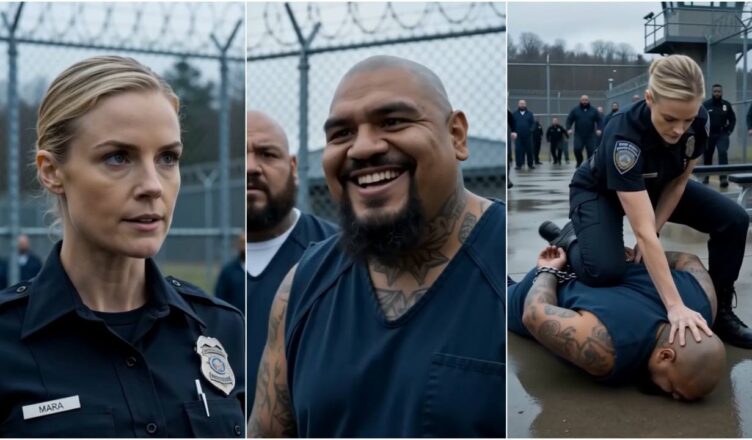
The yard at Blackwater State Penitentiary had its own weather.
Even before the morning fog lifted over northern Pennsylvania, the place felt cold in a way that had nothing to do with temperature. Wet concrete. Chain-link fences. Razor wire coiled along the top like frozen snakes. Cameras staring from every corner. A guard tower above the far wall, its dark windows reflecting the yard without giving anything back.
Men moved in groups around the weight benches and basketball court, speaking low, laughing too loud, measuring every new face that stepped through the gate.
At 8:02 a.m., Officer Mara Blake walked into the yard.
The gate slammed shut behind her.
Every conversation near the weight area weakened.
Mara was early thirties, slim, blonde, beautiful in a way that made inmates underestimate her for the wrong reasons. Her hair was pulled tight at the back of her head. Her dark correctional uniform fit cleanly, without extra movement, without nervous adjustment. Her face gave away almost nothing.
No hurry.
No fear.
No performance.
That was the first thing Officer Daniels noticed from beside the equipment cage.
The second thing he noticed was Vincent Kroll watching her.
Kroll stood near the bench press, heavyset and bald, with a thick beard, a wide neck, and tattoos covering his arms like old warnings. He was Latino, late thirties or maybe forty, built like a man who had spent years turning prison yards into stages. Two inmates stood behind him, pretending to stretch, pretending not to wait for his signal.
Daniels lowered his voice.
“That’s Kroll,” he said.
Mara didn’t look at him immediately. “I know.”
Daniels glanced over. “You read his file?”
“I read enough.”
“No,” Daniels said. “You didn’t. Files don’t explain men like him.”
Mara’s eyes moved across the yard, calm and exact.
Daniels continued, “He runs contraband through laundry and kitchen channels. Doesn’t touch anything himself. Doesn’t have to. Two assaults last year. One inmate lost an eye. Nobody saw a thing.”
“Convenient.”
“Smart,” Daniels corrected. “And he likes testing new officers. Especially women.”
Mara’s expression did not change.
Across the yard, Kroll dropped a barbell onto the rack with a violent metallic clang.
The sound cut through the morning.
A few inmates looked over.
Kroll sat up slowly, wiped his hands on his prison shirt, and smiled.
Daniels lifted his radio slightly.
Mara said, “Not yet.”
“You don’t want backup?”
“I didn’t say that.”
Kroll started walking toward her.
His two men followed.
Then several others drifted closer, spreading in loose half-circles around the weight area. Not close enough to be accused of anything. Close enough to watch.
Kroll loved an audience.
He stopped in front of Mara, too close for respect, too far to justify force.
His eyes traveled over her face, then her uniform, then back to her eyes. His grin widened.
“You lost, sweetheart?”
A few inmates laughed.
Mara did not move.
“Return to your assigned area.”
Her voice was cold. Controlled. Almost bored.
Kroll tilted his head, enjoying himself.
“Or what?” he said. “You gonna cry?”
The laughter grew louder.
Daniels stepped forward with another officer, but Mara lifted one hand slightly at her side. Not a wave. Not a warning.
A signal.
Wait.
She kept her eyes on Kroll.
“Final warning. Step back.”
Kroll leaned in farther. His breath smelled like stale coffee and prison cafeteria sugar.
“You’re shaking,” he said softly. “I like that.”
The instant the last word left his mouth, Mara moved.
Not big.
Not dramatic.
Fast.
Her left hand trapped his wrist before he understood she had touched him. Her shoulder turned under his arm. One foot cut behind his ankle. She used his weight, his forward lean, his arrogance, all of it. Kroll’s balance disappeared before his strength had a chance to matter.
He hit the concrete face-down with a hard, wet slap.
The yard went silent.
Mara followed him down, one knee beside his ribs, one hand locking both his arms behind his back, the other pressing the side of his head firmly to the concrete.
“Stop resisting,” she said.
Her voice still had not changed.
Kroll tried to buck once.
Pain shut him down.
Guards rushed in from the background. Daniels reached them first, stunned despite himself.
“You good?” he asked.
“Yes.”
Kroll’s cheek was flat against the concrete. His eyes were wide, not just with pain.
With disbelief.
For years, men had moved around him like weather. Officers approached in pairs. Inmates lowered their eyes. Kroll had built his power out of one assumption: eventually, everybody stepped back.
Mara Blake had not stepped back.
Daniels cuffed Kroll’s wrists while another officer secured his legs.
Kroll sucked air through his teeth. “You broke my arm.”
“No,” Mara said. “I stopped you from using it.”
The inmates were still staring.
That was worse for Kroll than the pain.
His men near the weight bench had gone quiet, their faces carefully empty. They knew what everyone in that yard knew: power in prison lived in public. If it died in public, it did not come back the same.
Daniels pulled Kroll to his knees.
That was when Kroll looked at Mara properly.
Not at the blonde hair.
Not at the uniform.
At her face.
His breathing changed.
The smugness vanished.
“No,” he whispered.
Mara said nothing.
Kroll’s eyes narrowed, searching through memory.
Then color drained from his face.
“No,” he said again, louder. “You’re dead.”
Daniels looked at Mara.
“You know him?”
Kroll stared at her like he was looking at a ghost.
“Blake,” he breathed.
Mara crouched slightly in front of him.
“Hello, Vincent.”
For the first time that morning, the yard heard fear in Kroll’s voice.
“You were in Camden.”
“Yes.”
“They said you died.”
“You should’ve checked.”
Eight years earlier, Mara Blake had not worn a corrections uniform.
She had been a federal agent embedded in a task force investigating Kroll’s trafficking crew, a network moving weapons, fentanyl, and people through warehouses along the East Coast. Kroll had been the crew’s enforcer then — not the boss, but worse in some ways. The man sent when fear needed a face.
The operation was supposed to end in arrests.
Instead, someone tipped Kroll off.
The warehouse in Camden became a trap.
Mara’s partner, Isaac Reyes, was shot before he reached cover. Mara took two rounds and crawled under a loading dock in the dark, one hand pressed to her side, listening while Kroll walked through the smoke calling her name.
“Come on, sweetheart,” he had said then. “Don’t make me hunt.”
He never found her.
She survived.
Isaac did not.
Three months later, Mara testified from behind a screen while Kroll stared at the witness box like hatred alone could reach through it. Her testimony helped put him away for life.
After that came surgeries, leave, protection details, a new assignment, years of rebuilding a body that healed faster than the parts of her mind that still heard Isaac choking on concrete.
Then Blackwater called.
Not because they needed another officer.
Because Internal Affairs had a problem.
Two inmates dead from overdoses.
Three correctional staff under suspicion.
A contraband network moving through laundry carts and chapel volunteers.
And at the center of it, from inside a life sentence, Vincent Kroll.
Mara had requested the transfer herself.
Not for revenge.
She told herself that often enough to almost believe it.
Kroll looked toward the tower, then the cameras, then Daniels.
“You came here for me.”
Mara’s face stayed still.
“You’re not that important.”
The words hit him harder than an insult.
His jaw tightened.
Mara leaned closer, speaking low enough that only he and the nearest guards could hear.
“I came because men keep dying in this yard. Because somebody in uniform is taking your money. Because you got comfortable.”
Kroll’s fear flickered into calculation.
Mara saw it.
“There you are,” she said quietly.
The side gate opened.
Warden Harris entered with two lieutenants and a response team. He was compact, gray-haired, and severe, the kind of man who spoke in short sentences because he expected them to be obeyed.
“What happened?” he demanded.
Daniels answered first. “Kroll refused orders, threatened Officer Blake, advanced on her, and was restrained.”
Kroll spat onto the concrete. “She jumped me.”
Mara stood.
“You were warned three times.”
Harris looked at her. “Injuries?”
“None serious.”
Then he looked down at Kroll.
“Segregation.”
Two officers pulled Kroll to his feet.
He twisted enough to glare at Mara.
“You think this scares me?”
“No,” Mara said. “I think what comes next will.”
For once, he had no answer.
They walked him across the yard in cuffs.
Nobody called out to him.
Nobody laughed.
Nobody tried to defend him.
That silence told the truth better than any report could.
Kroll’s kingdom had cracked.
At the gate, he turned back once.
Mara stood exactly where he had left her, calm beneath the gray morning light.
The gate opened.
Then closed behind him.
Only after he was gone did the yard begin to breathe again.
Daniels stepped beside Mara.
“You could’ve told us who you were.”
“I told the warden.”
“That’s not what I mean.”
Mara looked toward the weight benches, where inmates were pretending to return to normal.
“If the yard knew before today,” she said, “Kroll would’ve had time to prepare.”
Daniels frowned. “Prepare for what?”
Mara adjusted the cuff of her sleeve where Kroll had leaned too close.
“The warrants.”
Daniels went still.
She continued, “The laundry contractor. Two outside accounts. One former officer. State police hit all three locations twenty minutes ago.”
Daniels stared at her.
“This was planned?”
“Kroll chose the confrontation,” Mara said. “I just knew he wouldn’t resist an audience.”
From the far side of the yard, an older inmate sitting near the fence gave her the smallest nod.
Not warmth.
Recognition.
Mara did not return it.
Her radio cracked to life.
“Control to Yard Two. Confirmation from state police. Laundry contractor in custody. Three phones recovered. Narcotics recovered. Ledger recovered.”
Daniels slowly turned toward the gate where Kroll had disappeared.
“Damn.”
The warden’s voice came over the channel next.
“All units, lockdown after yard clearance. Staff interviews begin immediately.”
A murmur moved through the inmates.
They knew.
Not the details.
Enough.
By noon, segregation was no longer just punishment for Kroll. It was containment. Officers stripped his cell. Investigators pulled names from the ledger. Two correctional officers were escorted from the building in handcuffs before dinner.
By evening, Blackwater had changed.
Not cleaned.
No prison changed that quickly.
But shifted.
Kroll’s name no longer moved through the yard like a command. It moved like a warning.
In segregation, Vincent Kroll sat alone on a metal bunk, one cheek bruised from the concrete, both wrists sore from the cuffs. He heard footsteps outside his door and kept expecting Mara Blake to appear again.
She did not.
That bothered him more.
Men like Kroll understood hatred. Hatred meant you still mattered.
Mara’s absence told him something colder.
He had become evidence.
Across the prison, Mara stood in a small administrative office while Warden Harris closed the door behind her.
“You took a risk,” he said.
“Yes.”
“If he’d had a blade—”
“He didn’t.”
“You knew that?”
“I knew he wanted humiliation, not a murder charge in front of cameras.”
Harris studied her. “And if you were wrong?”
Mara looked through the narrow window toward the yard, now empty under the dim afternoon.
“Then I would’ve adapted.”
The warden watched her a moment longer.
“You always this calm?”
“No.”
That was the first honest answer she had given all day.
His expression softened by a fraction.
“You knew Reyes?”
Mara’s eyes stayed on the yard.
“He was my partner.”
“I read the file.”
“Then you know enough.”
Harris nodded once. “The operation worked.”
Mara did not answer immediately.
Outside, rain began again, light at first, stippling the concrete where Kroll had fallen.
Finally she said, “Operations don’t bring people back.”
“No,” Harris said. “They don’t.”
For a while, neither spoke.
Then Mara straightened.
“Any more questions?”
“Only one.”
She looked at him.
“Can you finish the job?”
Mara thought of Isaac Reyes in the warehouse, telling her to keep moving because one of them had to make it home. She thought of the two inmates who had died in Blackwater while men in uniform looked the other way. She thought of Kroll face-down on the concrete, finally understanding that the past had not forgotten him.
“Yes,” she said.
The next morning, Mara returned to the yard.
The same gate opened.
The same razor wire watched from above.
The same wet concrete stretched beneath her boots.
But the inmates did not look at her the same way.
Some looked away.
Some stared.
Some measured distance.
Mara walked to the equipment cage and took her post.
No rush.
No fear.
No performance.
Officer Daniels stood nearby, watching the yard with new attention.
After a long moment, he said, “You know, they’re going to talk about yesterday for months.”
Mara scanned the yard.
“Let them.”
Near the weight benches, Kroll’s former followers sat apart from each other now, each pretending the others did not exist.
Power had moved.
Not to Mara.
She did not want it.
Power had moved back where it belonged: into procedure, consequence, and the quiet understanding that even in Blackwater, some men could still be brought down.
Mara rested one hand near her radio and watched the yard breathe under the cold Pennsylvania sky.
The most dangerous man in the prison had learned the truth face-down on concrete.
Officer Mara Blake had not come to Blackwater to prove she belonged there.
She had come because she already knew exactly who she was.