I went to my ex’s wedding to laugh at the man she picked over me.
That is the truth.
Not the clean version. Not the version where I tell myself I was curious, or nostalgic, or simply passing through Sacramento that weekend and decided to stop by like a civilized adult.
No.
I went there because I heard Claire Bennett was marrying a man in a wheelchair, and some rotten little part of me wanted to see it.
Wanted to compare him to me.
Wanted to stand at the edge of her perfect wedding in my tailored black suit, with my gold watch catching the sunset, and feel like I had won.
That was the kind of man I was.
My name is Andrew Morel. I was thirty-nine years old, successful, polished, and almost completely hollow. I lived in San Francisco in a glass apartment with a view I barely noticed anymore. I drove expensive cars, wore expensive clothes, dated women who looked good beside me in restaurants, and built a life that photographed better than it felt.
Claire knew me before all that.
Before the suits. Before the title. Before I learned how to enter a room like everyone in it should be grateful.
We met in college. She worked evenings at the campus library. I used to come in pretending to study just so I could sit near her. She had this calm warmth about her, the kind people trust before they understand why. She loved old books, quiet mornings, small diners, ordinary kindness.
I loved her.
I did.
But I loved ambition more.
Back then, I talked about success like it was a war and everyone else was too weak to fight it. Claire would listen quietly, then say something that found the one soft place I didn’t know I still had.
Once, after I spent half an hour talking about internships, money, status, and how badly I wanted to be someone important, she looked at me across her tiny kitchen table and said, “Andrew, if everything in your life is a competition, eventually even love will start feeling like one.”
I laughed it off.
Years later, that sentence would come back to me like a verdict.
After college, I moved to San Francisco. Claire stayed near Sacramento, working at a small hotel because she wanted stability and a life she could actually touch. We tried long distance for a while, but the truth was that I expected her to orbit my future while I built it.
She came to visit once. I remember sitting across from her in a restaurant full of sharp people and sharper lights. She wore a simple blue dress. She looked tired from the bus ride, but she smiled at me like being there was enough.
And I remember thinking something so shallow it still makes me sick.
She doesn’t fit this life.
I didn’t tell her that.
I just started leaving.
Not physically at first. Emotionally. Quietly. Efficiently. Fewer calls. Shorter answers. Irritation where tenderness used to be.
Then one night, she asked me directly, “Do you still see a future with me?”
And I said, “I think I need more.”
She looked at me for a long time.
“More than me?” she asked. “Or more than the life you think I represent?”
I didn’t answer.
That was my answer.
Eight years passed.
I heard she moved on. I heard she was happy. I heard she met someone.
Then, one week before her wedding, an old college acquaintance found me at a work event and said, “You remember Claire Bennett? She’s getting married.”
I kept my face still. “To who?”
“Some decorated Army veteran outside Sacramento,” he said. “Daniel Mercer. Wheelchair now. Big hero type. Everybody acts like he’s some legend.”
“A wheelchair?” I asked.
He nodded. “Yeah. Lost a lot overseas, from what I heard.”
I laughed lightly, like I was above the whole thing.
But something ugly woke up in me.
Claire had chosen him.
A man in a wheelchair.
And instead of wondering whether he made her happy, instead of hoping she had found peace, I thought, Of course. Claire always did mistake kindness for enough.
So I went.
Not alone.
That would have looked too honest.
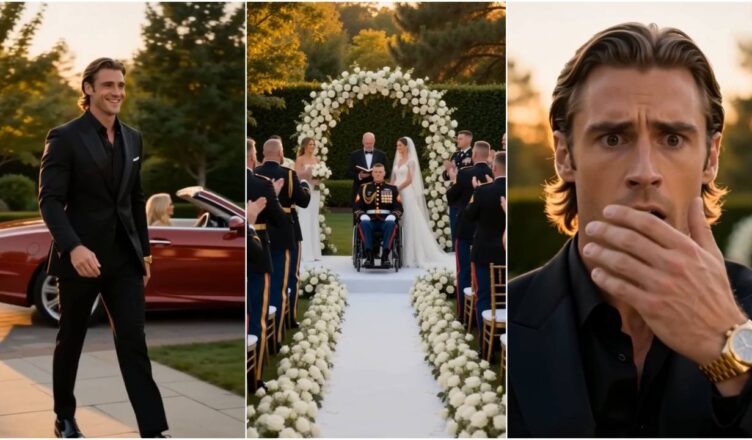
I brought a woman named Tessa, a glamorous blonde I barely knew beyond dinners, drinks, and the fact that she liked expensive cars. She drove the red convertible because she loved being seen behind the wheel, and I loved stepping out of it.
That afternoon, we pulled up near the ceremony entrance just as the sun was dropping low over the estate garden outside Sacramento.
The wedding was beautiful.
Annoyingly beautiful.
White floral aisle. Rows of tasteful chairs. Manicured greenery. Golden light lying over everything like a blessing. It was elegant without trying too hard, which somehow irritated me more.
Tessa parked the convertible near the entrance.
I leaned over and kissed her before getting out, not because I loved her, but because I wanted the gesture to be seen. I wanted to arrive like a man who had not been left behind by anything.
Then I opened the passenger door, stepped out in my tailored suit, closed the door behind me, and smiled.
The kind of smile men wear when they think life has confirmed their superiority.
Tessa drove away.
I walked toward the ceremony alone, laughing softly to myself.
I could already picture it: Claire, beautiful but sentimental, standing beside some tragic symbol of noble suffering. Guests pretending not to notice the chair. Everyone acting as if pity were romance.
Then I reached the garden.
And saw the wheelchair.
It was matte black. Practical. Strong. Positioned at the front beside the bride. The groom sat in it with a straight back and broad shoulders, wearing a formal military dress uniform covered in medals.
Claire stood beside him in a snow-white gown.
She looked radiant.
Not decorative. Not nervous. Not like a woman settling.
Radiant.
The officiant stood slightly to the side with an open book in his hands. On one side of the aisle sat civilians in expensive suits and formal dresses. On the other side sat military guests in dress uniforms, medals shining in the golden light. Some had canes. Some had visible scars. One woman in uniform had a sleeve pinned neatly at the elbow.
Nobody looked at the groom with pity.
That was the first thing I noticed.
They looked at him with respect.
Deep, unmistakable respect.
I slowed.
My smile was still on my face, but it no longer belonged there.
Then the officiant said something I couldn’t hear clearly, and in one movement, the military guests rose to their feet.
Then the civilians stood too.
The applause began quietly, then grew.
Not the cheerful applause of a wedding crowd.
This was different.
It was solemn. Grateful. Heavy with something I did not understand yet.
Daniel Mercer sat in his wheelchair beside Claire, alive and calm, receiving the respect like a man who had never asked for it and would rather share it with people who were not there.
Claire turned toward him with tears in her eyes.
She was not embarrassed by his chair.
She was proud of him.
I felt something inside me shift.
A crack, small but deep.
Near the entrance, on a table beside the guest book, I saw a framed photograph.
Daniel in the same formal military uniform, seated in his wheelchair at the White House. His posture was rigid. His face was calm. A ribbon with a star rested against his chest. The President stood beside him.
I stepped closer.
Below the photo was a small printed card.
Major Daniel Mercer. Medal of Honor recipient.
My throat tightened.
I knew that story.
Everyone knew that story.
An explosion overseas. A burning vehicle. Men trapped. Daniel Mercer, already grievously wounded, dragging two soldiers out through fire and metal before he allowed medics to treat him. He stayed conscious long enough to direct rescuers toward the rest of his unit.
He lost the use of his legs.
Other men lived because of him.
And I had come to laugh.
The applause continued.
The groom lowered his head slightly, not in weakness, but humility. Claire placed her hand on his shoulder.
I stood frozen at the edge of the ceremony while my smile disappeared.
For the first time in years, I saw myself clearly.
Not successful.
Not impressive.
Not above anyone.
Small.
Pathetic.
Worthless in a way no expensive watch could hide.
The ceremony continued, but I barely heard it. I watched Claire say her vows. Her voice shook, but her face was steady.
“Daniel,” she said, “the first thing I loved about you was not your strength. It was your gentleness. You make every room safer. You taught me that courage doesn’t have to be loud, and love doesn’t have to prove itself by taking up all the air.”
Daniel looked up at her like she had just given him something sacred.
When it was his turn, his voice was low and controlled.
“After the war,” he said, “people kept looking at me like they were measuring what was missing. You never did. You looked at me like I was whole before I believed it myself.”
Claire cried then.
So did half the people sitting near the aisle.
I didn’t cry.
Not yet.
Shame is too dry at first.
It burns before it breaks.
After the ceremony, guests moved into the garden reception under strings of warm lights. I stayed near the edge, unsure whether to leave or punish myself by staying.
Then the speeches began.
Daniel’s best man was a former sergeant named Tommy Ruiz. He stood with a glass in one hand, his uniform decorated, one side of his face marked by an old burn scar.
“I know a lot of you know the public version of Daniel,” Tommy said. “The headline version. The medal version.”
He looked toward Daniel.
“But I knew him before the country knew his name.”
The garden fell silent.
Tommy’s voice stayed steady, but his eyes shone.
“We were in the second vehicle. The blast hit so hard the whole world went white. Daniel took the worst of it. But he didn’t ask about himself. Not once. He asked who was trapped. He asked who was breathing. Then he dragged himself through dirt, fire, and fuel because leaving men behind was not something he knew how to do.”
Daniel looked down.
Claire’s hand tightened over his.
Tommy lifted his glass.
“Some of us are alive because Daniel Mercer refused to die before making sure we had a chance to live. That’s the man Claire married. Not because of a medal. Not because of a story. Because he is the same man every day. Steady. Decent. Brave when nobody is watching.”
Everyone raised their glasses.
I raised mine too, though I had no right.
Later, when the music started, Claire danced with Daniel by standing close to his chair, her hands resting on his shoulders. He held her waist lightly, looking up at her with quiet devotion. They moved almost without moving.
And somehow it was the most graceful thing I had ever seen.
That was when Daniel noticed me.
He wheeled over after the song ended.
Up close, he had a presence I could not fake if I spent the rest of my life trying. His body had been damaged, yes. But nothing about him felt diminished.
“You’re Andrew,” he said.
Not hostile.
Just certain.
“I am.”
“Claire told me about you.”
I looked toward the grass. “Then you know I probably shouldn’t be here.”
“Probably not.”
There was no cruelty in his voice.
That made it worse.
“I came for the wrong reason,” I said.
Daniel watched me for a moment.
Then he said, “Most men do damage before they understand what they’ve done. The lucky ones figure it out while they still have time to become better.”
I gave a humorless laugh. “And if it’s too late?”
He looked toward Claire.
“For her?” he said. “Yes.”
The words landed clean.
Then he looked back at me.
“But not for you.”
He wheeled away before I could answer.
A few minutes later, Claire came over.
No anger.
No trembling.
No unfinished longing.
Just peace.
“You look well,” she said.
It was a kind thing to say. Kinder than I deserved.
“You look happy,” I answered.
She smiled and glanced toward Daniel.
“I am.”
I swallowed hard.
“He’s a remarkable man.”
Her eyes softened.
“Yes,” she said. “He is.”
There were a thousand things I could have said then. Explanations. Regrets. Memories. All the useless language people reach for when they want forgiveness without earning it.
Instead, I said the only true thing.
“I’m sorry.”
Claire held my gaze.
For leaving. For underestimating you. For making you feel small. For thinking ambition made me better than tenderness. For coming here today with cruelty in my heart.
I only said two words.
She seemed to hear the rest.
“I know,” she said quietly.
Then, after a moment, “I hope you find something real, Andrew.”
That hurt more than if she had hated me.
Because she meant it.
I should have left.
Instead, after the reception began winding down, I helped fold chairs.
No one asked me to. No one praised me for it. I carried tables, stacked programs, hauled a cooler across the grass, and ruined the shine on my polished shoes. For once, I did something useful without needing it to become part of my image.
That was where I met Nora.
She was trying to carry a cardboard box full of leftover candles when the bottom started to give way. I caught it before everything spilled.
“Nice save,” she said.
She was in her mid-thirties, wearing a dark green dress and flat sandals, with intelligent eyes and a tired, amused smile. Not flashy. Not performing.
Human.
“It’s my big heroic moment for the night,” I said.
She looked at my suit, then at the box in my arms.
“You don’t exactly look like a cleanup volunteer.”
“I don’t exactly feel like one either,” I said. “This is new.”
She laughed.
Her name was Nora. She had known Claire from years earlier, back when they both worked at the same hotel. We carried things back to the side porch together. She told me Daniel proposed on a Tuesday morning while making coffee because he said waiting for the perfect moment would only give him time to ruin it.
I laughed for real.
For the first time all day.
When the last chairs were stacked and the estate had quieted, I started toward the driveway.
“Andrew,” Nora called.
I turned.
She walked over holding a paper coffee cup with a plastic lid.
“For the drive,” she said. “You look like a man who probably shouldn’t be alone with his thoughts for two hours without caffeine.”
I smiled. “That obvious?”
“A little.”
There was a phone number written on the side of the cup.
I looked at it, then at her.
No drama. No rescue. No grand new beginning wrapped in a bow.
Just a number.
A chance at an honest conversation.
Something small.
And I was finally beginning to understand that most good things start small.
“I’d like to call,” I said.
“Then call,” she answered. “But only if you’re done trying to impress people.”
I looked back toward the garden.
Claire was laughing under the string lights, Daniel beside her, surrounded by people who loved them without pretending.
“I’m trying to be,” I said.
Nora studied me for a second.
Then she nodded. “Good. Drive safe.”
On the way back to San Francisco, I didn’t turn on music.
I drove with the windows cracked, the coffee warm beside me, and the dark road stretching ahead. I thought about Claire. About Daniel. About the man I had been when I arrived in that red convertible, smiling like cruelty was confidence.
I thought about a decorated veteran in a wheelchair who stood taller than any man I had ever known.
I thought about the woman I lost because I was too arrogant to recognize peace when it was offered to me.
And I thought about the strange mercy of seeing the truth about yourself before it is too late to become someone else.
Claire was right to choose him.
Not because he was a hero to the country.
Because he was safe for her heart.
That night, I went home alone.
But for the first time in years, alone did not feel the same as empty.
On the passenger seat sat a paper coffee cup with a phone number written on the side.
And somewhere behind me, under golden lights outside Sacramento, the woman I once loved was beginning her life with a man worthy of her.
For the first time in my life, that did not feel like losing.
It felt like finally understanding what love was.