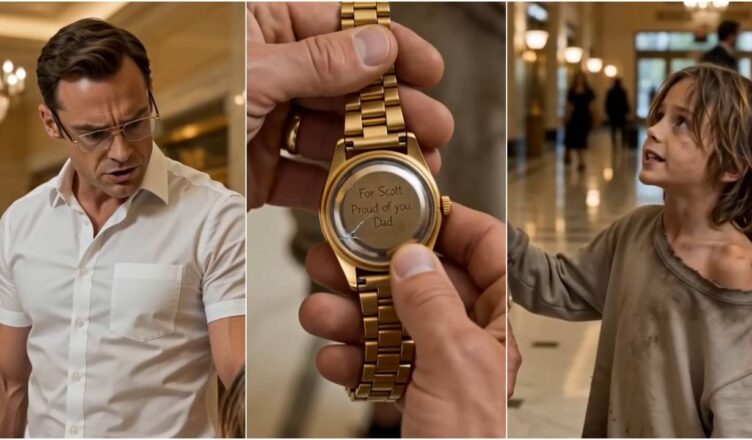
The Watch
The boy touched the sleeve of the man’s navy coat and asked, in a voice barely louder than the piano drifting through the Grand Meridian lobby,
“Sir… where did you get that watch? My dad had one exactly like it.”
The man turned with the polished impatience of someone used to being interrupted only by problems worth solving.
He was tall, sharply dressed, and composed in that expensive, practiced way that made strangers step aside without knowing why. The silver watch at his wrist caught the chandelier light as he moved, and for a moment his face held nothing but annoyance.
Then he looked down.
The child couldn’t have been more than nine. His sweatshirt hung off one shoulder, his jeans were too short at the ankles, and dust had dried pale around the toes of his sneakers. He looked like he had wandered into the wrong world by accident and stayed only because he had nowhere else to be.
But his eyes weren’t wandering.
They were fixed on the watch with such certainty that the man’s hand moved to his own wrist before he even realized it.
“What did you say?” he asked.
The boy swallowed.
“My dad had the same watch,” he said. “The same scratch near the glass.” He pointed carefully, not touching. “And I think the back had writing on it. My mom keeps an old picture of him wearing it.”
The man turned the watch over.
The engraving was still there, worn softer by years of skin and habit:
For Scott — Proud of you. — Dad
His throat tightened so fast it hurt.
“What was your father’s name?” he asked, and the question came out rougher than he intended.
The boy’s eyes widened.
“Scott,” he said.
That single word hit like a blow.
The man’s name was Grant Mercer, and fifteen years earlier he had been a seventeen-year-old drifter sleeping under an overpass with a stolen backpack for a pillow and no plan beyond making it through the next night without freezing.
He hadn’t had family worth calling.
He hadn’t had money.
He hadn’t had anyone in the world likely to say the words proud of you without laughing first.
Then one wet November evening, outside a one-bay auto shop on the edge of Dayton, Ohio, he collapsed beside a stack of bald tires and woke up to the smell of motor oil and tomato soup.
A mechanic named Scott Reed had found him there.
Scott wasn’t rich. He wasn’t educated in the ways impressive people liked to list. He didn’t deliver speeches about second chances. He was just a man with grease worked into the lines of his hands, a bad knee, and a tired face that had somehow never learned how to be mean.
He gave Grant a sandwich before he asked his name.
Then he pointed toward a heater in the corner and said, “Sit there till you stop shaking.”
The next morning he handed him a broom.
A week later he let him organize sockets and wrenches after hours.
A month later he showed him how to hear a loose belt before he saw it.
A year later he was the closest thing Grant had ever had to a father.
Scott wore that silver watch every day.
It was never flashy. Plain face. Heavy case. Practical band. Too solid to be stylish and too sentimental to replace. Sometimes, when repairs were going badly or money was tight, Scott would tap two fingers against the glass and smile to himself like he was remembering something private.
One night, while they were closing up the shop, Grant had finally asked about it.
Scott turned the watch over and showed him the inscription.
For Scott — Proud of you. — Dad
“My old man gave it to me when I opened the garage,” Scott said. “Didn’t have money for much. But he had enough for one good watch and one honest sentence.”
Grant had stared at those words for a long time.
No one had ever said anything like that to him.
Scott had noticed and pretended not to.
By the time Grant was nineteen, he had a real job offer in Columbus—small company, bad office carpet, decent pay, and the first legal opportunity anyone had ever placed in his hands without trying to take something first. On his last night in Dayton, he stood behind the garage with his duffel bag and one cheap winter coat and tried to thank Scott properly.
Scott wouldn’t let him.
Instead, he took off the watch and pressed it into Grant’s palm.
Grant tried to give it back immediately.
“I can’t take this,” he said. “It was your father’s.”
Scott closed Grant’s fingers over it.
“Then let it do one more job,” he said. “Wear it until you know how to be proud of yourself. After that, do whatever you want.”
Grant wore it every day after that.
He built a fleet-repair company.
Then sold it.
Then built another business bigger than the first.
Then a software platform.
Then a hotel group.
Then an entire life that looked, from the outside, like proof that effort and intelligence could outrun any ugly beginning.
But before he could go back to Dayton and do for Scott what Scott had done for him, he got there too late.
When Grant finally returned years later, the garage was gone. The apartment above it had been emptied out. The man who ran the laundromat next door told him only that Scott had gotten sick fast, died before summer ended, and that everything had fallen apart afterward.
Grant had spent years trying to track him down before that, mostly to thank him, then too late trying to find where his memory had gone.
Every trail ended in silence.
And now Scott’s son was standing in front of him in a luxury hotel lobby, in shoes splitting at the seams.
Grant crouched until they were eye level.
“What’s your name?” he asked carefully.
“Ethan.”
“Where’s your mom, Ethan?”
The boy glanced toward the service corridor near the back elevators.
“She’s working,” he said. “Housekeeping. She does evenings here after the diner.” He hesitated. “Sometimes I wait for her in the lobby if nobody tells me to move.”
Grant looked toward the corridor and back at him.
“And your dad?”
The boy’s face changed in the smallest, most terrible way.
“He got sick,” he said quietly. “Then he died.”
Grant closed his eyes for a beat.
He had known the outline already. Hearing it in the boy’s voice made it cruel all over again.
“We lost our apartment after that,” Ethan added with the practical flatness children use when life has forced practicality on them too early. “Mom says we’re okay. But she cries when she thinks I’m asleep.”
The words cut more cleanly than any accusation could have.
Grant looked down at the watch in his hand.
Then back at Ethan.
“I spent years trying to find your father,” he said quietly. “I wanted to thank him. I never got the chance.” His voice caught. “I didn’t know there was anyone else left behind.”
Ethan didn’t move.
He looked wary, the way hungry children looked when kindness arrived from strangers—interested, but already preparing for the trick.
Grant knew that look. He had worn it once.
“I’m not supposed to go off with people,” Ethan said.
“Good,” Grant said immediately. “Then we won’t.”
He stood and looked toward the concierge desk.
“I need the Willow Lounge opened,” he said, and his tone turned the nearest employee into motion. “And food. Now.”
Then he looked back at Ethan.
“You stay where your mother can find you. But you’re going to eat.”
Ethan opened his mouth, maybe to argue, maybe to be polite.
Then the smell from the kitchen reached them.
Hunger won.
They sat in a quiet lounge off the main lobby, all polished brass and leather chairs. Ethan picked grilled cheese and tomato soup—not the steak, not the burger, not the most expensive thing he could name. Just something familiar enough that his body believed it was safe.
He ate carefully at first.
Then faster.
Not greedily. Just honestly.
When the edge of hunger eased, he said, “Mom said Dad gave the watch away once.”
Grant looked up.
“What did she say exactly?”
Ethan wiped his mouth with the napkin. “She said Dad told her there was this boy who came in soaked and angry and thought the whole world was out to get him.” He glanced at Grant, then at the watch. “She said he used to say maybe the watch did more good on your wrist than his for a while.”
Grant had to look away.
An hour later, Ethan’s mother came through the service corridor in a housekeeping uniform, pushing an empty linen cart.
She saw her son first.
Then the stranger sitting across from him.
Her whole body changed.
“Ethan.”
He stood immediately. “Mom, wait. It’s okay.”
It clearly was not okay, as far as she was concerned. She crossed the room fast and placed herself between them with the protective force of a woman who had learned exactly what desperation cost.
“Who are you?” she asked Grant.
“Grant Mercer,” he said, standing slowly, hands visible. “Scott Reed took me in when I was seventeen.”
Her expression didn’t soften.
“A lot of people said they knew Scott after he died,” she said. “Most of them wanted something.”
Grant nodded once.
Then he said, “He kept a cracked red coffee mug on the workbench because he said coffee tasted better when the cup had survived something. He hummed old Motown songs when he was trying not to swear. He wrapped Christmas presents in newspaper because he said store paper tore too easy and cost too much. And whenever I messed something up, he’d tap that watch and say, ‘My old man was proud of me before I deserved it. Least I can do is pass that trouble along.’”
The woman’s face broke before she could stop it.
That was when Leah Reed believed him.
They sat together after her shift, long after the lobby had emptied and the city outside turned black and silver with winter. Grant told her things only someone who had loved Scott in the plain, unglamorous way men sometimes loved one another could know. The bad jokes. The impossible optimism. The spare gloves he kept in winter because “cold hands make bad decisions.” The way he always saved the least broken pastry from the bakery tray because he said pretty things usually tasted disappointing.
Leah cried silently at first.
Then openly.
Then with the exhausted anger of someone who had spent too long carrying grief alone.
When Grant finally told her what Scott had done for him, she covered her mouth with both hands.
“He never told me,” she whispered.
“He didn’t do it to be thanked,” Grant said. “He did it because he saw me.”
Leah’s eyes dropped to the watch.
“He loved that watch.”
“I know.”
“And you kept it all these years.”
Grant turned it over once in his hand. The engraved words caught the lamplight.
“I kept it because no one had ever said anything like that to me before,” he said. “Not until I saw it on the back of his watch. Not until he let me borrow it.”
She looked up. “And what do you want from us now?”
Grant answered immediately.
“Nothing.”
Then he corrected himself.
“That’s not true. I want the chance to do for Ethan what Scott did for me. And I want to make sure neither of you spends one more night wondering how to hold your life together alone.”
Leah studied him for a long time.
Then she said, with tired honesty, “People say things like that when they want to feel noble.”
“Then don’t trust the words,” Grant replied. “Trust what I do next.”
And he moved.
Fast.
Not in the performative way wealthy men sometimes help when they want gratitude to arrive on schedule. In the real way. The costly way. The paperwork way.
Within a week, his attorneys had cleared the rent debt trailing the Reeds like a threat.
Scott’s medical bills were negotiated and paid.
Leah and Ethan moved into a small townhouse with good locks, working heat, and a school close enough to walk to.
A protected trust was created in Ethan’s name—education, housing, medical care, later college, later business capital if he wanted it.
Leah had veto power over everything until Ethan turned eighteen.
Grant insisted on that.
Help should make people safer, not smaller.
Most important, he stayed.
He took Ethan to his repair shops on Saturdays.
He taught him how to read invoices, then brake rotors, then balance sheets.
He repeated Scott’s sayings so often that Ethan started rolling his eyes before, eventually, he started using them.
Years passed.
Leah’s face lost its permanent strain.
Ethan grew taller.
School got easier.
Then harder.
Then easier again.
He learned to trust slowly, like a child who had once counted crackers in secret and hidden food in his room for fear it might vanish.
Grant never made him call him anything.
Never asked for father.
Never tried to replace what couldn’t be replaced.
He just kept showing up.
On Ethan’s eighteenth birthday, Grant invited him to dinner in the private room of the same hotel where they had first met.
After dessert, he set a small velvet box on the table.
Ethan opened it and went very still.
Inside lay the silver watch.
He picked it up carefully, turning it over until the engraving caught the light.
For Scott — Proud of you. — Dad
His thumb found the scratch near the glass.
“That was his,” Ethan said softly.
“It always was,” Grant said.
Ethan’s throat moved. “You wore it all these years.”
“It reminded me who made me possible.”
For a long moment Ethan just stared at the watch.
Then he looked up.
“Do you think he was proud of me?”
Grant smiled, though his vision had gone blurry.
“Every single day,” he said.
Ethan looked down again, then back up with a question so quiet it nearly disappeared under the piano in the lobby below.
“Do you think he was proud of you too?”
Grant let out a breath that felt like fifteen years of gratitude.
“I think,” he said, “your father decided that before I’d done a thing to earn it. That’s why I had to spend the rest of my life trying.”
Later, people liked to talk about the coincidence.
The luxury hotel.
The worn-out shoes.
The little boy who recognized his father’s watch on a rich man’s wrist.
The way fate had somehow circled all the way back.
But that was never the real miracle.
The real miracle was smaller than that.
A mechanic with rough hands and an old silver watch once looked at a freezing teenage boy and decided he was worth the trouble.
Years later, that decision came back wearing his son’s face.
And by then, it wasn’t about money anymore.
It was about inheritance in the truest sense—not cash, not property, not status, but the passing of dignity from one life into another.
Scott Reed never lived to see what his kindness built.
But it lived anyway.
In the watch.
In the boy.
In the man who finally understood that the greatest fortune he would ever hold had nothing to do with what sat in his accounts.
It was the day someone chose to believe in him when he had nothing left to offer except the chance to be right.