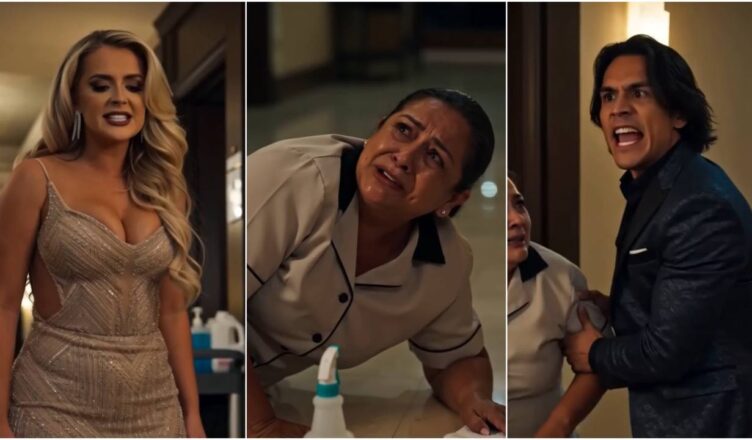
Rosa Morales hit the marble floor hard enough to knock the air from her lungs.
A spray bottle rolled from her hand. A folded cleaning cloth slid across the polished stone. The housekeeping cart trembled against the wall, and a small bottle of lemon disinfectant tipped over, spilling a thin yellow line beneath the warm glow of the hotel sconces.
For one breath, the corridor outside the Presidential Suite went silent.
Then Cassandra Vale’s voice cut through the quiet like broken glass.
“What were you doing in there, you filthy immigrant?”
Rosa tried to push herself up, but pain shot through her shoulder. She was fifty-two, full-figured, with dark hair pinned tightly beneath a maid’s cap and hands worn rough by bleach, laundry steam, and years of work no one noticed unless something went wrong.
Her eyes filled with tears.
Not from the fall.
From the humiliation.
Cassandra stood over her in a short silver dress and high heels, blonde hair falling in polished waves around her shoulders, red lips tight with disgust. Diamonds flashed at her wrists. Her engagement ring looked heavy enough to bruise.
Rosa pressed one palm against the marble.
“I was told to clean the room,” she said softly.
Cassandra laughed once.
“People like you only know how to steal.”
A waiter froze near the corner with a champagne tray. Two guests stopped by the elevator. A junior manager stepped out of the service hallway, saw Cassandra, and immediately stopped moving.
Everyone knew who she was.
Cassandra Vale was marrying Adrian Reyes in three weeks.
And Adrian Reyes was not simply wealthy. He was the kind of wealthy people spoke about carefully. Founder of a global cybersecurity company. Owner of hotels, real estate, and private equity holdings. A man who had crossed an ocean with nothing but a scholarship and a secondhand laptop, then built a name powerful enough to make old money nervous.
Cassandra loved that name.
She loved the parties. The magazine mentions. The private clubs. The way people lowered their voices when she entered a room now.
What she did not love was finding a hotel housekeeper alone inside Adrian’s private suite.
“I didn’t take anything,” Rosa whispered.
“Don’t lie to me.”
“I’m not lying.”
“You were in my fiancé’s room with the door closed.”
“I was cleaning.”
Cassandra’s eyes narrowed.
“You people always have an excuse.”
Rosa lowered her head.
That seemed to anger Cassandra even more.
“Look at me when I’m talking to you.”
Rosa looked up slowly.
“I have worked in hotels most of my life,” she said. “I would never steal from a guest.”
Cassandra stepped closer.
“And yet here you are, somewhere you don’t belong.”
Before Rosa could answer, Cassandra grabbed her wrist and yanked her forward.
Rosa winced.
“Please let go.”
“Where’s the key?”
“It’s my work key.”
“Where is it?”
A black key card slipped from Rosa’s apron pocket and landed between them.
Cassandra looked around, making sure the little audience understood what she had “caught.”
Then she pointed sharply toward the suite door.
“Get out of here.”
Rosa’s mouth trembled.
“I can explain.”
“No. You can pack your things and leave before I have security drag you out.”
The words carried down the corridor.
Farther away, near the elevator, Adrian Reyes stopped walking.
He had arrived quietly, phone still in one hand, his charcoal suit slightly loosened after a long investor dinner downstairs. At first, he saw only the scene: his fiancée standing over a fallen housekeeper, guests watching, staff frozen.
Then he saw the woman’s face.
And the world tilted.
Not because he recognized her immediately.
Because some part of him recognized her before his mind did.
The tired eyes.
The dark hair pinned back.
The way she held herself small when someone cruel stood over her.
The voice that had once calmed a dormitory full of frightened children during thunderstorms.
Adrian moved before anyone noticed him.
Cassandra raised her hand as if she might strike Rosa.
“Don’t.”
Everyone turned.
Adrian was already walking toward them, fast now.
Cassandra’s expression shifted into relief.
“Adrian, thank God. I found her in your suite.”
He did not look at her.
He dropped to one knee beside Rosa.
“Are you hurt?”
Rosa stared at him.
For a moment, she only saw a powerful man in an expensive suit.
Then his eyes softened.
“Rosa?”
Her lips parted.
The name came out as a whisper.
“Adrian?”
The corridor went quiet in a different way.
Adrian helped her stand carefully. His hands trembled when he touched her arm.
“It’s you,” he said.
Rosa looked at his face like she was seeing two people at once — the small, angry boy from the orphanage and the man he had become.
“My God,” she whispered. “Look at you.”
Cassandra stared at them.
“What is happening?”
Adrian turned toward her.
The fury in his face was controlled, and somehow that made it worse.
“What did you do to her?”
Cassandra blinked.
“What did I do? I caught her in your room.”
“She works here.”
“She was alone in your suite.”
“She was cleaning it.”
“She had a key.”
“She’s staff.”
Cassandra’s face hardened with disbelief.
“You’re defending the maid?”
Adrian’s jaw tightened.
“Do not call her that.”
Cassandra laughed, stunned.
“She is the maid.”
Rosa looked down.
Adrian saw it.
That small movement hurt him more than anything Cassandra had said.
He stepped between them.
“You stupid bitch,” he said, his voice low and furious. “Do you have any idea who this woman is?”
Cassandra went still.
“Excuse me?”
Adrian took Rosa’s hand.
“This woman raised me.”
The words landed harder than a shout.
Cassandra looked at Rosa, then back at Adrian.
“What?”
“I grew up in an orphanage,” Adrian said. “Until I was eighteen, Rosa worked there. She fed me when I was too proud to say I was hungry. She hid birthday cupcakes in napkins because the budget was too small. She stayed after her shift to help me study English. She was there when I got rejected, when I got sick, when I wanted to give up.”
Rosa’s eyes filled.
“Adrian, please…”
“No,” he said gently. “People should know.”
Then he looked back at Cassandra.
“She was the closest thing I had to a mother.”
Cassandra swallowed.
“I didn’t know.”
“That is not an excuse,” Adrian said. “That is the truth about you.”
Her face flushed.
“I thought she was stealing.”
“Because she was Latina? Because she wore a uniform? Because she didn’t look rich enough to be treated like a human being?”
Cassandra had no answer.
Adrian looked at Rosa’s bruised wrist.
“I watched you put your hands on her.”
Cassandra stepped toward him, panic rising.
“Adrian, listen to me. This is a misunderstanding.”
“No. A misunderstanding is when you get a room number wrong. This is who you are.”
“We’re getting married.”
“No,” he said.
The word was quiet.
It ended everything.
Cassandra stared at him.
“You can’t be serious.”
“I am.”
“You’re throwing away our wedding over some woman from your past?”
Adrian’s eyes went cold.
“She is not some woman.”
Cassandra looked around and suddenly seemed to realize there were witnesses.
“You can’t humiliate me like this in public.”
Adrian’s voice stayed calm.
“You made it public.”
The junior manager finally stepped forward.
“Mr. Reyes?”
“Preserve the hallway footage,” Adrian said. “File an incident report. Notify legal.”
Cassandra’s mouth opened.
“Legal?”
“You assaulted an employee of this hotel.”
“I’m your fiancée.”
“No,” Adrian said. “You were.”
Cassandra removed the engagement ring with shaking fingers and dropped it onto a side table near the suite door.
It made a small, dull sound.
No sparkle.
No power.
Security arrived moments later. Cassandra looked at Adrian one last time, mascara cutting dark lines down her cheeks.
“I loved you.”
Adrian held her gaze.
“No. You loved what standing beside me made you.”
The guards escorted her down the hall.
When the elevator doors closed, the corridor began breathing again.
Rosa pulled her hand away softly.
“You didn’t have to do that.”
“Yes,” Adrian said. “I did.”
“I’m sorry you saw me like this.”
His face broke.
“No. I’m sorry I lost you.”
After he turned eighteen, Adrian had left the orphanage on a scholarship. Then came London, Singapore, San Francisco. Years of survival disguised as ambition. He had sent money once, then the old address stopped working. The orphanage closed. Staff scattered. Records vanished. Life swallowed the trail.
But not the memory.
Rosa had never blamed him.
“You were building your life,” she said.
“I should have found you.”
“You were a boy when you left.”
“I’m not a boy now.”
She smiled through tears.
“No. You’re not.”
Adrian pulled her into his arms.
At first, Rosa stood stiffly, shocked by the attention, by the expensive corridor, by the powerful man holding her like someone precious.
Then she hugged him back.
And Adrian, who had not cried in front of anyone in twenty years, closed his eyes.
“I’m sorry,” he whispered. “For her. For tonight. For disappearing.”
Rosa touched the back of his head the way she had when he was twelve and pretending not to be scared.
“You came back now,” she said. “That counts.”
He laughed once, broken and quiet.
Later that night, Adrian sat with Rosa in a private lounge while the hotel doctor checked her shoulder and wrist. She kept apologizing for taking his time. He kept telling her to stop.
When the doctor left, Adrian ordered tea and soup, the way she used to do for him when he came down with a fever in the dormitory.
Rosa noticed.
“You remember that?”
“I remember everything.”
She looked away, overwhelmed.
He asked about her life.
She told him the simple version first. She worked at the hotel. She rented a small apartment in Queens. Her daughter, Sofia, was twenty-seven and had studied business administration while working part-time, but every decent opportunity seemed to require a connection neither of them had.
Adrian listened without interrupting.
Then he said, “Send me her résumé.”
Rosa stiffened immediately.
“No.”
Adrian blinked. “No?”
“I don’t want pity for my daughter.”
“It’s not pity.”
“You don’t even know her.”
“I know you raised her.”
“That doesn’t mean she should be handed something.”
“Then she won’t be handed anything,” Adrian said. “She’ll interview like everyone else. If she’s good, she’ll get a chance. If she isn’t, I’ll tell you the truth.”
Rosa studied him carefully.
“And if she embarrasses herself?”
“She won’t.”
“You don’t know that.”
“Yes,” Adrian said softly. “I do.”
For the first time that night, Rosa smiled.
A small smile.
Tired, but real.
Three weeks later, Sofia Morales walked into Reyes Technologies wearing a navy blazer she had pressed twice that morning and shoes that hurt before noon.
She expected Adrian Reyes to be intimidating.
He was.
But not in the way she had imagined.
He greeted her in the lobby himself.
“Sofia Morales?”
She turned.
He stood beside the security desk, sleeves rolled back, no entourage, no performance.
“Yes.”
“I’m Adrian.”
“I know.”
He smiled.
“Fair.”
She had her mother’s eyes, but sharper. Dark hair, calm posture, and the kind of guarded confidence that came from having to prove herself in rooms where no one expected much.
Adrian noticed.
Sofia noticed that he noticed.
He did not interview her himself. He was careful about that. The operations director handled it. Human resources handled it. Sofia was given the same assessment as every other candidate.
By the end of the week, she had found two billing irregularities in a mock vendor file, flagged a hidden contract risk no one expected her to catch, and corrected a senior analyst’s assumption without making him feel stupid.
The operations director called Adrian afterward.
“She’s good,” he said.
Adrian looked through the glass wall at Sofia sitting in the conference room, reviewing notes with a pencil behind her ear.
“How good?”
“Good enough that if we don’t hire her, someone smarter will.”
Sofia joined the company as a junior operations analyst.
Not because of Rosa.
Because she had earned it.
Still, Adrian kept his distance at first. He had spent too much of his life watching powerful men blur lines and call it charm. He refused to become one of them.
But Sofia was not easy to ignore.
She was direct. Funny when she did not mean to be. Careful with people others overlooked. She spoke to janitors, assistants, and executives in the same clear tone.
One evening, nearly two months after the hotel incident, Adrian found her in a conference room, still working after most of the floor had gone dark.
“You know the office closes,” he said.
She looked up.
“You own the building. I’m guessing you know it opens too.”
He almost laughed.
“You sound like your mother.”
“Thank you.”
“I meant that as a compliment.”
“I took it as one.”
On the table between them lay a stack of vendor reports. Sofia had marked them with color-coded notes.
Adrian picked one up.
“This is strong work.”
“It’s accurate work.”
“There’s a difference?”
“Yes. Strong sounds like you’re surprised.”
He looked at her.
She held his gaze.
Then he smiled, slow and genuine.
“You’re right.”
“I usually am.”
That time, he did laugh.
A real one.
Sofia tried not to smile and failed.
A month later, Sofia was promoted into a rotational fellowship that reported to a different executive team. Adrian made sure the paperwork was clean and the decision documented. He told himself it was professional discipline.
It was also self-protection.
Because every time Sofia walked into a room, something in him shifted.
Something he had not expected to feel after Cassandra.
Not performance.
Not hunger.
Peace.
On a Friday evening, after Sofia’s fellowship officially transferred her out of his reporting chain, Adrian found her in the lobby holding a cardboard box of files.
“Leaving already?” he asked.
“Different floor. Same building. Don’t celebrate too hard.”
“I was going to ask if you wanted coffee.”
Sofia paused.
“Is this a professional coffee?”
“I hope not.”
She studied him carefully.
“My mother thinks you hung the moon.”
“She used to accuse me of stealing bread.”
“Did you?”
“Yes.”
“Then she was right.”
“She usually was.”
Sofia looked down, smiling despite herself.
“This is complicated.”
“Yes,” Adrian said. “It is.”
“I don’t want to be someone you help because you feel guilty.”
“You’re not.”
“How do I know?”
“Because guilt feels heavy,” he said. “This doesn’t.”
Sofia looked at him for a long moment.
Then she said, “One coffee.”
“One coffee,” he agreed.
That night, Rosa watched from her apartment window as Adrian opened the car door for her daughter.
Sofia turned back and waved.
Rosa waved too, one hand pressed gently against her chest.
For years, she had believed life only took people away.
But sometimes, it returned them differently.
Not as the children they had been.
Not as the dreams they once promised to become.
But as grown people, carrying scars, apologies, and second chances.
Downstairs, Adrian and Sofia walked side by side into the warm evening.
Nothing was certain.
Not yet.
But when Sofia laughed, Adrian looked at her the way a man looks at a future he did not know he was still allowed to want.
And this time, he did not walk away from it.