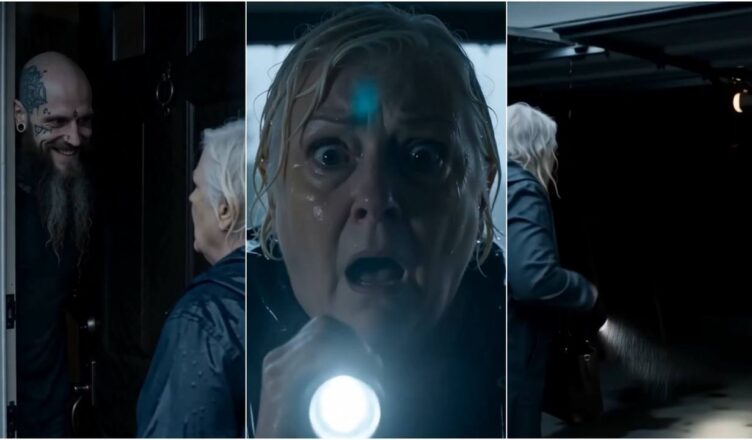
The first thing I heard behind the garage door was not a scream.
It was a thud.
Soft. Weak. Buried under rain.
The kind of sound a person makes when they no longer have the strength to call for help but still cannot stop trying.
I stood in my daughter’s driveway with water running down my face, one hand frozen around the strap of my handbag, staring at the brand-new padlock on the side garage door.
It was shiny.
That was what frightened me most at first.
Everything else on Emily’s little Portland house looked familiar: the peeling white trim around the windows, the blue ceramic planter she had bought at a farmers market, the crooked porch light her father had installed badly and proudly before he died.
But the padlock was new.
Heavy. Silver. Clean.
It did not belong on that door.
Neither did the silence inside the house.
Neither did the way Ryan had smiled at me.
Seven days earlier, my daughter stopped answering her phone.
At first, I tried to be reasonable. Emily was thirty-two. She had a demanding job. She hated long calls. Sometimes she forgot to charge her phone. Sometimes she answered texts three days late with: Sorry, Mom, alive, just buried.
But this was different.
My messages showed delivered.
Then nothing.
Her voicemail was full.
Her best friend said she had not heard from her either. Her office said Ryan had emailed them that Emily had a family emergency and needed the week off. That was the first lie I could prove, because I was her family, and I had not heard one word.
So on the seventh morning, I got into my car and drove three hours through rain with my hands locked around the steering wheel.
The whole way, I kept hearing my own voice trying to calm me down.
Maybe she’s sick.
Maybe she and Ryan had a fight.
Maybe she just needs space.
But underneath all of that, a quieter voice kept saying:
No.
Something is wrong.
When I pulled up to the house, Ryan opened the door before I knocked twice.
He had always made me uneasy.
Thin, pale, bald, with a long beard, tattoos crawling up his neck, and silver piercings along his eyebrow and lip. Emily used to say I judged him too fast. Maybe I did. But there was something in his eyes I never trusted — a patient, watching stillness, like he was always waiting for people to become useful.
That morning, he stood half-hidden behind the door in a black hoodie, blocking the hallway with his body.
“Linda,” he said, smiling too slowly. “Wow. I wasn’t expecting you.”
“Where’s Emily?”
He blinked once.
“She’s away.”
“Away where?”
“Work thing.” He scratched his beard. “Seattle. Maybe farther. Some retreat.”
I stared at him.
“Her office said there was a family emergency.”
His smile tightened.
“Right. Yeah. It’s complicated. She didn’t want people asking questions.”
“Then why didn’t she call me?”
Ryan leaned against the doorframe.
“She’s overwhelmed. You know how she gets.”
No, I thought.
I know how you describe her when you want her to sound unstable.
Behind him, the house looked too clean. Not Emily clean. Ryan clean. Countertops wiped bare. Shoes aligned by the wall. No coffee mug near the sink. No mail on the side table. No cardigan over the chair.
Emily left small signs of life everywhere.
This house looked staged.
“I brought her lemon cookies,” I said, because I needed a reason to stay one more minute. “I’ll just leave them inside.”
Ryan’s hand tightened on the edge of the door.
“She’s not here.”
“I heard you.”
“I’ll give them to her when she gets back.”
He did not move.
For a moment, we stood there with rain pouring behind me and the narrow gap of the doorway between us.
Then somewhere to my left, beyond the side of the house, something hit wood.
A muffled thud.
Ryan heard it too.
His face changed for less than a second.
Then he smiled again.
“Old pipes,” he said.
The garage did not have old pipes.
I looked toward the side yard.
Ryan stepped out onto the porch just enough to block my view.
“You should head home before the weather gets worse.”
That was when fear stopped being a feeling and became a fact.
I nodded slowly.
“You’re right,” I said. “I left the cookies in the car anyway.”
I turned before he could read my face.
Every step down that driveway felt like walking away from my own child.
My car was parked near the curb. I opened the passenger door, reached inside, and grabbed the emergency tool kit I kept under the seat. My late husband had insisted on it years ago: flashlight, jumper cables, gloves, tire gauge, small crowbar.
I slid the crowbar into my handbag with shaking fingers.
Then I took out my phone and typed one message with my thumb.
My name is Linda Hart. I am at my daughter Emily Hart’s house. Her husband says she is gone, but I heard sounds from the locked garage. I believe she may be inside. Please send police. I am going to check now.
I sent it to 911 text service and turned on my location.
A reply came almost immediately.
Help is on the way. Stay safe if possible.
I looked back at the house.
Ryan was still on the porch.
Watching.
So I forced myself to smile and lifted the bag of cookies like I had found what I came for.
Then I walked toward the side yard.
“Linda?” Ryan called.
I didn’t answer.
The rain gave me cover. It roared against the gutters, slapped the leaves, blurred the windows. My shoes slipped in the mud as I rounded the corner of the house.
The side garage door came into view.
That new padlock gleamed against the old hasp.
I heard the thud again.
Closer now.
Weaker.
I pressed one hand flat against the door.
“Emily?” I whispered.
For a second, nothing.
Then a sound came from inside.
Not a word.
A broken breath.
My knees almost folded.
I opened my handbag, pulled out the crowbar, and jammed it behind the lock.
The first pull did nothing.
The second tore skin from my palm.
The third made the metal groan.
Behind me, Ryan’s voice cut through the rain.
“What are you doing?”
I did not turn around.
I pulled with everything I had.
The hasp snapped off the frame.
The lock fell into the mud.
Ryan ran toward me.
“Linda!”
I grabbed the garage handle and yanked.
The door rose only a foot before it stuck.
Darkness opened under it like a mouth.
A smell came out first.
Damp concrete. Sweat. Gasoline. Fear.
I dropped to my knees and pulled the flashlight from my bag. My fingers were so wet I almost lost it. The beam shook as I pointed it into the black space.
At first, I saw only boxes.
A lawn mower.
A rolled-up rug.
Then the light caught movement in the far corner.
A hand.
Thin. Dirty. Trembling against the concrete.
The flashlight slipped in my grip.
“Emily.”
The sound I made was barely human.
Ryan grabbed my shoulder from behind.
I spun and hit him with the handbag as hard as I could. It was not graceful. It was not brave. It was a mother swinging whatever she had because the world had narrowed to one thought:
Get to her.
Ryan stumbled back, more surprised than hurt.
“You don’t understand,” he snapped. “She’s not well.”
I dropped flat and crawled under the half-open garage door.
The concrete soaked through my coat. My shoulder scraped the bottom edge. Behind me, Ryan cursed and tried to pull the door down, but I had wedged the crowbar into the track without thinking.
Inside, the darkness was colder.
My flashlight rolled near my knee, its beam cutting sideways across the floor. I grabbed it and crawled toward the corner.
Emily was there.
My daughter.
She was sitting against a storage cabinet with her wrists bound loosely in front of her by a phone charger cord, her mouth covered with silver tape that had been pulled partly loose at one side. Her hair was tangled. Her lips were cracked. One eye was swollen. Her purple sweatshirt hung off one shoulder, and she was shaking so badly the boxes behind her rattled.
For one second, she stared at me like she did not believe I was real.
Then she made a sound through the tape.
I tore it gently from her mouth.
She gasped.
“Mom.”
I gathered her into my arms, and she collapsed against me with such weakness that terror flashed through my body.
“I’m here,” I kept saying. “I’m here. I’m here.”
Behind us, Ryan’s shoes scraped outside the garage.
“You need to come out,” he said, voice suddenly calm. Too calm. “Both of you. This looks bad because you don’t know the context.”
Emily clutched my raincoat.
“He was drugging me,” she whispered. “Mom, don’t let him near me.”
Something inside me went completely still.
Not cold.
Clear.
I reached into my pocket, found my phone, and saw the call had connected. The 911 dispatcher was already listening.
I put it on speaker.
“Police are coming,” I said loudly.
Ryan stopped moving.
For the first time that morning, his silence sounded afraid.
Then sirens rose in the distance.
Faint at first.
Then closer.
Emily began to cry.
Not loudly.
She did not have the strength for loud.
She cried the way a person cries when survival finally catches up with the body.
I held her tighter.
Ryan tried to run.
I heard his footsteps slap across the wet driveway, heard the front gate bang, heard a shout from the street.
“Police! Stop!”
Then another shout.
Then the hard sound of a body hitting wet pavement.
By the time the officers pulled the garage door fully open, Emily was wrapped around me like she was five years old again, her fingers locked in my coat.
Paramedics took one look at her and moved fast.
They cut the cord from her wrists. They checked her pulse, her pupils, her blood pressure. One of them asked how long she had been inside.
Emily looked at me.
“Six days,” she whispered.
I closed my eyes.
Six days.
Six nights.
While I slept in my own bed telling myself not to overreact, my daughter had been locked in the dark less than ten feet from her kitchen.
At the hospital, the truth came out in pieces.
Ryan had not snapped all at once. Men like him rarely do.
He had been tightening control for months.
He started with her phone. Then her email. Then her friends. He told her she was anxious, unstable, dramatic. He convinced her to take “something natural” to help her sleep. When she refused, he crushed pills into tea.
Emily had discovered he was using her accounts to apply for credit cards and transfer money from her savings. When she told him she was leaving and calling the police, he panicked.
He locked her in the garage.
Then he started pretending to be her.
Texts to coworkers.
Emails to friends.
One message to me on the second day, from her phone, that simply said:
Busy week. Love you.
I had stared at that message for ten minutes when it came.
Something about it felt wrong.
Emily never wrote “Love you” without the little red heart emoji. I told myself that was silly. People change their texting habits. Adults get busy. Mothers imagine things.
I will regret that for the rest of my life.
But Emily, lying in the hospital bed with an IV in her arm and bruises on her wrists, would not let me keep it.
“You came,” she said.
“I almost waited.”
“But you didn’t.”
Her voice was thin, but there was a firmness in it I recognized. The little girl who once refused to leave a wounded bird in the street. The teenager who argued with principals. The woman who had survived six days in the dark and still knew the difference between truth and blame.
“You came,” she said again. “That’s what matters.”
Ryan was charged before midnight.
Kidnapping. Assault. False imprisonment. Financial crimes. The list grew as detectives searched the house and found Emily’s phone hidden behind the furnace, her car keys taped underneath a drawer, and printed bank forms stacked on his desk.
He had been planning to say she ran.
That she was unstable.
That she emptied the accounts herself.
That he was the worried husband left behind to explain the wreckage.
But he did not count on one muffled thud.
He did not count on a mother who knew her daughter’s silence was not peace.
Three weeks later, Emily came home with me.
Not to Ryan’s house.
Never there again.
She moved into my spare bedroom, the one with the yellow curtains she used to hate as a teenager and now said made the mornings feel less sharp. Some nights she woke screaming. Some days she sat at the kitchen table for an hour without touching her coffee. Healing did not arrive like a sunrise. It came in small, stubborn pieces.
A shower with the door unlocked.
A meal finished.
A phone call answered.
A laugh that startled both of us.
One afternoon, while rain tapped softly against my windows, Emily stood in the hallway holding the old emergency tool kit from my car.
The crowbar was still inside.
The metal was scratched near the tip where it had torn through the garage hasp.
She ran her thumb over it.
“Dad bought this, didn’t he?”
I nodded.
“He said every woman should have tools and know where they are.”
Emily smiled faintly.
“Sounds like him.”
Then her face changed.
She looked toward the window, where rain blurred the glass.
“I kept trying to make noise,” she said. “But he told me nobody would hear. After a while, I started believing him.”
I crossed the room slowly.
She did not like sudden movement anymore.
“I heard you.”
Her eyes filled.
“I know.”
She set the crowbar back in the box and closed the lid.
For a while, neither of us moved.
Outside, the rain kept falling, softer than it had that day.
The kind of rain that made the world feel washed, not buried.
Emily leaned her head against my shoulder.
“I thought my life was over in there,” she whispered.
I put my arm around her.
“No,” I said. “It was waiting for someone to open the door.”
And this time, when the house grew quiet around us, it did not feel like danger.
It felt like rest.