THE GIRL IN THE RAIN
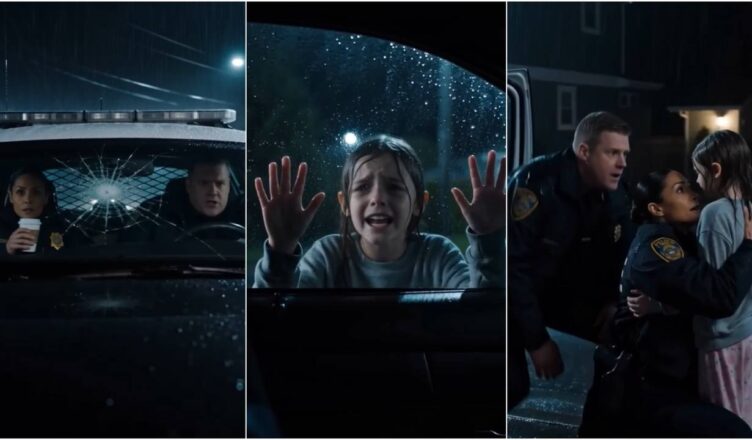
Freezing rain hammered the windshield, turning the Portland street ahead into a blur of silver and black. Officer Olivia Price sat in the passenger seat with both hands around a paper cup of coffee, pulling what warmth she could from it. Beside her, Officer Daniel Harris drove the cruiser slowly past a row of tired one-story houses with weak porch lights glowing through the storm.
Then a rock hit the windshield.
The crack sounded like a gunshot.
Daniel slammed the brakes. The cruiser lurched on wet pavement, tires hissing, and a white spiderweb exploded across the passenger side of the glass. For one violent second both officers thought the same thing:
Ambush.
Daniel’s hand went to the radio. Olivia twisted toward the passenger window—
And saw a little girl running through the rain.
She was barefoot, soaked through, maybe seven years old. She skidded on the slick street, caught herself, then slammed both hands against the passenger-side window hard enough to rattle it.
Olivia shoved the door open and stepped into the cold.
“Please!” the girl cried. “Please help me! There’s somebody in our house!”
Daniel was out a second later. He dropped into a crouch in front of her, keeping his voice low and steady even as rain poured off the brim of his cap.
“Hey, hey. Look at me. You’re okay. Tell me what happened.”
In one hand she still clutched a small stuffed bear, soaked almost black by the storm.
“I heard glass break,” she said. “In the kitchen. I saw a man.”
Olivia glanced at the shattered windshield. “You threw the rock?”
The girl flinched. “I’m sorry.”
Olivia pulled off her rain jacket and wrapped it around her shoulders. “Don’t apologize. You saved yourself.”
Daniel asked, “What’s your name?”
“Lily.”
“Lily, who else is in the house with you?”
The answer came out so softly Olivia almost missed it.
“Nobody.”
Daniel leaned closer. “Nobody else?”
Lily shook her head once. “I was home alone.”
Daniel’s face changed too.
Not panic.
Anger.
Olivia keyed her radio. “Dispatch, Unit Twelve. Possible burglary in progress, suspect still inside. Child out of residence. Start another unit and EMS.”
She opened the back door of the cruiser and guided Lily inside. Heat rushed out into the rain. Daniel looked toward the house halfway down the block—a narrow place with sagging gutters and one weak porch bulb flickering in the storm.
“Show us,” Olivia said.
Lily pointed with a trembling finger.
Daniel checked the street, then looked at Olivia.
“I’m going.”
“Backup’s close.”
Static crackled from Olivia’s shoulder mic. Another unit was two minutes out.
Then both of them heard it.
From the direction of the house, faint under the rain—something metal hitting the floor.
Daniel was already moving.
He cut across the yard with his flashlight in one hand and his weapon in the other. The kitchen window at the back had been smashed in. Glass glittered across the concrete. Muddy shoe prints marked the sill. The rear door stood slightly open, rocking with the wind.
“Police!” Daniel shouted. “Come out now!”
No answer.
Then a scrape from inside. A drawer slamming. Quick footsteps.
Daniel pushed through the back door.
His light cut across overturned mail, an open junk drawer, a purse dumped out on the table. In the next room a large man in a dark jacket froze with a duffel bag in one hand.
For a beat they stared at each other.
Then Daniel barked, “Drop the bag!”
The man bolted for the hallway.
He didn’t make it. His boots hit the wet linoleum, slipped, and he slammed shoulder-first into the wall. Daniel hit him before he could recover. The duffel flew. A screwdriver skidded under the couch. The man swore, twisted, tried to buck free, but fear had already made him sloppy. Daniel drove him face-down and cuffed him.
“Wrong house,” Daniel said.
By the time the second unit came through the front door, the intruder was already on the floor in handcuffs, cursing and insisting he “didn’t take anything.”
Outside, Olivia sat in the cruiser with Lily while the heater blasted warm air at full force. She had wrapped a blanket over the rain jacket, but the child was still trembling. Olivia softened her voice. “You did exactly the right thing tonight.”
Lily stared down at the soaked bear in her lap. “I didn’t know if you’d stop.”
“We stopped.”
For the first time, Lily looked straight at her. “Mom says never talk to strangers.”
Olivia gave the smallest, saddest smile. “Tonight was a good time to ignore your mom.”
The paramedics arrived and began checking Lily’s feet for cuts and cold exposure. Daniel emerged a minute later, rainwater streaming off his uniform, and the child’s whole body stiffened.
“That him?” Olivia asked.
Lily nodded without looking up.
Once the suspect car was gone and the house was secure, Olivia asked the question she had been holding back.
“Lily, where’s your mom?”
The girl went quiet.
Olivia waited.
Finally Lily whispered, “She told me to go to sleep.”
“Did she go to work?”
A small shake of the head.
“Then where did she go?”
Lily’s fingers tightened around the bear. “Mark’s house.”
Olivia said nothing.
The child looked up, exhausted and earnest, trying to explain something bigger than she had words for.
“She goes there when my dad’s away,” Lily said. “My dad works overseas. Mom says I’m supposed to be asleep, so it doesn’t count.”
Olivia turned toward the rain-streaked window and keyed her radio again. Her voice, when it came, was flat and controlled.
“Dispatch, notify child services. And keep trying the mother.”
Laura Anderson answered on the third call.
She sounded sleepy, annoyed, and nowhere near frightened enough.
“What?”
Olivia identified herself. “Your daughter was alone during a break-in tonight. Where are you?”
A pause.
“Driving,” Laura said.
Olivia looked at Lily in the back seat, wrapped in police blankets, feet red from the cold.
“No,” Olivia said. “Where are you really?”
Another pause. Then Laura tried a different tone—breathless, offended, already reaching for an excuse.
“I only stepped out for a little while.”
Olivia’s jaw tightened. “Your little while ended with your daughter barefoot in the street throwing a rock through a police windshield to get help.”
Silence.
Laura arrived forty minutes later in heels, a black coat over an evening dress, smelling faintly of perfume, wine, and wet leather. She took in the flashing lights, the broken window, the officers, the paramedic van—and then looked at Lily.
Olivia watched for it.
The rush to her child.
The panic.
The guilt.
What Olivia saw first was calculation.
“Lily? Oh my God—baby, why were you outside?” Laura said, hurrying forward.
Olivia stepped between them. “Because there was a man in your house, ma’am. And because she was alone.”
Lily did not move toward her mother.
That told Olivia more than any report ever could.
The lies fell apart fast. A neighbor’s doorbell camera showed Laura leaving hours earlier. Her phone placed her across town for most of the night. And when detectives later pulled the messages, the pattern got uglier: nights away, excuses, promises that Lily “sleeps hard” and “never knows.”
What broke Olivia wasn’t the affair. It was the routine. This had happened before.
When a child-services counselor sat with Lily the next morning, the girl quietly explained that being left alone overnight was not new. She said it the way children say devastating things when they don’t yet know which truths are supposed to shock adults.
Michael Anderson got the call just after dawn.
He was working overseas on a long engineering contract. Olivia could hear machinery in the distance and the fuzz of a bad connection when he answered, but after she identified herself and said there had been an emergency involving his daughter, the line went almost perfectly still.
Then he asked, in a voice that sounded scraped raw, “Is she alive?”
“She’s alive,” Olivia said. “She’s safe. She needs you here.”
He was back in Oregon less than thirty hours later.
Lily was sitting in a child-services room in borrowed pajamas, hugging the same bear, when Michael stepped into the doorway. He looked like the flight had carved ten years into his face.
For one second Lily only stared at him.
Then she ran.
Michael dropped to his knees and caught her so hard the chair behind him tipped over.
“I’m here,” he said into her hair, voice breaking. “I’m here, baby.”
Lily clung to him with both arms around his neck. “Are you leaving again?”
He shut his eyes. “No. Not like that. Never like that again.”
Emergency custody was granted that week.
The burglary case against the intruder was easy. The rest of it wasn’t. There were hearings, neighbor statements, phone records, interviews, and more than one adult forced to say ugly facts out loud in a clean room under fluorescent lights.
Laura tried to defend herself. She said she loved her daughter. Said she had been lonely. Said the doors had been locked.
That argument died the moment a caseworker answered her.
“She was seven years old and alone overnight.”
The courtroom went quiet.
Michael moved back for good. He ended the overseas contract, rented a smaller house in a quieter neighborhood, and set up Lily’s bedroom before he unpacked most of his own boxes. For months she still woke whenever rain hit the windows too hard. Every time, he came and sat beside her until her breathing slowed.
He never promised her the world was safe. He promised she would never face it by herself again.
By the time the court terminated Laura’s parental rights, Lily had stopped waiting for headlights in the driveway that never came. She had stopped listening for keys at the door. She had stopped believing love meant being left behind and told to stay quiet about it.
A year later, on another rainy night, Lily stood at the living-room window in the house she shared with her father and watched water stream down the glass in silver lines. In the kitchen, Michael was making grilled cheese and humming badly along with an old song on the radio.
The whole house smelled like butter and toasted bread.
His keys hung by the door.
His phone sat on the counter.
His voice moved easily through the rooms.
No one was disappearing before morning.
Lily touched the cool windowpane and listened to the rain.
It still sounded like rain.
But it no longer sounded like being left behind.