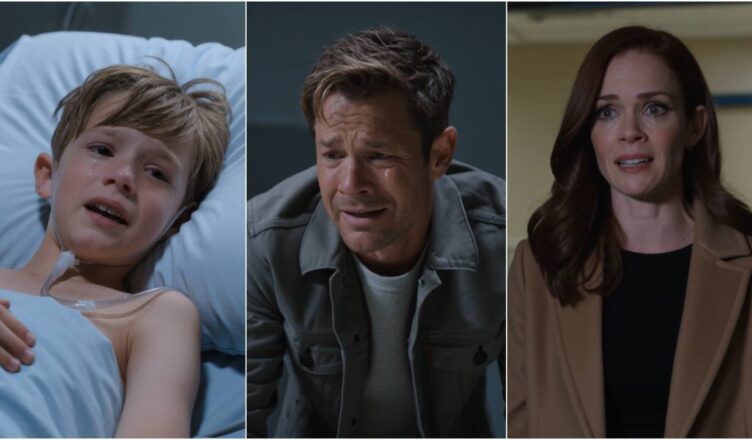
The Night They Tried to Send Him Home
The night my son asked me if we were taking him home to die, I still had drywall dust packed into the seams of my boots and a crack running through my hard hat I hadn’t had time to think about twice.
St. Mary’s never really got quiet. After visiting hours, it only changed volume. The voices dropped. The lights dimmed a shade. The smell in the halls shifted from coffee and cafeteria grease to disinfectant, warm plastic, and that faint, sour scent that hangs around too many frightened people who haven’t slept enough.
In Room 417, though, everything still felt too bright.
Ethan looked too small for the bed.
He was eight years old and all sharp elbows, brave eyes, and hospital tape. Clear tubing curved beneath his nose. IV lines disappeared into pumps and poles beside him. His appendix had burst thirteen days earlier. It should have been a routine emergency. Instead, the infection had spread through his abdomen. There had been one surgery, then a second to wash everything out, then drains, stronger antibiotics, more scans, more waiting, and then that subtle change in adults’ faces that told me we were no longer talking about a normal recovery.
By then, I had stopped counting days.
I was counting other things.
How much was left in my checking account.
How much I could borrow from the guys on my crew before I started hearing hesitation in their voices.
How long an insurance company could hide behind the word authorization while my son lay in a hospital bed waiting to find out whether someone in another state thought he was worth another week of care.
I pulled Ethan’s blanket a little higher on his chest.
“You remember what you told me?” I asked.
His eyes opened halfway.
I smiled because fathers are supposed to make things sound possible, even when they’re not sure of anything. “You said you were gonna score the winning goal this summer.”
The smallest smile touched one corner of his mouth.
“I still will,” he whispered.
“Yeah?”
He nodded once against the pillow. “You’ll see.”
I nodded like belief cost nothing.
Truth was, by then, belief felt like lifting wet concrete.
There was a soft knock on the door. Dr. Howard stepped in first, still in scrubs, shoulders tight with the kind of fatigue that makes people more honest than they want to be. Behind him came a case manager with a tablet and a folder hugged to her chest.
I knew bad news by then.
Bad news had posture.
It had that careful, measured slowness people used when they were about to tell you something cruel and wanted credit for saying it gently.
Dr. Howard glanced at Ethan, then back at me. “Mr. Miller, can we talk for a minute?”
I stood.
“You said his labs were better.”
“They are better,” he said. “But the CT still shows a pocket of infection. He needs another procedure and continued IV antibiotics here, with pediatric surgical monitoring.”
For one stupid second, relief rose in me.
Then I saw the case manager’s face.
And I understood.
She opened the folder. “Your insurance approved the emergency admission and the first phase of care,” she said. “They have denied continued inpatient authorization at St. Mary’s. We’re filing an appeal, but at this moment there is no approval for the next procedure here.”
I stared at her.
“I’m sorry,” she added, in the practiced voice of someone who said that a lot.
Dr. Howard spoke before I could. “I disagree with the denial. Medically, I do not think discharge is appropriate.”
“Discharge?” I said.
The case manager swallowed. “Administration is asking us to prepare for transfer if a county pediatric bed becomes available. If no bed opens and the appeal doesn’t clear by morning, they may push for home IV antibiotics with strict return precautions.”
I laughed once, because sometimes the body makes a sound when the mind has nothing useful left.
“He can barely sit up.”
“I know,” Dr. Howard said quietly.
“He has another infection inside him.”
“I know.”
“Then don’t stand here and talk to me like sending him home is a plan.”
The case manager lowered her eyes. Dr. Howard looked like a man trying not to put his fist through drywall.
“I’m telling you where it stands,” he said. “Not because I agree with it.”
I looked past them toward the chair by the wall.
My hard hat sat on it, white and dusted gray, the crack still running down one side from the windshield I had smashed on Interstate 86 three weeks earlier.
I had sold my pickup four days ago.
Borrowed against next month’s pay.
Emptied the little savings account I’d started when Ethan was born.
There was nothing left now except my tools, and without tools I didn’t work, and without work I didn’t keep any roof over us after the hospital was done talking.
The case manager set the paperwork on the counter.
“I’m very sorry,” she said again.
I signed where she pointed because my hand was still capable of moving, even if the rest of me felt like it had stopped.
My signature went crooked.
Each letter felt like surrender.
When they turned to leave, a small voice came from the bed.
“Dad?”
I looked up.
Ethan was watching me with the terrible clarity sick children sometimes get when adults forget they are still in the room.
“Are we going home?” he asked.
I crossed back to him and took his hand.
“It’s temporary,” I said. “We’re gonna figure something out.”
He kept looking at my face.
He had his mother’s eyes. She died when he was two, and sometimes that made moments like this feel even crueler, like life had decided one parent wasn’t enough suffering for one house and had circled back for more.
Then Ethan asked, very softly, “Am I going home to die?”
My knees nearly gave out.
I bent over the bed before he could see my face come apart. One tear hit the blanket near his wrist before I could stop it. I had spent half my life in steel-toed boots. I had worked winter jobs with split hands and frozen knuckles. I had carried sheetrock up three flights when the freight lift died and the schedule didn’t care.
None of that meant a damn thing in a room like that.
I opened my mouth to answer him.
Before I could, the door opened behind me.
A woman stepped in fast, still wearing a camel coat over a dark dress, her hair partly loose as though she’d pulled free of whatever evening she was supposed to be having. A boy stood beside her, maybe Ethan’s age, holding a model airplane in both hands.
For half a second, I thought they had the wrong room.
Then the woman looked at the hard hat on the chair and straight at me.
“It’s you,” she said.
I straightened slowly. “I’m sorry?”
Three weeks earlier, I had been driving from a jobsite straight to St. Mary’s after the first call from Dr. Howard—the one where he told me Ethan’s appendix had ruptured and I needed to get there now.
Traffic on I-86 had slowed near the median.
There was an SUV upside down in the drainage ditch, smoke pushing from under the hood. Cars had pulled over. People were standing on the shoulder. Nobody was moving toward it.
I remember grabbing my hard hat without thinking.
I remember hearing a child screaming inside.
The passenger-side window didn’t break the first time. The crack in my helmet came from the second hit. I got the boy out first because he was closest and because when there is a child inside a burning car, every other decision in the world gets made after that. Then I went back for the woman in the driver’s seat, half-conscious, blood on her forehead, the smell of gasoline so strong it sat in the back of my throat the rest of the night.
By the time the troopers arrived, flames were already licking under the engine block.
I gave one statement, said my son was in surgery, and left.
Now that same boy stood in my hospital room, alive, pink-cheeked, staring at me like he’d finally found a ghost he had been promised was real.
The woman took another step toward me.
“My son is Henry,” she said. “I’m Evelyn Mercer. You pulled him out of my car on the interstate. Then you went back for me.”
I looked at the boy.
He nodded hard. “You told me to keep my eyes closed and not look at the fire.”
Something moved through my chest so fast it hurt.
“How did you—”
“I saw the helmet,” Evelyn said. “Henry saw it too. We were downstairs at a foundation dinner. He kept saying, ‘That’s the man from the car.’”
She looked at Ethan, then at the folder on the counter, then back at Dr. Howard and the case manager, who had both stopped in the doorway and turned around.
“What is happening here?” she asked.
Nobody answered quickly enough.
So I did.
“They’re trying to transfer him,” I said. “Or send him home on antibiotics while they argue with insurance.”
Evelyn’s face changed.
Not dramatically. Not loudly.
It just became the face of a woman nobody in that building probably enjoyed disappointing.
“No,” she said.
The case manager started carefully, “Mrs. Mercer, the issue is an authorization denial and—”
“I know what an authorization denial is,” Evelyn said. “I also know St. Mary’s has a pediatric bridge fund for uncovered surgical care.”
The case manager blinked. “That fund requires foundation approval.”
Evelyn did not raise her voice.
“That fund bears my husband’s name,” she said. “I chair the foundation.”
The room went perfectly still.
She stepped fully inside and glanced at Ethan again. “Approve the Mercer bridge account tonight. Keep him here. Schedule the procedure. If insurance wants to fight later, they can fight with me.”
I stared at her.
“You don’t have to do that,” I said.
She turned to me then, and something in her expression softened.
“Yes,” she said. “I do.”
Henry moved closer to Ethan’s bed. Ethan, pale and exhausted, turned his head on the pillow and looked at him.
“You’re the fire kid,” Ethan said weakly.
Henry nodded. “And you’re the soccer kid.”
The faintest smile touched Ethan’s mouth.
Evelyn laid her hand over mine where it rested on the blanket.
“My husband died on the side of a road six years ago,” she said quietly. “Not in a crash he couldn’t have survived. In a crash people stood around and watched until help got there too late.”
I looked at her.
“That bridge fund exists because I promised myself that if I ever had the money to shorten the distance between an emergency and mercy, I would.”
Her hand tightened once over mine.
“Three weeks ago, you did for my son what no one did for my husband. So no, Mr. Miller. I’m not going to stand in this room and let paperwork send your boy home half-treated.”
Dr. Howard was already moving.
“I’ll call the OR,” he said.
The case manager vanished into the hall with her phone at her ear.
Everything after that accelerated with a violence that almost made me angry. Nurses came in. Consents appeared. An anesthesiologist introduced herself. Blood was redrawn. Orders that had apparently been impossible an hour earlier started happening all at once, now that money had stopped being the locked door everyone was pretending not to see.
At some point Henry fell asleep in the waiting room with the toy plane still in his hands. Evelyn draped her coat over him and stayed.
Just before they took Ethan down, he reached for me.
“Dad?”
“Yeah, buddy?”
“We’re not going home?”
I swallowed hard.
“No,” I said. “Not tonight.”
He nodded, satisfied, and let them wheel him away.
The surgery took almost three hours.
I learned more about Evelyn Mercer in that waiting room than I had learned about some men I had worked beside for years. Her husband, Daniel, had built a construction supply company from nothing. After he died, she sold it, built a foundation, and put most of the money into pediatric trauma and surgical care. She said Henry still asked about the man with the white helmet. She had tried to find me through the trooper’s report, but all they had was “male, construction worker, left scene to reach child at St. Mary’s.”
“You were heading here?” she asked.
“My son was already in surgery.”
For the first time that night, she looked shaken.
“And you still stopped.”
I looked at the floor. “There was a kid in the car.”
She nodded once, like that was the only answer she had expected.
When Dr. Howard finally came back, there were deep marks beside his mouth where his surgical mask had been.
“It went well,” he said. “We got the remaining infected material. He’s still got a recovery ahead of him, but this was the right call.”
A recovery ahead of him.
Not the end.
Not the beginning of the end.
Recovery.
It was the most beautiful word I had heard in weeks.
That summer, Ethan scored the winning goal in a Saturday rec league game on a field that smelled like cut grass, sunscreen, and melted orange popsicles.
He was thinner than before. He still had a pale scar low on his belly. He got tired faster, and every now and then I still caught him touching his side without realizing it. But in the final minute of a tied game, the ball broke loose in front of the net, and Ethan got there first.
When it hit the back of the goal, he turned toward the sideline with both arms in the air like the world had finally decided to keep one promise.
I was already standing.
So was Henry.
So was Evelyn, laughing and crying at the same time.
After the game, Ethan ran straight at me and hit my waist hard enough to knock the breath out of me.
“Told you,” he said into my shirt. “I told you I’d score.”
“You did,” I said, holding him tighter than he liked now that he considered himself practically grown. “Yeah, you did.”
The hard hat still hangs on a hook in my garage.
I kept it because some things stop being objects after a while. They become evidence.
Of who you were on the worst day of your life.
Of the turn that came after.
Of the fact that sometimes the world does not repay goodness neatly, or quickly, or at all—but every now and then, when you are certain you have run out of road, help comes back wearing a face you recognize.
And when it does, it can sound a little like a child asking if he gets to stay.
Or a surgeon saying the right call.
Or a soccer net snapping in the summer heat while your son throws both arms in the air because he was brave enough to promise himself a future before the rest of the world had caught up.