The cold in Detroit did not arrive like weather.
It arrived like a debt.
It slipped under doors, through cracked windows, through torn gloves and secondhand coats, settling into the bones of anyone who had nowhere warm to go. By late afternoon, the sky over the east side had turned the color of wet concrete. The old textile mill on Hastings Street stood boarded and hollow, its broken windows covered with plywood, its loading docks buried under trash and dead leaves.
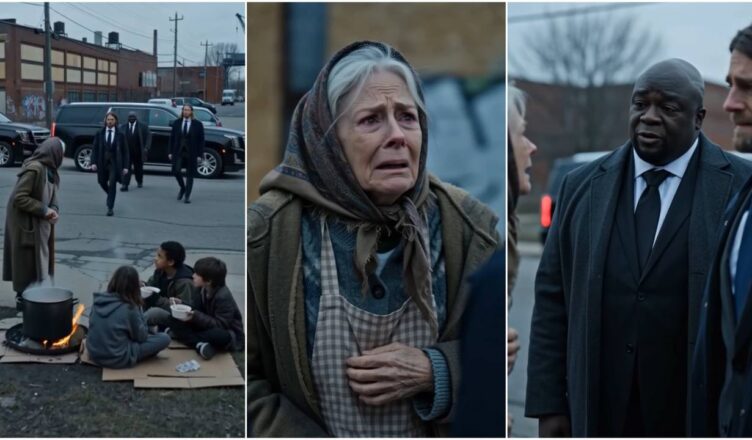
On the corner beside it, a small fire burned inside a dented metal barrel.
Above the flames hung a black cast-iron pot.
And beside that pot stood Ruth Bell.
Most people in the neighborhood called her Miss Ruth, though nobody seemed to remember who started it. She was seventy-one, slightly hunched, with white-gray hair tucked beneath a faded scarf and a cane she pretended she only carried because “the sidewalk had attitude.” Her coat was old. Her checkered apron was older. Her hands were swollen at the knuckles, but they moved gently as she stirred the soup.
Potatoes.
Carrots.
Onions.
A little chicken.
Mostly water.
Enough salt to make it taste like someone had cared.
Three children sat right beside the barrel on flattened cardboard, holding plastic bowls close to their chests. The oldest was a teenage girl named Keisha, thin and sharp-eyed, trying to act like hunger was a private inconvenience. Her younger brother Jamal kept coughing into his sleeve. The smallest boy, Nicky, had not told Ruth his last name yet. He watched the pot with the solemn seriousness of a child who had learned not to trust good things until they were in his hands.
“Eat slow,” Ruth told him, lowering herself carefully onto a wooden crate. “That soup is hot enough to argue with you.”
Nicky looked up at her, unsure whether smiling was allowed.
Keisha nudged him. “Say thank you.”
He whispered, “Thank you.”
Ruth waved it off. “You can thank me by finishing it.”
The wind pushed hard down the street, lifting a sheet of old newspaper and dragging it across the wet pavement. Across from them, a liquor store sign flickered. Farther down, a man pushed a shopping cart full of blankets, his shoulders bent against the cold.
Once, the mill behind Ruth had been full of life.
She remembered the sound of it from years ago — trucks backing in, workers shouting over machines, women walking in before dawn with lunch bags and tired jokes. Her husband Walter had worked there until the plant closed and took half the neighborhood’s future with it.
After Walter died, Ruth started cooking.
At first, it was only extra soup for one boy sleeping behind the laundromat. Then another. Then a girl. Then a whole little line that formed quietly at the corner on Wednesdays and Saturdays.
She never called it charity.
Charity made people feel looked down on.
Ruth called it supper.
“Jamal,” she said, hearing the cough again, “you need a clinic.”
“I’m fine.”
“You are not fine. You sound like a lawn mower full of rocks.”
Keisha gave a quick laugh.
Jamal glared at her, but he kept eating.
Ruth reached into her coat pocket and pulled out two cough drops wrapped in tissue. She set them beside his bowl.
“After the soup,” she said.
He looked at them like they were gold.
The street was quiet after that.
Not peaceful.
Just abandoned.
Then Ruth heard engines.
Smooth, deep, expensive engines.
Keisha stopped eating first.
Jamal lowered his spoon.
Nicky slid closer to Ruth’s coat without a word.
Three black SUVs rolled slowly down Hastings Street and stopped near the curb in front of the boarded textile mill. Their polished sides reflected the barrel fire, the trash, the old brick, the children’s thin shoulders. For a moment, the vehicles looked like they had driven in from another city entirely.
Doors opened.
Three men stepped out.
They wore tailored suits under dark winter coats. They were not young, but not old either — men in their forties, men who had built lives far from corners like this. One was white, with medium-length brown hair and a restrained, emotional face. One was Black, heavyset, serious, with warmth in his eyes even from a distance. The third was white and blond, with long hair pulled back loosely, his face already full of something Ruth could not name.
They began walking toward her together.
Slowly.
Shoulder to shoulder.
Ruth stood.
Her knees complained. She ignored them.
She gripped her cane near her chest and moved half a step in front of the children.
The men stopped directly in front of her, forming a straight line between the black SUVs and the fire.
For a few seconds, nobody spoke.
The barrel crackled.
Steam rose from the soup pot.
The children watched with their bowls frozen in their hands.
Ruth looked from one man to the next. Her heart had started beating too fast.
“Please,” she said, her voice steady only because she forced it to be. “I don’t want any trouble.”
The brown-haired man’s eyes filled.
He looked directly at her, not past her, not through her, but at her with a grief so old it seemed to have followed him all the way to that street.
“You really don’t remember us?” he asked gently.
Ruth stared at him.
There was something about his eyes.
Not the suit. Not the expensive coat. Not the polished shoes.
The eyes.
She had seen those eyes cold before. Hungry before. Younger before.
But the memory would not come.
“No,” she whispered. “Who are you?”
The Black man stepped forward just enough for the firelight to touch his face. His voice was low and sincere.
“You fed us when we had nowhere to go.”
Ruth’s hand tightened around the cane.
The blond man swallowed hard. He looked straight at her, his expression breaking open.
“You were an angel to us,” he said. “Now it’s our turn to take care of you.”
The street seemed to go silent around them.
Ruth could not move.
Her lips parted, but no sound came out.
The three children beside the pot stopped eating completely. Keisha’s eyes moved from Ruth to the men, trying to understand whether this was danger or miracle. Jamal held his bowl against his chest. Nicky stared at Ruth’s face as if waiting for her to decide what the world was.
The brown-haired man took one careful step closer.
“You called me Eli,” he said.
The name struck Ruth somewhere deep.
Eli.
Not this man in the dark coat.
A boy.
Twelve years old, maybe thirteen. Too thin. Hair too long. Standing guard while two younger boys ate behind the mill in the winter of 1998.
Ruth’s breath caught.
The Black man touched his chest.
“Marcus.”
A quiet boy who used to collect newspaper scraps because he liked to read anything with words on it. A boy who once asked Ruth how to spell “engineer” because he wanted to become one and did not know if children like him were allowed to say that out loud.
The blond man smiled through tears.
“Andre,” he said. “You called me Little Dre, even after I got taller than you.”
Ruth covered her mouth with one trembling hand.
“Oh,” she whispered. “Oh, Lord.”
The ruined street vanished in front of her.
She saw them as they had been.
Three boys sleeping in the loading bay behind the textile mill, wrapped in a stolen moving blanket and pretending not to be afraid. Eli trying to act grown because he was the oldest. Marcus hiding books under his coat. Andre angry enough to fight anyone who looked at him too long.
She remembered giving Andre dish towels to wrap around his hands because his fingers had gone numb.
She remembered Eli bringing back a bottle of cough syrup he had stolen because guilt made him cry harder than hunger.
She remembered Marcus staring into the soup pot and asking, “Do you think people can still become something if nobody wants them?”
Ruth had told him, “Baby, seeds grow in dirt. Don’t let anybody tell you dirt is the end of a thing.”
Now Marcus stood in front of her in a suit that probably cost more than her monthly rent.
Ruth began to cry.
Eli moved first. He stepped forward slowly, giving her time to refuse him.
She did not.
He wrapped his arms around her with careful strength, and Ruth folded against him like the years had finally become too heavy to carry.
“You saved us,” he said into her scarf.
She shook her head against his coat. “No. I just fed you.”
Marcus’s voice broke behind him.
“When you’re starving, Miss Ruth, that’s the same thing.”
Andre wiped his face with the back of his hand and turned toward the children by the pot.
“What are your names?” he asked.
Keisha hesitated.
Ruth looked at her gently. “It’s all right.”
“Keisha,” the girl said.
“Jamal,” her brother added.
The smallest boy said nothing.
“That’s Nicky,” Ruth said. “He’ll talk when he trusts you.”
Andre nodded with complete seriousness. “Smart man.”
A tiny smile pulled at Nicky’s mouth before he could stop it.
Ruth stepped back from Eli, embarrassed by her tears, and wiped her cheeks with her sleeve.
“You boys came all this way in those fancy cars just to make an old woman fall apart on the sidewalk?”
Marcus looked toward the old mill.
“No, ma’am,” he said. “We came to show you something.”
He nodded toward the building.
Only then did Ruth really look at it.
The plywood over the front windows was gone.
New glass had been installed behind the old brick arches. The entrance had been cleaned. A ramp led up to the main doors. The rusted chains that used to hang across the entrance were missing.
Warm light glowed inside.
Ruth stared at the doors.
“What did you do?”
Andre gave her a nervous smile, almost boyish.
“We bought it.”
Ruth blinked. “You what?”
Eli turned toward the mill, his voice thick with emotion.
“Two years ago.”
Marcus said, “We tried to find you sooner. Nobody had a number. Churches said you moved around. Shelters knew your name but not where you stayed. Then one of Andre’s drivers saw you here last month and called us before he even parked.”
Ruth kept staring at the building.
The front doors opened.
Warmth spilled out onto the sidewalk like sunlight.
Inside, she could see long wooden tables, a clean kitchen, shelves stacked with blankets, a children’s reading corner, a small medical station, and walls painted in soft colors that had no business existing in that part of Hastings Street.
People stood inside watching through the open doors — nurses, cooks, volunteers, a few former street kids now grown, city workers in winter coats, and people Ruth recognized from years of soup lines and church basements.
Above the entrance hung a canvas cloth.
Eli nodded.
A worker pulled the cord.
The cloth dropped.
A bronze sign caught the firelight.
RUTH BELL HOUSE
Meals, Shelter, Medical Care, and Education for Children and Families in Crisis
Founded by the boys she fed when no one else would.
Ruth read the words once.
Then again.
Her face crumpled.
“No,” she said, shaking her head. “No, no, you cannot put my name on a building.”
Marcus stepped beside her.
“We already did.”
“I’m nobody.”
Eli’s eyes filled again.
“You were never nobody to us.”
Ruth turned away, overwhelmed, looking back at the dented barrel, the old pot, the three children on cardboard, the gray street where she had spent so many years trying to hold back winter with soup.
“I don’t know how to be the name on a building,” she whispered.
Andre picked up the ladle from beside the pot.
“Then don’t be,” he said. “Just be Miss Ruth. That’s who we built it for.”
Nicky stood suddenly, his bowl still in both hands.
Everyone looked down at him.
He stared at the open doors and asked, “Can we eat inside?”
The question broke Ruth completely.
Eli knelt in the street, not caring about his expensive coat or the wet pavement.
“Yes,” he said softly. “You can eat inside.”
Nicky looked at Ruth. “Can she come too?”
Ruth laughed and cried at the same time.
Marcus removed his coat and placed it carefully around her shoulders.
She tried to protest. “I’m fine.”
He gave her a look.
The exact look she used to give him when he claimed one bowl of soup was enough.
Ruth let the coat stay.
Andre lifted the pot from the hook over the fire with both hands.
Ruth immediately straightened. “Careful. That pot is older than your confidence.”
Andre froze. “Yes, ma’am.”
“You run twelve restaurants now, don’t you?”
He looked surprised. “How did you know that?”
“I guessed from the shoes.”
For the first time, all three men laughed.
It was soft at first, then fuller. Not because anything was funny enough to erase the pain, but because they were standing together in the same place where they had once been cold and hungry and afraid — and somehow, impossibly, they were still there.
Keisha helped Jamal stand.
Nicky walked ahead with his bowl, serious as a little mayor inspecting a city.
Ruth stepped toward the mill doors, Eli on one side and Marcus on the other, Andre behind her carrying the soup pot like a sacred object.
At the threshold, she stopped.
The lobby had been restored, but not erased. Some of the old brick remained exposed. One steel beam still carried rust under the new paint. The place remembered what it had been, but it was no longer trapped there.
Everyone inside began to applaud.
Not loudly.
Not like a performance.
Softly, with respect.
Ruth looked around at all the faces.
Some she knew.
Some she did not.
And some she had known only as children standing in the cold with empty stomachs and eyes too old for their age.
She turned back once toward the street.
The barrel fire still burned outside. The sidewalk was still cracked. The wind still pushed trash across the pavement. Detroit had not transformed because someone opened a door.
But the door was open.
That mattered.
Eli leaned close.
“You don’t have to fight the cold alone anymore,” he said.
Ruth looked at him, then at Marcus, then at Andre.
Her boys.
Grown now.
Powerful now.
But still hers in the only way that had ever mattered.
She stepped inside.
The warmth rose around her all at once.
Keisha sat at the first long table with Jamal and Nicky. A volunteer brought them bread. Real bread, thick-cut and warm. Jamal stared at it like he needed permission before touching it.
Ruth crossed the room, took the bread basket, and set a piece directly on his plate.
“Eat,” she said.
He smiled.
Andre carried the old soup pot into the new kitchen, still moving carefully.
Ruth watched him and called, “Don’t you dare let that boil over.”
He grinned back at her through tears.
“Yes, ma’am.”
And for the first time in decades, Miss Ruth Bell did not serve dinner on a freezing sidewalk.
She served it under a roof, at a long table, with children laughing nearby and three grown men standing behind her like sons who had finally found their way home.