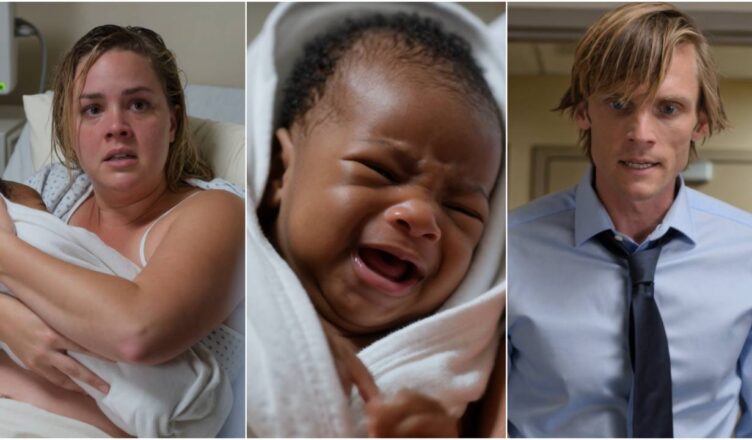
Less than ten minutes after Julie Caldwell gave birth, her husband looked at the baby in her arms and asked, in a voice emptied of all warmth, “Whose baby is this?”
Until that moment, the room had been exactly what Julie had imagined through months of waiting. The maternity suite was quiet except for the soft beeping of monitors and the rustle of blankets. A nurse had just tucked their newborn more securely against Julie’s chest. Julie herself was exhausted to the bone, her body trembling from labor, her skin damp, her hair stuck to her forehead in loose strands. But none of that mattered. She was staring down at her son with the dazed, sacred wonder of someone who had just met the center of her world.
He was beautiful.
His tiny fingers opened and curled again as if he were testing the air. His breathing was soft and uneven. His skin was a deep warm brown against the white hospital blanket, and every time Julie looked at him, her chest tightened with a kind of love so immediate it felt like terror.
Then Mark walked in.
He had spent most of the labor pacing the hallway, too anxious to sit still, too wound tight to be useful. When he finally appeared at the door, he looked exactly like the husband Julie had expected to see—shirt wrinkled, face pale with nerves, eyes bright with the fragile joy of a man about to meet his son.
“Julie?” he said, breathless. “How are you? Is he okay?”
Then he saw the baby.
The change in him was instant.
The hope vanished first. Then the softness. His body went rigid, as though something inside him had turned to stone. He stared at the child, then at Julie, then back again, his face tightening with each breath.
“Whose baby is this?” he asked again, louder this time.
For one suspended second, Julie thought she had misunderstood him.
“Mark?”
“He’s not mine.” His voice came out sharp, almost shaking under the force of what he thought he knew. “Don’t do that thing where you act confused. He is not mine.”
The nurse by the IV pole froze.
Julie pulled the baby closer without realizing she was doing it. “Yes,” she said, her voice unsteady. “He is.”
Mark let out a short, disbelieving laugh. “Julie, look at him.” He gestured toward the baby with an open hand. “You want me to pretend I’m not seeing what I’m seeing?”
The words hit harder because she was still so physically fragile. She had barely stopped shaking from the birth. Her body was aching, her limbs heavy, her thoughts slow with exhaustion. And yet in an instant, humiliation cut through all of it.
“I never cheated on you.”
“Don’t lie to me while you’re holding him.” His face had turned red. “Not in this room. Not like this.”
The baby startled at the sound of his raised voice and let out a thin, raw cry.
Julie pressed one trembling hand over her son’s back and rocked him instinctively, trying to soothe him while her own breath came too fast. “Mark, please. Please just listen to me.”
“Then explain it.”
His eyes were bright now—not only with anger, but with hurt, humiliation, and the kind of panic that had already hardened into accusation.
The nurse stepped in gently. “Sir, your wife just delivered. She needs calm right now.”
“This is between me and my wife.”
Julie stared at him as if he had become a stranger in front of her eyes.
She had imagined this day in a hundred different ways. She had imagined tears, laughter, shaking hands, whispered promises over a newborn’s head. She had imagined fear, maybe, because becoming parents was enormous and frightening. But never this. Never bleeding and exhausted in a hospital bed while the man she loved looked at her as though she had deceived him in the most unforgivable way possible.
“Mark,” she said again, quieter now because the baby was still fussing, “I swear to you. I never touched another man.”
But she could see it in his face.
He had already decided.
His jaw tightened. His expression went cold in a way that was somehow worse than shouting. “You’ll pay for this,” he said.
The nurse sucked in a breath.
Then he turned, strode out of the room, and slammed the door so hard the empty bassinet rattled beside the bed.
For a few seconds, the only sounds left were the baby’s crying and the frantic little spikes of Julie’s pulse on the monitor.
Then she broke.
Not loudly. Not dramatically.
The tears just came.
They spilled silently down her cheeks while she bent over the baby and held him tighter, trying not to cry hard enough to frighten him, trying not to let the full weight of the moment crush her while her son was still learning how to breathe.
The nurse was beside her in seconds. “Hey,” she said softly. “Breathe. Hold him close.”
Julie did. She held him so tightly it felt like she was trying to shield him from the entire world.
A few minutes later, Dr. Harris came in.
She took one look at Julie’s face, the nurse’s expression, and the tension still hanging in the room and understood this was no ordinary postpartum scene.
Julie explained what had happened as steadily as she could, though her voice kept threatening to crack. She repeated the same sentence more than once.
“I did not cheat on my husband.”
Dr. Harris listened without interrupting.
When Julie finished, the doctor pulled a stool closer to the bed and sat down. “Then we need to talk through what may have happened here carefully,” she said. Her tone was calm, clinical, but not cold. “Because there are genetic explanations for a baby’s appearance that people don’t always understand in the moment.”
Julie closed her eyes briefly. She had known, in some distant and private part of herself, that one day she might have to say the things she had kept folded away for years.
Just not like this.
Not while still bleeding.
Not while holding her newborn.
Not after being accused before she had even had time to become a mother.
“I know,” she whispered.
Dr. Harris studied her face. “Is there anything in your family background your husband doesn’t know?”
Julie said nothing at first.
The silence stretched long enough for the question to become its own answer.
“There is,” Dr. Harris said gently.
Julie looked down at her son. He had finally drifted back to sleep, his tiny fist tucked beneath his chin, his face peaceful in that devastating way only newborns could be.
“When Julie was a baby, she was adopted,” she said at last, but the words sounded strange coming out of her own mouth, as if she were telling someone else’s story. “She was raised by a white couple in Ohio. Good people. Loving people. As far as she knew growing up, that was her whole story.”
Dr. Harris nodded once for her to continue.
“It wasn’t.” Julie swallowed hard. “Years later, during college, she had some medical testing done. Something in the results didn’t line up with the family history she’d been given. That led to old records. More records after that. Eventually she found out that her biological father was Black.”
The room was quiet except for the monitor.
Dr. Harris remained still, letting the words settle.
Julie’s voice dropped lower. “She never knew him. Never met him. And she didn’t tell many people. Not because she was ashamed. Because every time the subject came close to the surface, it felt like it stopped being her life and became other people’s fascination.”
She looked at the baby again. “Mark never knew.”
Dr. Harris folded her hands. “That explains far more than your husband realizes.”
Julie gave a bitter, broken little laugh. “He seemed pretty certain.”
“Yes,” Dr. Harris said evenly. “Because most people know just enough about genetics to be shocked, and not enough to be accurate.”
Julie looked up at her.
The doctor continued, more precisely now. “A child’s appearance is shaped by many genes, not one simple formula. Skin tone, facial structure, hair texture—those traits are polygenic, meaning they’re influenced by multiple inherited factors. Some of those factors can remain visually subtle or completely unexpressed in one generation and become more visible in the next, especially when paired in certain ways. So if you carry ancestry from your biological father’s side, your child can absolutely inherit features that appear more strongly than they do in you.”
Julie listened without moving.
“This would not be unusual medically,” Dr. Harris said. “Emotionally, it can be explosive if the parents don’t know the full family history. But biologically? Yes. It can happen.”
For the first time since Mark had walked out, Julie felt something other than humiliation.
Not relief exactly.
But footing.
A solid place to stand.
Dr. Harris paused. “Would you like me to explain this to your husband?”
Julie shook her head almost immediately. “No. He needs to hear it from her.”
Mark did not return that night.
He came back the next morning looking as if sleep had passed him by without stopping. The rage was gone, but what had replaced it was hardly better. He stood just inside the door with both hands in his coat pockets, his face drawn, his posture guarded, as though even entering the room had cost him something.
Julie was too tired for gentleness.
“I never cheated on you,” she said the moment the door closed.
He looked down. “Julie—”
“No.” Her voice was quiet, but it cut cleanly through the room. “You accused me in the first hour of our son’s life. You can hear the rest now.”
And this time she told him everything.
She told him about the adoption. About growing up believing her story was simple. About the medical screening in college that had raised questions. About the paperwork, the photocopies, the sealed records that eventually opened. About the biological father she had never met. About the fact that part of her history had lived inside her quietly for years, mostly invisible until their son arrived and brought it into the light all at once.
When she finished, Mark was still standing by the door.
“You should have told me,” he said finally.
Julie gave one exhausted nod. “Maybe she should have. But that is not the same as cheating on you.”
His jaw flexed.
“You saw one thing you didn’t understand,” she said, “and decided, immediately, that the woman you married was a liar.”
He flinched.
She kept going. “The doctor explained it already. A child can inherit traits from ancestry that don’t present strongly in the parent. Skin tone and features aren’t a simple copy-and-paste. That baby is yours.”
Mark looked at the floor for a long moment.
Then Julie said the part that mattered most. “Let’s do a DNA test today. Not because I need proof for myself. And not because our son should have to earn your love. But because I will not build his first day in this world on your suspicion.”
Pride and shame battled visibly across Mark’s face.
Then, quietly, he nodded. “Okay.”
The hospital arranged a rapid paternity test through a private lab. Swabs were taken. Papers were signed. Too many signatures for something that should have required trust and nothing else.
Then they waited.
Mark sat in a chair by the window, elbows on his knees, hands clasped so tightly they looked bloodless. Julie stayed in the bed with the baby. The room felt crowded with everything they had failed to protect.
At one point the baby stirred and made a soft hungry sound.
Mark looked up instinctively.
For one brief moment, Julie saw the father in him before the shame returned and lowered his gaze again.
That was the cruelest part, maybe. Not that he felt nothing. It was that fear had outrun love.
The nurse entered just after noon with the preliminary results in her hand.
Her expression was professional, but kind.
“Mr. and Mrs. Caldwell,” she said, “the test confirms paternity. Probability is 99.99 percent. Mark, you are the biological father.”
Silence fell over the room.
Mark stared at the paper as though it might rearrange itself into a different sentence if he waited long enough.
“I’m his father,” he said, but not really to them. It sounded like a man trying to say the truth aloud because he didn’t yet know how to survive it privately.
“Yes,” the nurse said softly, and left them alone.
Mark stood up slowly.
There was nothing aggressive left in him now. Nothing righteous. He crossed the room as if approaching the wreckage of himself.
“I’m sorry,” he said.
Julie looked at him, but she didn’t answer.
He stopped beside the bed and looked down at the baby—really looked at him this time. Not as evidence. Not as accusation. Not as something to solve. Just as a child. His child.
“I’m so sorry,” he said again, and this time his voice broke.
The baby stretched one tiny hand out from the blanket. Mark touched his palm with one finger on instinct. The baby’s fingers closed around it.
That was when Mark began to cry.
Not angrily. Not dramatically. Not in a way that asked to be rescued from his own guilt.
It was the quiet grief of a man forced to see himself clearly.
“I accused you before I even gave you a full minute to speak,” he said hoarsely. “I saw something I didn’t understand, and I made you carry my fear, my ignorance, my humiliation. I put all of it on you.”
Julie held the baby tighter. Her hurt had not disappeared just because the truth had been confirmed. “Yes,” she said.
He nodded, accepting it. “I can’t undo it.”
“No.”
“But I will spend the rest of my life trying to be better than the man who walked out of this room.”
That might have sounded redemptive in another story.
Here, it only sounded honest.
And honesty, Julie was beginning to understand, was more valuable now than comfort.
She shifted slightly and allowed him to sit on the edge of the bed.
“Our son’s first day,” she said, “should never have been this.”
Mark closed his eyes. “I know.”
Then he looked at her directly for the first time since returning. “I failed you.”
“You failed us,” Julie said.
His throat moved. “Us.”
They brought their son home three days later.
The nursery Mark had painted in soft greens and creams no longer looked like the room Julie had imagined during pregnancy. It looked different now—not ruined, but honest. As if the room itself had witnessed something ugly and refused to pretend it hadn’t.
Mark changed after that.
Not all at once. Not magically. Not in the cheap way stories sometimes forgive men the moment they cry.
But truly.
He became gentler. Quieter. More deliberate. He asked before he assumed. He listened when Julie spoke about adoption, bloodlines, family history, and the strange loneliness of carrying truths no one else could see. In the middle of the night, while the baby slept on his chest, he read about genetics with the concentration of a man trying to understand how ignorance had humiliated him—and nearly cost him something holy.
Most importantly, he did not demand quick forgiveness.
That mattered more than any apology.
One evening, a week after they came home, Julie stood in the nursery doorway and watched him lean over the crib.
The baby had finally settled after nearly an hour of fussing. Mark rested one hand lightly on his son’s chest, just enough to feel the rise and fall of his breathing.
“Welcome home, little man,” he whispered.
The room was lit gold by the setting sun. For a moment he looked like the man Julie had married again—but altered. Humbled. Sharpened by regret. More careful with love because he had learned how quickly fear could turn it cruel.
He turned and saw her in the doorway.
“I still don’t know how you’re letting me stand here,” he said quietly.
Julie stepped into the room. “She’s not pretending it didn’t happen.”
He gave a faint nod. “I know.”
“She may never fully get over how fast you stopped trusting her.”
This time he didn’t defend himself. Didn’t explain. Didn’t reach for excuses. “I know that too.”
Julie came to stand beside him.
Together they looked down at their son—his warm brown skin, the dark little tuft of hair at his crown, the tiny sleeping mouth that had no idea how much pain and repair had already shaped the first week of his life.
There was nothing left to explain anymore.
Only someone to love well.
“The truth didn’t break them,” Julie said after a long silence.
Mark looked at her, eyes already wet again. “No.”
“It showed them exactly where they were weakest.”
He lowered his head. “And where I was weakest.”
Julie rested her hand over his on the crib rail.
Love, she had learned, was not proved in the moments when everything made sense. It was proved in the moment confusion invited cruelty—and in whether a person chose trust long enough for the truth to arrive.
Mark had failed that test.
He had failed it completely.
But he had come back. He had listened. He had let shame become responsibility instead of defensiveness. That did not erase the wound. It did not restore what had been taken from the first hour of their son’s life.
But it was a beginning.
And sometimes a beginning, honestly faced, was the hardest and most valuable thing love could offer.
Their son stirred, then settled again under the quiet weight of their watching.
Outside, evening spread slowly across the neighborhood, painting the windows with soft amber light. Inside, the house held something fragile, bruised, and real:
not the illusion that nothing had happened,
but the difficult grace of choosing to keep loving after the truth had rearranged them.