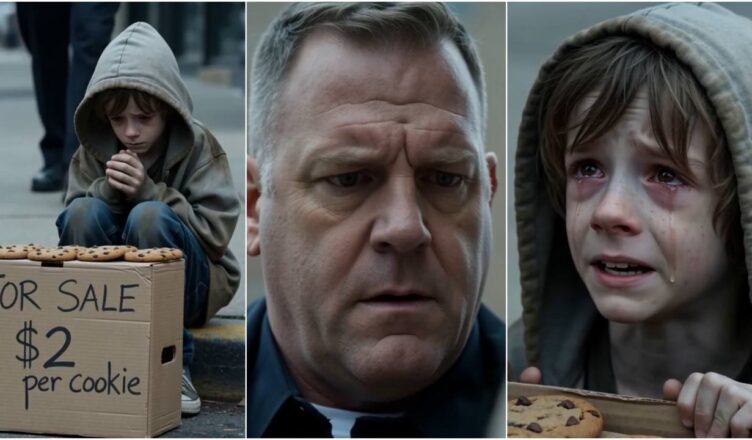
The cold made Evan Miller’s hands shake before Officer Thomas ever reached the curb.
He had been sitting there since a little after seven that morning, hunched behind a low cardboard display box he had turned into a tiny cookie stand. The box was old and soft at the corners, probably the kind a grocery store would throw away without thinking twice. Evan had flattened one side forward so people could see the sign he’d written in black marker with his best careful handwriting.
FOR SALE
$2 per cookie
On the top of the box, several round chocolate chip cookies sat neatly arranged on folded wax paper. They were not perfect. Some were darker around the edges. One had cracked across the middle. A few had too many chocolate chips on one side and almost none on the other.
But Evan had made every single one himself.
He was twelve years old, thin in a way that made his oversized faded hoodie hang strangely from his shoulders. His brown hair was messy from the wind, his eyes red and watery, his lips chapped from sitting outside too long in late-March cold. His sneakers were cheap and worn flat at the soles, and every time a gust moved down the sidewalk, he tucked his hands deeper into his sleeves until he remembered he needed them visible in case someone wanted to buy.
Nobody had.
Not really.
By noon, he had sold two cookies.
By two, his stomach had started making noises so loud he pressed one arm across it and looked around, embarrassed, even though none of the blurred pedestrians passing in the gray daylight had noticed. He had planned to eat one cookie if he got too hungry, but every time he reached for the smallest one, he saw the black marker on the box.
$2 per cookie.
Two dollars was two dollars.
And his mother’s medicine cost more than any number Evan could make sense of.
Jennifer Miller used to make the apartment feel full even when they had almost nothing. She used to sing while washing dishes. She used to laugh at old sitcoms like the jokes were new. She used to dance barefoot in the kitchen just to make Evan roll his eyes and pretend he was too old to laugh.
Then the kidney disease got worse.
Stage three, the doctor had said, in the careful voice adults used when they were trying not to scare a child.
But Evan had learned that careful voices were often where the scariest truths hid.
Now his mother moved slowly. She sat on the edge of the bed before standing, one hand pressed against her side, breathing like even getting to the bathroom required a plan. Some mornings she smiled too brightly and said she felt fine, but Evan could see the gray under her skin. He could see the way her hand shook when she opened pill bottles. He could see the way she added water to soup and pretended it was because she liked it thinner.
Two weeks earlier, the doctor had prescribed a new medication.
At the pharmacy, the woman behind the counter had said the price like it was just another number on a screen.
Jennifer had smiled.
That was how Evan knew it was bad.
His mother smiled at bad news the way other people flinched.
On the walk home, she squeezed his hand and said, “We’ll figure it out, baby.”
But Evan had seen the receipt.
He had seen the number.
He had seen the orange bottle sit unopened on the kitchen counter because his mother was trying to decide whether being sick was cheaper than getting better.
So Evan figured something out.
He baked.
The oven in their apartment didn’t close right unless he wedged an old brick under the handle. It ran too hot on the left side and too weak on the right. He watched baking videos on a cracked tablet with one broken speaker, measured flour with a chipped mug because they didn’t have proper measuring cups, and stretched one small bag of chocolate chips as far as he could.
He burned his fingers on the first tray.
The second batch spread too thin and turned brittle.
The third made him cry because he was so tired and because the kitchen smelled like a version of home they were losing.
By the fourth batch, the cookies looked good enough to sell.
At sunrise, he packed them carefully, wrote the sign, and left a note on the kitchen table.
Mom, I went to school early. Love you.
It was not exactly the truth.
But it was not exactly a lie either.
He carried the cardboard box six blocks to a busy sidewalk near a row of small shops. He chose that corner because adults walked by with coffee, bakery bags, and phones in their hands. He thought people who could buy five-dollar coffee might have two dollars for a cookie.
For the first hour, he sat up straight.
“Cookies for sale,” he said softly when people passed.
Most did not look down.
A woman in a beige coat slowed, read the sign, then looked at Evan’s face.
“Where are your parents?”
“My mom’s home,” Evan said.
“You can’t just sell food on the sidewalk, honey.”
She said honey like a soft word could make judgment kind.
A man with a briefcase glanced at the cookies and muttered, “Probably a scam.”
Evan stared down at the wax paper.
They did not look like a scam to him.
They looked like standing on a chair to reach the flour. Like washing his hands until the skin dried out. Like pulling hot trays from a broken oven with a towel wrapped around his wrist. Like every coin he had counted at the corner store while the cashier sighed.
Sometime in the afternoon, someone must have called the police.
Evan did not know who.
He noticed the sidewalk change before he saw the officer. A few people slowed. Someone across the street lifted a phone, then lowered it halfway. A man near the curb stopped walking and pretended to check his messages.
Then Officer Thomas came into frame.
There was no police car in sight. No siren. No flashing lights. Just a tall, broad-shouldered man in a dark uniform walking toward him from the sidewalk with a steady, authoritative calm that made Evan’s stomach drop.
Thomas looked mid-forties, with a weathered face and calm eyes. He did not look cruel. Somehow, that made Evan more afraid, because kind adults could still take things away if the rules told them to.
Evan sat frozen behind the cardboard box as Thomas approached.
The cookies trembled on the wax paper when another gust of wind hit.
Thomas stopped in front of him and looked down at the display. His eyes moved over the round chocolate chip cookies, the crooked black letters, the price.
FOR SALE.
$2 per cookie.
Then he looked at Evan.
Evan scrambled up from the curb so fast he nearly knocked the box over. He stood behind it, clutching the cardboard edge with both hands, trying to look respectful, trying to look like a kid who had not meant to do anything wrong.
Thomas held his gaze.
“Hey, kid, do you have a permit for this?”
Evan’s throat tightened.
“No, sir.”
Thomas glanced again at the box, the cookies, the handwritten price. His voice stayed stern, controlled.
“I ought to fine you and take that box.”
The words hit Evan harder than the cold.
His face dropped before he could stop it. Fear opened into desperation. His fingers pressed into the cardboard until the edge bent under his grip. Tears flooded his eyes so quickly the whole sidewalk blurred.
“Please don’t, sir. I’m trying to stop something bad from happening.”
Then he went silent.
The wind moved between them.
A few pedestrians lingered in the background, watching without wanting to admit they were watching.
Thomas did not answer right away.
Something in his expression shifted. Not pity. Not yet. Something sharper and more careful, as if he had realized this was no longer about sidewalk vending.
He studied Evan differently now.
Not like a kid breaking a rule.
Like a kid carrying something too heavy for his size.
“What’s your name?” Thomas asked.
Evan wiped his face with his sleeve, ashamed of the tears but unable to stop them.
“Evan,” he whispered. “Evan Miller.”
“You out here by yourself, Evan?”
Evan nodded.
“How old are you?”
“Twelve.”
Thomas lowered his voice. “What bad thing are you trying to stop?”
Evan looked down at the cookies.
He had rehearsed a better answer in his head. Something grown-up. Something clear. He had planned to say his mother needed medication and he was trying to raise money. He had imagined people would understand if he explained it right.
But standing in the cold with a police officer in front of him and his hands shaking on the cardboard, the truth came out smaller and more painful than he wanted.
“I just want my mom to live longer.”
The words were thin and trembling, but they cut through the gray afternoon.
Thomas’s face changed.
Evan swallowed hard and kept going because now that the truth had escaped, there was no hiding the rest of it.
“She’s sick,” he said. “Her kidneys. The doctor gave her new medicine, but it costs too much. She says we’ll figure it out, but that means she won’t buy it. She does that. She acts like things are okay when they’re not.”
His voice cracked.
“I had some money saved, but it wasn’t enough. So I made cookies.”
He looked down at the display box like it might defend him.
“I didn’t know I needed a permit. I wasn’t trying to break the law.”
Thomas slowly lowered himself until he was closer to Evan’s eye level. He did not crowd him. He did not touch him. He simply made himself less towering.
“How long have you been out here?”
Evan looked away.
“Since morning.”
“What time?”
“Seven.”
Thomas looked at the cookies. “Have you eaten today?”
Evan said nothing.
The answer was obvious enough.
Thomas looked at Evan’s hands then—the trembling fingers, the faint red burns near two knuckles, the dry split skin near his thumb. These were not the hands of a boy running a trick. They were the hands of a child who had tried to become an adult overnight because no adult had stopped him in time.
Thomas stood and looked toward the people hovering nearby.
A woman who had been filming lowered her phone.
A man with a coffee cup suddenly found the traffic very interesting.
Nobody wanted to look like the kind of person who had watched a hungry twelve-year-old cry over a cardboard cookie stand.
Thomas turned back to Evan.
“How many cookies do you have left?”
Evan blinked, confused by the question.
“Twenty-six,” he said, then quickly counted. “No—twenty-five. One broke earlier.”
“How much each?”
Evan pointed weakly to the sign.
“Two dollars.”
Thomas reached into his wallet.
Evan stiffened. “Sir, you don’t have to—”
“I know.”
Thomas pulled out a fifty-dollar bill and set it gently on the cardboard box beside the cookies.
“I’ll take them.”
Evan stared at the money.
“All of them?”
“All of them.”
“But…” Evan looked from the bill to the cookies. “You don’t have to eat them.”
Thomas’s mouth softened just slightly.
“I’ve eaten worse things on night shift.”
It was not quite a joke, but it loosened something in Evan’s chest. A shaky breath slipped out of him, half laugh, half sob.
Then Thomas added, quieter, “And I’m not really buying cookies.”
Evan looked up.
“I’m buying you time until we get you real help.”
Evan’s face went blank.
Real help was not a phrase he trusted. Adults said help when they meant questions. Forms. Waiting rooms. Shame. People looking around your apartment and deciding things about your life.
Thomas seemed to understand.
“I’m not taking you away from your mom,” he said carefully. “That’s not what this is. But a twelve-year-old shouldn’t be sitting on a curb in the cold because his mother needs medication. There are programs for this. School liaisons. Social workers. Charity pharmacies. Emergency prescription assistance. Someone should have told you.”
Evan’s eyes filled again, but the tears came slower this time.
“No one asked,” he whispered.
Thomas looked down at the cardboard display, at the black marker, at the cookies arranged with heartbreaking care.
Then he looked back at Evan.
“I’m asking now.”
A woman stepped forward from the small gathering, shame plain on her face.
“I’ll buy some too,” she said softly.
Thomas turned to her, not unkindly.
“They’re sold.”
She stopped. “Oh. Right.”
Evan panicked. “No, it’s okay. She can—”
Thomas lifted one hand gently.
“Sold,” he repeated. Then he looked at the woman. “But if you want to help, there’ll be a better way than buying cookies from a kid on a curb.”
The woman nodded quickly. “Of course. Yes.”
A man who had earlier muttered something about scams cleared his throat.
“I can donate,” he said. “If there’s something set up.”
Thomas gave him a steady look that was not hostile, but it made the man stand straighter.
“There will be.”
Then Thomas keyed his radio.
“Dispatch, this is Thomas. I need the school liaison officer and a family support worker to contact me. Non-emergency. Possible medical hardship situation involving a minor caregiver. Also send the number for emergency prescription assistance.”
The dispatcher confirmed.
Evan stared at him.
“Minor caregiver?” he asked.
Thomas lowered the radio.
“That means you’ve been doing too much alone.”
Evan looked away because he had no defense against that.
It was true.
Thomas crouched again.
“Evan, I need to ask you something important. Is your mom safe at home right now?”
Evan nodded quickly. “Yes. She’s just tired. She sleeps a lot after appointments.”
“Does she have food?”
Evan hesitated.
Thomas saw that too.
“Okay,” he said gently. “We’ll handle that.”
Evan’s panic returned.
“Please don’t make her feel bad.”
Thomas’s eyes softened.
“I won’t.”
“She already feels bad,” Evan said, words rushing now. “She thinks I don’t know, but I know. She skips dinner and says she ate earlier. She puts water in soup to make more. She cuts pills sometimes, and I told her not to, but she says I’m just a kid.”
His voice broke on the last word.
“I’m just a kid,” he repeated, as if the fact itself had betrayed him.
Thomas was quiet for a moment.
Then he said, “You are. And that’s exactly why adults need to step in.”
Evan stared at him, searching for the trick.
“There’s no catch?”
“No catch.”
“You’re not going to fine me?”
“No.”
“You’re not taking the box?”
Thomas glanced at the cardboard display.
“I paid for the cookies,” he said. “You can keep the box.”
For the first time all day, Evan almost smiled.
Then he remembered his mother, the medicine, the rent, the unopened orange bottle, and the fact that fifty dollars was both a miracle and nowhere near enough.
Thomas saw the hope fade before it fully arrived.
“This won’t fix everything today,” he said. “But it starts today.”
A few minutes later, the crowd began to change.
People who had stopped to watch trouble unfold now stood awkwardly with their hands in their pockets, wanting to help because they had nearly been part of the harm. One woman offered Evan her scarf. He refused politely, but Thomas accepted it and wrapped it around the cookie box so the wind would stop lifting the wax paper. Someone brought hot chocolate from the bakery nearby. Evan accepted only after Thomas promised it was not coming out of his cookie money.
The bakery owner came outside last.
She had seen Evan earlier through the window. She had watched him sit there, small and cold, and had done nothing because the world was full of people asking for help, and she had grown tired of deciding who deserved it.
Now she stood in front of him with guilt written plainly across her face.
“I’m Mara,” she said. “I own the shop.”
Evan glanced toward the bakery behind her.
“I’m sorry,” he said immediately. “I wasn’t trying to take customers.”
Mara’s face crumpled a little.
“Oh, sweetheart,” she said. “No.”
She looked at Officer Thomas.
“If someone sets up a fund, I’ll put a jar by the register,” she said. “And food. He and his mom can have dinner from the bakery tonight. Not pastries. Real food. Soup. Bread.”
Evan’s eyes widened.
“You don’t have to.”
Mara shook her head.
“I know.”
That was the second time someone said that to him, and he still did not know what to do with it.
Thomas stayed until the school liaison called back. He spoke to Evan’s middle school, then to a family support worker, then to someone at a local nonprofit that handled emergency medical needs. He did not perform kindness for the people watching. He simply kept making calls until a structure began to form beneath Evan’s feet.
When everything was arranged, Thomas helped Evan pack the cookies into a clean bakery box Mara provided. The original cardboard display folded badly, softened from wind, pressure, and the way Evan’s fingers had clutched it when he thought it would be taken from him.
Thomas reached to carry it.
Evan held on.
For a second, both of them stood with their hands on the box.
Thomas understood and let go.
It was not just cardboard.
It was proof that Evan had tried.
“All right,” Thomas said. “You carry the box. I’ll carry the cookies.”
Evan nodded.
They walked together toward Evan’s apartment, six blocks through a neighborhood that looked different now. Not fixed. Not safe exactly. Just less impossible.
Evan kept glancing at Thomas like he expected the officer to disappear.
Thomas pretended not to notice.
When they reached Evan’s building, the boy stopped outside the front entrance.
“She’s going to be scared,” Evan said.
“Then you go in first,” Thomas told him. “Tell her I’m here to help, not punish anyone.”
Evan nodded, though his hand shook as he unlocked the door.
The apartment was on the second floor. The hallway smelled like old carpet and fried food. Evan opened the door quietly.
Inside, the place was small and worn but clean in the way people keep homes clean when pride is one of the last things they can still control. A folded blanket lay neatly over the couch. Medical papers sat stacked on the kitchen table. Three pill bottles lined the counter beside a glass of water.
Jennifer Miller was asleep in a recliner near the window, wrapped in a faded blue robe.
She looked younger than Thomas expected.
And sicker than Evan should have had to understand.
“Mom,” Evan said softly.
Jennifer stirred. Her eyes opened slowly, then sharpened when she saw the uniform behind him.
She tried to sit up too fast.
“Evan?” Her voice was hoarse. “What happened?”
“Nothing bad,” Evan said quickly. “I’m not in trouble.”
Jennifer looked at Thomas, then at the cardboard box in Evan’s arms, then at her son’s wind-reddened face.
Her expression changed.
She knew.
Mothers often did.
“Oh, baby,” she whispered.
Evan’s face twisted. “I was trying to help.”
Jennifer reached for him, and he crossed the room so fast he nearly stumbled. She pulled him into her arms with what little strength she had. He buried his face against her shoulder and finally cried like a child, not like someone trying to hold a household together.
“I’m sorry,” he sobbed. “I just wanted you to get the medicine.”
Jennifer closed her eyes as tears slid down her face.
“You don’t apologize for loving me,” she whispered. “Never.”
Thomas stayed near the door, giving them space.
After a moment, Jennifer looked up at him, ashamed and frightened.
“Officer,” she said. “I didn’t know he left. I thought he went to school early.”
“I believe you,” Thomas said.
That seemed to surprise her.
He stepped farther inside only after she nodded.
“Mrs. Miller, Evan told me about the prescription. I’ve contacted a family support worker and the school liaison. There are emergency programs that may cover the medication while longer-term assistance is arranged. Someone will be calling you today.”
Jennifer pressed a hand over her mouth.
“I tried,” she said. “I filled out forms. I called numbers. They kept transferring me.”
“I know,” Thomas said. “That happens too often.”
“I didn’t want him carrying this.”
Thomas looked at Evan, still curled against his mother’s side.
“He already was.”
Jennifer shut her eyes as if the words hurt because they were true.
By evening, the first call came through.
By the next morning, a caseworker named Denise sat at the kitchen table with a folder, a laptop, and the calm efficiency of someone who knew where the hidden doors were. She found a prescription assistance program Jennifer qualified for. She contacted the clinic and corrected a coding issue that had pushed one medication into a higher cost category. She arranged transportation vouchers for appointments. She helped apply for food benefits Jennifer had avoided because she thought other people needed them more.
“You are other people,” Denise said gently when Jennifer tried to protest.
Mara from the bakery sent soup and bread that night.
She also placed a small jar by the register with a handwritten note:
For a local family’s medical expenses.
She did not use Evan’s name.
Officer Thomas came by two days later, not to inspect, not to warn, but to check in. He brought a bag of groceries and left it on the counter before Jennifer could argue.
“Department community fund,” he said.
Evan knew from the way he avoided eye contact that this was only partly true.
The story spread anyway.
Not because Thomas posted it. He didn’t.
It spread because someone from the sidewalk had recorded the moment Evan cried behind the cookie box. The video cut off before Thomas could explain anything, leaving only the image of a police officer standing over a trembling boy and a cardboard sign that read FOR SALE and $2 per cookie.
For a few ugly hours, strangers online assumed the worst.
Then Mara posted the truth from the bakery’s page.
She wrote about the boy who had been trying to buy medicine for his mother. She wrote about Officer Thomas buying every cookie. She wrote about emergency support and how people could help without turning a child’s pain into entertainment.
By nightfall, the jar at the bakery was full.
By the end of the week, the local pharmacy called Jennifer personally. The medication was ready. The cost had been covered.
Jennifer cried so hard on the phone that Evan thought something had gone wrong until she held the receiver away and whispered, “It’s paid for.”
For the first time in months, Evan slept through the night.
Not perfectly. Not peacefully. He still woke once and listened for his mother’s breathing. But when he heard it—steady, soft, real—he closed his eyes again.
Spring came slowly.
Jennifer did not magically get better. Illness did not work like a movie. There were still bad days. Still appointments. Still lab results, side effects, and mornings when she sat on the edge of the bed gathering strength to stand.
But the medicine helped.
The support helped.
Food in the fridge helped.
Transportation helped.
Not watching her son count coins under the kitchen light helped most of all.
Evan went back to school full-time. His teachers, who had noticed the tiredness but not understood the cause, began checking in differently. One made sure he had breakfast. Another helped him catch up on math. The school counselor met with him every Tuesday and never once called him “brave” in a way that made him feel like adults were praising him for surviving what they should have seen sooner.
Officer Thomas kept visiting.
At first, Evan was stiff around him, unsure what the rules were once a crisis became ordinary life. But Thomas never made a big deal of it. Sometimes he stopped by the bakery on Fridays and bought one cookie from the small tray Mara let Evan prepare after school.
This time, the cookies were sold legally through the bakery.
Mara taught Evan how to measure properly, how to rotate trays, how to keep the edges from burning. She paid him for helping after school, real wages for real work, and insisted he put some of it into savings.
“Not for emergencies,” she told him. “For your future.”
Evan had never had money labeled that way before.
One Friday afternoon, Thomas came in while Evan was arranging chocolate chip cookies behind the counter. The officer placed two dollars on the glass display.
“One cookie,” he said.
Evan smiled. “Chocolate chip?”
“Always.”
Evan slid one cookie into a small paper sleeve and handed it over.
Thomas accepted it with the same seriousness he had shown the first time, back when the stand was made of cardboard and desperation.
For a moment, neither of them spoke.
Then Thomas looked at him and asked, “How’s your mom?”
“Better,” Evan said. “Not all better. But better.”
“That’s good.”
Evan nodded.
Then, more quietly, he said, “I thought you were going to ruin everything that day.”
Thomas leaned one elbow on the counter.
“I know.”
“I was really scared.”
“I know that too.”
Evan looked down at the register, then back up.
“But you didn’t.”
Thomas’s expression softened.
“No,” he said. “I didn’t.”
Evan swallowed. “Why?”
Thomas took a long breath before answering.
“Because sometimes the law tells you what you can do,” he said. “But it doesn’t always tell you what you should do.”
Evan thought about that.
Then he nodded once, as if filing it away with other things he had learned too early.
Months later, Jennifer was strong enough to walk with him to the bakery.
She moved slowly, one hand on Evan’s arm, but she made it all six blocks. When they reached the corner where Evan had sat behind the cardboard box, she stopped.
The sidewalk looked ordinary now.
People walked past with coffee cups and grocery bags. Cars moved through the intersection. Wind pushed a napkin along the curb.
There was no sign of the boy who had sat there freezing.
No trace of the cookies.
No proof of how close despair had come to swallowing them quietly.
Jennifer looked down at the curb, then at her son.
“You should never have had to do that,” she said.
Evan shrugged, but his eyes were wet.
“I know.”
She touched his cheek.
“But you did it because you loved me.”
He nodded.
“And now,” she said, voice trembling, “I need you to let people love us back.”
That was harder.
Harder than baking. Harder than standing in the cold. Harder than crying in front of a police officer.
But Evan tried.
On the first warm Friday of May, Mara let him put a small tray of cookies near the bakery register. The sign was neat this time, written by Evan himself in careful black marker.
FOR SALE
$2 per cookie
Mara had offered to raise the price. She said the cookies were worth more now. Evan had shaken his head.
“Two dollars,” he said. “That’s where it started.”
So two dollars it stayed.
Thomas came in near the end of his shift.
No crowd. No lights. No drama.
Just a man in uniform buying one cookie for two dollars like it was the most normal thing in the world.
Evan placed the cookie in a paper sleeve and handed it over with both hands.
Thomas took it, then glanced toward the corner table, where Jennifer sat in the sunlight, thinner than before but smiling as she warmed her hands around a cup of tea.
“Still trying to stop something bad from happening?” Thomas asked.
Evan followed his gaze to his mother.
Then he looked back at the officer.
“No,” he said. “Now I’m trying to make something good happen.”
Thomas smiled.
“That’s even better.”
Outside, late-afternoon light softened across the sidewalk where Evan had once sat alone in the cold. People passed without knowing the whole story, and that was all right. Not every rescue needed to become a spectacle. Not every act of kindness needed sirens around it.
Sometimes it began with a cardboard box, a handwritten sign, a child’s shaking hands, and one adult willing to stop long enough to ask the right question.
And sometimes, that was enough to change the direction of a life.