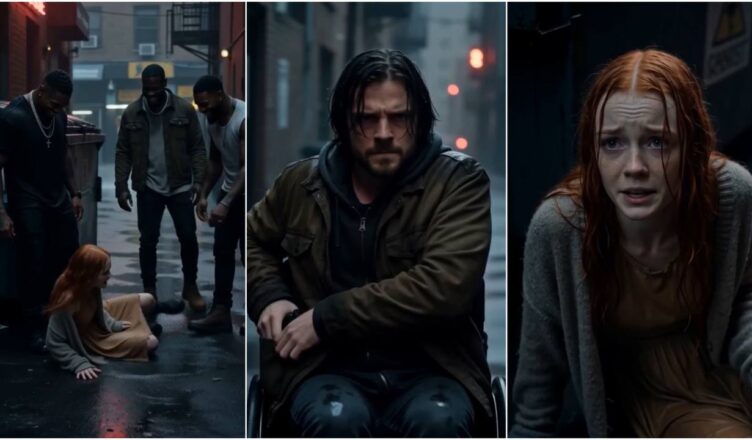
The first scream came just as the rain began.
Not a storm yet. Just a cold, nervous drizzle sliding through Baltimore and turning the sidewalks black beneath the red glow of traffic lights. The city looked bruised at night, all wet brick and smeared neon, the kind of place where people learned to keep walking because stopping could cost too much.
Jonah Ellis heard the scream from outside Ray’s Diner.
He was thirty-one, sitting in his wheelchair beneath the flickering sign, one hand on the rim of his wheel, the other wrapped around a paper cup of coffee that had gone cold ten minutes ago. Rain gathered on the shoulders of his dark jacket and soaked into the hood of his sweatshirt. He barely noticed.
Most people in Baltimore knew the Ellis name.
Ellis Development owned half the new glass towers rising over the harbor, three hotels downtown, and enough political favors to make problems disappear before they reached the newspapers. Jonah had been born into money, but he had never worn it well. He liked job sites more than boardrooms. Hard hats more than charity galas. Steel beams, concrete dust, and men who said what they meant.
Four years earlier, he had been working as a construction foreman on one of his family’s projects when a support beam snapped.
The accident crushed two vertebrae, damaged his spinal cord, took his ability to walk, ended his career, and turned him into the one thing his family did not know how to handle: a broken heir.
His mother, Eleanor Ellis, controlled everything after that. Doctors. Specialists. Private nurses. Experimental clinics. Press statements. Quiet settlements. She wanted his recovery to look expensive, respectable, and perfectly managed.
Jonah wanted silence.
So he left the family estate outside the city and moved into a modest apartment above a closed tailor shop, three blocks from Ray’s Diner. His mother hated the place. That was half the reason he stayed.
The second scream came sharper.
“No! Please, stop!”
Jonah turned toward the alley behind the diner.
For one second, fear told him to stay where he was. Call the police. Let someone else handle it. He had heard that voice often since the accident. It sounded reasonable. Mature. Safe.
He hated it.
Jonah dropped the cold coffee into a trash can, gripped his wheels, and pushed hard around the corner.
The alley behind Ray’s was narrow, ugly, and empty, boxed in by wet brick walls and a rusted metal fire escape. A dumpster sat halfway down, black water pooling around its wheels. Red neon from the diner sign spilled weakly across the pavement, bleeding into puddles. There were no cars in the alley. No bystanders. No traffic visible from inside it. Just rain, brick, garbage, and fear.
Then Jonah saw her.
A young woman with long red hair plastered to her face was trapped near the dumpster. She looked about twenty, slim and soaked, wearing a worn brown dress beneath an oversized gray sweater that hung off one shoulder. One man had her bag twisted in his fist. Another tugged at her sweater. A third stood close enough to block her escape.
The three men were all in their mid-to-late twenties, each one different enough for Jonah’s mind to catch details even through the adrenaline. One was tall and broad in a black leather jacket, tattoos crawling up his neck. Another was wiry, with piercings in both eyebrows and a red hoodie under a denim vest. The third wore a dark green tracksuit, a gold chain, and heavy boots that splashed through the puddles.
“Let go of me!” Lucy cried.
The tallest one shoved her hard.
She fell backward into a puddle with a wet slap, one hand hitting the pavement, water splashing across her dress. The other two loomed over her and laughed silently, their bodies filling the narrow alley like a wall.
Something old and furious moved through Jonah’s chest.
Before the accident, he would have stepped between them with his body. He would have shoved them back, taken the hit, made himself the barrier.
Now all he had was a wheelchair, two useless legs, and a voice most people underestimated.
He rolled farther into the alley.
“Hey, assholes. Leave her alone.”
The three men turned.
The one holding the bag looked Jonah up and down, and a slow, cruel smile spread across his face.
“Or what? You can’t even stand up, loser.”
The words struck exactly where they were aimed.
Jonah’s hand moved to the side pocket of his wheelchair.
The pistol was there.
He had carried it for two years after a man followed him home from a pharmacy one night and tried to take his pain medication outside his building. Jonah hated the gun. Hated the weight of it. Hated the fact that carrying it made him feel both safer and smaller.
He had prayed he would never have to touch it.
Now he pulled it out.
The attackers stiffened.
The woman on the ground froze.
Jonah did not aim at them.
He raised the pistol straight up into the rain-dark sky between the brick walls and fired one warning shot.
The sound tore through the alley like thunder.
The three men panicked instantly. One stumbled back so hard he nearly slipped. Another swore, turned, and ran. The man with the bag dropped it and followed, boots splashing through puddles. Within seconds, all three were sprinting away into the dark at the far end of the alley, leaving the woman alone on the wet pavement.
Jonah lowered the pistol, his hand shaking.
He shoved it back into the wheelchair pocket and rolled toward her.
She was still on the ground, soaked and breathing hard, her red hair stuck to her cheeks. The puddle around her reflected the diner’s red neon in trembling streaks.
Jonah stopped a few feet away, giving her space.
“It’s okay. You’re safe now.”
She looked up at him.
Her eyes were gray, soft and steady beneath the fear.
“Thank you… you saved me. Now let me help you.”
Jonah blinked.
“Help me how?”
She pushed herself slightly up from the puddle. Rain slid down her face, but her expression changed. The panic was still there, but underneath it came a strange calm, as if the moment had turned and she had suddenly seen something Jonah couldn’t.
“I can help you walk again.”
Jonah went still.
The rain, the neon buzz, the distant city hum—everything seemed to pull back.
For a second, he only stared at her.
Then he gave a short, frightened laugh.
“Don’t do that.”
“Do what?”
“Say things like that to people like me.”
“To people like you?”
“To people in chairs. To people who have already heard every miracle story, every experimental treatment, every prayer, every doctor trying not to say never too harshly.” His voice hardened, but the anger was only fear wearing armor. “You don’t say that unless you can do it.”
Lucy lowered her eyes to his legs, then back to his face.
“I don’t promise miracles.”
“You just did.”
“No,” she said quietly. “I said I can help.”
Jonah looked away first.
A door creaked open behind him.
Ray, the diner owner, stood in the back doorway holding a baseball bat in both hands, his face pale under the kitchen lights.
“Jonah?” he called. “You all right?”
“I’m fine,” Jonah said. “Bring a towel. And something hot.”
Ray looked at Lucy, then at the far end of the alley.
“I heard a shot.”
“Warning shot.”
Ray’s mouth tightened, but he disappeared inside without arguing.
Lucy slowly stood and hugged the wet bag against her chest.
Jonah looked at her bare arms, her trembling hands, the way she was trying not to cry.
“You have somewhere safe to go?” he asked.
She wiped rain from her cheek.
“I’ll be okay.”
“That’s not what I asked.”
A faint smile appeared through her tears.
“You saved me, and now you’re interrogating me?”
“I’m making sure I didn’t scare off three idiots just so you could wander into worse trouble.”
That made her laugh once, softly. Then her gaze dropped to his wheelchair again.
Jonah saw the question before she asked it. He had seen it on hundreds of faces. Curiosity dressed as sympathy.
But Lucy did not ask what happened.
Instead, she stepped closer and said, “How long?”
Jonah’s jaw tightened.
“Four years.”
“Do you feel anything?”
“In my legs?” He gave a short, bitter laugh. “No.”
Lucy crouched carefully in front of him, keeping her hands to herself.
“I don’t believe that.”
His face changed.
“You don’t know anything about me.”
“No,” she said. “But I know what it looks like when someone is afraid of their own body.”
Jonah stared at her.
Lucy’s voice softened.
“I helped my brother after his accident. Doctors said he might never walk again. For months, he couldn’t move his legs. He stopped trying because every failed attempt felt like losing twice. But there was still strength there. Buried. Weak. But there.”
Jonah looked away.
“Good for your brother.”
“I’m not saying it’s the same.”
“It isn’t.”
“I know.”
“No, you don’t.” His voice sharpened. “People hear wheelchair and suddenly everyone has a miracle story. A cousin, a neighbor, some guy from church. Stand up. Believe harder. Try this treatment. Pray this prayer. Think positive. You know what that does to someone like me?”
Lucy did not flinch.
“It makes you feel blamed for not healing.”
The answer stopped him.
Rain tapped against the metal rims of his wheels.
Jonah looked at her again.
Lucy’s eyes were wet, but not only from the rain.
“I work with a small rehab clinic on the east side,” she said. “Mostly people who can’t afford fancy places. I’m not a surgeon. I’m not magic. But I know conservative therapy. Strength work. Nerve stimulation. Balance training. Weight-bearing. Fear retraining. The body remembers more than people think.”
Jonah shook his head.
“My family hired the best doctors in the country.”
“And did they listen to you?”
The question landed harder than the insult had.
Ray returned with a towel and a steaming cup of coffee. Lucy took both with shaking hands.
Jonah looked at the wet pavement between them.
“What are you asking me?”
“One hour,” Lucy said. “Once a week. No cameras. No promises. Just work.”
Jonah almost laughed.
His mother would have called it reckless. His doctors would have called it unstructured. His family attorneys would have called it liability.
Maybe that was why he said yes.
“Fine,” he muttered. “One hour.”
Lucy smiled, and for the first time since the scream, she looked young.
“One hour,” she said.
By the following Thursday, Jonah had nearly talked himself out of it.
He sat in a back room of St. Agnes Community Clinic, staring at faded blue mats, parallel bars, resistance bands, and a cracked mirror mounted on the wall. The place looked nothing like the private facilities his mother had dragged him through. No marble lobby. No specialist flown in from Switzerland. No framed donor plaque with his last name on it.
Lucy walked in wearing jeans, sneakers, and a navy sweatshirt with her hair tied back.
“You came,” she said.
“I almost didn’t.”
“But you did.”
“For the record, I still think this is stupid.”
“For the record, that’s allowed.”
She did not touch him at first. That surprised him.
She watched how he transferred from the chair to the mat. How he used his arms. How his shoulders did too much work. How he looked away every time his legs failed to respond.
Then she asked about the accident.
Jonah hated that part.
He told her about the beam. The noise. The dust. The men shouting. The way one second of falling steel had split his life into before and after.
Lucy listened without trying to fix the silence.
At the end of the session, she said, “Your body is scared.”
“My spine is damaged.”
“Yes,” she said. “And your body is scared.”
He wanted to argue.
Instead, he looked at the mirror and saw a man who had spent four years bracing for impact long after the beam had already fallen.
They met every Thursday.
At first, nothing happened.
Lucy worked with him on breathing, posture, hip activation, assisted standing, and exercises so small they felt humiliating. Jonah cursed under his breath when his legs refused to obey. Sometimes he snapped at her. Sometimes he apologized. Sometimes he left without saying goodbye.
But he always came back.
Over time, Lucy learned the shape of his pain.
Not just the physical kind. The other kind.
She learned that he hated being helped but feared being abandoned. That he missed his old life but resented anyone who talked about it. That he avoided his mother’s calls because every conversation with Eleanor Ellis made him feel like a failed investment.
And Jonah learned Lucy too.
Her brother’s name was Noah. He had been nineteen when a drunk driver hit his car. Lucy had been twenty-two and terrified, but she had spent every day beside him, reading medical journals she barely understood, arguing with insurance companies, learning exercises from therapists, refusing to let Noah disappear into the chair he thought would become his whole life.
“He walks now?” Jonah asked one night.
“With a limp,” Lucy said. “And an attitude.”
Jonah smiled.
“That sounds healthy.”
“It is. He’s impossible.”
The first time Jonah made her laugh hard, really hard, something shifted between them.
It happened during a balance exercise. He nearly fell, grabbed the parallel bar, and said, “If I die in here, tell people I was doing something cooler.”
Lucy laughed so suddenly she had to cover her mouth.
Jonah stared at her.
“What?”
“Nothing.”
“No, what?”
“You’re funny when you’re not trying to be cruel.”
He looked offended.
“I’m not cruel.”
“You’re a little cruel.”
“I’m charming.”
“You’re rich. People confuse that with charming.”
Jonah blinked, then laughed.
After that, the sessions became something he waited for.
He still kept them secret.
His mother believed he was seeing a neurologist at Hopkins twice a week. Jonah allowed her to believe it. Eleanor would never have approved of Lucy. Not because Lucy was unkind or unqualified or careless. Because she was not chosen by the family. Because she did not come with a reputation Eleanor could brag about over dinner. Because Lucy spoke to Jonah like a man, not a medical project.
One evening, Eleanor called while Lucy was helping Jonah stretch his right leg.
The phone buzzed on the mat.
MOTHER.
Lucy glanced at it.
Jonah silenced the call.
“You’re afraid of her,” Lucy said quietly.
Jonah stiffened.
“I’m tired of her.”
“That’s not what I said.”
He looked away.
Lucy placed a hand lightly on his knee.
“You can tell her.”
“No, I can’t.”
“Why?”
“Because the second she knows about you, she’ll investigate you, insult you politely, offer money you won’t take, and then try to replace you with someone whose last name sounds expensive.”
Lucy smiled faintly.
“That specific?”
“You haven’t met Eleanor Ellis.”
“No,” Lucy said. “But I’ve met men who still live inside their mother’s voice.”
Jonah looked at her.
There was no judgment in her face. Only honesty.
That scared him more.
Weeks turned into months.
The first sign came on a rainy Tuesday.
Lucy was working his right leg through slow assisted movement when Jonah suddenly sucked in a breath.
“What?” she asked.
He looked down.
“Do that again.”
She repeated the movement.
His fingers tightened around the edge of the mat.
“What do you feel?”
Jonah did not answer at first. He was afraid saying it out loud would make it vanish.
“Warmth,” he whispered.
Lucy froze.
“Where?”
“My calf.” His voice shook. “My foot too. It feels like… like heat under the skin.”
Lucy’s eyes filled before she could hide it.
“That’s good.”
“Don’t say that unless it is.”
“It is.”
He laughed once, breathless and terrified.
“It hurts.”
“I know.”
“No, it burns.”
“I know.” Lucy moved closer. “Jonah, listen to me. I told you there was strength there.”
His breathing grew uneven.
“It doesn’t mean I can walk.”
“No. Not today. Not because of one feeling.” She held his gaze. “But it means your body is answering.”
Jonah stared at his leg like it belonged to someone else.
Lucy touched his knee.
“There is strength in your legs. You need time. You need work. And you need to believe your body isn’t your enemy.”
Something in him broke quietly.
He covered his face with one hand.
Lucy did not rush him.
The next night, Jonah did not sleep.
The warmth stayed.
It moved through his legs in waves, strange and deep, sometimes burning, sometimes tingling, sometimes so intense he sat up in bed and gripped the sheets. By dawn, he was exhausted, scared, and more alive than he had felt in years.
At 6:12 in the morning, he called Lucy.
She answered on the third ring, her voice thick with sleep.
“Jonah?”
“I need you to come over.”
“What happened?”
“I don’t know.” He swallowed hard. “I feel them.”
Lucy was at his apartment forty minutes later.
Her hair was damp from the rain. She wore no makeup, an old jacket, and the worried expression of someone trying not to hope too loudly.
Jonah sat in his wheelchair in the middle of the living room.
“I didn’t sleep,” he said before she could ask. “All night, my legs felt like they were burning. Not pain exactly. Not like before. More like… like they were waking up angry.”
Lucy knelt in front of him and carefully placed both hands around his lower legs.
Her eyes widened.
“They’re warm.”
“I know.”
“No, Jonah. Really warm.”
His throat moved.
“What does that mean?”
“It means we try.”
He stared at her.
“Try what?”
Lucy stood and held out both hands.
“Stand up.”
Fear moved across his face so openly that her heart hurt.
“I can’t.”
“You might not. And if you don’t, nothing is ruined.”
“I can’t fall in front of you.”
“You already have.”
He gave a broken laugh.
“That was supposed to comfort me?”
“Yes.”
She stepped closer.
“I’m here. I’ve got you.”
Jonah looked at her hands.
Then at his legs.
Then at the wheelchair that had carried him through four years of grief, rage, silence, and survival.
He took her hands.
The first attempt failed.
His knees trembled, his arms shook, and he dropped back into the chair with a gasp.
“Again,” Lucy said.
“I can’t.”
“Again.”
The second attempt lifted him halfway before panic took him down.
Lucy moved closer, bracing him with her body.
“Don’t think about four years,” she whispered. “Don’t think about doctors. Don’t think about your mother. Don’t think about the accident. Just the floor. Your feet. My hands. Right now.”
Jonah was crying before he realized it.
“I’m scared.”
“I know.”
“What if I can’t?”
“Then I’ll still be here.”
That was the sentence that did it.
Not the therapy. Not the heat. Not the months of exercises, though all of it mattered.
It was that sentence.
Then I’ll still be here.
Jonah pushed down through his feet.
His legs shook violently beneath him. His body pitched forward. Lucy held him, her arms tight around his waist. His muscles fought him, weak and furious, but they held.
One second.
Two.
Three.
Jonah Ellis stood.
A sound tore out of him, half sob, half laugh.
Lucy looked up at him, tears spilling down her face.
“You’re standing,” she whispered.
He tried to answer, but no words came.
His knees buckled after a few seconds, but Lucy caught him before he fell. They sank together onto the rug, both crying now, both laughing through it.
Jonah wrapped his arms around her and held on like she was the only solid thing in the world.
“You did it,” she cried.
“No,” he whispered into her hair. “We did.”
Lucy pulled back just enough to look at him.
For months, they had been careful. Careful with touch. Careful with words. Careful not to name the thing growing quietly between therapy sessions and late-night phone calls, between arguments and small victories, between pain and hope.
But now there was no careful left.
Jonah kissed her.
At first, it was soft, almost uncertain.
Then Lucy kissed him back.
The front door opened.
“Jonah, I told you I was coming by this morning because you refuse to answer—”
Eleanor Ellis stopped in the doorway.
She was elegant even in shock, dressed in a cream coat and pearls, her silver-blond hair pinned perfectly beneath the kind of face that had frightened board members for thirty years.
Her handbag slipped from her arm.
Jonah and Lucy froze on the rug.
Eleanor stared at her son.
Then at the wheelchair.
Then at Jonah’s legs.
“Jonah?” she whispered.
Lucy quickly stood and helped him up, instinctively bracing him.
And there, shaking badly but standing on his own feet, Jonah faced his mother.
Eleanor’s mouth opened.
No sound came out.
Her eyes rolled back.
She fainted straight onto the hallway floor.
For one stunned second, nobody moved.
Then Jonah said, “Oh my God.”
Lucy rushed to Eleanor’s side while Jonah grabbed the arm of the couch and lowered himself carefully down.
“She’s breathing,” Lucy said. “I think she just passed out.”
Jonah wiped his face with both hands.
“I have imagined shocking my mother a thousand times,” he said shakily. “That was better than every version.”
Lucy looked at him.
Despite everything, she laughed.
Eleanor woke five minutes later on Jonah’s couch with a cold towel on her forehead and her pride severely injured.
She stared at Lucy.
“Who are you?”
Lucy sat straighter.
“Lucy Bell.”
Eleanor’s eyes narrowed.
“And what exactly have you been doing with my son?”
“Helping him,” Jonah said.
Eleanor turned to him.
“You stood.”
“I did.”
“How?”
“Work. Therapy. Time.” He looked at Lucy. “And someone who believed me back into my own body.”
Eleanor’s expression trembled.
For the first time in Jonah’s life, his mother looked old.
“Why didn’t you tell me?”
“Because you don’t help, Mom. You manage. You control. You turn pain into a project and call it love.”
The words hit her hard.
Eleanor looked down at her hands.
“I was afraid,” she said quietly.
Jonah’s anger softened, but it did not disappear.
“So was I.”
Lucy rose.
“I should go.”
“No,” Jonah said.
She paused.
He reached for her hand.
“You stay.”
Eleanor saw it then. Not just the therapy. Not just the miracle of her son standing. She saw the way Jonah looked at Lucy, and the way Lucy looked back.
For a moment, the old Eleanor appeared. The woman who measured people by family name, education, money, usefulness.
Then her eyes moved to the wheelchair.
To her son’s trembling legs.
To the woman who had helped him stand when all Eleanor’s money had not.
She lowered her gaze.
“Thank you,” she said.
Lucy blinked.
Eleanor swallowed.
“I’m not good at saying that.”
Jonah almost smiled.
“No, you’re really not.”
After that morning, everything changed.
Not instantly. Not perfectly.
Jonah did not throw away his wheelchair. Recovery was not a movie scene. He still needed it on hard days. He still fell. He still cursed through therapy. He still woke at night with spasms and fear. Some mornings, his legs felt like they belonged to a stranger.
But he walked.
First between parallel bars.
Then across his apartment.
Then down the hallway with Lucy beside him.
Then into Ray’s Diner with a cane.
Ray came out from behind the counter and hugged him so hard Jonah nearly lost his balance.
“You fall in my diner after all this,” Ray said, voice rough, “I’m charging you for the floor damage.”
Jonah laughed in a way that no longer sounded forced.
People wanted explanations. Doctors wanted scans. Reporters wanted interviews. Eleanor wanted to donate an entire wing to the clinic and name it after the family.
Jonah told her no.
Then Lucy told him he was being stubborn.
So they compromised.
Eleanor funded the clinic anonymously.
Lucy pretended not to know.
Jonah pretended not to be proud of both of them.
Six months after the night in the alley, Jonah walked back there with a cane in one hand and a small velvet box in his coat pocket.
It was raining again.
Not a storm. Just a cold drizzle sliding down the brick walls, turning the pavement black beneath the red glow of Ray’s sign.
Lucy stood beside him, wrapped in a gray coat, her red hair tucked under the collar. She looked at the alley and shivered.
“You picked a romantic place,” she said.
Jonah nodded seriously.
“Dumpster. Puddles. Possible tetanus. Very Baltimore.”
She laughed.
“I’m serious,” he said.
Her smile faded when she saw his face.
Jonah took one careful step forward.
Then another.
His leg trembled, but he did not fall.
He turned to her in the exact spot where he had first seen her on the ground, frightened and soaked, while the whole city looked the other way.
“I thought my life ended four years ago,” he said. “I thought I was just surviving what was left of me. Then you came into my life and you didn’t fix me. You didn’t save me like some miracle. You stayed. You made me work. You made me angry. You made me believe there was still strength in places I had already buried.”
Lucy’s eyes filled.
“Jonah…”
He lowered himself slowly, carefully, painfully onto one knee.
Lucy covered her mouth.
The cane slipped against the wet brick, but he caught himself and smiled through the effort.
“I’m not doing this because I can stand,” he said. “I’m doing this because you taught me what standing means.”
He opened the box.
“Lucy Bell, will you marry me?”
For a second, she could not speak.
Then she dropped to her knees in front of him, crying and laughing at once.
“Yes,” she whispered. “Yes.”
Jonah slid the ring onto her finger with shaking hands.
Lucy threw her arms around him, and this time when they kissed, there was no fear in it. No secret. No shame. No unfinished grief standing between them.
Behind them, the back door of Ray’s Diner opened.
Ray stepped out holding a towel, saw them on the wet pavement, and froze.
“Oh,” he said. “This better be what I think it is.”
Lucy laughed through her tears.
Jonah looked back at him.
“She said yes.”
Ray lifted both hands toward the rainy sky.
“Thank God. I already baked the cake.”
Lucy stared at him.
“You knew?”
Ray shrugged.
“Kid, this man has been walking around with a ring box for two weeks like it had a bomb in it.”
Jonah groaned.
Lucy kissed him again.
The rain kept falling. The neon kept flickering. Somewhere beyond the alley, Baltimore moved the way it always had, loud and tired and full of people pretending not to see each other.
But in that small red glow behind the diner, two people stayed.
And for Jonah Ellis, that was where the miracle truly began.