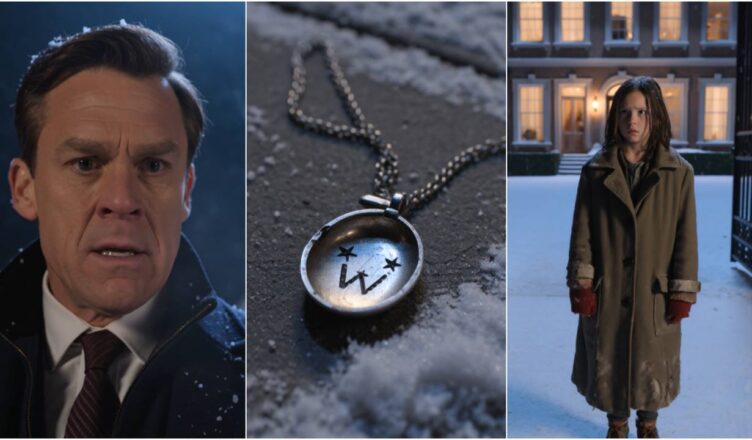
The wind off Long Island Sound didn’t blow so much as hunt. It slipped through the holes in my surplus army jacket and settled in my bones while I stood outside the Sterling estate, staring at a house so bright it looked unreal—stone and glass and chandeliers blazing against the snow.
“You’re back,” Mike said from the security booth.
He cracked the door open just enough to let out a ribbon of heat. He was the kind of man who watched cameras for the rich and slipped leftovers to strays without ever admitting he did either one out of kindness.
“Bad night to be seen,” he said. “Mr. Sterling’s hosting the foundation gala.”
“When isn’t it a bad night?”
He looked toward the house, then back at me. “It’s also the anniversary. He’s never right on the anniversary.” His voice dropped. “Go around back. Catering leaves untouched trays in a compost bin by the service entrance. Still warm if you’re fast.”
Warm hit me harder than pity.
I slipped through the hedge gap Mike pretended not to know about and cut across the snow. Through the ballroom glass I saw tuxedos, glittering trays, women in jewel-colored gowns, and Richard Sterling himself beneath a portrait of his family: Richard in black tie, Elena in blue silk, and a dark-haired little girl grinning beside a telescope.
My fingers went to the locket at my throat.
It was small and oval, no bigger than a quarter, silver gone dull from years of skin and weather. On the front was a hand-engraved W, worn soft at the edges from being rubbed over and over by nervous fingers. The clasp had been repaired once with a crooked bead of solder, not pretty but careful. It was the only thing I owned from before the hospital, before intake, before a county caseworker looked at the vase of white lilies on her desk and wrote Lily on my file because I couldn’t give her another name.
The patio door opened.
I stepped back, hit black ice, and crashed into a ceramic urn tall as my hip. It shattered across the stone.
The music inside cut off. Conversations died. Faces turned.
Richard Sterling came out onto the patio with the kind of speed that meant anger had been living just under the surface all evening.
“How did you get in here?”
“I’m sorry,” I said, scrambling over broken pottery. “I was leaving.”
His eyes moved over my split shoes, my jacket, my face. “There are shelters in this county.”
“Not with food that smells like that.”
Something flickered behind him—pain, maybe, or embarrassment—but it was gone before I could name it. He caught me by the collar and hauled me upright.
“Richard, stop.” The woman behind him stepped into the cold. Her voice was sharp enough to cut glass. “She’s a child.”
“She’s trespassing.”
Panic took over. I clawed at his wrist, and the chain at my throat snapped.
The locket hit the stone, sprang open, and flashed in the floodlights.
Richard froze.
He bent down slowly and picked it up with shaking hands.
In his palm the little silver locket lay open, the engraved W bright against the worn metal.
Elena made a broken sound in the back of her throat. “The clasp,” she whispered. “Richard, that’s the clasp you soldered yourself. When she snagged it on the dock ladder in Watch Hill.”
Both of them looked at me differently then. Not like I was dirt. Not like I was trouble.
Like I was impossible.
“Willa?” Richard said.
The name passed through me without landing. “My name is Lily.”
Elena came closer, trembling so hard I could see it in her bare shoulders. “Your right shoulder,” she said. “When you were six, you fell off the swing at the beach house. Three stitches. The scar curves like a crescent.”
No stranger should have known that.
I pulled the jacket aside.
There it was.
Elena covered her mouth and started crying right there in the snow. Richard’s face went strange and empty, as if every year he had survived since losing me had just collapsed on top of him at once.
That was when I understood what Mike had meant. The gala wasn’t just a party. It was the anniversary of the night their daughter disappeared.
An hour later a doctor had looked at my ankle, my wrists, the old scars on my arms, the raw skin on my knuckles, and the damage winter and hunger had done. He said I was exhausted, underfed, and running on instinct. Elena asked what I wanted to eat.
“Bread,” I said. “Peanut butter.”
Not roast chicken from downstairs. Not pastries with lacquered fruit. Something plain. Something safe.
They took me to a bedroom kept exactly as I had left it five years earlier. The telescope still stood by the window. Star charts still hung on the walls. There were books on the shelf with a child’s name written in looping marker inside the covers.
Willa Sterling.
I stared at the bed, too white, too soft, too untouched for my body to believe in.
“I can’t sleep here,” I said.
Richard had taken off his jacket and tie by then. He looked older without them, less like a man from a magazine and more like someone who had been holding himself upright by force for years. “Where can you sleep?”
I pointed to the walk-in closet.
Neither of them argued.
So at two in the morning my parents dragged a mattress into a closet and made me a nest out of blankets. When I woke before dawn, Richard was still sitting on the floor outside the half-open door in his wrinkled dress shirt, keeping watch.
Mrs. Higgins, the housekeeper, set out enough breakfast for ten people. I asked for toast, ate fast, and slipped two muffins into the pocket of my borrowed sweatshirt before I could stop myself.
Detective Miller arrived before I finished chewing.
He had the face of a man who believed feelings were the enemy of facts. He took one look at me and started thinking in forms.
“DNA will confirm identity within forty-eight hours,” he said. “In the meantime, I need a clear timeline. One of the most publicized missing-child cases in Connecticut doesn’t just turn into an unidentified patient in a Nassau County hospital and then disappear into state custody for five years without somebody missing something important.”
Richard’s attorney, who had shown up ten minutes earlier, told him he would get his timeline later.
Miller’s jaw tightened. “I’m not here to cause distress.”
“That’s exactly what you’re doing,” Richard said.
Miller looked at me again, softer this time, though not soft enough. “I’m coming back,” he said. “With the hospital records, the transfer paperwork, and every mistake that made this possible.”
After he left, Richard noticed the shape of the muffins in my pocket.
I went still.
Instead of calling me out, he set cash and a black credit card on the counter beside my plate. “You never have to hide food again,” he said quietly. “But if carrying some makes you feel safe, carry some.”
That almost made me run.
By afternoon Elena had turned hope into a project.
First came warm clothes, then a bath, then soft talk about trimming my hair, moisturizing my hands, helping me feel like myself again. She moved around me with the fragile determination of someone trying to rebuild a cathedral from ash.
That was the problem.
I didn’t know who that self was.
A stylist lifted a section of my hair. Metal flashed near my cheek.
And suddenly I was back in Philadelphia.
Not in a mansion. In an alley behind a check-cashing place, freezing under a broken security light while Spider’s friend hacked my hair off with drugstore scissors and laughed when I flinched. Hold still, Rat. No one looks twice at a ragged kid anyway.
I shoved the cape away and shot to my feet so fast the chair tipped over.
“Stop.”
The room went dead silent.
Elena stepped toward me. “Honey, no one is hurting you.”
“Then stop acting like you can fix me with a haircut.”
“I’m trying to help.”
“By turning me into the girl in those pictures?”
Her face changed.
I could see she was exhausted, terrified, and trying not to drown in what I’d brought back with me. But she still reached for me, maybe out of instinct, maybe because mothers do. I slapped her hand away.
The sound was small, sharp, humiliating.
And she slapped me.
Not hard enough to knock me sideways. Not hard enough to leave a mark. But hard enough to turn the room cold.
Elena stared at her own hand in horror, as if it belonged to someone else.
I didn’t cry. I knew too much about what came after crying.
“I’m going to my room,” I said.
No one stopped me.
That night I saw Spider standing under an oak beyond the gates, cigarette glowing red in the dark. My old prepaid phone buzzed where I had hidden it back in the lining of my jacket.
Nice castle, Rat. You tell them about Philly?
Then another message.
Boathouse. Midnight. Alone. Or I send your daddy the store footage and let the cops do the rest.
My stomach dropped.
Footage.
A convenience store. Spider shoving a bag into my hands. A clerk shouting. A gunshot. Blood on white tile. I hadn’t pulled the trigger, but I had been there. I had run because Spider told me to run, and on the street that kind of obedience could mean the difference between getting hit and getting fed.
Richard found me on the balcony with the phone in my hand.
He draped a wool coat around my shoulders and started talking about increasing security, moving the night team closer to the house, locking down the grounds. I barely heard him.
“Tell me about the crash,” I said.
He went very still.
“The roads were slick,” he said. “The car went over.”
“You told everyone you were driving.”
“I was.”
“No.” The memory came fast and sharp, bright as broken glass. His hands on wet metal. His body outside the vehicle while it moved away from him. “I remember you on the bridge.”
His answer came too quickly. “Trauma distorts memory.”
A neat lie was still a lie.
At eleven fifty I climbed down the trellis outside my window and ran across the lawn to the boathouse.
Spider was waiting inside, perched on a stack of life jackets like he owned the place. He grinned when he saw the silk pajama pants sticking out below my coat.
“You clean up nice.”
“What do you want?”
“Fifty grand. Cash. Or your rich father learns his miracle daughter was part of a robbery where a man died.”
“I was a kid.”
“You still ran the bag.”
He stood and caught my wrist.
“Let her go.”
Richard filled the doorway, an iron flashlight in one hand. He must have checked the cameras when he found the closet empty and followed me down alone.
Spider laughed. “Did she tell you what she is?”
Richard didn’t blink. “I know exactly what she is. She’s my daughter.”
Security lights flared outside, flooding the boathouse windows white. Somewhere on the path men were shouting. Spider shoved me backward and bolted through a side door into the dark.
The second he was gone, my body started shaking.
Richard crossed the room, then slowed when he saw me flinch. “Are you hurt?”
“I was there,” I said. “At the store. I remembered it. And you still lied to me.”
He sat down hard on the bench by the wall and covered his face for a moment.
“I wasn’t driving,” he said at last.
The room narrowed.
“We stopped on the old causeway to watch the Perseids. You loved meteor showers. You used to make up stories about the stars and correct me when I named the constellations wrong.” He swallowed. “The rear tire looked low, so I got out to check it. I pulled the hand brake and thought it held. You were seven. You wanted to help. You reached for the release lever because you’d seen me use it before.”
A tiny metallic click sounded in my head.
“I heard it and turned,” he said. “The Rover was already moving. I ran for the door. I got both hands on the frame. I tried to hold it. I could not hold it.” His voice broke on the last word. “It went through the rail and into the inlet.”
I couldn’t breathe.
“A lobsterman found you at dawn tangled in marsh grass on the New York side,” he said. “You’d hit your head. You were hypothermic. You had no identification except a locket with a W on it, and that wasn’t enough for a hospital trying to process storm casualties in the middle of the night. They logged you as Jane Doe. Then a transfer order carried the wrong case number. By the time anyone connected an unidentified child in Nassau County to a missing girl from Connecticut, you’d already been moved again. We chased paper for years. Every time we got close, the trail had already gone cold.”
I stared at him.
“So you told everyone you were driving.”
“To protect you.” He looked up, and his face was wrecked. “I could not bear the thought of you waking up one day and believing you had caused it. The blame belonged to the adult who should have known better. It belonged to me.”
For five years I had lived inside a blank space. And inside that blank space I had hidden another story: that no one had really wanted me enough, or searched hard enough, or loved me enough to find me.
Now the truth opened underneath it.
A man on a bridge in the rain, trying to stop a moving car with his bare hands.
A father carrying the blame because he thought it was the only way to keep his daughter from drowning twice.
My knees gave out. I sat down on the boathouse floor.
“Daddy,” I said, and this time the word felt real.
He was beside me a second later, holding me as carefully as if I might still vanish in his arms.
By spring the house felt less like a museum and more like a place people were learning to live in honestly.
Spider went to jail for extortion, witness intimidation, and warrants older than I was willing to ask about. Detective Miller, to his credit, did what he said he would do: he dragged the hospital records, transfer forms, intake reports, and foster-system files into the light until the chain of mistakes finally made sense. A storm. A head injury. An initial instead of a full name. A bad case number. Too many agencies and not enough people willing to assume the lost child in front of them might belong to someone important somewhere else.
Richard’s lawyers proved the rest. Whatever I had done on the street, I had done as a hungry minor under coercion. No one was interested in charging a child for surviving.
Elena never excused the slap.
She apologized the first time the next morning, then again a week later, and once more in therapy when she said she wanted me to hear it without the fog of shock around us. She stopped trying to pull the old Willa out of me by force. She knocked before entering rooms. She asked before touching me. She left food where I could see it and never commented when I tucked a granola bar into my pocket anyway. Some nights she sat outside my closet and named constellations through the half-open door until I fell asleep.
Therapy gave us words I hated at first—hypervigilance, trauma response, recovered memory, dissociation—but the words helped. In that house, when I said stop, people stopped. Locks began to sound like safety instead of punishment.
Three months after the night at the gate, Richard climbed onto the roof with two mugs of hot chocolate and the repaired locket in his hand.
He had replaced the broken chain, but not the scratches.
“They’re part of it,” he said.
The sky over Connecticut deepened from violet to black. I turned the locket over in my fingers. The engraved W caught the last of the light.
“Put it on for me?”
His hands were steady at the back of my neck. “There.”
I touched the cool silver and felt my own pulse beating under it.
I wasn’t Lily exactly.
I wasn’t the untouched Willa from the portrait either.
I was the girl who had slept in shelters, hidden food, lied when she had to, and survived long enough to come home changed. The house hadn’t erased any of that. It had only become the first place where surviving wasn’t the whole job.
“Dad?”
“Yeah, sweetheart?”
“I love you.”
He kissed the top of my head. “I love you too. More than anything.”
Below us the house glowed warm against the dark, and beyond it the Sound breathed under the night sky. For years I had believed I was the girl who disappeared.
I wasn’t.
I was the girl who came back.