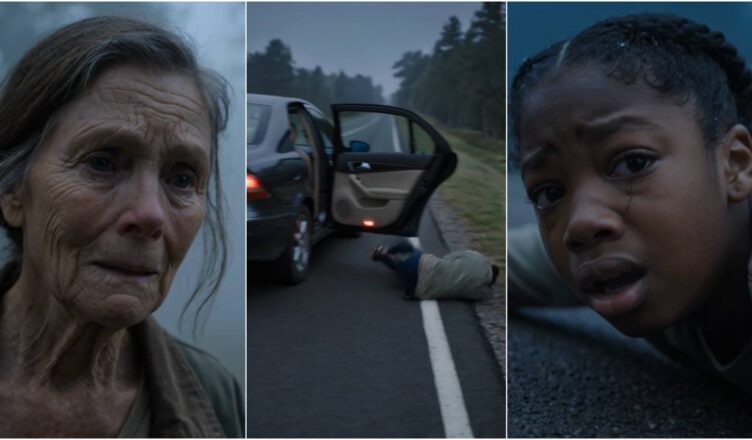
Aaliyah understood what her aunt and uncle had done only after the car’s taillights vanished.
One second she was half asleep in the back seat, cheek against the cold window, thinking they had stopped for gas. The next, the rear door flew open, fingers locked around her arm, and she was dragged out onto loose gravel so hard she nearly went to her knees.
“Wait—”
The trunk slammed. The engine rose. Red taillights swept across the trees and disappeared around a bend, leaving her alone on a narrow road cut through miles of black forest.
No houses. No porch lights. No passing traffic. Just wind in the branches and the sound of her own breathing going thin and fast in the dark.
At sixteen, Aaliyah already knew how to make herself smaller than her fear. Since her parents died in a car accident when she was nine, she had lived with her mother’s sister and her husband in a house where kindness had spoiled by degrees—first into impatience, then into resentment, and finally into the sort of cold tolerance that made a person feel like a bill no one wanted to keep paying.
At first they called her family. Then came the sighs when she needed lunch money, the arguments that stopped when she entered a room, the way bills were discussed louder when she was nearby. Over the last year, the mood in the house had hardened. She heard her name in low conversations she was never meant to catch.
We can’t keep doing this.
She’ll be eighteen before we know it.
Then what?
Aaliyah had learned not to ask questions when adults wanted her quiet. Standing on that road with darkness pressing in from both sides, she understood that all those silences had been rehearsal.
Her hands shook as she pulled out her phone.
No signal.
She turned in a slow circle, searching for anything human—a mailbox, a distant porch light, even headlights through the trees—but the world stayed blank. She started walking in the direction the car had gone, because standing still felt worse. Gravel crunched under her sneakers. Wind cut through her thin jacket. The road remained empty.
By the time the last blue light drained from the sky, fear had changed shape. It was no longer only the fear of being left. It was the colder fear of what would happen if she stayed exposed all night and nobody came.
So she stepped off the shoulder and into the trees.
Branches snagged her sleeves. Wet leaves slid under her shoes. At first she tried to keep the road in sight, then lost it once the woods thickened. At last she found a hollow tree, old and split wide enough at the base to block some of the wind. She crawled inside, pulled her knees to her chest, and stayed awake listening to the forest move around her.
Morning made the isolation plain.
The woods seemed endless in daylight—gray trunks, damp earth, low brush, no sign of houses or people anywhere. Hunger came quickly. Thirst came faster. Aaliyah found rainwater pooled in a fold of stone and drank from her cupped hands. She kept walking until her legs trembled, but every break in the trees opened onto more of the same.
That night she went back to the hollow tree because at least it was a place she knew.
The second day was worse. Around noon she found a narrow run of water and followed it, hoping it would lead somewhere, but it vanished into brush so thick she could barely push through it. By evening she was shivering even when she sat still.
On the third morning, fog lay low between the trunks. Aaliyah woke with her cheek against the rough wood and, for one disorienting second, could not remember where she was. Then the cold came back, and the truth with it.
She tried to stand and nearly blacked out.
That was when she heard footsteps.
Not rushing. Not crashing. Slow, steady footsteps, someone used to walking uneven ground.
Aaliyah froze.
The sound came closer until an older woman stepped through the fog carrying a basket and a walking stick. She wore a weathered brown coat and mud-streaked boots. White hair showed beneath a wool cap. She stopped the instant she saw Aaliyah.
She did not gasp. She did not rush forward. Her gaze moved once over the hollow tree, the gray face, the trembling hands. Then she set the basket down.
“You don’t have to come out,” she said. “And I won’t touch you unless you tell me I can.”
Her voice was rough with age, but calm.
Aaliyah tried to answer. Nothing came out.
The woman unscrewed the lid of a canteen and set it on the leaves a few feet away. “Little sips first,” she said. “Not too fast.”
It took Aaliyah two tries to reach it. The water was cold and tasted faintly of metal and relief.
“I’m Margaret,” the woman said after a moment. “I’ve got a cabin nearby. Stove’s on. Soup, too, if you think you can keep it down.”
Aaliyah looked up then.
Margaret’s face held something Aaliyah had stopped expecting from adults—concern without suspicion, patience without demand.
“You can stay where you are if that feels safer,” Margaret said. “But you look about done in, honey.”
That was what broke her. Not the promise of warmth. The simple fact that this stranger had looked at her once and told the truth without making it cruel.
Aaliyah nodded.
Margaret helped her only after asking. Even then, her hand stayed light at Aaliyah’s elbow. The cabin sat deeper in the woods than Aaliyah would have thought possible, tucked beside hemlocks with smoke lifting from a metal chimney. Inside, it was plain and warm: a woodstove, a scarred pine table, shelves lined with jars, two quilts folded over the back of a chair.
Margaret gave her broth first, then bread torn into small pieces. She asked no questions while Aaliyah ate. She watched with the calm attention of someone who understood that a body had to stop feeling hunted before a mind could speak.
Aaliyah slept for hours in a narrow bed near the stove.
When she woke, evening had darkened the windows, and Margaret was at the table with an old landline phone pressed to her ear.
“Yes,” she was saying. “A girl. Teenager. She says she was left out here.” She glanced over. “No, she’s awake now. And no, I’m not sending her anywhere alone.”
The sheriff’s deputies arrived half an hour later. Wrapped in a blanket at the kitchen table, Aaliyah told them what happened in fragments—the drive, the shove, the road, the car disappearing, her aunt’s name, her uncle’s name. She had to stop often. Each time, Margaret slid a glass of water closer without interrupting.
By morning, the case had already begun to turn.
Her aunt and uncle had not reported her missing. Toll records placed their car heading north that night. Gas station cameras showed Aaliyah asleep in the back seat hours before she was abandoned. Investigators also found survivor benefits from her parents’ insurance drained for years, forged signatures tied to a settlement account, and messages showing panic over an upcoming review.
They had not simply gotten tired of her.
They had decided she was a liability.
After that came the procession of officials: a social worker, a state investigator, then a lawyer appointed to speak only for Aaliyah’s interests. Through all of it, Margaret stayed nearby unless Aaliyah asked for space. She drove her to a clinic in town, bought her a toothbrush and warm socks, and moved through each practical kindness without comment.
Only later did Aaliyah learn Margaret had been widowed for fifteen years and had lived mostly alone ever since, sustained by old savings and the habits of a small, orderly life.
When the county began discussing placement, the answers on paper were easy. Foster care. Emergency housing. Group placement.
Aaliyah said no to every one of them.
The social worker finally asked, “Is there anywhere you do feel safe?”
Across the room, Margaret stood at the stove pretending to fuss with a kettle so she would not crowd the answer.
“With her,” Aaliyah said.
There were background checks after that. Home visits. Training classes Margaret completed without complaint. Temporary guardianship first. Then something steadier. Aaliyah started school again, catching up in pieces. Margaret learned to leave the hall light on when nightmares were bad and not to ask for explanations Aaliyah could not yet give.
Trust returned in quiet increments.
In the way Margaret always knocked before entering a room.
In the fact that she never raised her voice just because she was tired.
One evening, nearly a year after the forest, Aaliyah was doing homework while Margaret stirred soup on the stove. Without thinking, she looked up and said, “Mom, can you pass the salt?”
The room went still.
Heat rose to Aaliyah’s face. “I didn’t mean—”
Margaret picked up the salt and set it gently beside her notebook. Her eyes were wet, but her voice stayed even.
“Of course,” she said.
The adoption was finalized the following spring.
Later, Aaliyah studied law, drawn toward cases most people preferred not to think about—children abandoned by relatives, money stolen under the cover of guardianship, harm hidden inside respectable families. She learned how often cruelty arrived quietly, and how often the people trusted to protect a child were the very people counting on that child’s silence.
Margaret never left the cabin, and Aaliyah never asked her to.
No matter how full life became, she returned—to visit, to help, to sit once more at the same worn kitchen table where someone had first let her drink water in peace before asking for her story.
Years later, after winning a case for a teenage boy whose relatives had been stealing from him while insisting they were “doing their best,” Aaliyah drove back through the forest after dark. The cabin windows glowed amber between the trees. Margaret, slower now but still stubbornly upright, opened the door before Aaliyah even knocked.
“You’re late,” she said.
“I brought pie.”
“That makes it forgivable.”
Aaliyah laughed and stepped inside, into the smell of woodsmoke and onions and the life that had begun the day everything else ended.
People sometimes called Margaret her rescuer, but the word was too small for what had happened between them. Rescue was only the first moment. What came after was harder and rarer.
Margaret had stopped.
She had looked.
And then she had stayed.
So did Aaliyah.