The Boy With the Red Toolbox
By dawn, Hangar 4 was already awake.
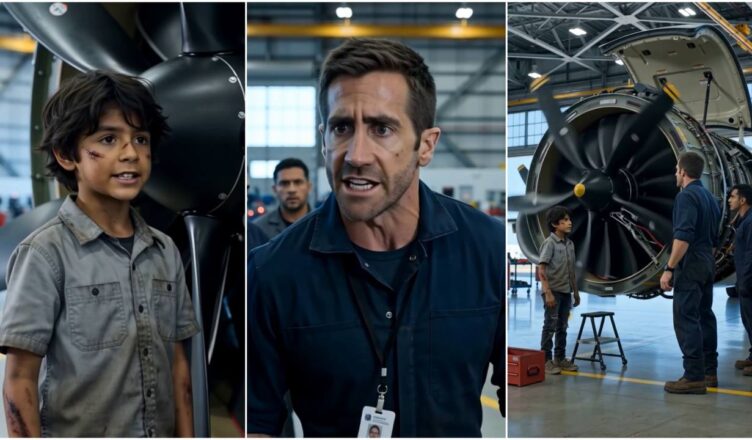
The cargo turboprop sat inside the massive maintenance hangar with one engine nacelle open and its giant black propeller locked still under the industrial lights. Tool carts surrounded the wing. Yellow safety lines marked the floor. The wide hangar doors were open to the cold blue morning, and airport noise carried in from the ramp.
Daniel Carter had been awake for twenty-two hours.
As maintenance director, he had spent the night answering calls from operations, legal, and a customer who wanted one simple answer:
When will my aircraft fly again?
Advertisements
Daniel didn’t have one.
The turboprop had come in after a rough shutdown warning during taxi. The crew had reported vibration from the left engine. Daniel’s team had opened the nacelle, inspected the propeller assembly, checked the gearbox area, replaced a sensor harness, and reinstalled a support bracket that had been removed during the night.
Everything should have been ready for a controlled turnover test.
But the propeller still wouldn’t rotate smoothly.
The airline wanted the plane back in service. Daniel wanted the engine cleared. The mechanics wanted the night to end.
Then one of the mechanics near the hangar entrance stopped walking.
“Daniel,” he said. “Look.”
Daniel followed his stare.
A boy was inside the safety-marked bay.
He was standing on a low rolling maintenance step beside the open engine, leaning into the exposed nacelle as if he belonged there. He was twelve, maybe, small and slim, with grease on his cheeks and forearms. His faded gray shirt hung loose over ripped jeans. Beside the step sat an old red metal toolbox, dented and chipped at the corners.
For one second, Daniel didn’t move.
Then anger hit him.
He strode across the polished concrete with three mechanics behind him.
The boy kept working.
Daniel stopped at the edge of the safety line.
“Hey! What the hell are you doing in here?”
The boy looked back at him without panic.
“Fixing what you put back together wrong.”
The mechanics behind Daniel went silent.
Daniel stepped closer, furious now.
“Step away from that engine.”
The boy turned back toward the nacelle instead. He pointed into the exposed assembly, where the support bracket sat behind a cluster of lines and fittings.
“Wait. That support bracket’s crooked.”
Daniel froze.
The mechanics looked where the boy pointed.
At first, Daniel saw nothing. Then he saw it: the bracket was seated, but not cleanly. Slightly off. Just enough to change the alignment. Just enough to bind under load.
The boy pointed again, this time toward the propeller hub.
“Turn it over. Now.”
Nobody moved.
The request was insane. A child had broken into a restricted maintenance area and touched an aircraft engine. Daniel should have called security. He should have removed him, locked down the bay, and written the incident report before anyone touched the aircraft again.
But the boy’s certainty stopped him.
Daniel looked at the bracket again.
Then he stepped to the nearby maintenance control panel.
“Clear the bay,” he said.
The mechanics backed up. One of them muttered under his breath, but he moved.
Daniel checked the safety zone, confirmed the propeller arc was clear, then activated the controlled test starter.
The propeller moved.
Slowly at first.
Then smoother.
The huge blades rotated through the hangar air with a steady mechanical rhythm. No hard catch. No ugly binding. No uneven drag.
The mechanics stared.
Daniel watched the propeller spin, and the anger drained from his face.
The boy had been right.
Daniel shut the test down.
The propeller slowed, blade by blade, until it stopped.
For a moment, the hangar was silent except for the low hum of lights and distant airport traffic.
Daniel turned back to the boy.
“What’s your name?”
“Leo.”
“Leo what?”
“Rivera.”
One of the older mechanics behind Daniel looked up sharply.
“Rivera?”
Leo glanced at him.
The mechanic stepped closer. His name was Alvarez, and he had worked in that hangar longer than almost anyone.
“Michael Rivera’s boy?” he asked.
Leo’s expression changed slightly.
“Yeah.”
Alvarez let out a breath. “I knew your father.”
Daniel looked from Alvarez to the boy. “Who was Michael Rivera?”
“One of the best engine mechanics this airport ever had,” Alvarez said. “Worked turboprops before half these guys knew what a torque wrench was. He could hear a bad bearing before diagnostics caught it.”
Leo rested one hand on the red toolbox.
“This was his.”
That shifted the room.
Not enough to make what Leo had done acceptable. But enough to make everyone understand that this wasn’t random.
Daniel pointed toward the open nacelle.
“How did you know the bracket was crooked?”
Leo shrugged. “The prop hub didn’t sit right.”
“You saw that from outside the bay?”
“I saw it when your guy tried to turn it earlier.”
Daniel’s jaw tightened. “You were watching us?”
“My mom cleans the admin offices. I came in with her before her shift. I was supposed to wait in the contractor lounge.”
“And instead you walked into a live maintenance hangar.”
“The door was open.”
“That does not make it safe.”
“I know.”
“But you did it anyway.”
Leo looked back at the engine. “You were about to sign off on a bad assembly.”
A younger mechanic bristled. “You don’t know what we were about to do.”
Leo looked at him. “You had the test sheet on the cart.”
The mechanic glanced at the clipboard and said nothing.
Daniel rubbed his eyes with one hand. Exhaustion was catching up now, but so was the truth. The boy hadn’t guessed. He had watched the work, noticed the error, and understood the consequence.
That didn’t erase the breach.
It did make the mistake impossible to ignore.
Daniel turned to his lead mechanic. “Open it back up. Full inspection. Every fastener, every line, every bracket. Nothing moves until we document exactly what happened.”
The team got to work.
Leo stepped down from the rolling step and moved toward his toolbox.
Daniel stopped him.
“Don’t touch anything else.”
Leo pulled his hand back.
For the first time, he looked his age.
Alvarez crouched near the bracket and examined the lower mount.
After a minute, he looked up.
“He’s right,” he said.
Daniel came closer.
Alvarez pointed with a gloved finger. “Lower seat was tightened first. Bracket pulled slightly out of alignment. When we tried the hand rotation, it bound at the hub.”
The lead mechanic stared at it, then cursed softly.
Daniel asked, “Damage?”
“Not from the turnover. We caught it early.”
Daniel looked at Leo.
Leo was not smiling. He looked almost annoyed that adults needed so long to see what he had seen.
Security arrived five minutes later.
So did Leo’s mother.
Maria Rivera came in wearing a janitorial uniform, one hand gripping the strap of her work bag. She was out of breath and terrified before anyone spoke.
“Leo,” she said. “What did you do?”
Leo looked down.
Daniel stepped forward. “Mrs. Rivera?”
She nodded quickly. “I’m sorry. He was supposed to stay in the lounge. I only left him there because school doesn’t open for another hour and I couldn’t—”
“He entered a restricted bay,” Daniel said.
Maria’s face went pale.
“I know,” she whispered. “I’m sorry. I’ll pay for anything if he broke—”
“He didn’t break anything.”
She stopped.
Daniel glanced at the engine. “He found something my team missed.”
Maria looked from Daniel to Leo.
Leo said nothing.
Alvarez walked over and touched the red toolbox lightly.
“Your husband’s?” he asked.
Maria’s face softened and tightened at the same time.
“Yes.”
“He taught him?”
“Every chance he got,” she said. “Before he got sick.”
Daniel noticed Leo’s eyes drop at that.
Maria continued, quieter now. “After Michael died, Leo kept that box under his bed. He reads old manuals like other kids read comics. I tell him to sleep, and he’s watching engine videos with the sound off.”
Alvarez smiled faintly. “That sounds like Michael’s kid.”
Daniel looked at Leo again.
The boy was dirty, underfed-looking, and too proud to ask for anything. But the way he had moved around the engine was real. Careful. Specific. Trained by memory, practice, and need.
Daniel turned to Maria.
“I’m not going to pretend what happened is fine. It isn’t. This is aviation maintenance. People can die when rules get treated like suggestions.”
Maria nodded, ashamed. “I understand.”
“But,” Daniel said, “I’m also not going to pretend your son didn’t just prevent a bad call.”
Leo looked up then.
Daniel held his gaze. “You were right about the bracket.”
Leo’s face barely changed, but Daniel saw what the words did to him.
Maria pressed her hand over her mouth.
“What does that mean?” she asked.
“It means the aircraft is staying grounded until the full inspection is complete,” Daniel said. “It means my team is writing up the assembly error. It means we’re fixing our process.”
He looked at Leo.
“And it means I want to talk to you both after your shift.”
Leo frowned. “Why?”
“Because there are youth aviation programs through the airport. Technical prep. Summer workshops. Mentors. Real training, when you’re old enough for each step.”
Maria looked overwhelmed. “Mr. Carter, we can’t afford—”
“I didn’t ask you for money.”
Leo stiffened. “We’re not charity.”
Daniel nodded once. “Good. Then don’t treat it like charity. Treat it like a path. If you want it, you’ll work. You’ll follow rules. You’ll start with basics, not engines. And you will never walk into a restricted bay again.”
Leo looked toward the open nacelle.
Then at his toolbox.
Then at his mother.
Maria’s eyes were wet now, but she didn’t cry. “Your father would have lost his mind if he saw you inside that bay,” she said.
Leo looked down.
Then she added, “And after he finished yelling, he would’ve asked you how you spotted it.”
Alvarez laughed once.
Even Daniel smiled a little.
The rest of the morning was still difficult.
Security wrote a report. Daniel wrote one too. The engine inspection took hours. The bracket was removed, checked, reinstalled, and documented properly. The propeller turnover was repeated under full procedure and recorded by the lead mechanic.
This time, everything moved cleanly.
The aircraft did not return to service that morning, but the engine was not scrapped. The repair stayed manageable. The customer still complained, but less loudly once Daniel explained that an alignment issue had been caught before it became damage.
He did not mention Leo in the client report.
Not yet.
That afternoon, Maria and Leo sat with Daniel in a small break room near the hangar offices. Leo had washed his hands, but grease still sat under his nails. The red toolbox rested on the floor beside his chair.
Daniel placed a folder on the table.
“These are the programs I mentioned,” he said. “This one is weekend-based. This one starts in summer. This one has scholarships. Alvarez already agreed to mentor if you’re accepted.”
Leo looked suspiciously at Alvarez, who stood by the coffee machine.
Alvarez shrugged. “Don’t look so happy.”
Leo almost smiled.
Maria looked through the pages slowly. “He’ll have to keep up with school?”
“Yes,” Daniel said. “No grades, no program.”
Leo made a face.
Daniel pointed at him. “That part isn’t negotiable.”
“I know math.”
“Then prove it on paper.”
Leo didn’t like that, but he didn’t argue.
Three months later, Leo returned to Hangar 4 legally for the first time.
He wore safety glasses, borrowed work gloves, and a visitor badge that said STUDENT PROGRAM. He was not allowed inside active maintenance zones without supervision. Alvarez made that clear three times before breakfast.
Leo rolled his eyes each time.
But he followed the rules.
He started with tool control, safety markings, part labels, and cleaning procedures. He hated half of it and complained about most of it.
Daniel made him do it anyway.
“If you can’t account for a socket,” Daniel told him, “you don’t belong near an engine.”
Leo looked offended.
Then he learned to account for every socket.
By the end of summer, he could explain basic turbine operation better than some adults Daniel had interviewed. He still had a sharp mouth. He still hated being corrected. He still carried the red toolbox, even though Daniel offered him newer tools twice.
Leo refused.
“This one works,” he said.
Daniel didn’t offer again.
A year later, Hangar 4 had a small framed photo near the break room entrance. Michael Rivera stood in it twenty years younger, smiling beside a turboprop engine with the same red toolbox open at his feet.
Maria cried when she saw it.
Leo didn’t.
He just stood there for a long time, staring at the picture.
Then he went back to the training bench and finished labeling parts for Alvarez.
Daniel watched from the office window.
The cargo turboprop from that morning was long back in service. The paperwork was filed. The incident was closed.
But the red toolbox still came through the hangar doors every Saturday.
And this time, Leo entered through the front, with a badge, a mentor, and a place he had earned the hard way.