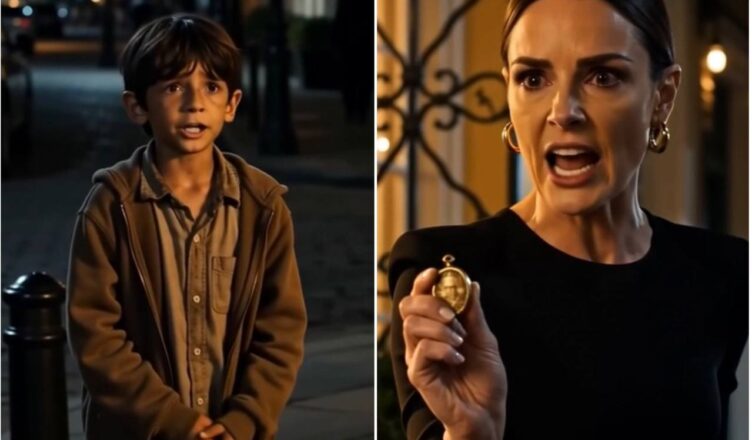
The Pendant on Royal Street
Amelia Bennett stepped out of La Rue just as the dinner rush hit its perfect rhythm.
Warm light spilled from the tall restaurant doors onto Royal Street. A valet in white gloves waited near the curb. Jazz drifted from inside, soft and expensive, mixing with the sound of glasses, laughter, and cars moving slowly through the French Quarter.
Amelia looked like she belonged there. Thirty-two, polished, dressed in a fitted black dress, gold hoops, sleek dark hair, expensive clutch in one hand. People greeted her by name when she entered places like La Rue. Doors opened. Tables appeared. Problems stayed hidden.
Then a boy ran past her.
He was eight or nine, thin, wearing a worn brown coat, faded shirt, old pants, and scuffed sneakers. He moved fast, like he had somewhere urgent to be. As he nearly brushed her shoulder, something slipped from inside his coat and hit the pavement with a small metallic click.
Advertisements
The boy kept running.
Amelia looked down.
An old gold oval pendant lay near her heel.
She bent, picked it up, and froze.
The edges were worn. The hinge was slightly bent. The gold was scratched from years of use, but she knew it instantly.
Her hand tightened around it.
She turned sharply toward the direction the boy had run, holding the pendant up with tense fingers.
“Hey—wait! Where did you steal that from?”
The boy had stopped several steps away. He turned back, wary but not guilty. He looked tired, guarded, and scared of losing the pendant more than of her.
“It belongs to my mom,” he said. “I really need to sell it.”
Amelia’s anger sharpened because the answer made no sense. The pendant in her hand had belonged to her sister. Her younger sister, Rosie, who had vanished eleven years ago and had been treated like a wound no one in the Bennett family knew how to close.
Amelia gripped the pendant tighter.
“That’s impossible. What’s your mother’s name?”
The boy swallowed.
“Rosie.”
The name hit her so hard her breathing broke.
For one second, she was fourteen again, standing in their old bathroom while Rosie shouted at her for trying to borrow the pendant without asking. The hinge had bent that night when it slipped into the sink. Their mother had laughed from the doorway and said they would either become best friends or kill each other before college.
Amelia opened the locket with shaking fingers.
Inside was a faded photo.
Rosie at seventeen, smiling with windblown hair. Their mother beside her. Amelia on the other side, pretending not to smile.
Her eyes filled instantly.
“Oh my God…”
She covered her face with both hands, still clutching the pendant, and started to cry right there under the golden restaurant lights.
The boy did not run this time.
He stood a few yards away, frightened by her reaction.
Amelia lowered her hands and forced herself to breathe.
“What’s your name?” she asked.
“Evan.”
“How old are you?”
“Nine.”
“And Rosie is your mother?”
He nodded.
Amelia looked at him more carefully. Beyond the worn clothes and guarded eyes, there was something familiar in his face. Not proof. Not enough for certainty. But enough to make her stomach turn.
“Where is she?”
Evan hesitated.
Amelia softened her voice. “I’m not going to hurt her.”
He looked at the pendant in her hand.
“She said if anyone knew that necklace, I should ask their name.”
“Amelia Bennett.”
Evan went still.
“She said Bennett means family.”
Amelia almost broke again.
“Take me to her,” she said.
He stepped back slightly. “What if you call the police?”
“I won’t.”
“What if you take it and leave?”
“I’m not leaving.”
He studied her for a long moment, then nodded.
They walked away from La Rue, leaving the restaurant lights, the valet, the jazz, and the expensive diners behind. Within a few blocks, the French Quarter changed. The sidewalks cracked. The lights thinned. The air smelled less like butter and wine and more like damp brick, trash bins, and old rain.
Evan walked fast. Amelia followed in heels for two blocks before taking them off and carrying them in one hand.
“How sick is she?” Amelia asked.
Evan did not look back. “Some days she can’t get up.”
“What kind of medicine does she need?”
“The clinic gave her pills. But they cost too much.”
Amelia’s throat tightened.
“Has she been to a hospital?”
He shook his head. “She says hospitals ask too many questions.”
Of course she did, Amelia thought.
Rosie had always been proud. Even as a girl, she would rather bleed quietly than admit she needed help.
They turned onto a narrow side street lined with small old houses. Evan stopped at a shotgun house with peeling paint, one boarded window, and a warped screen door.
“This is it.”
Inside, the room was dim and hot. A box fan clicked in the corner. There was a folding table, two chairs, a hot plate, three prescription bottles near the sink, and a mattress against the far wall.
A woman lay under a thin blanket.
At first Amelia saw only how sick she was. Too thin. Too pale. Hair cut short and uneven. Breathing shallow.
Then the woman turned her head.
Amelia nearly dropped the shoes.
Rosie.
Older, worn down, but alive.
The same eyes. The same mouth. The same small frown she made when she was trying not to cry.
Rosie stared at her.
“Millie?”
Nobody had called Amelia that in years.
Amelia crossed the room and dropped to her knees beside the mattress.
“Rosie.”
Rosie’s eyes moved to Evan. “You found her.”
“He dropped the pendant,” Amelia said, half crying, half laughing. “Outside La Rue. He ran past me and dropped it.”
Rosie closed her eyes. “Of course he did.”
“Don’t do that,” Amelia said. “Don’t smile like this is funny.”
Rosie opened her eyes again. “You’re still dramatic.”
Amelia pressed a hand over her mouth, fighting another sob.
Evan stood near the door, watching them like he wasn’t sure whether he had done something good or terrible.
Amelia held up the pendant. “You kept it.”
Rosie’s gaze softened. “Mama gave it to me.”
“I know.”
“I almost pawned it a dozen times.” Rosie looked toward Evan. “Couldn’t. Not until now.”
Amelia looked around the room again—the medicine bottles, the empty bread bag, the thin blanket.
“Why didn’t you call me?”
Rosie’s face changed.
“That’s a long answer.”
“I’ve got time.”
Rosie coughed into a cloth and turned slightly away. When she lowered it, she folded it quickly in her palm.
Amelia saw enough.
“What did the clinic say?”
Rosie didn’t answer.
“Rosie.”
“Cancer,” she said quietly.
The word settled into the room.
Evan looked at the floor. He had heard it before. Amelia could tell.
“How long have you known?” Amelia asked.
“A few months.”
“And you sent your son to sell a pendant instead of calling me?”
Rosie’s eyes flashed with some of the old fire. “What was I supposed to say? Hi, Amelia. Sorry I disappeared for eleven years. I’m sick, broke, and I have a child you never knew existed?”
“Yes,” Amelia said. “You were supposed to say exactly that.”
Rosie looked away.
Amelia’s anger faded almost as quickly as it came. There would be time for that later. Right now, Rosie needed help.
She stood and pulled out her phone.
Rosie watched her. “What are you doing?”
“Getting you out of here.”
“Amelia, don’t—”
“No.”
Rosie tried to push herself up, but she was too weak.
Amelia was already calling her driver. Then a concierge doctor. Then the private oncology center her family had donated to for years. She gave the address, Rosie’s symptoms, the medication names, and enough information to make people move quickly.
Within ten minutes, a car was on the way.
Within twenty, medical transport had been arranged.
Evan packed their things in a torn backpack: two shirts, a school notebook, the prescription bottles, a toothbrush, and a small plastic dinosaur with one missing leg.
That was all.
Amelia watched him tuck the notebook carefully under his arm.
“Is that for school?”
He shrugged. “When I can go.”
She said nothing, but something hard settled inside her.
Rosie lay back on the mattress, exhausted from listening.
“You don’t have to fix everything tonight,” she whispered.
“I’m not fixing everything,” Amelia said. “I’m getting you to a hospital.”
“Same thing, to you.”
Amelia looked at her. “Not tonight.”
The transport arrived soon after. Rosie tried to protest once more, then stopped when Evan took her hand.
“Mom,” he said, “please.”
That ended it.
By midnight, Rosie was in a clean hospital bed with oxygen under her nose and real doctors moving around her. Evan sat in a chair beside the bed, eating a turkey sandwich from the cafeteria with both hands. He tried to eat slowly but couldn’t.
Amelia stood near the window, barefoot, black dress wrinkled, hair loose now from the walk and the panic.
The pendant lay open in her palm.
Rosie noticed. “You opened it.”
“Yes.”
“Still hate that photo?”
Amelia looked down at it. “My eyebrows were terrible.”
Rosie smiled weakly. “You were mean to me that day.”
“You stole my sweater.”
“It looked better on me.”
“It did not.”
For a moment, they were girls again.
Then Rosie closed her eyes, tired.
Evan looked between them. “You’re really sisters?”
Amelia sat beside him. “Yes.”
He thought about that, chewing.
“I figured.”
“How?”
“You both get mad the same way.”
Rosie laughed, then winced. Amelia almost laughed too, but the sight of Rosie’s pain stopped it.
Later, after tests and bloodwork, Evan fell asleep curled in the chair under a hospital blanket. Rosie was awake, staring at the ceiling.
Amelia sat beside the bed.
“Tell me why you left,” she said.
Rosie was quiet for a long time.
Then she told her.
She had been twenty, proud, and in love with a man their father hated. When the relationship turned bad, she was too ashamed to come home. Then she found out she was pregnant. By the time Evan was born, she had convinced herself she would return once her life looked less broken.
But one month became one year.
One year became eleven.
“I thought Dad would punish me through him,” Rosie said, looking at Evan. “I could survive him judging me. I couldn’t let him judge my son.”
Amelia did not argue.
Their father would have done exactly that.
“He’s dead now,” Amelia said softly.
Rosie turned her head.
“I know.”
“You knew?”
“I saw the obituary online.”
“And still you didn’t call.”
Rosie’s eyes filled. “By then I didn’t know how.”
Amelia leaned back in the chair.
It hurt. It all hurt. But for the first time, the story at least had a shape.
“You should have called me anyway,” Amelia said.
“I know.”
“I would have come.”
Rosie’s mouth trembled. “I know that now.”
Amelia reached over and adjusted the blanket around her sister’s shoulders, the way their mother used to do when one of them was sick.
Rosie watched her. “You still do that.”
“You still kick blankets off.”
Rosie smiled, and for a moment she looked almost like herself.
The next morning, Evan woke up confused by the clean room and the soft beeping machines. Amelia was sitting nearby with two cups of hot chocolate and a bag from the hospital bakery.
“Where’s my mom?” he asked.
“Asleep. Doctors were in late.”
He took the hot chocolate carefully.
After a moment, he asked, “Are you rich?”
Amelia stared at him, then laughed once. “Yes.”
He nodded, thinking.
“Are you nice?”
That question landed harder.
Amelia looked toward Rosie, then back at him.
“I’m trying to be.”
He accepted that.
By noon, a treatment plan had started. By evening, Amelia had arranged for Evan to stay at her house while Rosie remained in the hospital. Not forever. Not without Rosie’s say. Just for a bed, clean clothes, school help, and food that didn’t come from vending machines.
Before Amelia left with him that night, Rosie caught her wrist.
“I was trying to protect him,” she said.
Amelia looked at her.
“I know.”
“I did it badly.”
“Yes,” Amelia said. “You did.”
Rosie nodded, accepting it.
Evan stood by the door with his backpack on, holding the pendant in both hands.
“I think she should keep it,” he said.
Amelia looked at Rosie.
Rosie’s eyes filled again.
Evan walked over and placed the pendant in his mother’s palm. Rosie closed her fingers around it.
Then Amelia held out her hand to him.
He looked at it for a second, then took it.
They left the hospital room together, stepping into the bright hallway, while Rosie rested against the pillows with the old gold pendant pressed to her chest.