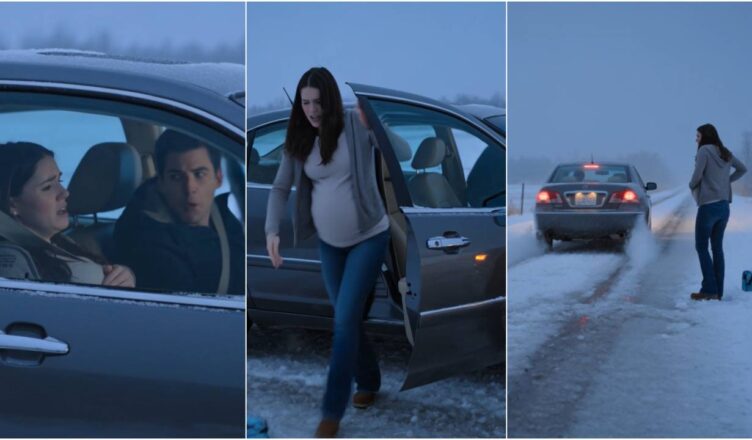
My water broke on the shoulder of the interstate outside Milwaukee, and my husband looked at me as if I had done it on purpose.
For one stunned second, I thought the contraction had scrambled my hearing. Snow hissed across the windshield. The car had just skidded onto the shoulder, and pain was pulling so tight through my back and belly that the whole world seemed to narrow around it. I had one hand on the dashboard, the other under the weight of my stomach, and all I could think was hospital, hospital, hospital.
Then Greg turned toward me with open irritation on his face.
“You knew how important today was,” he said.
Warm fluid soaked through my jeans, already cooling in the draft leaking through the doors. I could barely breathe. “Greg,” I managed. “Please. We have to go.”
He looked at me like I had ruined his evening.
Outside, the interstate was almost empty, a black ribbon of ice and slush running through open fields. We were supposed to be on our way to his mother’s birthday dinner. Sharon had already called twice to remind him dinner started at six sharp and that she would not forgive another “pregnancy scene.”
Sharon had never disliked me quietly. I was too plain, too quiet, too small-town for her son, whom she still introduced as “my brilliant engineer.” Greg spent our marriage trying to keep her pleased, and because she was impossible to please, someone else was always made to pay for it.
Usually, that someone was me.
The first hard pain had hit twenty minutes earlier. Greg told me it was Braxton Hicks and kept driving. When I asked him to turn toward the hospital, he said, “Do not do this tonight.”
Then the pressure inside me changed. A deep twist. A pop. Warmth spreading fast.
Now we were stranded in a Wisconsin storm, and my husband was acting as though labor were an insult.
“This is your baby too,” I said. “I can’t control this.”
He laughed once, shoved open his door, and got out.
Panic hit me so hard I went light-headed. “Greg? What are you doing?”
He yanked my hospital bag from the trunk—the one I had packed weeks earlier with tiny sleepers, toiletries, chargers, and the flannel baby blanket my mother had sewn—and threw it into the snowbank.
“Get out,” he said.
For a second I truly thought I must be hallucinating. That if I blinked hard enough, I would wake up beside the version of Greg who painted the nursery pale green and rubbed my swollen feet at night.
“Please,” I whispered.
He got back behind the wheel and stared straight ahead.
“My mom comes first,” he said. “She raised me. You’re just my wife.”
Then he drove away.
I stood there for one frozen heartbeat, watching his taillights smear red through the snow until they vanished. Then another contraction ripped through me, and the truth arrived with it: if I stayed on that shoulder much longer, my baby and I could die there.
That thought got me moving.
The wind hit me so hard when I opened the door that it stole half my breath. My boots sank into icy slush. By the time I reached my bag, snow had already started to bury it. I dragged it back toward the shoulder and raised my arm at passing headlights with a desperation that stripped me of pride.
My phone showed one weak bar, then none.
The world narrowed to pain, cold, and the hiss of tires on wet pavement.
I do not know how long I stood there. Long enough for my fingers to go numb. Long enough for fear to flatten into something practical. I stopped hoping Greg would come back. I started bargaining with my own body instead. Not here. Please not here.
Then, through the snow, I saw headlights slow.
An older sedan eased onto the shoulder ahead of me. The driver’s window rolled down, and a man with a gray beard leaned toward the opening.
“Ma’am,” he called. “Are you in labor?”
I tried to answer, but another contraction folded me in half. By the time I straightened, he was already out of the car and moving toward me with the steady urgency of someone who understood bad roads and emergencies too well to waste time.
He caught my elbow before I slipped. “Easy,” he said. “I’ve got you.”
Up close he looked to be in his late sixties, broad through the shoulders even with age on him, wearing a faded work jacket over a red flannel shirt. There was nothing performative in his face. Just focus.
“My name’s Nathan,” he said, guiding me toward the back seat. “You are not having that baby out here if I can help it.”
He got me inside, wrapped his coat around my shoulders, then went back for my hospital bag without being asked. When he slid behind the wheel again, the heater came on full blast, and I started crying—not because I thought we were safe yet, but because someone had finally chosen me.
Nathan drove the way experienced men do in bad weather: careful with the road, impatient only with time. He kept talking in a low, steady voice while the storm worked at the windows.
“Breathe through this one.”
“That’s it.”
“Stay with me.”
Near the city, my phone picked up signal again. Nathan took it, called the hospital himself, and told them a full-term woman in active labor was coming in from the interstate. By the time we pulled up to the emergency entrance, two nurses were already outside with a wheelchair.
After that, the night broke into bright pieces: automatic doors, antiseptic, wet clothes being cut away, monitors beeping, a nurse asking where my husband was.
“He left,” I said.
She paused only a second. “Do you want this gentleman listed as your support person?”
I looked past her and saw Nathan in the hall, snow still melting from his boots.
“Yes,” I said.
So he stayed.
They kept him mostly in the waiting area, but every time the doors opened, I saw him there: standing, sitting, pacing, too stubborn to go home. It was still dark when my son was finally born, furious and beautiful and loud enough to announce himself to the whole floor.
When they laid him on my chest, something inside me that had been clenched for months loosened all at once.
“Max,” I whispered.
Later, when the room had gone quiet, Nathan appeared in the doorway as if he were not sure he was allowed to come farther.
“You can come in,” I told him.
The look on his face when he saw my son nearly undid me all over again.
“Thank you,” I said. “If you hadn’t stopped—”
He shook his head. “No woman should be left on a road like that.”
“Do you want to hold him?”
Nathan hesitated only long enough to make sure I meant it. When the nurse placed Max in his arms, he held him with the reverence of a man receiving something breakable and holy.
“He’s beautiful,” Nathan said softly.
On the morning I was discharged, reality arrived with paperwork. A social worker came in and asked whether I had a safe place to go. I tried to lie the first time. I could not make myself do it twice. She gave me numbers for legal aid, emergency housing, and domestic-abuse services, and told me none of what had happened on that highway was normal.
Nathan showed up before noon carrying a new car seat and my winter coat, warm from the dryer.
“The hospital said he can’t leave without one,” he said, as if buying it had been the most ordinary errand in the world.
When the social worker asked whether I knew him well enough to trust him, Nathan answered before I could drown in the humiliation of it.
“She doesn’t owe me trust,” he said. “I’ve got a spare room. That’s all I’m offering. If she wants me to drive her somewhere else, I will.”
The social worker looked at me. “Do you feel safe with him?”
I looked at Nathan holding the car seat instructions in one hand and my coat in the other, patient as winter itself, and realized safety had a shape. It was not dramatic. It simply made room.
“Yes,” I said.
Nathan lived in a small two-bedroom house on a quiet block west of the city. He gave me and Max the bedroom at the back, set a bassinet beside the bed, and never once acted as though I owed him anything but honesty.
I filed for divorce before Max was six weeks old. Greg did not fight it. He sent one ugly email through his lawyer claiming I had exaggerated “a marital disagreement” to punish him for being a dutiful son. Sharon left a voicemail saying I had embarrassed the family. I saved both for my attorney, then blocked the number.
Nathan never called what he had done a rescue. He acted as though the decent thing and the obvious thing were the same. He learned how to warm bottles at two in the morning. He walked Max through the house when colic made him scream. He showed me where the flashlight was during storms and how to jiggle the back door so it latched tight in winter. Piece by piece, the house stopped feeling borrowed.
So did my life.
I healed in the usual ways first. Stitches. Sleep. Food. Then in the harder ways. I stopped apologizing every time I needed help. I stopped flinching when a phone rang. I stopped mistaking volatility for love.
Nathan never pushed. He was a widower, I learned slowly, and loneliness had taught him the same patience pain had taught me. What grew between us was not sudden and it was not dramatic. It was soup left on the stove when I had a long day. It was a hand at my back in a grocery-store parking lot when my arms were full. It was a man checking the tires before the first snow because he wanted me and my son to get home safe.
By the time Max was nearly three, he ran to the door every evening yelling for Nathan before I could even get my key out.
That summer, Nathan asked me to take a walk after Max fell asleep. We went to the little park at the end of the block. Nathan stopped beside a bench and looked more nervous than I had ever seen him.
“Leah,” he said, “I know our story started in a terrible place.”
I laughed softly. “That’s one way to describe it.”
He smiled, then took a small velvet box from his pocket.
“I love you,” he said. “And I love Max. You brought life back into my house. I don’t want to call this anything smaller than what it is.”
He opened the box.
The ring was simple and beautiful and honest, which by then I knew was the rarest thing a person could be.
“Yes,” I said before he even finished asking. “Yes, Nathan.”
We married quietly that winter. Max wore a tiny gray suit and carried the rings in both fists like treasure. The following spring, Nathan adopted him.
I still keep the divorce decree in a file drawer. Not because I need the reminder. Because it marks a border I once crossed in blood and snow.
People sometimes tell the story of my life as if the miracle was Nathan stopping on the interstate that night.
But that was only the beginning.
What saved me was everything that came after: the waiting room chair he never left, the car seat, the spare room, the midnight bottles, the years of steadiness that asked for nothing and gave me back my sense of worth.
Anyone can rise to a dramatic moment.
Real love is what remains after the weather clears.