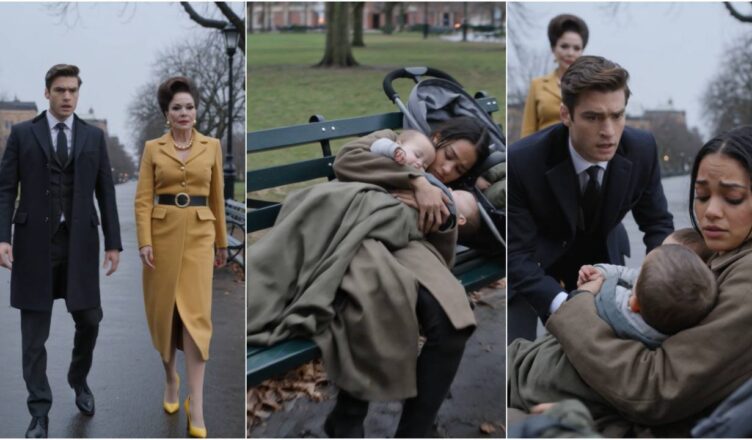
Caleb Smith did not do slow walks.
He did terminals and town cars, boardrooms and private dining rooms, calendars arranged down to the quarter hour. He lived inside systems that treated time like a weapon, and for years he had let his life run on momentum, precision, and whatever his mother called discipline.
But on the first Sunday of October, beneath a low Boston sky that made the whole city look washed in gray, he let Marianne Smith lead him through the Public Garden anyway.
Marianne walked as if weather itself were something to notice. She moved at a pace that made room for details—the wet shine on iron benches, the smell of damp leaves, the pond holding a dull strip of light beneath the clouds. Her gloved hand rested lightly on his sleeve now and then, the same way it always had: guiding, correcting, steering without seeming to.
Caleb listened with the relaxed half-attention he rarely allowed himself. He answered her in low, amused fragments. He was indulging her. He was almost enjoying it.
Then he stopped.
Ahead, beneath thinning branches, a woman sat curled into the corner of a park bench as if trying to make herself smaller than the cold. Her coat was too thin for October. A diaper bag sagged open at her feet. A stroller was jammed tight against the bench, its canopy half pulled down against the wind.
And there were three children.
One slept on her chest, face pressed against her throat beneath the loose edge of a blanket. One was wedged against her side, small body tucked under her arm. The third slept in the stroller, one socked foot pushed sideways against the fabric as if even in sleep there was no room to rest properly.
Caleb stopped so suddenly Marianne nearly walked into him.
He knew that face.
Even hollowed out by exhaustion. Even with her hair tied back carelessly, even with shadows carved beneath her eyes, even with the strain of survival sitting hard in the corners of her mouth.
Jade Monroe.
Five years ago, he had let his mother call Jade a complication. A mistake. A woman who did not belong in the life being built for him. He had told himself walking away was maturity. Distance. Focus. In truth, it had been easier to obey the version of the future Marianne had designed than to fight for something messy and human and real.
He had not said Jade’s name aloud in years.
Now she was here, in his mother’s favorite park, with three children draped over her body like she was the only warmth left in the world.
Jade shifted in her sleep. The child on her chest rolled slightly, one small arm slipping free of the blanket.
A hospital band slid into view.
Soft plastic. White. Fresh.
Caleb’s eyes caught on the print because they had nowhere else to go.
HAZEL MONROE-SMITH.
Below it, faint but unmistakable, was a hospital date stamp.
Yesterday.
For one blank, impossible second, his mind refused to build meaning out of what his eyes had read.
Then it did.
Marianne’s hand flew to her mouth. “Caleb…”
Jade’s eyes snapped open.
She registered Marianne first, and her whole body went rigid. Then she saw Caleb, and something even sharper moved through her face—not surprise, not hope, not relief.
Protection.
She pulled the child on her chest higher at once, angled her body toward the stroller, and tucked her free arm around the child pressed at her side. She did it fast, on instinct, the way someone moved when they had learned that hesitation cost too much.
“What are you doing here?” she asked.
Her voice was rough with exhaustion. As if she had not had enough water, enough sleep, enough softness from life in a long time.
Marianne took one careful step forward. “Jade—”
“No.” Jade’s eyes cut to her, cold and immediate. “You don’t get to say my name like that.”
Caleb still could not make his lungs work properly. He stared at the wristband again, at the last name, at the date, at the child’s flushed cheek against Jade’s coat.
His mouth moved before his mind caught up.
“Are they…?”
His throat failed.
He swallowed and tried again.
“Are they mine?”
Jade let out one short laugh, thin and bitter and utterly without humor.
“Now you ask?”
The child in the stroller made a weak, restless sound. Jade turned at once, adjusted the blanket, rested her fingers lightly over a tiny stomach until the sound faded again. No sweet shushing. No dramatics. Just the practiced efficiency of someone who had done everything alone for too long.
Caleb looked from one child to the next.
Three.
Not different ages. Not cousins. Not a misunderstanding.
Three children who belonged together.
Jade saw the realization hit him and did not soften for it.
“They turn one next week,” she said. “All three.”
Triplets.
The word never needed to be spoken. It landed between them anyway, heavy enough to change the air.
Marianne looked as if something inside her had given way. “Oh my God.”
Jade ignored her.
Caleb’s voice came out raw. “Why are you out here?”
Jade’s jaw tightened. “Because my landlord changed the locks a week ago.”
The words were flat. Not dramatic. Not arranged for pity. She said them like facts she had repeated too many times to people who could do nothing with them.
Caleb looked again at the stroller, at the thin coat, at the damp leaves stuck to the wheel.
“A week?” he said quietly.
Jade nodded once. “A week.”
Marianne’s face went pale. “With the children?”
“With my children,” Jade said.
Marianne flinched.
Caleb felt something cold slide under his ribs. Crisis was the one language he spoke fluently. His mind began arranging solutions at once—heat, food, doctor, shelter, car, room, supplies.
“Okay,” he said, already pulling his phone out. “We’re getting them inside. Right now. Hospital first.”
“No.” Jade pulled the child on her chest closer. “You do not get to arrive after a year of silence and decide what happens.”
“One week outside in this weather?” Caleb said. “They need to be checked.”
“They were checked,” Jade snapped. She nodded toward Hazel’s band. “Pediatric ER yesterday. Fever. She’s better.”
“Then again today,” Caleb said.
“Don’t do that,” Jade said.
“Do what?”
“Talk like you’re in charge.”
The child tucked under her arm stirred and whimpered. Jade shifted automatically, kissing soft hair without even seeming to realize she had done it.
Caleb lowered his voice. “I’m not trying to control anything. I’m trying to keep them safe.”
Jade stared at him. Then at Marianne. Then down at the three small bodies depending on her.
She was calculating, Caleb realized. Not whether she hated him. That part was already settled. She was calculating risk. Pride against necessity. Anger against temperature, fever, and three children who needed more than stubbornness to get through the day.
Finally, she looked at him again.
“One night,” she said. “You help because they need it. Not because you get to pretend this erases anything.”
“One night,” Caleb said immediately.
Her gaze slid to Marianne. “And she doesn’t decide a single thing.”
Marianne lowered her eyes. “She won’t.”
Caleb’s car looked obscene parked against the wet, muted park path, all black gloss and polished metal. He hated it the moment he saw Jade notice it. Hated what it represented. A whole life built at a distance from consequences.
He carried the stroller himself.
He had negotiated mergers worth more than some countries’ annual budgets, but he had never moved more carefully than he did while easing a sleeping one-year-old down the path over uneven stones. Jade climbed into the back seat with two children against her chest and did not stop watching him once.
At the hospital, fluorescent light made everyone look more tired than they were.
A pediatric nurse checked temperatures, listened to breathing, weighed each child, noted the hollowness in Jade’s face, the sharp alertness in her eyes, the way she tracked every adult hand that reached too close.
The children were not critical. That was the first mercy.
They were, however, underweight.
The pediatrician said it gently but plainly after reading the chart. “Their fevers are down, and their lungs sound clear. But they’ve lost weight. They’re also exhausted.”
Jade nodded as if none of it surprised her.
The doctor’s voice softened. “You’ve kept them safe under bad conditions. That matters.”
Jade looked down at Miles in her lap and did not answer.
A hospital social worker came in a little later, clipboard tucked to her chest, eyes tired in the specific way of someone who had spent years looking at family crisis without the luxury of sentimentality. She asked practical questions. Where had Jade been sleeping. Whether she had family. Whether she felt safe with Caleb present. Whether Caleb understood that help did not mean control.
Caleb answered only when spoken to.
When the question of where Jade and the children would sleep that night came up, he said, “A family suite near the hospital. Separate sleeping space. Cribs. Food. Whatever they need. In her name, not mine, if that makes this easier.”
The social worker looked at Jade. “Is that acceptable for tonight?”
Jade hesitated.
Then she nodded once. “For tonight.”
The social worker wrote it down. “I’ll document it as an emergency arrangement and schedule follow-up services tomorrow morning.”
Caleb felt the smallest loosening in his chest. Not relief. Nothing close. Just structure. A shape around immediate danger.
The suite was quiet, warm, and far too expensive. Caleb knew that. He also knew money could still do one useful thing when used correctly: remove immediate suffering.
He stayed back while staff carried in portable cribs, fresh diapers, wipes, clean blankets, age-appropriate food pouches, toddler cups, and medication from the hospital pharmacy. Jade checked everything with the wariness of someone who had learned that even help could hide conditions.
When Caleb reached instinctively toward June—just a reflex, just a hand moving before he thought—Jade recoiled so hard June startled and began to cry.
Caleb froze.
He stepped back at once and lifted his hands. “Okay. I’m sorry. I won’t touch them unless you say so.”
Jade held June tighter until the crying eased. Her jaw trembled once and steadied.
“Good,” she said.
Hours later, after baths, medication, and the slow battle of getting three over-tired one-year-olds to sleep in an unfamiliar room, the suite finally grew quiet.
Hazel slept in one crib, one arm slung above her head. Miles slept with his face turned into the mattress. June had refused the crib entirely and was asleep in the stroller after Jade had spent twenty minutes rocking it gently with her foot.
Marianne sat in a chair by the window with her coat still on, as if she did not deserve the comfort of settling in.
Jade sat on the edge of the bed, elbows on her knees, staring at nothing.
“I haven’t slept in a real bed since he locked us out,” she said at last. “A week. Church basement twice. One waiting room. Two nights on a friend’s couch until her landlord complained. The rest… wherever I could keep them warm.”
Her voice was quiet now. Not less sharp. Just tired enough that each word seemed to cost effort.
Caleb stood by the table, one hand flat against the wood to keep it from shaking.
“Why didn’t you tell me?” he asked.
Jade looked up.
For the first time since the park, there was something like disbelief in her face. Not because she thought he was lying. Because she could not believe he still did not understand the scale of what had been done.
“I did,” she said.
Caleb frowned. “Jade—”
“I told you when I found out I was pregnant.”
He went still.
“I called.” Her voice remained level by force. “I texted. I emailed. I came to your office. I waited in the lobby until security told me I wasn’t allowed upstairs.”
Caleb’s mind flashed to the marble lobby in Manhattan. The discreet desk. The security staff who knew exactly whose instructions mattered.
“I left letters,” Jade said. “I left messages with your assistant. I came back after the anatomy scan when the doctor told me it was triplets. I was twenty-two weeks pregnant and sick, and your mother met me downstairs herself.”
Silence filled the room.
Caleb turned slowly toward Marianne.
His mother was staring at her hands.
Jade laughed once, bitter and hollow. “You really didn’t know.”
Marianne closed her eyes.
“Know what?” Caleb asked. His voice had changed. Lower now. Controlled in a way that frightened even him.
No one answered.
He looked at Marianne. “Mother.”
She lifted her head, and for the first time in his life Caleb saw no poise in her face at all. Only age. Guilt. And the ruins of certainty.
“I knew she was trying to reach you,” Marianne said.
The words hung there.
Caleb did not move.
Jade looked away, as if the confession no longer had the power to shock her.
Marianne swallowed hard. “After the gala in New York, you told me you had seen her. You said it was nothing. That it had been one night and it was over. Then she started calling. Showing up. Saying she needed to speak to you.”
Jade’s eyes cut back to her. “I said I was pregnant.”
Marianne winced. “Yes.”
Caleb’s mouth went dry.
For years Marianne had managed his life in ways he had barely noticed. She had keys to old apartments, direct lines to assistants, opinions treated like policy by everyone around him. He had called it family. He had called it efficiency. He had let her sit inside the machinery of his life so completely that her hands had become invisible.
Now he saw what those hands had done.
“I told your assistant to block her messages,” Marianne said, voice shaking. “I told security not to let her through. When your number changed during the merger, I made sure she never got the new one. I told myself she was trying to trap you. That she would ruin everything you had built. I thought if I kept enough distance between you, it would all go away.”
Jade’s face was white with contained fury. “You told me if I came back again, you’d have me removed.”
Marianne nodded. Tears slipped down her cheeks, but Jade did not soften for them.
“I told you,” Jade said, each word precise, “that those children were his.”
“I know,” Marianne whispered.
Caleb sat down because his knees no longer felt reliable.
He stared at his mother as if looking at a stranger who had been wearing her face for years.
“You knew,” he said.
Marianne covered her mouth with trembling fingers. “Yes.”
“And you decided,” he said, “that I shouldn’t know I had children.”
“I thought I was protecting your life.”
“No,” Jade said sharply. “You were protecting your control.”
The room fell silent again.
Caleb felt nausea move through him, hot and rising. He thought of every month he had spent believing his life was his own. Every time he had let his mother handle something personal because it was easier. Every time he had chosen convenience over confrontation and called it maturity.
He looked at Jade. “I should have known.”
Jade’s expression did not change. “She did the worst of it,” she said. “You let her have that much power.”
There was nothing to say to that except the truth.
“Yes,” Caleb said.
The next morning, after the social worker returned and services were set in motion, Caleb did the first truly adult thing he had done in years.
He took his mother’s access out of his life.
He revoked her permissions with his staff, his office, his family accounts, his calendars, every quiet channel through which she had been able to make decisions in his name. He told his assistant, in a voice so calm it frightened the man more than shouting would have, that any future interference with personal messages would end his employment. Then he terminated him anyway.
Jade watched all of it with the hard, skeptical expression of someone who had seen promises dressed up as action before.
So Caleb stopped promising.
He acted.
At the social worker’s recommendation, he arranged immediate paternity testing. The results came back fast. No one was surprised by them. Law had simply caught up to truth.
He did not move Jade into one of his properties. He did not ask her to live under his roof. He did not offer rescue wrapped in ownership.
Instead, through Jade’s attorney and with every term reviewed by someone whose job was to distrust him, he secured a furnished apartment close to the pediatric clinic in Jade’s name. He backdated child support to the children’s birth. He created a medical fund that Jade controlled jointly with an independent trustee. He signed every paper she asked for without argument and removed every hidden lever that could have let him turn generosity into power.
Still, none of that earned trust.
Trust came harder.
It came at 2:13 in the morning when Hazel would not stop crying and Jade, half-dead from exhaustion, shoved a sleep sack at him and said, “Figure it out.”
It came when he learned that Miles hated bananas but loved pears, that June rubbed two fingers against her blanket when she was about to fall asleep, that Hazel needed silence when she had a fever and would fight comfort if a stranger tried to offer it.
It came when he showed up without a camera crew of assistants, without flowers, without speeches, without the polished guilt of a man trying to buy forgiveness wholesale.
Jade set the rules.
No disappearing.
No legal ambush.
No sudden claim that biology meant ownership.
No involving Marianne unless Jade said so.
Caleb agreed to all of it.
Then he lived inside those rules until they stopped feeling like punishment and started feeling like the first honest structure he had ever had.
Marianne, for her part, was not welcomed back into anything easily.
Her apology came once, in Jade’s kitchen, with no theatrics and no expectation of absolution.
“I stole a year from those children,” she said, standing with her hands clasped so tightly her knuckles had gone white. “And I stole a year from you. I thought I knew what kind of life my son should have. I never asked what kind of man that would make him. What I did was cruel.”
Jade stood across from her in silence.
Finally, she said, “Cruel is right.”
Marianne nodded, tears gathering again. “I know.”
“Sorry doesn’t fix a winter night outside with triplets.”
“I know.”
“Sorry doesn’t fix me being pregnant alone.”
“I know.”
Jade looked at her for a long moment.
Then, very quietly, she said, “You don’t get to act like their grandmother because you feel guilty. If you ever have a place around them, it will be because you earn it. Very slowly. And only if I say so.”
Marianne bowed her head. “That’s fair.”
It was more mercy than she deserved, and everyone in the room knew it.
By December, Caleb could buckle three car seats without sweating through his shirt. By January, he could get all three children fed breakfast without turning the kitchen into a disaster zone. By February, he knew the pediatrician’s extension by memory, could identify a teething cry from a fever cry, and had learned that love looked less like revelation than repetition.
Show up.
Wipe the face.
Wash the bottle.
Hold the child.
Come back tomorrow.
One night, when the children had finally gone down after a brutal stretch of colds and sleeplessness, Jade sat at the kitchen table staring at the steam rising from a mug she had forgotten to drink.
“I never wanted someone to save me,” she said.
Caleb looked up from the pile of folded laundry in his hands.
Jade’s eyes stayed on the cup. “I wanted someone to stay.”
The old Caleb would have reached for a perfect answer. Something smooth. Something memorable.
This version of him had learned better.
So he only said, “I know.”
And the next morning he was there again.
A year after the day in the Public Garden, they went back on purpose.
The sky was the same washed gray. The leaves were the same dark gold and rust underfoot. The same pond held the same dull ribbon of light. The bench was still there beneath the thinning branches, only now it looked like an ordinary bench instead of the place where several lives had finally collided with the truth.
The triplets were almost two.
They moved in bright knit hats and small boots, wobbling with the fierce seriousness of children who believed puddles were important work. Hazel ran first, then stopped to point at a pigeon as if she had discovered a miracle. Miles tried to follow and nearly fell over his own feet. June, more cautious, clung to Jade’s hand until Caleb crouched and held out both palms.
She considered him solemnly for a moment.
Then she toddled into his arms.
He lifted her, laughing under his breath, and pressed his face into the side of her head as if even now some part of him still could not believe he was allowed to hold what he had nearly lost without ever knowing it existed.
A moment later Hazel came barreling back toward him, cheeks pink with cold.
“Dada!”
The word hit him with physical force.
A year ago, the sight of his own last name on a hospital band had stopped his breath in terror. This was different. This was awe. Gratitude. Grief for lost time and wonder for what had somehow been rebuilt despite it.
He knelt and caught Hazel against his chest, his eyes burning.
Across the path, Jade watched him.
The anger that had once lived hard and sharp in her face was no longer the first thing visible there. It had not vanished. Some injuries did not vanish. But it had been joined by something steadier. Something earned.
He looked at her over Hazel’s shoulder.
“You kept your word,” she said.
Caleb held her gaze.
“I’m still keeping it,” he said.
A few steps away, Marianne stood back, exactly where she had been asked to stand: not in the center, not entitled to the picture, allowed only the distance that had been given to her. She watched quietly as June tugged at Caleb’s coat, as Miles demanded to be picked up too, as Jade finally laughed at something small and ordinary and human.
It was not redemption. Not fully. Some things did not resolve that cleanly.
It was harder than that.
It was accountability.
It was law where law had been needed, boundaries where boundaries had failed, daily presence where absence had once passed for power. It was a man who had let himself be shaped too long by control finally learning that love was not a performance, not a correction, not a rescue.
It was staying.
And when the wind turned colder and all three children reached for him at once, Caleb gathered them carefully into his arms and stayed exactly where he was.