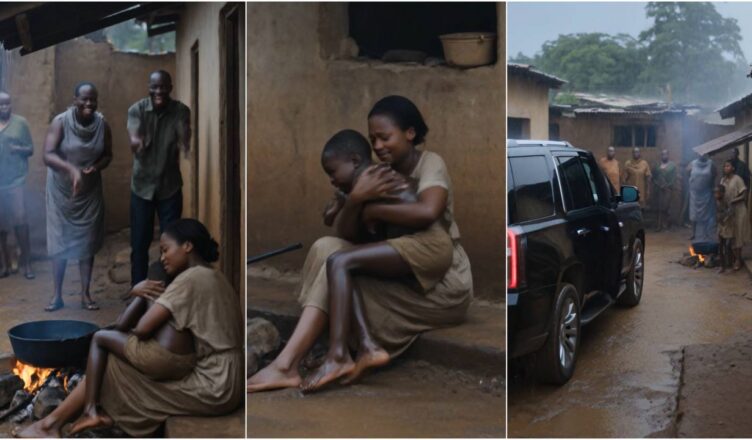
The Day the Engines Came
By late afternoon, the northern sun had turned the yard behind Amina’s house into heat, dust, and red powder. She was crouched beside the cooking stones, breaking dry sticks for the evening fire, when her son spoke from the doorway.
“Mom?”
She looked up at once. Something in his voice was wrong.
Kofi was ten, thin as a reed, serious in a way children should never have to be. He stood barefoot in the doorway, one hand on the frame, watching her.
“Yes?”
He swallowed. “Why don’t I have a father like the other boys?”
The branch in her hand snapped.
For a second, the whole yard went silent except for the wind dragging dust across the ground. She had known this question would come. She had not known it would feel like being cut open.
“Come help me with the wood,” she said.
He did not move.
“They laughed at me again,” he said. “Kojo said even a goat knows where it comes from.”
Amina stood slowly. “Come here.”
“You are not nobody,” she said, taking his face in both hands.
He searched her eyes. “Then whose am I?”
The question hit harder than the first one.
“You are mine,” she said.
He lowered his gaze. “That’s not what they mean.”
For ten years, that answer had lived in her chest like a stone.
When Amina got pregnant, she was nineteen and still young enough to believe love made people brave. Kwame had come north from Accra to visit relatives in the district. He wasn’t like the loud young men who liked to impress girls and disappear. He listened. He remembered small things. He spoke as if her thoughts mattered.
When she told him about the baby, she expected fear.
Instead, he took both her hands and smiled like she had handed him a future.
“I’m going to Accra tomorrow,” he said. “I’ll speak to my father properly, then I’ll come back. We’ll do this in the open. No hiding.”
Amina stared at him. “You promise?”
His smile faded into something more serious. “On my life,” he said. “I promise.”
The next morning, he left.
By evening, there was no call. By the following day, still nothing. She borrowed a phone at the roadside kiosk and tried the number he had given her until the battery died in her hand. After a week, the number stopped connecting. His relatives said they knew nothing. By the time her belly began to show, the village had finished the story for him.
At the borehole, women whispered with the kind of softness meant to cut.
“City men always leave.”
“She thought he would marry her?”
Men smiled too long when she passed. Children repeated things they didn’t understand. One night somebody threw rotten peels against her wall. In the morning, flies covered them.
Amina worked anyway.
She hauled sacks in the market. She weeded fields. She scrubbed pans behind a roadside chop bar until the skin on her knuckles split. Fear didn’t cook food, and shame didn’t keep a child alive.
When Kofi was born, the old midwife wrapped him, set him against Amina’s chest, and muttered, “A boy without a father’s name will have a hard life.”
Amina looked down at her son’s furious little face and answered before she could stop herself.
“Then I’ll make sure he survives it.”
She did more than that. She loved him hard.
Kofi grew into a quiet, gentle boy, quick with numbers, quicker with mercy. That softness should have made people kinder to him. Instead, it made the village crueler.
On festival days, fathers came home with pressed shirts, bags of rice, radios, and city stories. Boys ran to them shouting. Kofi stood beside Amina pretending not to watch.
Once, when he was seven, he asked while she stirred stew, “Was my father ugly?”
Amina turned too quickly. “Why would you ask that?”
He shrugged. “If he wasn’t ugly, maybe he forgot me because he had too many other children.”
She laughed before she could help it, and then hated herself for laughing.
“No,” she said. “He wasn’t ugly.”
“Tall?”
“Yes.”
“Did he talk too much?”
“Sometimes.”
Then came the real question.
“Did you love him?”
She looked at the thin steam rising from the pot.
“Yes,” she said. “And for a long time, I hated him too.”
Kofi frowned. “Can both happen?”
“Yes,” she said quietly. “Sometimes they happen together.”
That was the truth she lived with until the morning the engines came.
The rainy season was beginning. Amina was patching Kofi’s school shirt when a deep mechanical sound rolled through the lane.
Not a motorbike. Not a shared taxi.
Something bigger.
By the time she stepped into the yard, half the village was already staring down the road.
Two black SUVs crawled through the dust and stopped directly at her gate.
A cold feeling moved through her body.
Vehicles like that did not come to places like theirs unless they carried trouble, power, or both.
A driver got out first. Then a man in a dark suit opened the rear door.
The man who stepped down was in his sixties, neatly dressed, silver at the temples. He looked at Amina as if he had been searching for her in every room of his life.
“Amina?” he said.
Kofi had already come to stand beside her.
“Yes,” she answered.
The older man’s gaze shifted to the boy. It stayed there.
In front of the whole village, his polished shoes sinking into red mud, he dropped to his knees.
A murmur swept through the crowd.
“My name is Mensah,” he said, voice shaking. “Kwame Mensah was my son.”
The world narrowed.
Kofi’s fingers locked around hers.
Mr. Mensah looked at the boy again, and tears filled his eyes.
“He has my son’s eyes,” he whispered.
Amina led him inside because she could not bear to hear another word in public.
Their house had two rooms, a cracked cement floor, one good chair, and a table worn smooth by years of use. Mr. Mensah sat like a man who knew he did not belong there.
He placed a brown file on the table and opened it carefully.
“The day after Kwame left you,” he said, “he came to my office in Accra. He was smiling. Talking too fast. He said, ‘Father, I have done things out of order, but I am going to fix them. I’m going back north. I’m going to be a husband, and I’m going to be a father.’”
Amina pressed a hand to her mouth.
“I told him to slow down. He refused. He said there was a woman already waiting too long for him.”
Kofi’s voice came small. “He said that?”
Mr. Mensah nodded. “He did.”
Then he pulled out the papers: a police report, a hospital entry, a photograph of a crushed car, and one folded sheet of paper softened by time.
“Near Kintampo,” he said, “a truck crossed into his lane in heavy rain. Kwame died before they reached the hospital.”
For years Amina had survived by turning absence into betrayal. Death had always been the one answer she could not afford to believe.
Kofi stared at the table. “So he didn’t leave us?”
Mr. Mensah leaned toward him. There was no power left in his face now, only grief.
“No,” he said gently. “He was trying to come back.”
Amina forced herself to speak. “Then why did it take ten years?”
Mr. Mensah did not look away.
“Because we failed you,” he said. “Kwame had written your first name, your district, your mother’s name, and a few details about your house. He thought that was enough because he thought he would arrive before any letter mattered.”
He pushed the folded page toward her.
“We searched. Records were missing. Names were misspelled. Villages changed. We followed wrong leads. Then grief became years.” His voice broke. “That is my shame.”
He tapped the hospital form.
“Last month, a retired nurse helping in a records office recognized your mother’s name from Kwame’s papers. That led us to the clinic. The clinic led us to the birth register. The birth register led us here.”
Kofi pointed at the letter. “Did he know about me for sure?”
Mr. Mensah’s face softened.
“That morning, it was all he talked about. He said, ‘I don’t know how to hold a baby yet, but I already know I’m going to love this child with everything I have.’”
A sound escaped Kofi—half laugh, half sob.
When they stepped back outside, the lane was full. Faces Amina had known all her life stared at her with shock and embarrassment.
One of the women from the borehole gave a weak smile. “Amina, you know how villages are. People talk—”
“No,” Amina said. Her voice was calm, and that made it hit harder. “People choose.”
The woman’s smile died.
Mr. Mensah rested a hand on Kofi’s shoulder.
“This boy is my grandson,” he said. “His name is Kofi Mensah. You will speak it with respect.”
No one answered.
A man near the back muttered, “These things are not always clear.”
Amina turned to him. Ten years of swallowed humiliation sharpened her words.
“You were clear enough when you laughed.”
The lane went silent.
Mr. Mensah faced her again. “Pack what matters,” he said softly. “Come with us to Accra. Both of you. My son meant to return for you honorably. Let me do now what he died trying to do.”
Amina looked at her house—the patched wall, the cooking stones, the doorway where Kofi had first stood on unsteady legs. It was the only life she had known as a mother. It was also the place where shame had been fed to them for ten years.
Kofi tugged at her hand. “Mom?”
She looked down.
“If we go,” he asked, “will they tell me everything about him?”
She looked at Mr. Mensah and saw not a rich man arriving to save them, but an old man arriving too late, carrying grief and guilt in both hands.
“Yes,” she said.
The drive to Accra felt unreal. Kofi watched the whole road through the window. After a long silence, he leaned forward.
“Was my father funny?”
Mr. Mensah smiled faintly. “He believed he was.”
“Did he sing?”
“Badly.”
“Did he know my name?”
The old man turned in his seat. “No,” he said. “But he had already chosen to love you before he ever heard it.”
That was the answer Kofi carried all the way to Accra.
When they arrived, the house was large, quiet, and warm with light. The front door opened before they reached it.
Kwame’s mother stood there in a simple dress, both hands shaking.
She looked at Kofi once and covered her mouth.
Then she dropped to her knees, pulled him into her arms, and began to weep with the raw grief of someone who had lost a son and found part of him again in the same breath.
That night, Kofi slept in a clean bed under a roof that did not leak. Mr. Mensah had given him one of Kwame’s old schoolbooks, and he fell asleep holding it to his chest.
Amina stood alone by the window of the room they had prepared for her and listened to the city breathing outside.
For ten years, she had forced herself to believe the hardest version of the story: that she had been fooled, discarded, left behind.
The truth was cruel too. But it was a cleaner kind of pain.
Kwame had not abandoned her.
He had loved her, turned back toward her, and died on the road before he could make good on his promise.
Amina touched the old photograph in her pocket, then let her hand fall.
Not abandoned, she thought.
Not forgotten.
Only lost.
And finally, found.