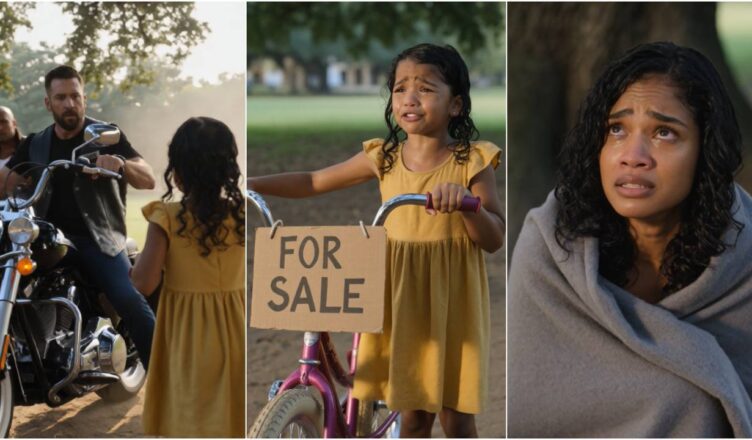
“Sir… please buy my bike! We need money for food!”
The sentence was so soft it should have been swallowed by the low growl of engines and the hiss of afternoon traffic.
But Cole Granger heard every word.
He and three other riders were rolling back into Savannah after a hospital fundraiser on Tybee Island—Cole in front, Bear Donnelly behind him, then Luis Ortega, then Roman Shaw. Four Harleys. Black denim vests. Summer heat rising off the pavement in shimmering waves. The kind of sight that made people look twice and decide things fast.
Most folks stepped aside when they saw them coming.
That afternoon, a little girl made all four men stop in the middle of the block.
Cole eased off the throttle near the edge of Forsyth Park and killed his engine. The others followed, one after another, until the street fell into that strange silence that comes after motorcycles go quiet—just cicadas in the live oaks, a bus braking somewhere nearby, and the nervous sound of a child trying not to cry.
She stood beside a small mint-green bike with white handlebars and worn silver streamers. The front basket had been repaired with zip ties. A piece of cardboard hung from it on fraying string.
FOR SALE — $25
Cole pulled off his helmet and crouched so he wasn’t towering over her.
Up close, she looked six. Maybe seven. Brown curls stuck damply to her temples. Her knees were dusty. She kept twisting the hem of her T-shirt in one fist like she needed something to hold on to.
“What’s your name?” he asked.
“Sadie.”
“Hi, Sadie.” His voice was gentle, the way men learn to speak when they know the world already finds them intimidating. “That your bike?”
She nodded. “Yes, sir.”
“You selling it for real?”
Another quick nod.
Cole glanced at the sign, then back at her face. “Why?”
She swallowed hard. Her eyes filled before she could stop them.
“Because my mom hasn’t eaten,” she said. “And she keeps saying she’s not hungry, but she is.”
Behind Cole, Bear shifted his weight. Luis looked away toward the park. Roman—who almost never showed much of anything—went perfectly still.
Cole followed the direction of Sadie’s glance.
Fifty feet away, under a wide live oak heavy with Spanish moss, a woman sat on a low brick wall with a backpack at her feet and two overstuffed trash bags beside her. She had a blanket around her shoulders even in the heat, which told him more than words would have. Not comfortable. Not resting. Drained.
“Is that your mom?” Cole asked.
Sadie nodded. “We’re waiting.”
“For what?”
“The shelter opens intake at six,” she said quietly. “They told us to come back then.”
That hit him harder than he expected.
He stood and walked over with careful, measured steps. The others spread out without needing instructions—Bear near the curb, Luis hanging back, Roman scanning the street the way some men never stopped doing once life taught them to keep watch.
“Ma’am,” Cole said, keeping a respectful distance. “You okay?”
The woman lifted her head. She was maybe thirty-two, maybe younger, but hunger and stress had a way of adding years where they didn’t belong. Her face was drawn, but there was pride in it too—in the way she straightened her back and tried to gather herself before answering.
“I’ve been better,” she said. Then, after a beat: “I’m Lena Rowan. I’m sorry if my daughter bothered you.”
“She didn’t bother me,” Cole said.
Sadie had followed him over, wheeling the bike beside her as if the sale still mattered. “It’s a good bike,” she said quickly. “The chain slips sometimes, but only a little.”
Lena closed her eyes for half a second. “Sweetheart…”
Cole looked at the bike, then at the child gripping it like she was offering up something sacred.
He reached into his wallet, pulled out several bills, and folded them into Sadie’s hand.
“Keep the bike,” he said.
She stared down at the money in disbelief. “That’s too much.”
“No,” Cole said softly. “It isn’t.”
Bear stepped forward and added cash of his own. Luis did too. Roman said nothing, just tucked a folded bill on top of the others and took a step back.
Lena’s face flushed with shame and gratitude all at once. “No, no—we can’t just take that.”
Cole lifted a hand, not to silence her, just to steady the moment. “You can. Right now, you should.”
Lena looked at each of them in turn, still trying to understand why four men who looked like trouble had stopped long enough to care.
“Why would you do this?” she asked.
Cole glanced at Sadie. “Because she shouldn’t have to do this.”
For a moment the only sound was the soft clink of Sadie’s bike pedal turning backward.
Then Cole nodded toward the bags at Lena’s feet. “What happened?”
Lena hesitated. Pride had probably kept her upright all day. But there comes a point when exhaustion is stronger.
“I worked in accounts payable for Calder Commercial Group,” she said. “Downtown. Seven years. Never had a write-up. Never missed payroll deadlines. Then I got sick—bronchitis that turned into pneumonia. I missed a few shifts, came back too early, tried to keep going, and by the end of the month they let me go.” She swallowed. “My last paycheck was short. Rent was already late. The sheriff posted the notice this morning.”
Sadie looked down at her sneakers. She already knew too much.
Cole kept his face calm, though something hot and bitter had started moving through him. “Who let you go?”
Lena already knew where that question was headed, and fear flashed across her eyes.
“Preston Calder,” she said. “But please don’t go over there starting something. I mean it. I can’t afford more trouble.”
“We’re not going to start something,” Cole said.
Bear glanced at him but didn’t argue. He knew that tone.
Cole crouched again in front of Sadie. “Listen to me. You are not selling this bike today. Not tomorrow either. That bike stays with you. Deal?”
Sadie nodded hard, tears slipping free now. “Okay.”
Cole rose and looked at Bear. “Stay here. Get them food. Figure out where they’re sleeping tonight if that shelter falls through.”
Bear was already pulling out his phone. “I know a motel owner on Abercorn,” he said. “Leave it to me.”
Cole turned back to Lena. “We’ll be back.”
Lena looked like she wanted to stop him again, but she also looked too tired to believe stopping him would do any good.
Three engines came back to life.
They did not leave like men riding toward a fight.
They left like men carrying a decision.
Calder Commercial Group occupied the top two floors of a restored brick building off Bay Street, the kind of place with exposed beams, polished concrete, a glass conference room, and expensive coffee in the lobby. The receptionist looked up once, saw the vests, and went tight around the mouth.
“Can I help you?” she asked.
Cole took the cardboard sign from inside his vest and set it neatly on the counter.
“We need five minutes with Preston Calder.”
“I’m sorry, do you have an appointment?”
“No,” Cole said. “But he’s going to want this one.”
A security guard started toward them from the elevator bank. Luis gave him a polite nod.
“We’re not here to make your day hard,” Luis said. “We just need the man upstairs to hear something.”
The receptionist hesitated, then made the call.
Ten minutes later they were escorted into Preston Calder’s office.
It was all river views and dark wood and carefully arranged success. Framed charity awards. Magazine features. A photograph of Preston shaking hands with the mayor. He stood behind a sleek desk in a pale blue dress shirt with the sleeves rolled once, like he wanted to look like a man who still worked for his money.
“Gentlemen,” he said smoothly. “What seems to be the problem?”
Cole walked to the desk and placed the cardboard sign in front of him.
FOR SALE — $25
Preston frowned. “What is this?”
“A little girl’s bike sign,” Cole said.
Preston looked up. “I can see that.”
Cole held his gaze. “Her name is Sadie Rowan. She’s six years old. She’s sitting near Forsyth Park trying to sell her bike because her mother hasn’t eaten since Friday.”
A flicker. Small, but there.
Preston leaned back slightly. “I’m not sure what you expect me to do with that information.”
“Her mother is Lena Rowan,” Cole said. “You fired her.”
The room changed.
Preston’s expression stayed polished, but now it was work.
“I don’t discuss former employees with strangers,” he said.
Roman finally spoke, voice quiet as gravel. “That’s convenient.”
Preston ignored him. “If this is some kind of attempt to intimidate me—”
“It isn’t,” Cole said. “If I wanted to intimidate you, you wouldn’t still be talking like that.”
Silence.
Luis stepped forward just enough to enter the line of sight. “A woman works seven years for your company, gets sick, gets cut loose, gets a short final check, loses her apartment, and now her kid is trying to buy dinner with a bicycle. At the very least, that’s a hell of a story.”
Preston’s jaw tightened. “We’re an at-will state. Hard decisions happen. That is unfortunate, but it is not illegal.”
“Maybe,” Luis said. “Maybe not. But it is ugly. And ugly travels.”
Cole tapped the cardboard sign once with two fingers.
“You spend a lot of money telling this city who you are,” he said. “The youth foundation dinners. The school supply drives. Your smiling face in every Chamber of Commerce photo op. So here’s the question: what happens when the story people tell about you is this instead?”
For the first time, Preston looked past them—to the glass wall, to the assistants outside pretending not to watch, to the office door that was not as private as he wished it was.
Cole kept his voice level.
“Nobody here is asking for miracles. You review Lena Rowan’s termination. You fix the paycheck issue. You issue severance. And you sign a recommendation letter she can actually use. Today.”
Preston let out a thin breath through his nose. “You people think the world works by emotion.”
Cole’s face didn’t change. “No. We think it works by pressure. Same as men like you do.”
That landed.
Another beat passed. Then Preston reached for his desk phone.
“Get Denise from HR,” he said, eyes still on Cole. “Now.”
No one smiled. No one thanked him.
Because everyone in the room knew this was not goodness. It was calculation. Still, calculation could keep a mother fed just as well as remorse if you used it right.
When they walked back out into the Savannah heat, Bear texted Cole.
Got them a room for four nights. Food handled. Kid still has the bike.
Cole stared at the message for a second longer than he meant to.
Eight years earlier, he had buried his daughter, Ellie, after a drunk driver blew through a red light outside Brunswick. Since then, he had learned how grief changed shape without ever really leaving. Some days it was a sharp thing. Some days just weight. Mostly, he kept moving fast enough that he didn’t have to stand still with it.
But a little girl trying to sell her bike so her mother could eat—there was no outriding that.
By dusk, help started to find Lena Rowan.
A legal aid volunteer called after hearing from a church contact Bear knew. The motel manager quietly waived the incidentals. Someone from a neighborhood pantry dropped off groceries and toiletries. Just before seven, Lena got an email from Calder Commercial Group: corrected payroll, two weeks’ severance, continuation paperwork for health coverage, and a signed recommendation letter.
It was not justice.
But it was air. It was time. Sometimes that mattered first.
The next afternoon, Cole and the others rode back to the motel.
Sadie saw them from the balcony and took off running before Lena could call her back.
“They came back!” she shouted.
She had cleaned the bike. Really cleaned it. The handlebars shone. The basket was still crooked, but the zip ties had been trimmed neatly and she had tied one fresh blue ribbon to the left side.
Cole smiled before he could stop himself. “Looks better than mine.”
Sadie grinned for the first time since he’d met her. It changed her whole face.
Lena stepped out of the room behind her with a paper cup of coffee in hand. She still looked worn down, but no longer like she might disappear if the wind picked up. There was color in her again. Something steadier in the eyes.
“I got the email,” she said. “And a call this morning. I have an interview Monday with a logistics company out near Pooler. One of Bear’s friends knew somebody.”
Bear gave a shrug, embarrassed by praise. “That part wasn’t hard.”
Lena looked at Cole. “I still don’t understand why you stopped.”
He could have given her something clean and easy. Instead he told her the truth.
“Because I had a little girl once,” he said. “And I know what it does to a person when you can’t fix the thing that matters most.”
The air went quiet around them.
Lena’s eyes softened. She didn’t ask what happened. She didn’t need to. Some grief arrived already explained.
Sadie rolled the bike in a small circle, then looked up at him.
“I’m glad you heard me,” she said.
Cole swallowed. “Yeah,” he said. “Me too.”
They stayed awhile after that. Long enough for Luis to make Sadie laugh by pretending he was too big to ride her bike. Long enough for Bear to leave two grocery gift cards on the dresser when he thought nobody was looking. Long enough for Roman, who almost never said much, to kneel by Sadie and fix the loose chain with a pocket tool he carried everywhere.
When the bikes finally pulled out of the motel lot, the sun was dropping low and gold across the parked cars.
Miles later, with Savannah behind him and the road opening into evening, Cole thought about Ellie.
Not the hospital room.
Not the phone call.
Not the worst parts.
Just Ellie at six years old, wobbling down a driveway on a bicycle that was slightly too big for her, laughing and yelling that she was doing it by herself.
For the first time in a long while, the memory did not feel like punishment.
It felt like a hand on his shoulder.
And somewhere back in the city, a little girl still had her bike.