Chicago wore Christmas lights the way wealthy cities always do in December—like enough sparkle might persuade people they were better than they were.
From the floor-to-ceiling windows of his penthouse in the Gold Coast, Daniel Mercer could see Michigan Avenue glittering below him in clean white lines. Cars moved in patient ribbons through the snow. The lake beyond the buildings was a sheet of black glass. Everything looked expensive, composed, almost harmless from this high up.
It used to calm him.
Lately, it had the opposite effect.
Across the kitchen island, his twelve-year-old daughter sat in sock feet, stirring cocoa with the concentration of a chemist. Ellie Mercer had grown up in a world of chauffeurs, private schools, and weekends planned three months in advance, but none of it had hardened her. She thanked building staff by name. She remembered birthdays. She noticed when someone looked tired. Daniel had worked very deliberately to raise her that way, because he knew what money did when people let it become a moral permission slip.
It didn’t make you better.
It made you more accountable.
That thought had been bothering him for weeks now, because he could no longer ignore what he had started seeing in Sloane Bennett.
Sloane was twenty-eight, stunning, camera-ready, and gifted in the exact way some people were gifted at mimicry. In public, she was effortless. Warm laugh. gentle voice. hand to the heart at precisely the right moment. At charity dinners, she could talk about compassion as if she had invented it. At fundraisers, she floated through rooms making older men feel younger and women feel studied.
But Daniel had begun to notice the version of her that appeared in the gaps.
The clipped tone with valets. The faint disgust when a waiter got something wrong. The way her smile disappeared the second a person had no social use to her. Nothing dramatic. Nothing she couldn’t explain away. Just a hundred tiny cuts that, taken together, had started to form a truth he didn’t want to name.
The problem was, naming it meant admitting he had let someone shallow get close to his daughter.
He leaned against the counter and watched Ellie take a sip of cocoa.
“Hey,” he said quietly.
She looked up. “That tone usually means I’m either in trouble or about to be asked something weird.”
Despite himself, he smiled. “Hopefully the second one.”
“Less terrible.”
He came around the island and sat across from her. For a second he said nothing, and that alone made her straighten a little.
“Ellie, I’m going to ask you something, and you can say no immediately. No guilt. No speech. Just no.”
Her brow furrowed. “Okay…”
Daniel folded his hands. “I need to know who Sloane is when she thinks nobody important is watching.”
Ellie didn’t answer right away. She was old enough not to rush into adult conversations, and young enough that her silence still had innocence in it.
“What happened?” she asked.
He told her, carefully. Not every detail. Just enough. The staff she talked down to. The strangers she dismissed. The ugly little flashes she never thought anyone important would see. Ellie listened the way she always did when she sensed that he was trying not to overstate something.
When he finished, she looked down into her mug. “So you think she’s pretending with you.”
“I think she’s selective,” Daniel said. “And I think I’ve been trying too hard to give her the benefit of the doubt.”
Ellie looked back up at him. “What are you asking me to do?”
He hated the next part even as he said it.
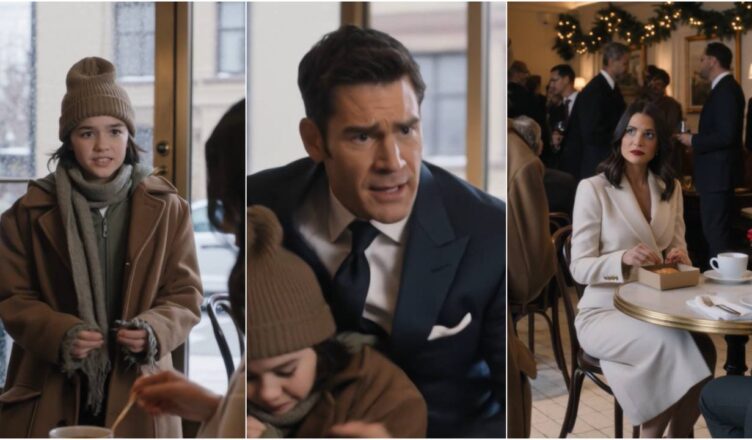
“Sloane goes to the Alder Room almost every Saturday afternoon. I want you to go in dressed down. Old coat, knit cap, no makeup, no obvious markers. I want you to ask for something to eat. Once. That’s it.”
Ellie stared at him.
“You want me to pretend I’m a kid nobody cares about.”
Daniel flinched, not because she was wrong, but because she had said it more honestly than he had been willing to.
“I want one clear answer before I let that woman get any closer to our life,” he said. “And if this feels wrong to you, we stop. Right now.”
Ellie sat back. The snow tapped softly against the glass behind him.
“Will you be there?”
“I’ll be right outside. Midday. Crowded room. Public place. If you feel uncomfortable for even one second, you walk out. I’m serious.”
She studied his face, as if weighing not just the plan but the fact that he was asking her at all.
Finally, she said, “I don’t like it.”
“I don’t either.”
“But I think I want to know.”
Daniel nodded once. “So do I.”
By one-thirty the next afternoon, Chicago had turned into the kind of gray winter postcard tourists loved and locals resented. Snow clung to parked cars in soft ridges. The sidewalks on Oak Street were slushy and crowded with people carrying shopping bags and coffee cups.
Ellie stood beside Daniel near the corner, zipped into an oversized brown coat they had found in storage. Her hair was tucked under a faded knit cap. A little makeup dulled the brightness in her skin and shadowed under her eyes. Nothing extreme. Just enough to make people glance past her instead of toward her.
She hated it instantly.
“I look sad,” she muttered.
Daniel adjusted the scarf at her neck. “You look like a kid people should treat gently.”
“That’s not what they’re going to see.”
He didn’t answer, because he knew she was right.
Across the street, the Alder Room glowed with amber light and window fog. Inside, Sloane sat at her usual corner table with two friends, framed by polished brass and evergreen garlands. She looked as if she had been placed there by a stylist: ivory coat draped over the chair, hair glossy, lipstick exact, one manicured hand wrapped around a cappuccino cup she barely touched. Even from outside, Daniel could see it—that subtle lift in posture Sloane got whenever she was in a room built for admiration.
Ellie blew into her gloves.
“Still time to call it off,” Daniel said.
She shook her head once, fast, before courage could leak out of her. “No. Let’s just do it.”
He swallowed. “Okay. I’ll be right there.”
Ellie crossed the street alone.
The Alder Room was warmer than outside in that overdesigned, expensive way that felt less like comfort and more like curation. Cinnamon, espresso, polished wood, cashmere damp from melted snow. Conversations floated low and self-satisfied. A couple near the front glanced at Ellie as she stepped in, then looked away with the speed of people who didn’t want to be implicated by eye contact.
At the counter, a barista noticed her, hesitated, and then got pulled into another order by a shift manager who had already recognized Sloane at the window table. Regulars with influence got handled first.
Ellie could hear her own heartbeat.
She walked toward Sloane’s table.
Sloane was mid-story, laughing at something that wasn’t funny. One of her friends had a phone half-lifted, ready to capture whatever moment might make them all look effortlessly alive.
Ellie stopped beside the table.
“Excuse me,” she said.
Sloane didn’t look up.
Ellie tried again, softer this time. “Excuse me… could you please help me? Could I have something to eat?”
The laughter at the table stopped.
Sloane lifted her eyes slowly, and the shift in her face was immediate. Not surprise. Not concern.
Annoyance.
“You can’t come up to people like this,” she said.
Ellie held her ground. “I’m sorry. I just— I haven’t eaten since yesterday.”
For a brief second, one of Sloane’s friends actually looked uncomfortable. Sloane didn’t.
Beside her coffee sat a paper box with two untouched pastries inside. She placed her fingertips on it, and Ellie felt a tiny surge of hope so sharp it hurt.
Then Sloane pushed the box off the edge of the table.
It hit the tile and burst open. A croissant and two danishes slid across the floor.
“There,” Sloane said. “Take it and go outside. You’re making everyone uncomfortable.”
The room didn’t fully go silent, but it changed. You could feel it. The air tightened. Heads turned and then angled away. No one wanted to be the first person to step into a scene like that. Public cruelty freezes people almost as effectively as danger.
Ellie’s face went hot.
She stared at the food on the floor for one terrible second, then crouched automatically, because humiliation has a way of making the body obey before the mind catches up.
At the same moment, the front door opened hard behind her.
Daniel Mercer crossed the room in six strides.
By the time Sloane looked up and saw him, he was already kneeling beside Ellie, taking the box from her shaking hands and setting it aside.
“Hey,” he said, his voice low and steady. “Look at me.”
Ellie did. Her eyes were glossy, but she nodded.
“You okay?”
She swallowed. “Yeah.”
Daniel rose with her, one hand at her shoulder. Ellie reached up with numb fingers, pulled off the knit cap, and let her hair fall loose from where it had been pinned underneath.
Recognition moved through the room in a visible wave.
Sloane’s whole face emptied.
“Daniel,” she said, too quickly. “Wait—what is this?”
He looked at her then, finally, and there was nothing theatrical in his expression. That was what made it worse.
“This,” he said, “is my daughter.”
One of Sloane’s friends exhaled something that sounded like a curse under her breath.
Sloane stood so abruptly her chair scraped back. “I didn’t know.”
“Exactly,” Daniel said.
Her eyes darted around the room, already calculating. “Okay, hold on. This is insane. I thought—”
“You thought she was a child with no power,” he said. “And that was enough.”
“That’s not fair.”
He let out a short, humorless breath. “You dropped food on the floor and told a kid to pick it up outside because she was ruining the mood.”
Sloane took a step toward him, lowering her voice as if intimacy could rescue her now. “Daniel, come on. Don’t do this here.”
His answer came without any effort at all.
“You did this here.”
That landed harder than if he had raised his voice.
Sloane’s composure started to split. “I thought it was a scam or something. People do that all the time in this city.”
Ellie looked at her, and the hurt in her face seemed to embarrass Sloane more than the room did.
“I asked for food,” Ellie said quietly.
Sloane opened her mouth, but nothing useful came out.
Daniel put a hand on Ellie’s back. “I’ve spent weeks explaining away who you are,” he said to Sloane. “That’s on me. But I’m done doing it.”
Her panic sharpened. “So that’s it? You set me up and now you get to act righteous?”
Daniel’s voice stayed calm. “No. I gave you one chance to be kind when there was nothing in it for you. You answered.”
“Daniel—”
“We’re done.”
The simplicity of it seemed to stun her more than any speech could have. Sloane glanced at the surrounding tables and, for the first time since he had met her, looked genuinely stripped of performance. Not sad. Not remorseful.
Exposed.
Daniel picked up Ellie’s scarf from the chair beside them and handed it to her. Then he turned and walked her out of the café without looking back.
The cold hit them cleanly outside.
For half a block, neither of them spoke. Snow crunched underfoot. Traffic hissed at the curb. Somewhere behind them a siren moved west.
Then Daniel said, “I’m sorry.”
Ellie glanced up. “For what part?”
He looked at the street ahead. “For asking you to do that. For needing proof when I should’ve trusted what I was already seeing.”
Ellie pulled her coat tighter around herself. “Would she have acted different if I looked like me?”
“Yes.”
“Then I’m glad I know.”
He nodded, though the answer sat heavy in him.
At the next corner, instead of turning toward home, Daniel kept walking east.
Ellie frowned. “Where are we going?”
“There’s somewhere I should’ve taken you a long time ago.”
Ten minutes later they stepped into St. Matthew’s Community Kitchen, tucked under a church annex on the Near North Side. The windows were fogged from heat. The entryway smelled like broth, bleach, wet wool, and fresh bread. Volunteers moved in practiced lines behind stainless-steel counters, filling trays, stacking cups, calling people by name.
Daniel had written checks to the place every winter for years.
He had almost never come in.
Mrs. Alvarez, the volunteer coordinator, looked up from a clipboard and gave him a measured smile that suggested she recognized both his face and the distance money sometimes liked to keep.
“Well,” she said, handing them two aprons, “looks like the donation finally grew hands.”
Daniel surprised himself by laughing. “Guess it did.”
Ellie tied her apron badly the first time and had to retie it. Within twenty minutes she was ladling tomato soup with fierce concentration, biting her lower lip every time she filled a bowl. She passed out bread, napkins, plastic spoons. She said hi. She said here you go. She said take two if you want. And slowly the tension left her shoulders, replaced by something steadier than adrenaline.
People weren’t scenery here. They were exhausted, funny, proud, embarrassed, chatty, quiet, grateful, suspicious, kind. One man complimented her careful pouring. An older woman in a purple knit hat called her “baby” and asked if she was staying warm enough. A teenage boy asked for extra crackers and winked like it was a business negotiation.
Near the end of the line, a woman with cracked red hands accepted a bowl from Ellie and held it close for warmth before she even took a sip.
“Thank you, sweetheart,” she said. “You have no idea how good this smells.”
Ellie smiled, but her throat tightened.
“No,” she said softly. “I think maybe I’m starting to.”
Daniel watched her from the coffee station and felt something painful and clarifying move through him. The day had begun with a test. It was ending with an education, and not just for Ellie.
For him too.
They stayed until the rush thinned and the floors were mopped. By the time they stepped back outside, evening had settled over the city. Chicago glowed again—streetlights, wreaths, headlights reflected in slush, high windows burning gold above dark stone.
This time the beauty didn’t irritate Daniel.
It just didn’t fool him.
Ellie walked beside him, her hands deep in her pockets. After a while she said, “Dad?”
“Yeah?”
“Next Saturday, can we come back without the costume?”
He looked over at her and smiled for real.
“Yeah,” he said. “Next Saturday without the costume.”
She nodded once, satisfied.
They kept walking through the cold, past decorated windows and bundled strangers and cabs throwing light across the snow. The city still looked polished from a distance. It still sold the same old illusion.
But now Daniel understood why the view from above had been bothering him.
Distance made everything look simple.
At street level, it never was.
At street level, people were hungry, proud, selfish, generous, frightened, decent, cruel, complicated, and worth seeing clearly.
Ellie slipped her hand into his, and he held on.
Neither of them looked back.