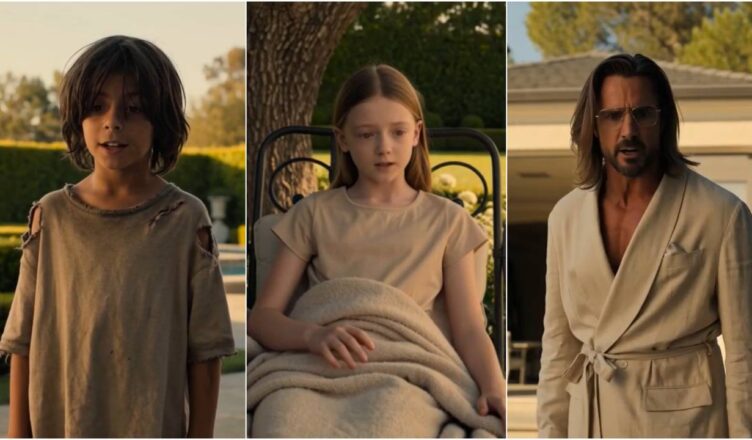
“I’m going to put a little mud on her eyes… and she’ll see again.”
For a second, I almost laughed.
Not because it was funny—because it was absurd. Because I’d spent the last six months living inside a world where every sentence came wrapped in credentials and caution, where specialists spoke in measured tones and never promised anything.
Those words didn’t come from a doctor.
They came from a barefoot kid standing at the edge of my perfectly landscaped backyard, dirt under his nails like he’d been born holding the earth.
I turned sharply, already feeling the familiar flare of anger that had become my default emotion.
“Who let him back here?” I snapped.
Rosa rushed in from the patio, face drained. “Mr. Cross, I’m so sorry—I brought Mateo with me. I didn’t think— I’ll take him inside. Right now.”
Mateo didn’t move. He just stood there, small and steady, looking past me toward the sycamore tree.
Under its branches sat my daughter.
Ellie Cross. Twelve years old. A blanket over her knees. Her hands folded in her lap like she’d been taught to take up as little space as possible. Sunlight warmed her face, but her eyes didn’t track it. They stared straight ahead—open, unseeing, like the world had shut the lights off and never turned them back on.
I stood behind her chair with my arms crossed because it gave my body something to do besides fall apart.
“There are no more treatment options,” the neurologist had said last week, voice gentle like he was apologizing for being human. “We can continue supportive therapy. But… this level of damage is permanent.”
Permanent. No recovery. Accept reality.
I’d heard those words from surgeons with hands worth millions, from rehab experts who wrote textbooks, from professors I funded. I owned private clinics. I financed research labs. I had access to every name that made other parents whisper, maybe he can get her in.
And still, my daughter couldn’t see.
And she couldn’t walk.
So I’d brought her home, where the air was softer, the light was warm, and the world couldn’t beep and buzz at her like a hospital machine.
And now some barefoot kid was talking about mud like it was salvation.
I looked down at Mateo’s feet—dusty soles, no shoes. Then at his hands. Then at my daughter’s face.
After everything I’d paid for, it felt like an insult.
“You have any idea how many doctors I’ve brought in?” I demanded. “How much I’ve spent trying to save her?”
Mateo nodded once, like Rosa had told him. “My mom told me,” he said simply.
Rosa flinched. “Mateo—”
He kept his eyes on me. “She says rich people trust money more than they trust hope.”
Something cold tightened in my chest. “Enough,” I said. “This isn’t a game.”
Ellie’s fingers moved—just slightly—toward the sound of his voice. When she spoke, it was a whisper so small it might’ve been swallowed by the wind.
“Dad… let him stay.”
I froze.
Ellie hadn’t asked for anything in weeks. Not really. She’d stopped. She’d learned the cost of hope the hard way.
“His voice makes me feel safe,” she added, softer. “Please.”
I stared at the back of her head. At the way she held herself—still trying to protect me from her disappointment. I felt my anger tilt into something else. Something uglier.
Desperation.
I exhaled like I was giving in to a weakness I hated needing. “Five minutes,” I said. “Not one more.”
Rosa’s shoulders sagged in relief and fear at the same time. “Thank you, sir,” she whispered.
Mateo walked closer, careful, like he was approaching an animal that might bolt. He didn’t touch Ellie. He didn’t reach for her. He just knelt near the flowerbed where the soil was dark and damp from last night’s watering.
“It’s not magic,” he said quietly, almost like he was warning me. “My grandma did this.”
I let out a humorless breath. “Your grandma was a doctor?”
“No,” Mateo said. “She was blind.”
That landed harder than it should have.
He scooped a little clay-like earth into his palm and motioned for Rosa’s water bottle. Rosa handed it over without a word, like she’d already decided she was past being surprised by anything in my yard.
Mateo dripped water into the dirt and worked it between his fingers until it became a cool, smooth paste. He moved slowly, deliberately, like he’d done it before—like this was a recipe, not a guess.
Ellie sat very still. Her chin lifted a fraction, as if she was bracing for disappointment.
I stepped forward, my voice low. “Ellie, you don’t have to do this.”
“I want to,” she whispered. “It feels… like something might happen.”
Something might happen. God. That’s what this had done to us—reduced us to maybe.
Mateo looked up at her. “Close your eyes,” he said gently. “And don’t be scared. Think about light.”
Ellie’s lashes fluttered. Her eyes shut.
And I watched a barefoot kid with dirty hands place cool mud across my blind daughter’s eyelids with a tenderness I hadn’t seen in a single conference-room prognosis.
He didn’t press hard. He didn’t smear it into her eyes. He laid it on her closed lids like a compress, like something meant to soothe, not force.
Rosa stood behind him, hands clasped tight, praying without saying a word.
I stood there feeling ridiculous. Furious at myself for allowing it. Furious at the universe for making me the kind of man who would, even for one second, take medical advice from a child.
Nothing happened.
Two minutes passed. Three.
Ellie’s breath stayed steady. Mateo’s face remained calm, like he was waiting for a door to unlock.
My embarrassment rose like heat. I looked away toward the patio, already imagining the quiet shame of this story. Ethan Cross, billionaire healthcare executive, lets a barefoot kid rub dirt on his daughter’s eyes out of sheer desperation.
Then Ellie flinched.
“Dad,” she whispered.
I snapped back so fast my neck hurt. “What?”
Her voice changed—thin, trembling, unfamiliar. “I… I see something.”
My heart stopped. “Ellie—”
“Not… not clear,” she said, words stumbling. “But… shapes. I see… like… shadows.”
Mateo removed his hands slowly. “Don’t open them fast,” he murmured. “Slow. Like sunrise.”
Ellie’s eyelids lifted by fractions, and I watched her pupils—those dull, unfocused pupils I’d learned to fear—shift, searching. Like they were trying to remember their job.
“I see… your outline,” she whispered.
My mouth went dry. I couldn’t make a sound.
Rosa made a small broken noise behind us—half sob, half gasp. Mateo sat back on his heels, not triumphant, not smug. Just… quiet. Like he’d expected it, and that expectation mattered.
I dropped to my knees beside Ellie’s chair so quickly my suit pants hit the grass. “Baby,” I whispered, barely trusting my voice. “Look at me.”
Her eyes slid toward my sound. Not perfectly. Not smoothly. But toward me.
“I can’t see your face,” she said, almost apologetic. “But I see… you’re there.”
My vision blurred so suddenly it startled me. I pressed my forehead to her hand, breathing like I’d forgotten how. “I’m here,” I said. “I’m right here.”
Five minutes became a blur.
Phones were called. Doctors were summoned back to my house as if time could be bribed. Within an hour, my living room looked like a private clinic again—portable equipment, laptops, hushed voices.
Specialists ran tests twice, then a third time. One neurologist stared at Ellie’s scan, then at her, then back at his screen as if he expected it to change out of spite.
“It’s… not structural,” he murmured finally, voice shaken in a way I’d never heard from him. “The pathways aren’t destroyed. They’re… suppressed.”
Another doctor—a calm woman with tired eyes—spoke carefully. “This is consistent with functional vision loss,” she said. “Sometimes after trauma, the brain shuts down sensory input it can’t bear. It’s not imagined. It’s real. But it’s the brain protecting itself.”
I swallowed. “So you’re telling me she wasn’t… permanently blind?”
The doctor held my gaze. “I’m telling you we should never have used the word permanent without exploring every angle. Functional disorders respond to safety, to sensory grounding, to belief, to consistent therapy. Not instantly and not always. But… yes. There’s hope.”
Hope.
That word knocked the air out of me because I’d buried it so deep I’d started to believe it was childish.
Ellie’s progress didn’t turn into a movie miracle. She didn’t leap out of her chair. She didn’t suddenly see every leaf on the sycamore.
But over the next weeks, her vision kept returning in increments. Colors. Edges. Movement. The outline of my face. The line of Rosa’s smile. The shape of Mateo’s head when he sat by the garden bed and hummed softly while Ellie did her exercises.
The physical therapy team adjusted too. They’d assumed Ellie’s lack of engagement was hopelessness. Now they recognized it as fear—a body that didn’t trust itself not to break again.
The day Ellie looked at me and said, “Dad… your eyes look tired,” I had to turn away so she wouldn’t see me cry.
And then came the part that broke me in a different way.
Late one night, after Ellie was asleep and the house had finally gone quiet, I stood in my office staring at a stack of old corporate reports—things I never read anymore because other people handled them. One file had been flagged by my legal team while they reviewed Ellie’s care: a discontinued rehabilitation program, canceled years ago under my company’s “profit realignment.”
Experimental neuro-rehab. Sensory reintegration. Trauma-based functional recovery protocols.
I’d cut it.
Not personally with a pen, maybe. But with a signature at the top of a quarterly review. With a decision made in a boardroom where outcomes were measured in charts, not children.
The lead physician listed on the program?
Dr. Hannah Kline.
The same woman who, years earlier, had helped a blind patient regain function through nontraditional sensory therapy—something Mateo’s grandmother had been part of, before funding evaporated and the clinic closed.
I sat down hard in my chair and felt something inside me go sick and cold.
My daughter had been told there were no options because I’d helped erase one of them.
The next morning, I asked Rosa to bring Mateo to my office.
When they walked in, Rosa looked like she wanted to disappear into the wall. Mateo stood beside her, barefoot again, shoulders squared like he’d decided fear wouldn’t run his life.
I didn’t let my assistant stay. I closed the door myself.
For a long moment, none of us spoke.
Then I said the sentence that tasted like swallowing pride.
“I judged you,” I told them. My voice tightened. “And I was wrong.”
Rosa’s eyes filled instantly. “Mr. Cross, you don’t have to—”
“Yes, I do,” I said, cutting her off gently. “I let my anger make me cruel. I saw dirt and assumed ignorance. I saw poverty and assumed inconvenience. And my daughter—” My throat caught. “My daughter saw safety in his voice when I couldn’t see anything at all.”
Mateo looked down, quiet. “I just… did what I thought was right,” he murmured.
I nodded slowly. “Tell me about your grandmother,” I said. “Tell me who helped her.”
Mateo hesitated, then spoke. “Her name is Abuela Luz,” he said softly. “She lost her sight after an accident. Doctors told her nothing could be done. But there was a clinic… a program. A doctor who didn’t laugh.”
“What was the doctor’s name?” I asked, already knowing, already afraid.
“Hannah,” Mateo said. “Dr. Kline.”
I exhaled, the last denial leaving my body.
“I’m bringing it back,” I said.
Rosa blinked. “Sir?”
“The program,” I said. “The one my company cut. I’m reinstating it. Fully funded. No quarterly games. No profit triggers. We’re reopening the clinic and expanding it. And anyone who qualifies will get treatment whether they can pay or not.”
Rosa’s hand flew to her mouth.
Mateo stared at me like he couldn’t tell if I was serious. “Why?” he asked, voice small.
Because my daughter almost lived her whole life in darkness because adults like me worshiped numbers. Because I’d spent months paying for the best and missing the truth that was right in front of me. Because I was tired of building a world where hope had to beg for permission.
I didn’t say all of that.
I just said, “Because it matters.”
Then I slid an envelope across the desk toward Rosa. “This is for your family,” I said. “Housing assistance. Tuition. Anything you need. No repayment. No press. No strings.”
Rosa shook her head immediately, panic in her eyes. “I can’t—”
“You can,” I said quietly. “And you will. Because I’m done pretending help is something people should be ashamed to accept.”
Mateo’s gaze flicked toward the window, toward the sycamore where Ellie sat every afternoon now, practicing with her therapist, eyes following light like she was learning the world again.
“She’s getting better,” he whispered.
“Yes,” I said. “Because she felt safe. Because you gave her something no money could buy in that moment.”
When they left my office, I sat alone for a long time, hands flat on the desk, listening to the house breathe.
I was still rich. I still owned clinics and funded labs. But the wealth didn’t feel like armor anymore. It felt like responsibility—heavy and overdue.
That afternoon, I wheeled Ellie into the backyard. She asked to sit under the sycamore again.
Mateo was there, rolling soil between his fingers like he was thinking. When Ellie heard him, her face softened.
“Hi,” she said.
“Hi,” he answered, gentle. “How’s the light today?”
Ellie lifted her chin, eyes searching the sky. “Brighter,” she said. “I can tell where the sun is now.”
I watched her smile—small, real—and felt my chest tighten.
I used to believe healing came from power and money and the right names on the right letters.
Then a barefoot kid in my backyard reminded me of something I should’ve learned a lifetime ago:
Sometimes healing begins when you finally notice the people you trained yourself to overlook.