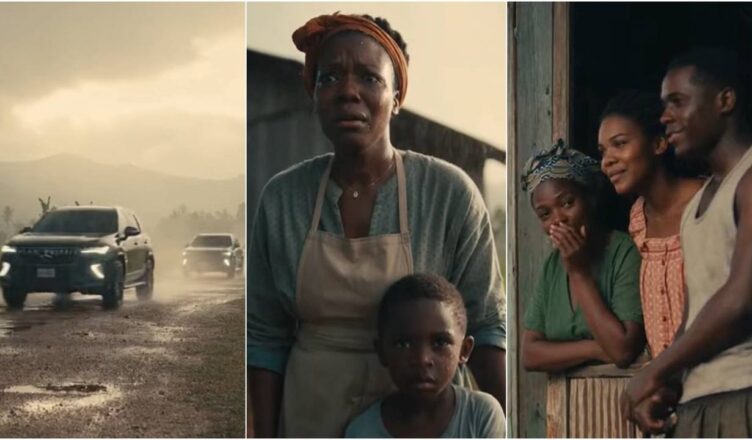
The Sahel sun hung heavy over our village in northern Ghana, turning the red earth into a fine dust that clung to skin and clothes. I—Amina—was kneeling behind our small cement house, gathering dry wood for the fire.
My son Kofi, ten years old, stood in the doorway watching me, his eyes far too thoughtful for a child.
“Mama,” he said softly, “why don’t I have a father like the other children?”
That question had lived in my chest for a decade. I swallowed it the way I had swallowed everything else.
“Come help me,” I said, reaching for another branch. “We’ll talk later.”
But he stayed where he was.
“They laughed at me today,” he said. “They said I’m nobody.”
I froze. The wind pushed dust across the yard like smoke. I looked at my son—my whole world—and felt the old wound split open again.
“You are somebody,” I told him. “You are mine.”
He nodded, but it wasn’t enough.
It never was.
TEN YEARS OF SILENCE AND SHAME
When I got pregnant, the village changed overnight.
Women who had once greeted me warmly began looking at me with hard, measuring eyes.
“Pregnant with no husband,” they whispered at the well.
“City men come, take what they want, and disappear.”
“She thinks she can wear shame like a crown.”
I kept working.
I pulled weeds in the fields. Carried sacks at the market. Washed dishes behind a roadside café until the skin on my hands split open.
Because I had no choice.
The man I loved—Kwame—was not a stranger who used me and vanished. He was the son of a well-known family from Accra, visiting relatives in our district. He was kind, thoughtful, careful with words. When I told him I was pregnant, he didn’t panic.
He smiled, as if I had just placed the future in his hands.
“I’m going back to Accra to speak to my parents,” he told me, holding both my hands in his. “Then I’ll come back, and we’ll do this properly. I promise.”
I believed him.
The next day, he was gone.
No message.
No call.
No letter.
Not even a sign that he was alive—or that I had ever meant anything to him.
When my belly began to show, the whispers turned into open cruelty. Someone started throwing spoiled scraps near our door. Children sang ugly songs when I walked by. Even some of the men laughed, as if my pain were entertainment.
When Kofi was born, the midwife’s face said everything.
“A boy,” she murmured. “May God help you.”
That night, holding my newborn against my chest, I made a promise in the dark:
We will survive.
A CHILDHOOD WITHOUT ANSWERS
Kofi grew quickly—thin shoulders, bright mind, quiet kindness. But school taught him what the village wanted him to believe.
On festival days, fathers arrived with drums and gifts. The other children ran into strong waiting arms.
Kofi stayed beside me.
Sometimes he pretended it didn’t hurt. Sometimes he came home with swollen eyes and said nothing at all. And at night, when he finally slept, I would sit beside the lamp and stare at the only thing I had left of Kwame: a faded photograph and the sound of his voice still living in my memory.
On the worst days, I hated him.
On the better days, I prayed he was still alive—because imagining him dead felt too cruel. And yet, with every passing year, the truth became harder to deny.
Ten years.
Then another season.
Then another.
Until the morning everything changed.
THE DAY THE ENGINES CAME
It was the beginning of the rainy season, with low, heavy clouds rolling in from the south. I was mending Kofi’s school shirt when a sound cut through the village—low, powerful, wrong.
Engines.
Not motorcycles.
Not the old shared taxi.
Heavy SUVs, moving slowly down our dirt road like they didn’t belong in our world.
The neighbors came out of their houses. Voices rose first in surprise, then in excitement.
“Who is that?”
“Is it the government?”
“Someone important is here?”
The vehicles stopped directly in front of our gate.
My chest tightened. In a village like ours, cars that expensive arrived only with power or with trouble.
A man in a dark suit stepped out first and opened the rear door of the lead SUV.
An older Black man emerged—distinguished even in that heavy heat. Gray at the temples. Tired eyes in the kind of way money can never fix.
He looked at me like he had been searching for me for years.
“Amina?” he called, his voice shaking.
My knees nearly gave out.
“Yes…?”
He took one step forward—
and then, right there in front of my house, in front of the entire village watching, he knelt in the red mud.
“Please,” he said, tears mixing with the first drops of rain, “forgive us. We found you too late.”
Kofi moved closer and took my hand.
The man looked up at my son, and his face broke with real grief.
“That child,” he whispered. “He has my son’s eyes.”
THE TRUTH INSIDE OUR LITTLE HOUSE
I brought him inside.
Our house was simple—two rooms, cracked floor, a table worn smooth by years of use. The contrast between his elegant suit and our poverty felt almost cruel.
He introduced himself quietly.
“My name is Mr. Mensah. Kwame was my only son.”
The past tense hit me like a slap.
“Was?” I repeated.
Mr. Mensah closed his eyes. When he opened them again, they were full.
“The day after he promised he would return to you, Kwame left Accra early,” he said. “He was on his way to see you. He wanted to bring you home properly. On the road near Kintampo, a truck crossed into his lane. There was an accident.”
My hands went cold.
“He died,” Mr. Mensah said, his voice breaking. “Instantly. He didn’t suffer. But he never made it back to you.”
For ten years, I had lived with a question that poisoned everything.
And the answer—now that it had come—was worse than anger.
But cleaner than shame.
Kofi’s voice came out small.
“So… my father didn’t leave us?”
Mr. Mensah leaned toward him gently.
“No, my son. He was trying to come back.”
Kofi blinked hard, fighting tears, and I felt something crack open in my chest—pain and relief at the same time.
“Why did it take ten years?” I asked, finally letting the anger speak.
Mr. Mensah nodded, as though he deserved the question.
“Because Kwame had tried to protect you,” he said. “He gave us your name, but not enough details. He wanted to present you properly. After his death, we searched. Too many villages. Too many dead ends. Too many officials who never helped.”
He pulled a folder from his bag and laid out documents—reports, records, copies, even a birth record with my name on it.
“Last month, someone finally connected the trail. We came as soon as we were certain.”
He looked around our home—the patched clothes, the bare shelves, the life I had carried alone.
“And when we understood how you had been living…” His voice lowered. “It broke my heart.”
THE VILLAGE THAT LAUGHED AT US
When we stepped back outside, the road was full.
Faces that had once judged me were now staring in shock—and fear.
Someone tried to laugh nervously.
“Amina, we always knew—”
Mr. Mensah turned toward them, calm and deadly.
“No,” he said. “You did not know. You mocked her. You humiliated her. You taught a child to be ashamed of himself.”
Silence dropped over the road like a heavy cloth.
He looked at Kofi and took his hand.
“This boy is my grandson,” he said. “And from this day forward, you will speak his name with respect—or not at all.”
Several neighbors lowered their eyes. A few women began to cry, not from sorrow, but from the shock of being seen clearly for what they had done.
Mr. Mensah turned back to me.
“Pack your things,” he said. “You and Kofi are coming with me to Accra. My son intended to marry you. In my house, intentions matter.”
I looked at my home—the only world I had ever known.
Leaving felt impossible.
But staying meant reopening the same wound every day.
Kofi squeezed my hand.
“Mama,” he whispered, “can we go?”
I nodded once.
“Yes,” I said. “We can go.”
A NEW BEGINNING
The drive to Accra felt like crossing into another life. Kofi stared out the window at everything—asphalt roads, tall buildings, lights that did not go dark at night. Mr. Mensah spoke gently the entire way, telling him about Kwame—his kindness, his sense of justice, the joy with which he had spoken about becoming a father.
“The last words he said to me,” Mr. Mensah admitted, his voice trembling, “were, ‘I’m going to be a father.’”
When we arrived, the house was large, protected, quiet. Not cold—just new to us. And when Kwame’s mother saw Kofi, she broke, gathering him into her arms as if she could undo ten stolen years in a single embrace.
That night, Kofi slept in a clean bed, beneath a roof that did not leak, in a house where people finally knew his name.
I stood alone for a moment, listening to the city breathing beyond the window, and I realized something I had never fully allowed myself to believe:
I had not been abandoned.
I had been lost.
And now, at last, we had been found.