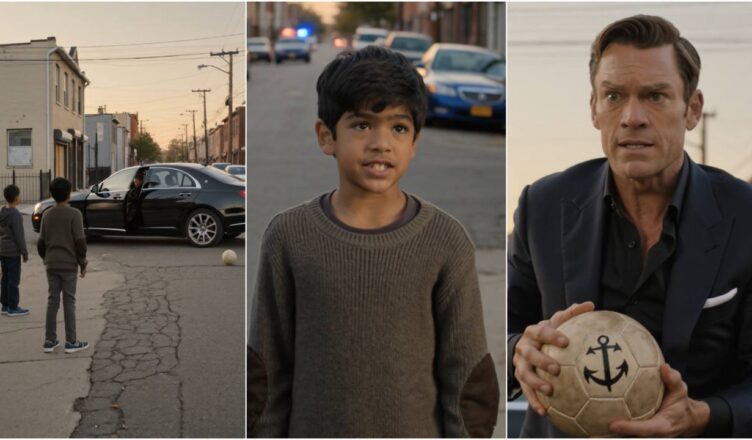
The Ball on Calder Street
The October light was fading over Calder Street, turning the dead-end block the color of old brass.
This part of South Baltimore looked forgotten. Peeling row houses. Rusted railings. Cracked pavement. Boarded storefronts with old flyers hanging loose in the wind. Somewhere beyond the avenue, a siren rose and faded.
Three boys played street soccer near the curb.
The ball was old and dirty, patched with tape in two places. Nico, the oldest at twelve, kicked it toward the smallest boy and grinned.
“Don’t miss this one.”
The youngest boy was ten, thin, with dark serious eyes and a sweater frayed at both elbows. He set his foot, swung hard, and mishit the ball.
It flew into the street just as a sleek black sedan turned onto the block.
The ball slammed into the rear passenger door with a loud hollow impact.
Brakes screeched.
The boys froze.
The sedan stopped hard, its black paint shining even under the dirty evening light.
For one second, nothing moved.
Then the rear door opened.
Rowan Cross stepped out angry.
He was in his early forties, lean, sharp-faced, wearing a dark expensive suit with the collar open. He looked like the kind of man who did not belong on Calder Street and knew it.
His driver started to get out, but Rowan lifted one hand.
“Stay in the car.”
He walked to the ball, picked it up, and turned toward the boys.
The youngest took half a step back.
Rowan was ready to throw the ball into the alley. Ready to curse. Ready to tell them exactly how expensive that door was.
Then his thumb dragged across a smear of dirt.
Something black appeared beneath it.
He rubbed harder.
A hand-drawn symbol came into view on one of the worn panels: a serpent wrapped around a broken anchor.
Rowan stopped breathing.
The anger drained from his face so quickly that Nico noticed it.
Rowan stared at the mark. His grip tightened around the ball.
For twelve years, he had seen that symbol only in memory.
On a napkin in Cartagena.
On the inside cover of a passport.
Drawn once in black ink by Elena Varela while she smiled across a café table and told him, “If I ever need you to find me, you’ll know.”
Then she died.
At least, that was what he had been told.
Burned apartment. Charred remains. Dental confirmation. A file closed too quickly by people who had wanted him too broken to ask better questions.
Rowan looked up at the youngest boy. His voice came out rough.
“Where did you get this?”
The boy took one cautious step forward.
He was frightened, but he did not run. His fingers twisted in the edge of his sweater.
“My mom gave this to me. She said the right person would recognize it right away.”
Rowan stared at him.
The block fell away.
The peeling houses. The rust. The sedan. The other boys. All of it became distant.
My mom.
The boy’s face blurred for a second, then sharpened. The eyes. The shape of his mouth. The small crease between his brows when he was trying not to be scared.
Not proof.
But possibility.
Rowan clutched the ball tighter.
“Jesus Christ…”
The boy looked down.
Nico stayed silent beside him, watching too carefully.
Rowan took one step closer, slow enough not to frighten him.
“What’s your name?”
The boy hesitated. “Mateo.”
Rowan swallowed.
“And your mother?”
Mateo looked at Nico again.
Nico gave the smallest nod.
“Elena,” the boy said.
Rowan’s chest tightened so hard he nearly lost his balance.
Elena.
He had buried that name inside himself because carrying it openly would have destroyed him. She had been an informant first. Then a partner. Then something neither of them had been allowed to call love while the operation was still alive.
He had been working undercover then, trying to bring down a private smuggling network that moved weapons, stolen art, and people through ports no one watched closely enough.
Elena had gotten him inside.
Then everything burned.
The official report said she died before she could testify.
Rowan never believed all of it, but he believed enough to disappear.
He changed cities, changed work, changed the shape of his life. The people hunting him lost the trail. The agency buried his name. Rowan Cross became someone no one said out loud.
Until now.
He looked at Mateo again.
“Where is she?”
Mateo’s face tightened.
“She said not to tell unless you knew the sign.”
“I know it.”
The boy looked at the ball in Rowan’s hands. “Then you’re him.”
Rowan lowered his voice. “Who?”
“My father.”
The word hit him harder than any weapon could have.
Inside the sedan, his driver shifted.
Rowan heard it but did not look away from the boy.
“How old are you?”
“Ten.”
That was impossible.
And exactly possible.
Ten years ago, Rowan had already been gone. Elena would have known she was pregnant after the fire. If she had survived, if she had run, if she had hidden—
His mind tried to build a bridge across twelve years and almost failed.
“Where is your mother now?” he asked.
Mateo’s eyes filled, but no tears fell.
“She said she couldn’t come.”
“Why?”
“She said they watch grown-ups. Not kids.”
The warning moved through Rowan too late.
He glanced at the symbol again.
The ink was dark.
Too dark.
Not faded into the cracked surface. Not worn by years of play. It sat clean and black over old grime.
Fresh.
His hand stopped halfway toward Mateo’s shoulder.
The boy saw him notice.
Something in Mateo’s face changed.
Not enough for most people to catch.
Enough for Rowan.
The fear was still there, but behind it was training. Control. A child repeating a role because someone had taught him exactly where to stand and what to say.
Rowan’s eyes shifted to Nico.
Nico’s hand was near his jacket.
The third boy had stopped looking like a scared kid. He was watching the end of the block.
Rowan took one slow breath.
“Mateo,” he said quietly, “who told you to say that?”
The boy’s mouth trembled.
For one second, the child looked real again.
Then a voice came from behind one of the boarded storefronts.
“Step away from him, Cross.”
Rowan turned.
A man in a gray field jacket stepped out from the shadow of the building. Mid-fifties. Trim beard. Calm face. Too calm. Four armed men followed him.
At the same time, two black SUVs blocked the ends of Calder Street.
The driver inside Rowan’s sedan reached for his weapon.
A shot cracked through the rear window before he could raise it.
The driver dropped out of sight.
Rowan did not move.
Red dots appeared on his chest.
Then on his shoulder.
Then on his throat.
The man in the gray jacket smiled faintly. “You were harder to find than I expected.”
Rowan kept the ball in his hand.
“Where’s Elena?”
The man tilted his head. “Still asking the only question that ever made you stupid.”
“Answer me.”
“She died in Cartagena.”
Rowan’s jaw tightened.
“You’re lying.”
“About a lot of things,” the man said. “Not that.”
Mateo flinched.
Rowan saw it.
The man saw him see it.
“Careful,” he said. “The boy doesn’t know which parts are true anymore.”
Rowan looked at Mateo.
The child’s face had gone pale.
“They told me she was my mom,” Mateo whispered.
Nico hissed, “Shut up.”
The man in the gray jacket lifted a hand, and Nico went silent.
Rowan understood then.
Not fully.
Enough.
They had built the trap from pieces of truth. Elena had drawn the symbol. They had taken it from an old interrogation file, maybe from something found after the fire. They had found a boy with the right face, the right age, the right hunger for belonging. They had put a dead woman’s ghost in his mouth and waited for Rowan to break cover.
It had worked.
Because part of him had wanted it to work.
The man stepped closer. “You should have stayed buried.”
Rowan’s driver groaned inside the car.
Rowan kept his eyes on the man. “You killed her.”
“We ended a leak.”
“You used a child.”
“We used what you still loved.”
Mateo stared at the pavement now, shaking. Whatever he had been promised had started to fall apart.
Rowan lowered the ball slowly.
The serpent and anchor faced up in the fading light.
“What did they tell you?” he asked the boy.
Mateo did not answer.
The man in the gray jacket said, “He doesn’t matter.”
Rowan’s eyes stayed on Mateo.
“What did they tell you?”
The boy swallowed.
“That you left her,” he whispered. “That she died because of you. That if I helped them find you, they’d tell me who I really was.”
Rowan looked at him for a long moment.
Then he said, “They were never going to.”
Mateo’s face collapsed, but he did not cry.
Nico stepped back from him.
The armed men tightened their circle.
The man in the gray jacket raised two fingers.
“Enough.”
Rowan shifted his weight.
A rifle clicked.
“Don’t,” the man said. “You’re not getting out of this street.”
Rowan looked at the sedan. His driver was still alive, but down. Too far to help. The alley was blocked. Storefronts occupied. High windows covered.
Bad odds.
Almost no odds.
But not none.
His thumb pressed against the soft panel of the soccer ball.
There was something under the leather.
Not air.
A tracker, maybe. Or a microphone. Something hard and small under the symbol.
Rowan almost smiled.
Elena would have laughed at that.
Not because it was funny.
Because even dead, she had taught him to never trust the obvious object in the room.
He looked at Mateo.
“Get down when I move.”
The boy’s eyes widened.
The man in the gray jacket frowned. “What did you say?”
Rowan threw the ball hard at the nearest streetlight.
The impact cracked the casing.
The block went half dark.
At the same time, Rowan dropped.
Gunfire tore across the place where his chest had been.
Mateo hit the pavement.
Nico shouted.
The driver fired from inside the shattered sedan, two fast shots that forced the men nearest the car back behind the SUV. Rowan rolled behind the sedan’s rear tire, pulled the backup pistol from his ankle, and fired low through the dust.
The man in the gray jacket disappeared behind a parked van.
Someone screamed. Not Mateo. One of the gunmen.
Rowan grabbed the boy by the back of his sweater and dragged him behind the sedan.
Mateo fought him for half a second on instinct.
“Stay down,” Rowan snapped.
“They’ll kill me.”
“They were always going to kill you.”
That made the boy stop moving.
The driver, bleeding from the shoulder, shoved open the front door and fired again.
“Boss, alley side!”
Rowan looked.
The third boy had dropped flat and covered his head. Nico had run toward the storefronts. Two gunmen were repositioning near the alley mouth.
Sirens sounded in the distance.
Real ones.
Close.
The man in the gray jacket heard them too.
His face changed.
Rowan saw it and understood: the ball had not only been a lure. It had been broadcasting. Maybe to the men in the SUVs. Maybe to someone else.
Maybe Elena had left more than a symbol behind.
Or maybe Rowan’s driver had triggered backup the moment the first SUV blocked the street.
Either way, the trap was breaking.
The man in the gray jacket shouted, “Take him now!”
Two gunmen rushed forward.
Rowan fired once.
The driver fired twice.
The nearest man went down behind the sedan’s hood. The second dove back as police sirens grew louder at both ends of the block.
The SUVs began to move.
Not toward Rowan.
Away.
The man in the gray jacket gave Mateo one last look.
Cold. Empty. Disposable.
Then he climbed into the rear SUV and vanished behind black glass.
The vehicles tore out of Calder Street seconds before the first police cruiser reached the intersection.
Then came shouting. Lights. Boots on pavement. Officers ordering hands up. Rowan put his pistol down and lifted both hands slowly.
Mateo stayed curled beside the sedan, shaking.
An officer tried to pull him away, but the boy grabbed Rowan’s sleeve with both hands.
“Don’t let them take me,” he said.
Rowan looked down at him.
The boy was not his son.
He knew that now.
But he was a child who had been used by the same people who killed Elena.
That was enough.
“He stays with me until federal agents arrive,” Rowan said.
The officer started to argue.
Rowan gave his real name and authorization code for the first time in eleven years.
Nobody on Calder Street understood what they were hearing, but the command channel did.
The argument stopped.
Later, after statements, ambulances, federal agents, and three different agencies took over the block, Rowan sat on the curb with Mateo beside him. Someone had wrapped the boy in a police blanket. He looked smaller now than he had during the lie.
The damaged soccer ball rested between them in an evidence bag.
The symbol was still visible through the plastic.
Mateo stared at it.
“I don’t know who my mother is,” he said.
Rowan looked at the boarded storefront across the street.
“We’ll find out.”
“You don’t have to help me.”
“I know.”
The boy turned toward him. “Then why?”
Rowan did not answer right away.
Across the street, investigators photographed bullet holes in the sedan. Farther down, Nico sat handcuffed beside an ambulance, silent and furious. The third boy was crying while a social worker spoke to him.
Rowan looked at Mateo again.
“Because they used her name,” he said. “And they used you.”
Mateo lowered his eyes.
That was all the answer he needed for now.
By midnight, the block was sealed, the sedan was towed, and the first arrests had begun.
The man in the gray jacket was gone.
So was the certainty Rowan had carried for twelve years.
Elena was still dead. Probably.
Mateo was not his son. Probably.
But the symbol on the ball was real, and someone had known enough to draw it.
That meant there were files still hidden, witnesses still alive, and a grave in Cartagena that might not hold the whole truth.
At dawn, Rowan stood in a federal safe house outside Baltimore, looking at the evidence bag on the table.
Mateo slept on the couch in the next room, one hand still gripping the edge of the blanket.
Rowan picked up the ball and stared at the serpent wrapped around the broken anchor.
For twelve years, that mark had meant loss.
Now it meant someone had opened the grave and left him a trail.
He set the ball down, took out his phone, and made the first call under his real name in over a decade.