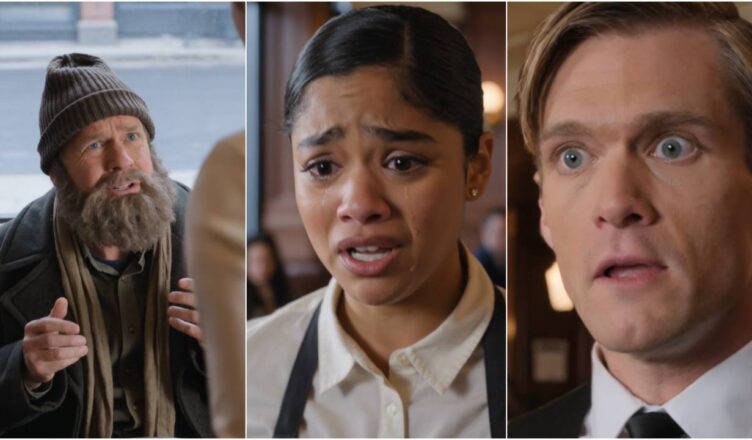
The Winter Café Reveal
By late afternoon, Boston had turned bitter.
Sleet tapped against the windows of Hawthorne Café, blurring the gray street outside. Inside, the room glowed with amber lights, polished wood, the warm shine of the pastry case, and the smell of coffee, butter, and beef stew.
Most customers came in to escape the weather.
William Ashcroft sat near the entrance like he had come in with it.
He looked homeless. Late sixties or early seventies, wrapped in dirty layers, a frayed dark coat, stained scarf, torn beanie, and a long rough gray beard. His hands shook from the cold. His shoulders were hunched. Every few seconds, someone glanced at him and looked away.
He had chosen the worst table on purpose.
Small. Drafty. Close to the door. Visible enough to make people uncomfortable.
Nora Flynn noticed him from behind the counter.
She was twenty-two, a waitress with tired eyes, warm manners, and bills waiting for her at home. Her father’s rehab costs had taken most of what she earned. Nursing school took the rest. She could not afford to be careless with money.
But she could not watch an old man freeze beside the door and pretend she hadn’t seen him.
She went into the kitchen, took a hot meal from the pass—beef stew, bread, potatoes—and carried it to his table.
William looked up as she set the plate down gently in front of him.
His eyes were the first thing that didn’t fit the rest of him. Sharp blue. Intelligent. Watching everything.
He stared at the food, then at her.
“Miss… I didn’t order this.”
Nora leaned in kindly.
“I know. Just eat.”
A little silence opened around them.
The customers nearby had heard enough to understand what she had done. One woman by the window looked down at her coffee. A man in a wool coat frowned as if Nora had broken some rule of the room.
Dean Keller came over before William picked up his fork.
Dean was the manager, mid-thirties, tall and thin, with neatly styled yellow-blond hair, small earrings in both ears, and the kind of polished cruelty that came from being almost powerful. He cared about appearances more than people, and Hawthorne’s rumored sale had made him worse.
He strode across the café, pointed at the plate, then at Nora.
“You’re fired for this! Who do you think you are, the owner of this place?”
Nora’s face crumpled.
The words hit too hard and too publicly. Her eyes filled instantly. She tried to hold herself together, but she couldn’t. She covered her face with both hands and began crying, right there between the tables.
No one spoke.
Dean looked satisfied for half a second.
Then Nora lowered her hands just enough to speak through the tears.
“I’ll pay for it myself.”
William slowly pushed back his chair.
The scrape of wood against the floor cut through the room.
He stood with effort at first, still playing the part of a cold, weak man. Then his spine straightened. His trembling stopped. One hand reached to the edge of his long gray beard.
Dean turned toward him, irritated. “Sit down.”
William ignored him.
While everyone watched, he peeled the beard away from his face.
The fake gray hair came off in one slow, deliberate motion, revealing a clean, powerful-looking older man underneath. Still worn by age, but not broken. Not helpless. Not someone Dean could dismiss.
William looked directly at Dean.
“Wait. I don’t think you recognized me.”
Dean’s face emptied.
The color drained from him so fast that Nora saw it even through her tears. His mouth fell open. His arrogance vanished in a single breath.
“Oh my God… Mr. Ashcroft.”
The café went completely silent.
William Ashcroft removed the torn beanie next. Then the old scarf. Under the filthy coat, he wore a dark suit jacket, simple but expensive. He placed the fake beard on the table beside the untouched meal.
Nora stood frozen, cheeks wet, still not understanding what had happened.
Dean understood perfectly.
Everyone in Boston hospitality knew William Ashcroft. Ashcroft Properties owned half the historic buildings on that block. Hawthorne Café had been one of his wife’s favorite projects before she died. Most of the staff had never seen him in person. They knew the name only from paperwork, rumors, and the gold plaque near the office door.
William looked around the café slowly.
At the customers who had stared at him.
At the staff who had stayed silent.
At Dean.
Then back at Nora.
“You gave me food,” he said.
Nora wiped her face quickly, embarrassed. “I thought you were hungry.”
“I was.”
Dean stepped forward, desperate now. “Mr. Ashcroft, I can explain. I didn’t know it was you.”
William turned to him. “That is exactly why I came.”
Dean stopped.
William’s voice stayed calm. That made it worse.
“For months, I’ve received complaints about this café. Staff leaving. Customers treated badly. People being judged at the door before anyone asked what they needed.” He glanced at Nora. “I did not know which complaints were exaggerated.”
His eyes moved back to Dean.
“Now I do.”
Dean swallowed. “Sir, with respect, we have standards here.”
“My wife built this café,” William said. “She served students, widows, nurses, cab drivers, lawyers, tourists, wealthy clients, and people who only came in because they were cold. Her standard was simple. No one gets humiliated for needing a table.”
Dean said nothing.
William looked toward the kitchen doorway. Two cooks stood there, silent. One had his arms folded. The other looked like he had been waiting years for this.
“Did he take the cost of that meal from your pay?” William asked Nora.
She hesitated.
Dean answered too quickly. “That was never finalized.”
Nora looked at William. “He said he would.”
William nodded once.
Then he turned to Dean.
“You’re done.”
Dean’s face tightened. “You’re firing me?”
“Yes.”
“In front of everyone?”
William’s expression did not change. “That was your preferred method.”
Dean looked around the room for support.
He found none.
Not from the customers. Not from the staff. Not from Nora, who was still crying quietly but no longer hiding her face.
William spoke to the assistant manager near the register. “Call payroll. Dean Keller is terminated effective immediately. Full audit of staff wage deductions, tips, scheduling, and disciplinary records. Anything improper gets corrected by close of business tomorrow.”
The assistant manager nodded fast. “Yes, Mr. Ashcroft.”
Dean laughed once, thin and panicked. “This is insane.”
“No,” William said. “This is late.”
Dean stood there another second, as if the room might still rearrange itself around him.
It didn’t.
He grabbed his coat from behind the counter and left through the side door without looking at anyone.
Only after he was gone did the café start breathing again.
A customer near the window quietly said, “Good.”
Someone else gave a small, awkward clap. Then stopped when William looked over.
He was not interested in applause.
He turned back to Nora.
“I’m sorry he did that to you.”
Nora shook her head, still overwhelmed. “You don’t have to apologize.”
“Yes,” William said. “I do. I stayed away too long.”
He sat back down, not as the homeless man now, but as himself. Still, he picked up the spoon and took a bite of the meal Nora had brought him.
The gesture broke something in her.
She looked away quickly.
William noticed but did not comment.
Later that evening, after the café closed early and the last customers left under umbrellas, William asked Nora to sit with him at the same small table near the entrance.
The fake beard was gone. The dirty coat had been taken away. He looked like a wealthy old man now, but tired in a way money did not fix.
Nora sat across from him, hands folded tightly in her lap.
“I’m not in trouble?” she asked.
William almost smiled. “No.”
“I really would have paid for the meal.”
“I know.”
“That was stupid of me.”
“No,” he said. “It was expensive. There’s a difference.”
She looked at him carefully.
He took a folded document from inside his coat and placed it on the table.
“My wife, Margaret, opened Hawthorne with me in 1984,” he said. “She believed a café should be warm before it was profitable. After she died, I stopped coming. I let managers run it. Then I let numbers decide too much.”
Nora glanced at the document but did not touch it.
William continued.
“I had already decided not to sell the building. But I hadn’t decided what to do with the café. Tonight made the answer easier.”
Nora frowned. “What do you mean?”
“I’m placing Hawthorne into a staff trust.”
She blinked. “A what?”
“A trust. The business stays open. The building stays protected. Profits will support wages, repairs, and staff benefits before they support investors. I’ll remain owner of the property, but the café operations will be managed locally.”
Nora stared at him.
“Why are you telling me?”
“Because I want you to run it.”
She laughed once because she thought he was joking.
He wasn’t.
“I’m a waitress,” she said.
“You’re a person who remembered what this place was supposed to be when everyone else forgot.”
“I’m twenty-two.”
“You’ll have help.”
“I’m in school.”
“Good. Then you know how to learn.”
She shook her head. “Mr. Ashcroft, I don’t know anything about running a café.”
“You know people,” he said. “The rest can be taught.”
Nora looked down at the table.
Her first instinct was to refuse. Not because she didn’t want it, but because wanting it felt dangerous. Good things did not usually walk into her life disguised as old men and hand her keys.
“I can’t quit nursing school,” she said.
“I didn’t ask you to. We’ll hire an operations lead. You’ll be paid for your role, trained properly, and scheduled around classes.”
Her eyes filled again. She hated that.
William looked toward the window, where sleet blurred the streetlights.
“There’s also a medical grant,” he said. “For your father’s rehabilitation. Separate from the café. No repayment.”
Nora’s face changed.
“How do you know about my father?”
“I asked questions after I saw you willing to lose wages you clearly needed.”
She looked down, overwhelmed.
“I didn’t do it for a reward.”
“I know,” William said. “That’s why you’re getting one.”
For a long moment, Nora said nothing.
Then she wiped her face and asked the only question that mattered to her.
“What happens to the staff?”
“They stay if they want to stay. Anyone Dean pushed out unfairly gets a call. If they want to come back, they get considered first.”
Nora nodded slowly.
“And the table by the door?” she asked.
William looked at her.
“It stays,” she said. “But nobody gets put there because they look like they don’t belong.”
For the first time that night, William smiled.
“Agreed.”
The next weeks were hard.
Dean’s audit uncovered wage deductions, tip manipulation, and written complaints he had buried. Two former servers returned. One cook who had nearly quit stayed. The schedule changed. The staff meetings became uncomfortable, then useful.
Nora made mistakes.
She overordered bread the first week. Forgot to approve a repair invoice. Cried in the walk-in freezer once after a vendor talked down to her for ten straight minutes.
Then she came back out and called him again with William’s attorney on the line.
He apologized before the day ended.
Hawthorne changed slowly.
Not into something flashy. Into something warmer.
The front table became a place for anyone who needed to get out of the cold quickly. The staff kept a small meal fund in the register, matched every month by William. No one announced it. No one made customers feel grateful on command.
Nora stayed in school.
She worked fewer hours on the floor and more on the business, learning payroll, inventory, hiring, and the strange art of staying kind without letting people take advantage.
William came in every Thursday afternoon.
Always as himself now.
He sat near the window, ordered tea, and watched the room his wife had once loved become alive again.
One year later, on the first bitter day of January, a man in a thin coat stepped into Hawthorne and hesitated near the entrance.
Several customers glanced up.
Nora saw him from behind the counter.
She picked up a menu, walked over, and smiled.
“Come in,” she said. “You can sit anywhere.”