The garden of the private institute was designed to look calm on purpose.
Refined stone paths. Elegant benches. Trimmed hedges that never grew wild. Even the air felt managed—clean, expensive, controlled. In daylight, it was almost beautiful… until you listened long enough to hear what people did with power when they thought it belonged to them.
That afternoon, the courtyard was crowded with men who wore confidence like cologne.
Tailored suits. polished shoes. soft laughs that landed sharp. They stood in a loose half-circle around a man in a high-end wheelchair—carbon frame, leather headrest, motors so quiet they barely made sound. The chair looked less like medical equipment and more like a throne.
The man’s name was Miles Harrow.
The institute didn’t call him that, of course. On the donor wall, he was “Mr. Harrow, Benefactor.” On the board, he was “Chairman.” In public, he was the kind of millionaire people pretended not to stare at, while secretly measuring how close they could get to his shadow.
He was forty-eight and famous for turning everything into a transaction.
He had arrived at the institute two years earlier after an accident that took his mobility. The doctors had done the scans, the tests, the long explanations. His spine was intact. His nerves still carried signal. His prognosis was complicated, not hopeless.
But hope, to Miles, was a humiliation.
Every visit, he showed up with a crowd. Every visit, he performed. It was his way of staying in control: if he could turn his paralysis into a joke, then nobody could use it against him.
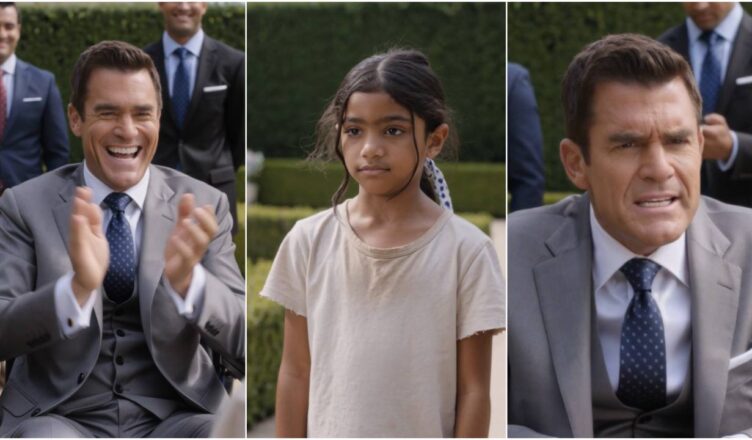
That day, he rolled into the garden under natural daylight, surrounded by well-dressed men, and clapped like he was opening a show.
“One million dollars,” he said, laughing, voice loud enough to bounce off the stone. “If you make me walk.”
A few men chuckled on cue. One raised a phone, already hungry for a clip.
In front of them stood a barefoot little girl.
She couldn’t have been more than ten. Her knees had faint marks that didn’t look like fresh bruises—more like old life that didn’t have the luxury of staying clean. Her T-shirt was faded. Her hair was tied back with a frayed ribbon.
She didn’t look like she belonged in a courtyard like this.
But she stood like she did.
Her name was Nina Alvarez, and she wasn’t supposed to be there either.
Nina’s mother cleaned the institute. Not in the glamorous wing, not the donor halls—she scrubbed the back corridors, the bathrooms, the corners people only noticed when they smelled wrong. Some days, Nina waited in the lobby with a book. Some days, when school had been closed and childcare fell apart, she waited outside on a bench, listening to the world.
She had learned how to be invisible in expensive places.
But Nina had also learned how to listen.
Not just with her ears—deeper than that. She listened the way a kid listens when she’s had to grow up too early: to tone, to tension, to the part of a person that leaks out when they think no one cares.
That’s why she didn’t flinch at the laughter.
She looked straight at the man in the wheelchair as if she could see the truth behind the joke.
He noticed her then—really noticed her—because she wasn’t shrinking.
His smile sharpened.
He liked the idea of an audience. He liked the idea of a child staring at him like he was a king.
In his mind, the scene was easy: he would humiliate the moment, prove again that nothing could be done, then enjoy the apology looks.
But Nina didn’t offer him pity.
She offered him a mirror.
“You’re laughing…” she said calmly, “because you don’t believe it.”
The air changed.
The men behind him chuckled, but it sounded thinner now, like they were unsure whether they were laughing at her or with him.
Miles leaned forward slightly in his chair, eyes narrowing.
The phone in the crowd lifted higher.
“Do you even know what a million is worth?” Miles asked, voice colder now, the mockery turning sharp.
Nina didn’t blink.
“More than my entire life,” she answered.
The laughter died, one by one, as if the words had cut the strings holding it up.
Nina took a small step forward. Bare feet on refined stone. No fear in her posture.
“If it were possible,” she said, voice still steady, “you wouldn’t turn it into a game.”
For the first time, Miles stopped smiling.
The men around him didn’t move. Their faces changed in subtle ways—discomfort, curiosity, irritation. The kind of discomfort that comes when a child says something true in a room built on pretending.
Miles’ jaw tightened.
“And what do you know?” he asked, darker now, as if he had decided she was no longer cute.
Nina’s hand lifted slowly—not toward the money, not toward the men, but toward him.
“You don’t heal a body,” she said low, firm, “when the heart is at war.”
Her fingers hovered in the air between them.
The courtyard felt suddenly too quiet, even though it was daylight and the city existed beyond the gates.
Miles stared at her hand like it was something dangerous.
And for one sharp second, his face did something he hadn’t allowed in front of anyone since his accident:
It flickered.
Not with anger.
With fear.
Because the girl wasn’t talking about his legs.
She was talking about what he had buried under jokes and donations and control.
Nina didn’t push her hand closer. She didn’t touch him. She didn’t perform kindness.
She simply held the moment, as if she understood that some doors only open when you stop trying to force them.
That’s where the clip ends.
But the real story starts right after that silence.
Because when Nina’s mother hurried out of the side corridor—eyes wide, whispering her daughter’s name—Miles didn’t order security. He didn’t ask who she was. He didn’t laugh again.
He asked the one question he had refused to ask for two years.
“What do you mean?” he said quietly.
The men around him shifted, uneasy. They were comfortable with mockery. They weren’t comfortable with truth.
Nina lowered her hand.
“My mom cleans here,” she said. “I sit outside and listen. I hear what the therapists say when they think nobody important is listening.”
Miles’ throat moved as he swallowed. His voice came out rougher now.
“And what do they say?”
Nina answered carefully, like she knew words mattered.
“They say your body can still carry signal,” she said. “They say you stopped trusting it. Or… you stopped believing you deserved to.”
A hard silence followed.
One of the men chuckled nervously, trying to rescue the mood. “This is ridiculous—”
Miles cut him off with a look.
For the first time, the circle realized something unsettling:
This wasn’t entertainment anymore.
Miles rolled his chair forward a few inches until he was closer to the girl than to his friends.
“You’re just a kid,” he said, but not dismissively—almost like he was asking permission to believe her. “What do you want?”
Nina’s voice didn’t change.
“I don’t want your money,” she said. “I want you to stop laughing at people’s pain. Because you’re using that laugh like armor.”
That landed.
Not because it was poetic. Because it was accurate.
Miles had laughed at every doctor, every therapist, every program, every “small improvement” suggestion—not because he was cruel by nature, but because hope meant surrendering control.
And surrendering control meant feeling what he refused to feel.
The men around him started to retreat without moving—checking watches, shifting weight, pretending they had somewhere else to be. They didn’t like rooms where power changed shape.
Miles stared at the stone path under Nina’s feet.
“I used to walk in here,” he said suddenly, voice low. “I walked in here the day of the accident. I stood right here and promised my sister I’d pick her up at the airport that night.”
Nina didn’t speak. She let him talk.
Miles’ hands clenched on the armrests.
“I was driving too fast,” he said. “Because I was late. Because I thought rules didn’t apply to me.” His voice cracked once. “She died. And I lived.”
The courtyard felt colder even in daylight.
“And after that,” he whispered, “I didn’t want to move forward. Not really.”
Nina nodded as if she’d expected it.
“That’s what I meant,” she said. “Your heart is still fighting the day you lost her.”
Miles’ eyes closed briefly. When he opened them, there was water there.
Not dramatic tears. The kind that happen when a person finally stops holding a door shut.
Nina’s mother stepped closer, terrified now.
“Nina, please—”
Miles lifted a hand toward the woman—not commanding, just quiet.
“It’s okay,” he said.
He looked back at Nina.
“Say I try,” he whispered. “What then?”
Nina didn’t pretend she had magic.
“Then you try honestly,” she said. “Not for your friends. Not for the cameras. Not to win. Just to listen.”
Miles turned toward the institute doors.
“Call Dr. Hsu,” he said to his assistant, who had been hovering nearby in panic. “Now.”
Within minutes, the therapist arrived, confused to be summoned into the garden. Nina stood back, letting professionals do what they do.
But the difference was this:
Miles didn’t mock.
He didn’t perform.
He listened.
He let them remove the chair’s footrests. Let them place electrodes. Let them test response. The data didn’t produce a miracle. It produced something smaller—something real.
A response.
A slight, involuntary twitch in his foot.
Not enough to stand. Not enough to “walk.” But enough to destroy the certainty he’d been using as a shield.
The men who had come for entertainment went quiet.
Miles stared at his own foot as if it belonged to someone else.
“I felt it,” he whispered.
Dr. Hsu nodded carefully. “That’s a signal,” she said. “And signal means we can work.”
Miles looked at Nina then—not like a child, not like a prop.
Like the person who had forced the truth into daylight.
The next day, he made the donation anyway—not as a prize, not as a performance. A real, quiet donation to fund therapy slots for people who couldn’t afford the institute.
And two weeks later, Nina’s mother was offered a new position inside the institute—training, benefits, stability. Not because Miles wanted to play savior, but because he had finally learned the difference between charity and repair.
He also created a scholarship fund—quietly, without cameras—for one specific kid.
When Nina’s mother tried to refuse, Miles said one sentence and didn’t raise his voice.
“I was sure I would never have to pay,” he said. “And you reminded me that certainty can be its own cruelty.”
Months passed.
Miles didn’t walk right away. There was no Hollywood scene where he stood up and the courtyard erupted. Recovery wasn’t a straight line. Some days he hated himself. Some days he hated hope. Some days he wanted to laugh again just to shut the feelings down.
But he kept showing up.
And Nina kept sitting on the bench nearby after school, doing homework, listening, not as a therapist—but as proof that someone had seen him without worship.
A year later, on a bright morning, Miles stood with braces and a therapist’s hands at his side.
It wasn’t graceful.
It wasn’t triumphant.
It was honest.
His legs shook. Sweat gathered at his temples. He took one step, then another.
Nina didn’t clap.
She didn’t smile like she’d won.
She just nodded once, as if to say: this is what happens when you stop turning pain into a game.
Miles looked down at the stone path.
“One million,” he said quietly, almost to himself.
Nina answered from the bench, calm as ever.
“Not for walking,” she said. “For finally coming back to life.”
And this time, nobody laughed.
A Millionaire Offered a Little Girl a Million Dollars for Healing