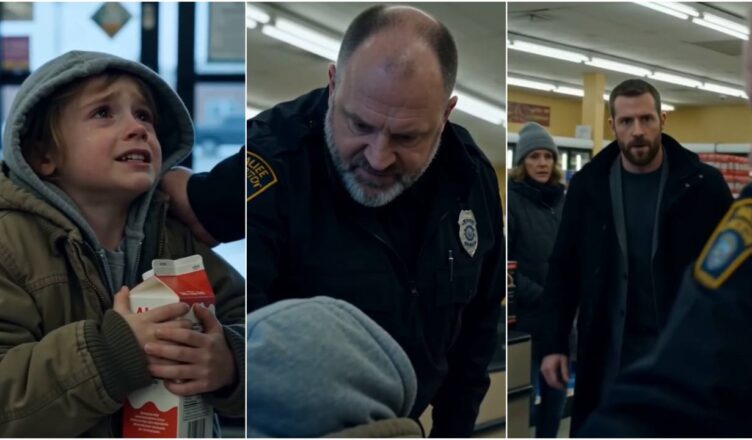
The manager caught the girl by the wrist before she made it to the sliding doors.
“Hey. Stop right there.”
His voice cut across the front of the store hard enough to turn heads at every register.
The girl froze. She was tiny, maybe eight, swallowed by a jacket that wasn’t warm enough and sneakers so big her heels lifted when she stopped. In her arms she clutched a single carton of milk like it was something breakable. Her face was pink from the cold outside. Or from crying. Probably both.
“I saw you take it,” the manager said, pulling her back from the door. “You don’t get to walk out with store property.”
The milk shook in her hands.
“I’m sorry,” she whispered. “Please. My brother and sister haven’t eaten since yesterday.”
She didn’t say it like an excuse. She said it like weather.
Around them, the store slowed. A woman near self-checkout stopped bagging groceries. Somebody lifted a phone. A man by the magazine rack muttered, “Call the cops.”
The manager reached for the milk.
“Rules are rules,” he said, louder now, playing to the crowd. “You steal, there are consequences.”
The girl let go. Her lower lip trembled, but she didn’t run.
A patrol officer came in less than two minutes later, cold air sweeping in behind him.
He took in the scene fast: the frightened kid, the manager standing tall, the customers hovering in a half-circle of curiosity. When he spoke to the girl, his voice was careful.
“Hey. What’s your name?”
“Lily.”
“Okay, Lily. I’m Officer Ramirez.” He glanced at the milk, then back to her face. “You want to tell me what happened?”
“I took it.”
“Where’s your mom or dad?”
Her eyes dropped. “It’s just me.”
The words were so quiet the whole store seemed to lean in to hear them.
Ramirez lowered himself a little so he wasn’t looming over her. “Are you here with another adult? Aunt, uncle, anybody?”
She shook her head.
“Where are you staying?”
Lily hesitated, and that hesitation said more than the answer ever could.
The manager stepped in. “Officer, she admitted it. There’s video. We need to handle this.”
Ramirez didn’t even look at him. “I am handling it.”
Then to Lily again: “I’m not going to let anything happen to you in this store. But I can’t send you back out alone either. So I need the truth.”
Lily twisted the cuff of her sleeve. “My brother and sister are waiting for me.”
That changed the room.
“How old?” Ramirez asked.
“Ben is six. Rosie is four.”
“And they’re alone?”
She nodded.
Ramirez exhaled slowly, recalculating everything.
That was when the man near register three stepped forward.
He had been watching the whole time, coffee in one hand, the other in his coat pocket. Mid-forties, tall, dressed simply but expensively in the quiet way some people are when they’ve never needed logos to prove anything.
“I’ll pay for the milk,” he said. “And the groceries she should have had in the first place.”
The manager scoffed. “Sir, that’s not the point.”
The man turned to him, calm as winter glass. “No. The point is that a child decided stealing milk was safer than asking adults for help. That should concern you more than inventory.”
The manager bristled. “You can’t reward this.”
“Reward?” the man said. “She took one carton of milk. She didn’t rob the place.”
Ramirez cut in before it became a bigger scene. “Sir, I appreciate it. Right now I need to know where the other children are.”
The man nodded, then crouched in front of Lily.
He didn’t use that fake-soft tone adults use when they want trust on demand. He just spoke to her like she mattered.
“Lily,” he said, “look at me.”
After a second, she did.
“If your brother and sister are out there alone, we need to get to them now. You are not in trouble with me. Do you understand?”
Her eyes filled, but she held his gaze.
“In the old bus station,” she whispered. “On Mercer.”
The man stood. “I’m coming with you.”
“This is now a police matter,” Ramirez said.
“It became a police matter when she said there were two younger kids alone in that terminal.” He pulled a card from his pocket and handed it over. “Daniel Whitmore.”
Ramirez glanced at the card, then back at him.
Daniel turned to the cashier. “Ring up milk, bread, peanut butter, bananas, soup, water, gloves, socks, and every hand warmer by the register.”
The cashier looked at the manager. The manager said nothing.
“Now,” Daniel said.
Ten minutes later, Ramirez’s patrol car pulled up beside the abandoned terminal, Daniel’s SUV behind it.
The building looked worse up close—crooked sign, cracked pavement, wind hissing through broken panes. Inside, the cold was immediate.
Ramirez swept his flashlight across overturned benches, soaked newspapers, graffiti, and a shopping cart with one wheel missing.
Then the beam found the far corner.
Two children were huddled under a ripped blanket and a flattened cardboard box. One little boy lifted his head at the light, eyes huge and guarded. The smaller child beside him was so still for a second Daniel thought she was asleep, until he saw her shaking.
“Ben,” Lily said, and ran to him.
Ben pushed himself upright. “Did you get food?”
Lily dropped to her knees. “Yeah. Yeah, I got some.”
Rosie was the smaller one. Daniel took off his coat and wrapped it around her before she could flinch away. She stared at him for a second, then leaned into the warmth.
Ramirez was already on his radio.
“I need EMS and child services at Mercer Terminal,” he said. “Three minors. Exposure risk. Possible abandonment. Send a second unit.”
He clicked off and looked at Lily. “How long have you been here?”
“Three weeks,” she said.
He stared at her. “Three weeks?”
“I go to the church pantry when it’s open,” Lily said. “And behind the bakery sometimes. But they were closed yesterday.”
Ben said nothing. He just watched every adult in the room.
Within minutes the terminal filled with movement—another officer, paramedics, and a county social worker named Elise Moran, a woman in her fifties with tired eyes and a voice that didn’t waste words.
Blankets appeared. Warm broth in paper cups. Rosie cried when the paramedic touched her hands, and Lily moved close until she calmed down.
Elise got the facts from Ramirez, then knelt in front of the children.
“My name is Elise,” she said. “You’re safe tonight. That’s the first thing. We’ll do the rest one step at a time.”
Daniel stepped aside with her near the patrol car.
“My foundation funds Harbor House on Wilcox,” he said. “There’s space tonight. Use it.”
Elise folded her arms against the cold. “Harbor House is licensed emergency housing, not a shortcut around county procedure.”
“I know,” Daniel said. “I’m asking for a warm bed instead of a crowded intake room.”
Ramirez nodded. “They need food, sleep, and doctors before anything else.”
Elise looked back toward Lily, who was holding Rosie’s cup with both hands so her sister could drink.
Then she nodded once. “Fine. Harbor House tonight under county supervision.”
Daniel handed over his ID without being asked. “Run whatever you need.”
She took it. “If you plan to stay involved, understand this now—it won’t be a one-night gesture. There’ll be background checks, home inspections, court dates, therapy, school meetings, and trust you won’t get quickly.”
Daniel didn’t blink. “I’m aware.”
She held his gaze. “Good. Because these kids do not need another adult who likes rescuing more than staying.”
Something quiet moved across his face.
“I know the difference,” he said.
Ramirez looked at Daniel’s ID one more time, then finally looked up properly.
“Wait,” he said. “You’re Daniel Whitmore.”
The name clicked into place—the philanthropist whose foundation funded shelters and meal programs across the city.
Daniel’s expression barely changed. “That’s not the important part of tonight.”
By midnight, the grocery store video was everywhere. The store fired the manager within days, not because policy didn’t matter, but because he had chosen humiliation over judgment.
The internet argued, of course.
Real life moved somewhere quieter.
At Harbor House, Lily took two showers in one day like hot water might disappear if she didn’t use it fast enough. Ben slept almost fourteen hours straight. Rosie cried whenever someone shut a door, so the staff left one cracked open with the hallway light on.
Daniel came back the next morning.
And the morning after that.
And the one after that too.
He didn’t arrive with speeches. He learned what the kids would eat, what scared them, and what each silence meant. After that came exactly what Elise had warned him about: background checks, interviews, home studies, and judges who no longer trusted words by themselves.
Daniel showed up for all of it.
When Lily had nightmares, he sat outside her room and talked through the door until she fell back asleep. When Ben got suspended months later for punching a boy who joked about shelters, Daniel picked him up himself and listened before he said a word about consequences. When Rosie started hiding crackers in her dresser, he bought clear jars for the kitchen and kept them full.
He never told the children they were lucky.
He never asked them to be grateful.
He just stayed.
By the time the court approved legal guardianship, the shape of their life had already changed. There was a quiet house with a small backyard and warm beds that didn’t feel temporary. There were doctor appointments, school forms, and bedtime arguments.
The first week Lily started school, Daniel found three unopened milk cartons in her backpack.
He held one up that evening. “You planning to open a grocery store in homeroom?”
She went red. “I just wanted some for later.”
Not because she was greedy. Because some part of her still believed full things could empty overnight.
Daniel put the cartons back in the fridge and said, “There will be milk here tomorrow.”
She nodded, but trust doesn’t move as fast as comfort.
A year later, a reporter finally cornered him outside a fundraiser.
“Why did you stop for that little girl?”
Daniel adjusted his cuff and answered without drama.
“Because I was paying attention.”
The reporter waited, expecting something bigger.
Daniel looked toward the street. “People love to call moments like that miracles,” he said. “Most of the time they’re not miracles. Most of the time somebody just finally decides not to look away.”
Years later, Lily would volunteer at shelters. Ben would study engineering. Rosie would paint murals in impossible colors on tired city walls.
But none of that was visible in the grocery store that night.
There was only a child with a carton of milk.
A room full of adults.
And one moment that could have ended in punishment.
Instead, it became a door.