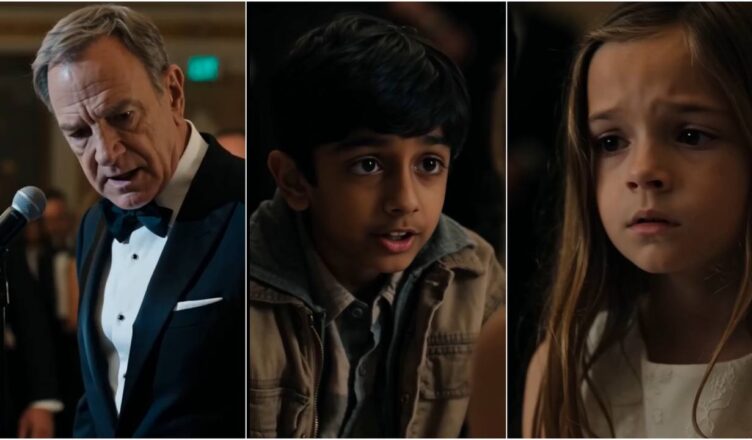
The Night Emily Spoke
The first time Emily spoke again, it was not because of a specialist, a miracle drug, or a therapy program that cost more than most people’s homes.
It happened because a thin, scruffy nine-year-old boy stepped into the middle of a chandelier-lit ballroom and said, in a calm, steady voice, “I think I can help her.”
For one terrible second, Harrington almost had him thrown out.
If he had, he would have lost the only moment in three years that mattered.
The Harrington estate had been built to impress. The marble floors reflected light like still water. Crystal chandeliers hung from the ceiling like captured constellations. Every doorway, every column, every polished surface announced power, taste, and old money. That night, the house was full of it—politicians, surgeons, investors, celebrities, people who knew exactly how to hold a champagne glass and exactly how to look sympathetic without letting genuine discomfort ruin the evening.
The occasion was meant to be a celebration: forty years of the Harrington name at the top of industries that rewarded ambition and punished weakness.
But there was no celebration in the man standing at the front of the room.
Harrington stood near the stage with a microphone in his hand and his daughter’s small fingers wrapped tightly around his own. Emily was eight years old, dressed in white silk with silver stitching at the hem. Her soft brown curls were pinned neatly away from her face. She looked exactly like the kind of child people turned to admire with softened smiles.
And she had not spoken in three years.
Three years earlier, she had been in the back seat when a drunk driver ran a red light and crushed the passenger side of the car. Harrington’s wife had died before the ambulance reached the hospital. Emily had survived with no broken bones, no internal bleeding, not even a visible scar.
The damage had settled somewhere deeper.
One day she had been laughing at breakfast. The next, her voice was gone.
Doctors had called it trauma-induced selective mutism. Therapists had explained it gently, clinically, with charts and optimism and expensive language. Harrington had listened to all of them. He had flown experts in from Los Angeles, New York, and Chicago. He had paid for speech therapists, child psychiatrists, trauma specialists, play therapists, and treatment plans with names that sounded like promises. He had spent money the way desperate men always spent it—like enough of it might force the world to become merciful.
Nothing worked.
Emily learned to communicate in other ways. She nodded. She pointed. She drew pictures with startling detail. She wrote careful little notes in a looping child’s hand. But her voice—her real voice—remained locked somewhere inside her, unreachable.
So Harrington had done the only thing left that felt remotely like action.
He had invited two hundred people into his home and turned his grief into a public plea.
The ballroom fell quiet as he lifted the microphone.
“I asked you all here tonight,” he said, his voice low at first, then roughening around the edges, “not only to celebrate my family’s anniversary, but because I need help.”
A murmur moved through the crowd and died just as quickly.
He felt Emily’s hand tighten around his.
“My daughter has not spoken in three years,” he continued. “We have tried everything. Every specialist. Every treatment. Every recommendation. If anyone can help her speak again—if anyone can truly reach her—I will pay one million dollars.”
The room seemed to inhale all at once.
A few guests looked moved. A few looked embarrassed. Others wore the strained expressions of people trying to decide whether the moment called for admiration, pity, or polite silence.
Harrington lowered the microphone. He looked down at Emily and tried not to let hope show on his face. Hope had become dangerous. Hope had become the thing that hurt the most.
Then a voice rose from the back of the ballroom.
“I can make her talk.”
Heads turned.
Near the open service entrance stood a boy no one in that room would have noticed anywhere else. He was thin and dark-haired, maybe nine years old, wearing a jacket that was too light for the weather and shoes whose soles were beginning to peel away. He looked as though he had entered the estate from another city entirely, another version of the world.
Security moved immediately.
One of the guards caught the boy by the arm. “You can’t be in here,” he snapped under his breath.
But the child didn’t struggle. He just looked past the guard, past the guests, past the glittering room, and fixed his eyes on Emily.
“I can help her,” he said again.
There was laughter this time—small, uneasy, quickly smothered. The kind of laughter people used when something made them uncomfortable and they did not want to feel exposed by it.
Harrington felt humiliation flare hot in his chest. For three years he had stood in offices and clinics and private consultation rooms with people whose résumés alone could intimidate a room. None of them had been able to reach his daughter. And now a child in torn clothes had walked into his ballroom as though this were a problem he could solve.
“Who let him in?” Harrington demanded.
The boy slipped free of the guard’s grip with practiced ease and took a few steps forward.
“I heard what you said,” he told Harrington. “I think I can help her.”
“This isn’t a game,” Harrington said sharply. The words came out harsher than he intended, sharpened by shame and exhaustion and the terror of wanting to believe him for even a second. “Go back outside.”
The boy did not flinch.
Instead, he kept walking toward Emily.
Something changed in the room then—not in the crowd, but in her.
Emily looked at him.
Not through him. Not vaguely in his direction. At him.
Harrington felt it immediately, that nearly imperceptible shift. For months she had endured strangers with polite blankness. Doctors could kneel in front of her with warm smiles and carefully modulated voices, and she would retreat behind her eyes until no one could tell what she was thinking.
But she was watching this boy.
He stopped a few feet away and crouched so they were eye level. He didn’t smile too broadly. He didn’t speak in the exaggerated, coaxing tone adults often used with frightened children. He didn’t act like he had arrived to fix her.
He acted as if he were meeting her.
“What’s your name?” he asked softly.
Emily said nothing.
Harrington let out a breath that sounded bitter even to his own ears. “She hasn’t answered that question in three years.”
The boy nodded once, as though Harrington had merely offered a useful fact.
“That’s okay,” he said to Emily. “You don’t have to talk.”
She blinked.
The boy slipped a hand into his pocket and pulled out a small toy car. It was cheap plastic, blue once but now worn pale at the edges. One wheel tilted slightly, as though it had been repaired more than once.
He set it gently on the floor between them.
“My mom gave me this,” he said. “Before she died.”
No one in the ballroom moved.
“For a while after, I didn’t talk either,” he went on. “Not because I couldn’t. I just… didn’t want anything to change. I thought if everything stayed quiet, maybe it would mean she wasn’t really gone.”
Harrington felt his throat tighten.
The boy’s gaze never left Emily’s face.
“People kept telling me I had to be brave,” he said. “I hated that. I didn’t want to be brave. I wanted my mom back.”
Emily’s fingers tightened around her father’s hand.
The boy noticed. So did Harrington.
“But then one lady at the shelter told me something,” he said. “She said talking again wouldn’t mean I loved my mom less. It wouldn’t mean I forgot her. It would just mean I was still here.”
Emily stared at the toy car.
The ballroom had gone so silent that the faint clink of glass from a distant tray sounded loud.
The boy’s voice softened even more.
“If you say one word,” he told her, “even just one, it doesn’t mean your mom disappears. It just means you don’t have to stay stuck with her in that last bad moment.”
Harrington’s vision blurred.
He did not wipe his eyes. He no longer had the strength to care who saw.
Emily looked from the car to the boy, and then slowly up at her father.
Her mouth trembled.
She opened it.
Nothing came out.
Harrington felt his body brace itself automatically for disappointment. He knew this moment. He knew the crushing drop that followed these almosts, these terrible little miracles that never quite crossed into reality.
Then Emily drew in a breath.
“Papa.”
It was barely audible. Fragile. Thin as thread.
Harrington dropped to his knees so fast the microphone slipped from his hand and thudded against the stage.
He stared at her.
“Papa,” she said again, clearer this time.
The room did not erupt. Not at first. It simply froze, as if two hundred people had forgotten how to react to something real. Someone covered her mouth. Someone began to cry openly. A few hands came together in stunned applause, but the sound barely registered.
All Harrington heard was his daughter’s voice.
“Emily,” he whispered, shaking now, unable to stop. “Baby, say it again.”
She threw her arms around his neck and clung to him with sudden desperate force.
“Papa,” she sobbed, the word breaking apart against his shoulder and somehow healing him at the same time.
He held her as if he could anchor her to the world by strength alone.
When he finally lifted his head, searching through the blur of faces, he saw that the boy had already stepped back. He stood near the edge of the crowd, as though he understood instinctively that this moment no longer belonged to him.
“Wait,” Harrington said, rising unsteadily with Emily still holding his hand.
The boy paused.
“What’s your name?” Harrington asked.
“Arjun.”
Harrington repeated it, quietly, committing it to memory.
“Where are your parents, Arjun?”
For the first time, the boy hesitated. Then he answered with a flat honesty that made the room feel smaller.
“My mom died two years ago,” he said. “I stay at a shelter a few blocks away.”
The words struck Harrington with almost physical force.
He thought of the million dollars he had offered into a room full of polished shoes and rehearsed sympathy, and it suddenly felt obscene in its simplicity. Money still mattered. He knew better than most that it did. But in that moment it felt like the least important part of what had happened.
Emily turned toward Arjun. Her cheeks were wet. Her voice, when it came, was tiny and raw but unmistakably real.
“Friend,” she said.
It was the second word she had spoken in three years.
Arjun smiled then—not broadly, not for the room, but with a kind of startled softness, as if kindness had landed on him so rarely that he did not quite know how to hold it.
The applause that followed was no longer performative. It came unevenly at first, then all at once, not as celebration but as release.
Much later, after the guests had gone and the staff had cleared the last of the glasses and folded away the evening’s elegance, Harrington sat with Emily on the balcony outside her room. The city lights glowed below them. The night air carried the scent of damp stone and clipped hedges.
Emily leaned against him, testing words under her breath as though trying on something that still belonged to her but felt new.
“Papa,” she whispered again.
He kissed the top of her head. “I’m here.”
She was quiet for a moment.
Then: “Mama… proud?”
His eyes closed.
“Yes,” he said, his voice unsteady again. “She would be so proud of you.”
The next morning, Harrington drove to the shelter Arjun had mentioned. He went alone. No driver, no assistant, no publicist, no press. Just a plain wool coat over a dark sweater and the feeling, unfamiliar but undeniable, that he needed to arrive as a man before he arrived as a name.
The shelter director recognized him immediately and straightened with visible caution. Harrington shook his head.
“I’m here as a father,” he said. “Not as a headline.”
They found Arjun in a common room, seated at a folding table and repairing a broken board game spinner with tape. He looked up, surprised first, then guarded.
Harrington held out a paper bag.
“Emily picked these out for you,” he said. “Just warm clothes. Nothing fancy.”
Arjun looked at the bag without touching it.
Then he looked back up. “Why?”
Because thank you was too small, Harrington thought. Because no one should save a child’s voice and then go back to sleeping in a shelter as if the world had not just shifted.
But what he said was simpler.
“Because you helped my daughter in a way no one else could.”
Arjun’s expression didn’t soften. “People say stuff like that,” he said. “Then they forget.”
Harrington nodded once. He accepted the truth of it. He had spent enough time around philanthropy to know how often generosity lasted exactly as long as the feeling that produced it.
“I’m not going to forget,” he said. “And I’m not going to insult you by acting like one check solves everything.”
That got the boy’s attention.
“What happens then?” Arjun asked.
Harrington glanced toward the director’s office, where paperwork waited, where rules existed, where adults would have to move carefully and correctly. Then he looked back at Arjun.
“Then we start with lunch,” he said. “And after that, if you want, dinner. And after that, we figure out what help actually looks like.”
Arjun studied him in silence.
Finally, he asked, “Emily really picked the clothes?”
A faint smile touched Harrington’s mouth. “She was very specific.”
That brought the smallest hint of a smile to Arjun’s face.
By the time Harrington drove home, the house waiting for him was still enormous, still immaculate, still full of everything money could buy. But it no longer felt quite as powerful as it had the day before.
Because the thing he had wanted most in the world had not come from expertise alone, or wealth, or the performance of desperation in front of a room full of influential people.
It had come from recognition.
From one child seeing another clearly enough to tell her the truth.
When Emily’s voice returned, it did not return because it had been purchased, demanded, or engineered. It returned because grief, for the first time, had met someone who spoke its language.
And in the end, that was worth more than any promise Harrington had ever made beneath a chandelier.
She Had Never Spoken Before—Then One Boy Changed Everything